The best Instaffo alternatives depend on what you want to replace: the marketplace (Honeypot, TieTalent), a network license (XING TalentManager, LinkedIn Recruiter) or the search itself, where Sprad delivers the most matching candidates. Switching pays off mainly when a 12 to 15 % fee per hire becomes too high, your roles sit outside tech and sales, or you want to approach candidates actively instead of waiting for people who signed up. Sprad checks every profile individually, searches LinkedIn, XING, GitHub and your own pool in one search, and starts free.
Why teams switch from Instaffo
Instaffo is a marketplace from Heidelberg, founded in 2017. In March 2024 Personalwirtschaft reported about 1,800 customers and a focus on tech and sales; Deutsche Startups described the idea of companies applying to professionals as reverse recruiting back in 2019. For a full assessment with prices and user voices see our Instaffo review and the provider profile. User reviews and the pricing logic point to four typical reasons to switch:
- The fee grows with salary. At a 70,000 € target salary it is 10,500 € (Essential, 15 %) or 8,400 € plus an 11,880 € annual fee (Professional, 12 %). From six hires a year the percentage fee becomes the biggest cost item.
- The pool is limited. It consists of people who signed up. Specialists, executives and passive candidates are often missing.
- The focus is tech and sales. If you hire in care, trades, finance or engineering, you find less.
- Outreach and ATS are limited. Users name missing integrations (for example Personio) and the portal chat as the only channel.
The alternatives compared
Instaffo is a marketplace. If you switch, you have three directions: another marketplace, a network license or AI-driven active sourcing. The table compares them; Instaffo sits in row two for reference.
| Vendor | Model | Price | Reach | Outreach |
|---|---|---|---|---|
| Sprad | Search + outreach + talent network | Free start (100 credits/month); Recruiter Lite 79 €/seat/month; Atlas Recruiter 299 €/seat/month | 1B+ profiles (LinkedIn, XING, GitHub), your own pool, employee networks | LinkedIn, email and InMail in one inbox; voice, chat and agent pre-qualification |
| Instaffo (for reference) | Marketplace, success fee | 0 € + 15 % or 990–1,100 €/month + 12 % hiring fee | 300,000+ signed-up talents (vendor claim), focus tech and sales | Portal chat |
| Honeypot | Marketplace | quote-only | signed-up tech talent | Portal |
| TieTalent | Marketplace | Free account, fee on hire | IT and digital, CH/DE/FR | Portal |
| XING TalentManager | Network license | Core 366 €/seat/month or 4,390 €/year | 20M+ XING profiles, DACH | XING messages |
| LinkedIn Recruiter Lite | Network license | 140 $/seat/month on an annual contract | LinkedIn network | 30 InMails per month |
| Talentwunder | Sourcing database | quote-only; estimates around 390 €/month, 24 months | 1B+ profiles (vendor) | Export, sequences via partners |
For the seat licenses see XING TalentManager alternatives, LinkedIn Recruiter alternatives and Talentwunder alternatives. For a DACH overview read the active sourcing tool comparison.
1. Sprad — the most matching candidates
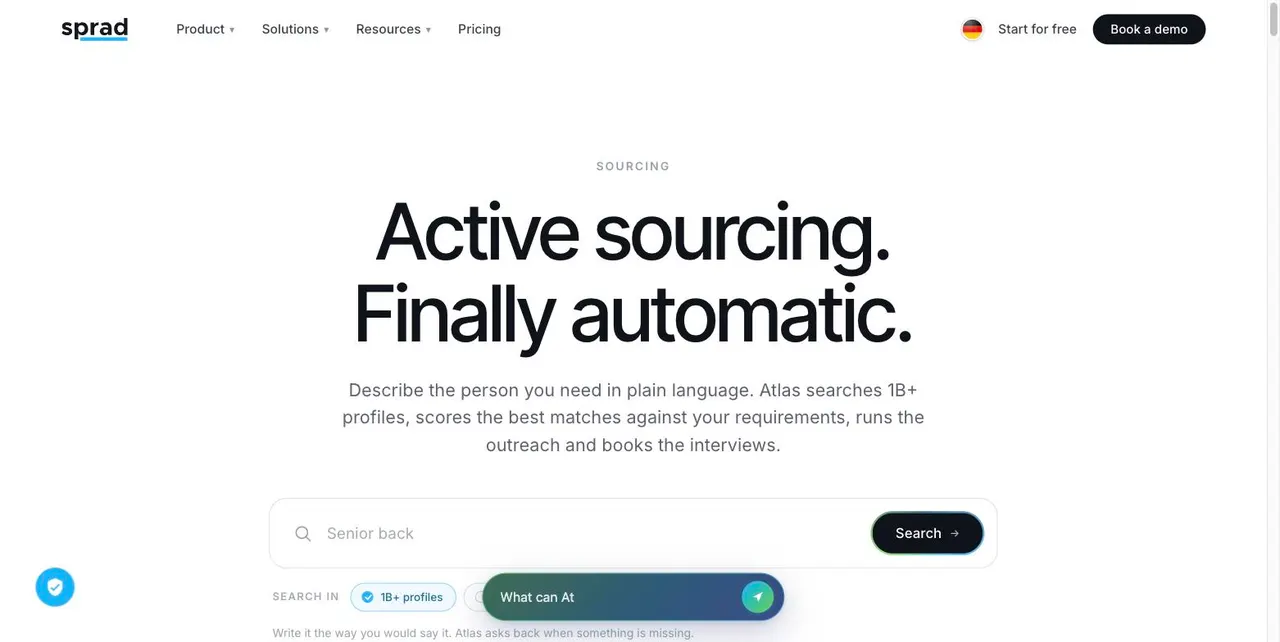
Sprad takes a requirement instead of a Boolean string. Atlas checks every profile individually against your requirements rather than returning a keyword ranking, so people with poorly maintained profiles show up too. Our rule of thumb from 7 years of matching (we started with employee referrals): if results appear instantly, it is almost always a keyword search. In the public PeopleSearchBench (Recruiting; 119 real search tasks) Atlas reaches 73.5 in our own re-measurement, converted to the published scale (Juicebox 65.7 as published); in recruiting it returned 14.2 of 15 matching profiles per search on average in that re-measurement.1
- One search over all sources: LinkedIn, XING, GitHub and your own talent pool, 1B+ profiles. Deep Context finds companies first, then people who worked there in a given period, for example a CFO who led an acquisition.
- LinkedIn and email in one inbox: automated with follow-ups, InMails straight from Sprad. The system warns when a talent was already contacted by a colleague or for another role, so no double outreach.
- Search networks: your uploaded LinkedIn network, and the networks of employees and former candidates.
- Your data stays yours: the talent network remains free after cancelling and a full raw-data export is available.
- Compliance: EU hosting and high data protection and security standards, as enterprise, public-sector and insurance customers are on board.
We state the limits openly: deep search takes a few minutes because more AI runs per profile, and Atlas Recruiter costs more per seat than some license tools. Benchmark details on the benchmark page.
2. Honeypot — the next marketplace
Honeypot was founded in Berlin in 2015 and acquired by XING in 2019 (P+P Pöllath + Partners; at the time about 100,000 tech professionals and 1,500 companies). The principle matches Instaffo: talents sign up, companies apply. If you only swap the vendor you stay in the same model with the same limits.
3. TieTalent — tech and digital in DACH and France
TieTalent is a marketplace for IT and digital marketing roles focused on Switzerland, Germany and France. According to the vendor the company account is free and a fee applies only on a hire. The amount is not public: ask for percentage, guarantee period and freelance terms.
4. XING TalentManager — German-speaking profiles
If you mainly search German-speaking professionals and managers, XING reaches many of them. The price is a fixed amount per seat: 4,390 € a year for one seat, 8,780 € for two. That is far below a hiring fee, but your team searches and writes itself.
5. LinkedIn Recruiter Lite — international reach
LinkedIn is the largest data set but limited to its own network. The Lite license costs 140 $ per seat and month on an annual contract (1,680 $ a year). A typical mistake: a team buys the license and only runs Boolean strings instead of checking candidates and following up.
6. Talentwunder — database with a DACH focus
Talentwunder sells a sourcing database; prices are not public. Expect a long commitment (24 months according to third parties) and get cancellation and data export confirmed in writing.
Worked example: fee per hire versus seat license
Assumption: your team fills six roles a year at a 70,000 € target salary each and could also fill them with its own search. At Instaffo Essential you pay 63,000 € (6 × 10,500 €), at Professional 62,280 € (6 × 8,400 € plus an 11,880 € annual fee). A seat costs per year: Recruiter Lite 948 €, Atlas Recruiter 3,588 €, XING TalentManager Core 4,390 €, LinkedIn Recruiter Lite 1,680 $.
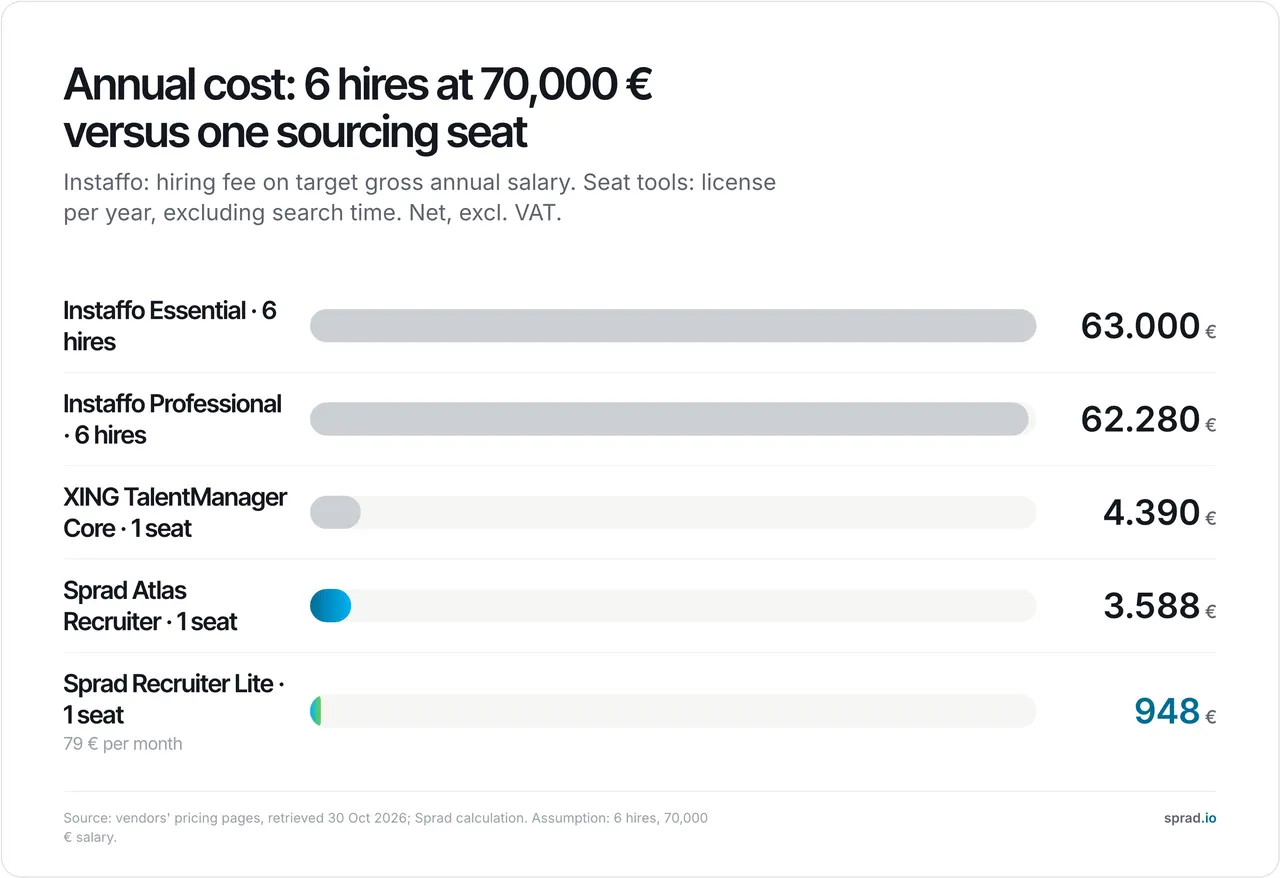
What the numbers say: if a seat replaces just one hire a year that would otherwise run through the marketplace (10,500 € fee), it pays for itself at each of these prices. That is a lower bound, not a guarantee: a seat saves the fee only if your team has the search time and actually fills the role. Our advice from practice: run one real role through both models and count conversations per week. For agencies that earn a fee per placement anyway, the seat model is almost always cheaper. Full prices on the pricing page; against separate LinkedIn and XING licenses Sprad saves 30 to 80 % depending on your starting point.
Which alternative finds more matching candidates?
It depends on the model. A marketplace delivers people who raised their hand, but only as many as have signed up. Networks such as XING and LinkedIn give reach, while pre-selection stays with you. Sprad checks every profile against your requirements and searches both networks and GitHub together; in PeopleSearchBench Atlas ranked first in recruiting. Instaffo, Honeypot and TieTalent were not part of the test, so we make no claim about them.
Data coverage in DACH and GDPR
In active sourcing you must inform people under Art. 14 GDPR when you did not collect their data from them; see Active sourcing and GDPR. On marketplaces talents signed up themselves; still check how the vendor documents consent. AI that filters applications or evaluates candidates can be a high-risk system under Regulation (EU) 2024/1689, Annex III; this covers matching marketplaces and sourcing tools alike, and a human should decide. The 2,000 € cap in § 296 SGB III concerns fees paid by job seekers, not the fee a company pays. Sprad hosts in the EU; enterprise, public-sector and insurance customers are on board.
Common mistakes when switching
- Only swapping the vendor: moving from Instaffo to Honeypot keeps the pool limit and the fee.
- Confusing reach with fit: 20M XING profiles do not help if pre-selection costs weeks.
- Missing the terms: 24 months at Talentwunder, 1–2 years at XING, an annual contract at LinkedIn.
- Deciding without a test: one real role, two models, four weeks, count conversations.
How to decide
- Few tech or sales roles, no search team, risk with the vendor: Instaffo, Honeypot or TieTalent.
- Several roles, specialist profiles, an own team or an agency: Sprad.
- German-speaking market, an existing license: XING TalentManager or LinkedIn Recruiter, ideally complemented by Sprad.
1 PeopleSearchBench (Recruiting), published by Lessie, October 2026. Other systems' scores as published in the benchmark; Atlas measured with the benchmark's open test procedure.
FAQ
What are the best alternatives to Instaffo?
Sprad for the most matching candidates and active search across LinkedIn, XING, GitHub and your own pool; Honeypot and TieTalent as further marketplaces; XING TalentManager and LinkedIn Recruiter as network licenses.
Who should switch away from Instaffo?
Teams with more than about six hires a year, roles outside tech and sales, specialist and leadership profiles, or the wish to approach passive candidates actively.
How do price, data coverage and GDPR differ?
Marketplaces charge 12 to 15 % of salary per hire; licenses cost per seat between 79 € per month (Recruiter Lite) and 366 € per month (XING Core); Sprad covers LinkedIn, XING and GitHub together. Active sourcing falls under Art. 14 GDPR and the platforms host in the EU according to the vendors; ask about the DPA and location.
Which alternative finds more matching candidates?
In the public PeopleSearchBench Sprad's Atlas ranks first in recruiting; the marketplaces were not part of the test.
Can I use Instaffo and Sprad in parallel?
Yes. The marketplace brings people who actively look, Sprad the passive ones; Sprad warns when a talent has already been contacted.
Sources: vendor pricing and home pages, Personalwirtschaft (20 March 2024), Deutsche Startups (2019), P+P Pöllath + Partners (2019), EUR-Lex, gesetze-im-internet.de; retrieved 30 October 2026. Vendor figures are the vendors' own claims and may change.
Jürgen Ulbrich
Jürgen Ulbrich has more than a decade of experience in developing and leading high-performing teams and companies. As an expert in employee referral programs as well as feedback and performance processes, Jürgen has helped over 100 organizations optimize their talent acquisition and development strategies.