Is scraping LinkedIn legal? It is not a crime in itself, but it is not safe either. In the USA, scraping pages that anyone can open has not been held to violate the Computer Fraud and Abuse Act, yet it breaches LinkedIn's User Agreement and invites account bans or lawsuits. In the EU, every profile is personal data, so the GDPR applies in full: you need a legal basis, you must inform the person, you may keep the data only as long as the purpose lasts, and you must stop when they object. "It was public" is not a defence.
Short answer: three separate layers, three separate answers
Most articles ask "legal or illegal?" as if there were one rule. There are three, enforced by different people, and they give different answers for the same act.
| Layer | The question | Public profiles, scraped | Typical consequence |
|---|---|---|---|
| Criminal / access law | Did you break into a protected system? | In the USA, probably not for pages anyone can open (hiQ, Van Buren) | Low for public pages; higher for logins, fake accounts and bypassing blocks |
| Contract (LinkedIn's User Agreement) | Did you agree not to scrape? | Yes, if you have an account: bots, crawlers and extensions are forbidden | Restricted account, cease-and-desist letters, damages claims against commercial scrapers |
| Data protection (GDPR) | Do you have a basis to process these people's data? | The data is personal data. Legitimate interest can work, with conditions | Fines of up to 20 million € or 4 % of turnover, orders to delete, damages claims |
A recruiter who reads profiles in a browser stays on the safe side of all three layers if the process is documented. A team that exports thousands of profiles with a browser extension is exposed on all three at once.
Is scraping LinkedIn a crime in the USA?
The US debate is about the Computer Fraud and Abuse Act (CFAA). In Van Buren v. United States (3 June 2021) the Supreme Court read the CFAA narrowly: it covers entering parts of a computer that are off-limits to you, not misusing information you were allowed to see (opinion). Applying that line, the Ninth Circuit held on 18 April 2022 in hiQ v. LinkedIn that scraping data on public pages, with no login, likely does not count as access "without authorization" (opinion).
That is less of a green light than it sounds. The court itself noted that website owners are "not without resort" under other laws, and the case ended in December 2022 with a consent judgment of 500,000 $ against hiQ and a permanent injunction to stop scraping and delete the data (Proskauer summary). The ruling applies to public pages; it says nothing about logins, fake accounts or EU data protection law.
What does LinkedIn's own rule say, and what happens to you?
LinkedIn's help centre states that crawlers, bots, browser plug-ins and extensions that scrape the site or automate activity are not allowed, and that members who use such tools violate the User Agreement; the consequences range from restricted accounts to tools that stop working (LinkedIn help centre, as of October 2026). For you as a recruiter this is the most likely real-world cost: a restricted recruiter seat in the middle of a search.
For commercial scrapers the cost is higher. On 24 January 2025 LinkedIn sued Proxycurl for scraping profiles and creating fake accounts (LinkedIn announcement of 24 January 2025) and has since announced the matter resolved. Tools built on that kind of data can disappear overnight, taking your workflow with them.
Does the GDPR apply to public LinkedIn profiles?
Yes. A name, job title, employer and photo are personal data whether or not the person made them visible. The GDPR applies to anyone who targets people in the EU, wherever the recruiter sits (GDPR text). Four duties matter in sourcing:
- Legal basis. The usual candidate is legitimate interest under Art. 6(1)(f): you have a real interest (filling a role), the processing is necessary, and the person's interests do not override yours. Write that balancing down per role. A person with a profile that signals openness to opportunities is easier to justify than someone who never expected to be contacted.
- Information. If you did not collect the data from the person, Art. 14 requires you to tell them who you are, why you hold the data, where it came from and what rights they have, at the latest within one month, or at the first message if you use the data to contact them.
- Retention. Keep data only as long as the purpose lasts. Profiles that were never contacted should not sit in a database for years.
- Objection. If someone objects (Art. 21), stop processing for that purpose and make sure the stop reaches every tool and list that holds them.
What regulators have actually done
The enforcement record is not about recruiters, but it shows how authorities read "public":
- KASPR (France, 5 December 2024): the CNIL fined the maker of a browser extension that reveals contact details from LinkedIn profiles 240,000 €. It collected details of people who had restricted who could see them, which exceeded what they could reasonably expect; it kept data for five years from each update; and it informed people only about four years after launch (CNIL decision).
- Clearview AI (Netherlands, 16 May 2024): 30.5 million € for building a database without a legal basis and without informing the people in it (EDPB news). The data was facial images, not CVs, but the principle is the same.
- Facebook scraping (Germany, 18 November 2024): the Federal Court of Justice held that even a loss of control over personal data can be damage under Art. 82 GDPR and indicated about 100 € for the mere loss of control (BGH press release). That case was against the platform whose data was scraped, but it shows that courts count control, not misuse.
What changes in Germany, Austria and Switzerland?
The GDPR logic is the same, but contact rules add a second test. In Germany, email and telephone approaches fall under § 7 UWG, which is stricter than the GDPR; a LinkedIn message and an email are not treated alike. XING profiles follow the same logic as LinkedIn: public visibility does not replace a legal basis or the Art. 14 notice. Our guide to active sourcing and the GDPR walks through the contact rules in detail.
How do I source without scraping risk? Step by step
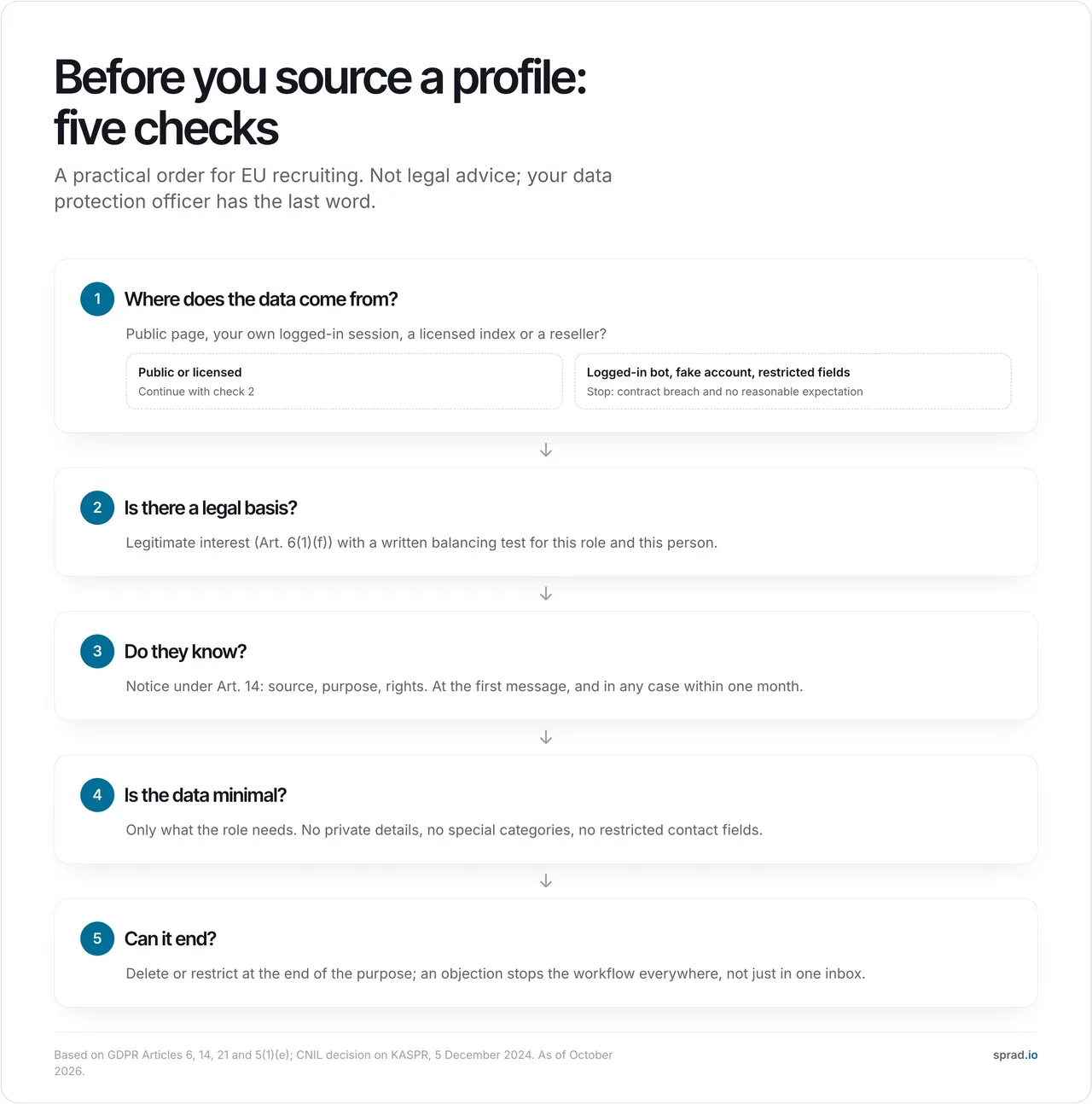
- Choose the source first. Prefer your own searches in the browser, an ATS or CRM, or a tool that tells you where its data comes from. Avoid anything that needs your password to run in the background.
- Write the balancing test once per role. Three lines: why this role needs sourcing, why these people are a fit, why the data used is no more than needed.
- Save fewer profiles. Save only people you will contact. Everyone you store becomes a record with notice and retention duties.
- Put the Art. 14 notice in the first message. Name yourself and the company, state the source ("your public professional profile"), the purpose, how long you keep the data and how to object.
- Set a retention date. For example, delete non-responders after six months unless the person agreed to stay in your talent network. The period is your call; write it down.
- Make objection a stop, not a reply. One list that every tool respects.
Worked example: a team of three
Assumption for illustration: three recruiters each save 40 profiles per week. That is 120 new records per week, about 520 per month. If all are stored without contact, you owe 520 Art. 14 notices a month and have 520 retention dates to manage. If you save only the profiles you will message, say half, and put the notice in the first message, the notice step costs nothing extra and the retained pool halves. The compliance step that saves the most work is storing fewer people.
The cost side is just as concrete: a restricted recruiter seat during a search wastes days, and a seat costs real money. Public price lists put a single LinkedIn Recruiter Lite seat at roughly 140 $ a month on an annual contract (check LinkedIn's current price page before relying on it).
| Method | Example | Risk | Why |
|---|---|---|---|
| Reading and noting a few profiles by hand | Opening 20 profiles for one role, saving 8 | Low | Small, role-specific, easy to justify and to inform |
| Search tool on a licensed or public-web index | AI search that returns profiles with reasons | Low to medium | Depends on the vendor's sources; you remain the controller for what you save |
| Bulk export from a scraper extension | Browser plug-in exporting search results to CSV | High | Breaks LinkedIn's rules, collects without a purpose per person, builds a database you cannot explain |
| Bots with logged-in or fake accounts | Automated visits at scale, rotating profiles | Very high | The pattern LinkedIn sues over; regulators treat collection beyond reasonable expectation as unlawful |
Which tools and templates help?
You need three short documents, and none requires special software:
- Balancing-test template (per role): purpose, necessity, impact on the person, safeguards, decision and date.
- Art. 14 text for the first message: "I found your public professional profile and think you could fit our open role X. We store your name, role, employer and the profile content under legitimate interest (Art. 6(1)(f) GDPR) for up to 6 months. You can object or ask for deletion at any time by replying to this message; our privacy notice is at [link]."
- Objection log: one list, checked before every send.
Ask every sourcing vendor six questions in writing: Where does the data come from? Does the tool log in with my account or use fake accounts? Which fields does it collect, and does it respect visibility settings? Where is data hosted? Do you offer a data processing agreement? Can I export and delete everything?
Which mistakes should I avoid?
- Believing "public" ends the discussion. The CNIL fined KASPR for exactly that kind of collection.
- Exporting everything "just in case". A database without a purpose per person cannot be defended.
- Sending the Art. 14 notice months late. KASPR informed people four years after launch and was fined.
- Treating a bounce or an unsubscribe as the only objection. It must reach every tool and list.
- Using scraper data to enrich candidates in your ATS without checking the source. The record inherits the problem.
- Skipping the data protection officer. A 20-minute review before launch is cheaper than any of the above.
How does AI change this?
AI makes scraping easier and the volume larger, so the duties scale with it. An agent that reviews 500 profiles a night creates 500 decisions about people you should be able to explain. Two points matter. First, notice and objection have to be automated along with the search, otherwise the process outgrows its own paperwork. Second, the EU AI Act classes AI systems used to filter or evaluate applicants as high-risk (Annex III), so the less a tool decides alone, the easier the compliance. LinkedIn, for its part, has kept suing scrapers as bots get better; the tools that last are the ones that do not depend on evading its defences.
Where Sprad fits
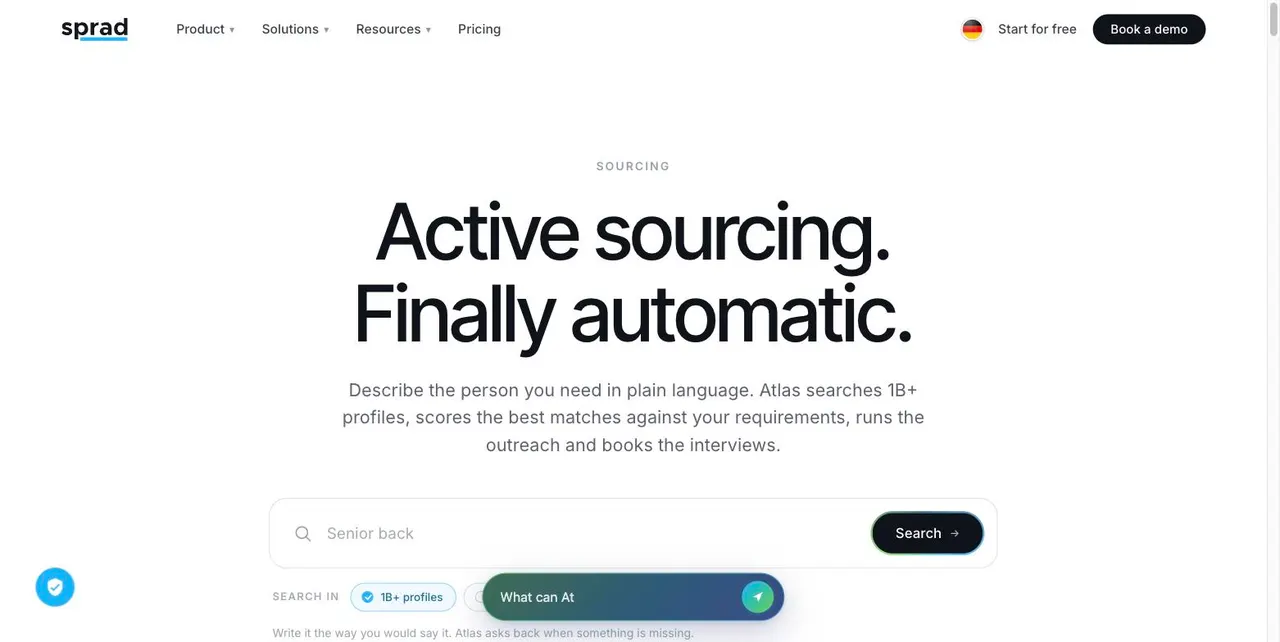
Sprad has built recruiting software for seven years, for start-ups, large enterprises, public-sector clients and insurers, and data protection is one of the first questions agencies and in-house teams ask us. Atlas, our sourcing tool, searches across LinkedIn, XING, GitHub and your own talent pool, checks every profile individually against your requirements and shows a reason for each result. Hosting is in the EU, with security standards set by enterprise, public-sector and insurance customers, and this applies for Europe and the USA. People you invite to your talent network join knowingly, you keep a full raw-data export, and the network stays free after you cancel.
What a tool cannot do is make a process lawful for you. You remain the controller: the balancing test, the notice and the retention rules are yours, and Atlas prepares while people decide. In the public PeopleSearchBench (Recruiting), Atlas reaches 73.5 in our own re-measurement, converted to the published scale (published by Lessie, October 2026; other systems' scores as published in the benchmark; Atlas is our own re-measurement with the benchmark's open test procedure, converted to the published scale; not an official entry). You can start free with 100 credits a month, or use Recruiter Lite from 79 € per seat and month; see pricing and Active Sourcing. If you want to keep your own data, read who owns your candidate data.
FAQ
Is scraping LinkedIn illegal in Europe?
Not automatically, but it is regulated. Public profiles are personal data, so you need a legal basis (usually legitimate interest with a written balancing test), an Art. 14 notice, a retention limit and a way to honour objections. Collecting data people restricted, or collecting without a purpose, has been sanctioned.
Can I get banned for scraping LinkedIn?
Yes. LinkedIn forbids scrapers, bots and extensions that automate activity and restricts or closes accounts that use them.
Did hiQ v. LinkedIn make scraping legal?
No. It held that scraping public pages likely does not violate the CFAA. The case ended with a consent judgment against hiQ, and it says nothing about LinkedIn's terms or about GDPR.
Do I have to tell candidates I found them on LinkedIn?
Yes, if you store their data. Art. 14 requires notice, at the first message at the latest, and in any case within one month of collection.
Is it safer to use a tool than to scrape myself?
Only if the tool is transparent about its sources and does not log in as you or use fake accounts. Ask in writing; you stay the controller either way.
This article gives general information as of October 2026 and is not legal advice. For your own process, ask your data protection officer or a lawyer.
Jürgen Ulbrich
Jürgen Ulbrich has more than a decade of experience in developing and leading high-performing teams and companies. As an expert in employee referral programs as well as feedback and performance processes, Jürgen has helped over 100 organizations optimize their talent acquisition and development strategies.