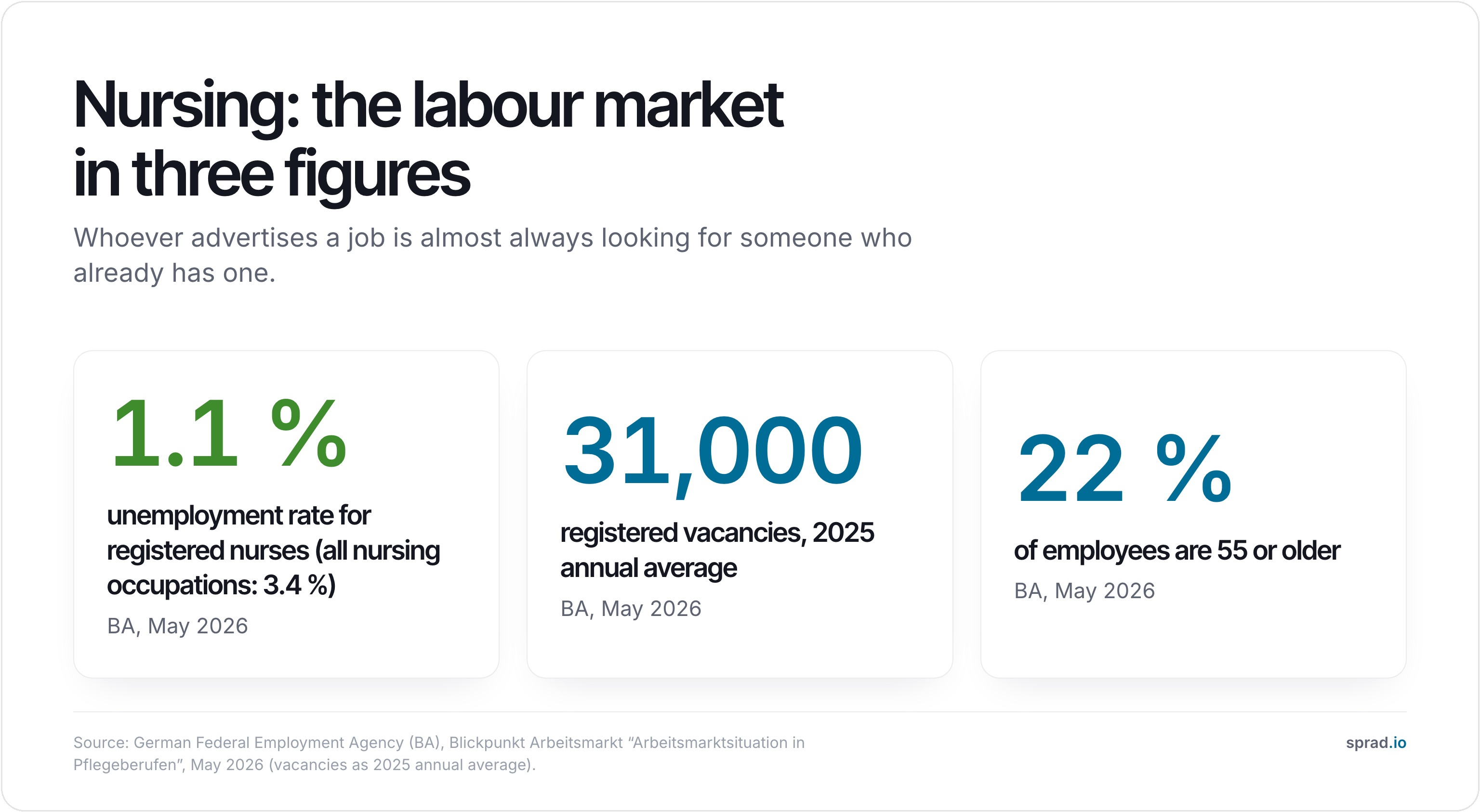
Germany’s nursing shortage is official in 2026: the Federal Employment Agency lists nursing as its second-biggest shortage occupation, and unemployment among registered nurses is just 1.1 %. The Federal Statistical Office expects between 280,000 and 690,000 nursing staff to be missing by 2049. For employers that means: anyone who advertises a nursing job is almost always looking for people who already work somewhere else. Retaining, upskilling, targeted outreach on the phone and your own applicant pool all help. As of October 2026.
How big is the nursing shortage in Germany in 2026?
According to the Federal Employment Agency’s labour-market report (BA, May 2026), about 1.8 million people work in nursing occupations subject to social insurance. In 2025 an annual average of about 31,000 vacancies was registered, 96 % of them for qualified and assistant staff. Unemployment is 3.4 % across all nursing occupations and 1.1 % for registered nurses.
Time to fill a vacancy was 269 days in general nursing and 296 days in elderly care, according to the BA (as of October 2024, quoted by medi-karriere.de). A vacancy therefore stays open for roughly nine to ten months on average. That is a mean; individual roles fill faster or slower.
How does demand develop to 2049?
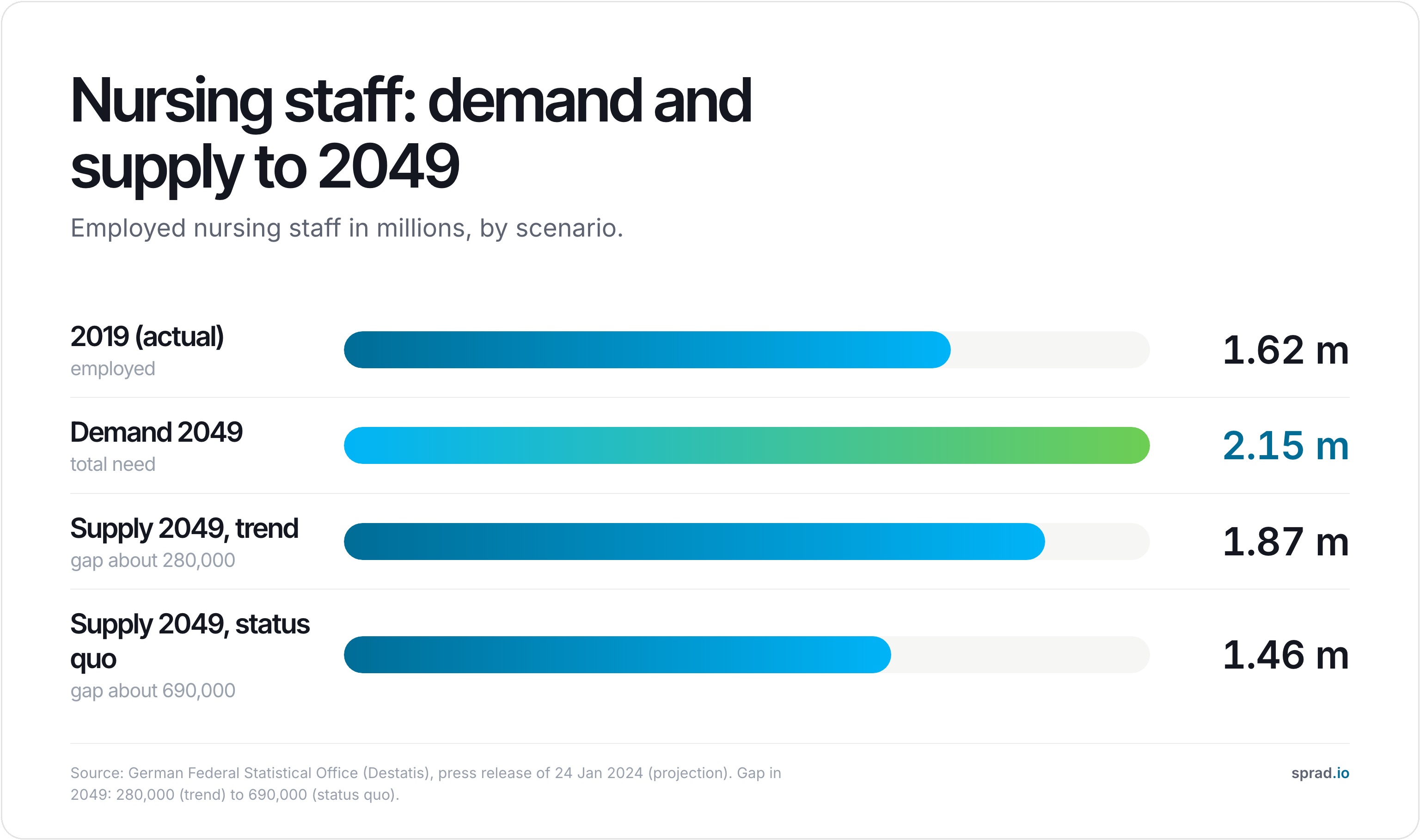
The Federal Statistical Office (press release of 24 Jan 2024) expects total demand of about 2.15 million nursing staff in 2049, up from 1.62 million in 2019. Even in the favourable trend scenario supply only grows to 1.87 million, leaving a gap of about 280,000. If only demographic effects apply, supply falls to 1.46 million and the gap grows to about 690,000.
Behind this is an ageing society: there are more people in need of care, while the baby-boomer cohorts retire. Both hit the same occupation.
Why are nurses missing? Five causes
- An ageing workforce: 22 % of employees are 55 or older. The BA expects about 389,000 age-related exits over the next ten years.
- High part-time share: 49 % of nursing staff work part-time, against 31 % in the whole economy. Many hours disappear without anyone resigning.
- A mismatch in supply: 96 % of vacancies target qualified and assistant staff, but more than half of the unemployed look for helper jobs.
- Training grows slower than demand: about 59,000 training starts in 2024/25 do not cover exits and rising demand.
- A drained market: there are only 57 unemployed for every 100 registered vacancies for registered nurses; even if all fitted, vacancies would stay open.
The figures come from the BA report of May 2026. Immigration closes part of the gap: the share of foreign employees is 20 %, up from 7 % in 2015.
What does this mean for employers?
With 1.1 % unemployment, hardly any registered nurses sign on at the employment agency. If you want a qualified nurse, you have to win someone who works elsewhere today and is not actively looking. This passive majority does not read job boards; it is on the phone during breaks and after duty. That is why nursing ads on Instagram and Facebook can pay off. They do not solve the structural problem, but they improve your chance of being seen by the few who are open to a move.
What employers can do: five levers compared
| Lever | Effect | Effort | When it shows |
|---|---|---|---|
| Retain: reliable rosters, raising part-time hours, onboarding | Every nurse you keep saves a replacement of about nine months | medium, internal | immediately to 6 months |
| Upskill: train helpers and career changers into qualified staff | Uses the pool that is actually unemployed | high, time and money | 1 to 3 years |
| Train: own apprenticeships, practical instructors | The most stable long-term source | high | 3 years |
| Recruit abroad: recognition and sourcing | Immigration is growing (BA), share already 20 % | high, procedures | 6 to 18 months |
| Outreach: social media recruiting plus fast pre-screening | Reaches people open to a move who search nowhere | low to medium | weeks |
No lever works alone. Retention and outreach are the fastest, training and upskilling the most lasting. Improving outreach while exits continue is like filling a leaky bucket.
What outreach on the phone looks like in practice
A nursing ad on Instagram or Facebook works when it shows five things: pay, shift pattern, place, team and an application route without a CV. “Apply now” leads to a short set of questions via WhatsApp, phone or web. An AI talent agent can ask them around the clock and typically asks:
- Qualification: registered nurse, nursing assistant or still in training?
- Setting: hospital, care home, home care, night duty?
- Hours: full-time or which part-time scope?
- Location and commute: home address and commute in minutes.
- Start: from when, with what notice period?
The page on recruiting in healthcare describes this in more detail. For why phone and WhatsApp work better than email for frontline applicants, see this article.
What does it cost to win nursing staff? An example
Social media recruiting charges for reach, not for the hire. The example is an order of magnitude, not a forecast or a guarantee of applicants:
| Model | Calculation | Cost |
|---|---|---|
| Ad spend plus 10 % (Sprad), 1 role | €3,000 budget over 3 months | €3,300 total |
| Ad spend plus 10 %, 3 roles | €3,000 budget split across three roles | €3,300 total |
| Social agency with flat fee | €5,000 per position, according to the provider | €5,000 per role |
For reach, the Boostpoint Benchmark 2026 reports a US median of $13.88 per applicant (891 campaigns). This does not automatically hold for nursing in Germany. Agency prices come from the providers, as of October 2026.
Tackle the nursing shortage with Sprad
Sprad Social Recruiting runs job ads on Instagram and Facebook, where nurses, tradespeople, drivers and other frontline workers spend time every day. An AI talent agent pre-screens every applicant via WhatsApp, phone or web. Every applicant lands in the employer’s own talent pool, so the relationships stay with you instead of a platform and are available for the next vacancy too. Pricing is ad spend plus 10 %, from a €1,000 budget that can be split across roles.
Learn more on the Sprad Social Recruiting page and on Talent Base.
Frequently asked questions
How big is the nursing shortage in Germany?
The BA registered an annual average of about 31,000 vacancies in 2025, and unemployment among registered nurses is 1.1 %. The Federal Statistical Office expects a gap of 280,000 to 690,000 nursing staff by 2049.
How long does it take to fill a nursing vacancy?
According to the BA (as of October 2024), 269 days on average in general nursing and 296 days in elderly care.
How many nurses are over 55?
According to the BA (May 2026), 22 % of employees in nursing occupations are 55 or older.
What can employers do about the nursing shortage?
Five levers: retain staff, upskill helpers, train, recruit abroad and approach people open to a move on their phones. No lever works alone.
Do Instagram and Facebook ads help against the shortage?
They do not solve the structural problem, but they reach nurses who are not actively looking. With 1.1 % unemployment that is the group new hires come from. There are no guarantees.
Jürgen Ulbrich
Jürgen Ulbrich has more than a decade of experience in developing and leading high-performing teams and companies. As an expert in employee referral programs as well as feedback and performance processes, Jürgen has helped over 100 organizations optimize their talent acquisition and development strategies.