Paraform is a recruiting marketplace, not a sourcing tool, so the best Paraform alternatives split into three kinds. If you want other people to do the recruiting for a success fee, look at Dover, Contrario, BountyJobs or a specialist agency. If you want to do the sourcing yourself and keep the process, the candidate data and the cost under control, Sprad is the alternative to start with: it checks every profile individually (see our own re-measurement in the public PeopleSearchBench, converted to the published scale), runs LinkedIn and email in one inbox, searches your own network and starts free. Stay with Paraform if a few hard roles per year need outside recruiters and you only want to pay on a hire.
What is Paraform, and how does it work?
Paraform started in 2023 as a marketplace where tech companies post a bounty and independent recruiters compete to fill it; TechCrunch reported a 1.4 million dollar pre-seed round at the time and recruiter payouts of 10,000 to 15,000 dollars per hire. Today Paraform describes itself as an “AI-native recruiting firm”: companies describe the role, a dedicated talent strategist and custom AI agents refine the search, and selected recruiters submit candidates. It works on a success basis (“a flat percentage of first-year base salary only upon hire”) and promises a free replacement search if a hire does not work out within 90 days. It names early-stage, growth-stage and enterprise companies and roles such as software engineers, go-to-market and legal. Its page does not say which countries it serves.
That is a different product from a sourcing tool. With Paraform, external humans do the search and outreach; with a tool like Sprad, your own team does it, much faster. Which one is cheaper and better depends on how many roles you fill and how much recruiter time you already have.
Why companies look for a Paraform alternative
- Price opacity. Paraform publishes no price list. Its own comparison page says roughly 20–25 % of first-year salary; other guides cite fixed bounties of 5,000–15,000 $ or even 10,000–30,000 $ per role. The sources disagree, so ask for the number in writing.
- Cost grows with salary. A percentage fee makes every senior hire expensive, whether the search took two weeks or six months.
- Candidate experience. A boutique agency that competes with Paraform points out that several recruiters can contact the same candidate, which looks disorganised. That is an interested source, but the mechanism is real in any marketplace.
- No process ownership. Outreach history, talent pool and learnings stay with the recruiters, not in your system.
- Mixed independent feedback. Trustpilot and Glassdoor reviews of Paraform are anonymous and mixed (praise from fast recruiters, complaints about transactional treatment). We do not treat them as evidence either way.
Paraform alternatives compared: price, data and GDPR
Prices are vendor-published or from public roundups, as of October 2026; Sprad prices are net of VAT. Competitor figures are the vendors' own claims or third-party estimates.
| Option | Type | Who does the sourcing | What you pay (public info) | Candidate data | EU / GDPR |
|---|---|---|---|---|---|
| Sprad | Search + outreach + talent network | Your team, with AI that checks every profile | Free start (100 credits/month); Recruiter Lite 79 €/seat/month; Atlas Recruiter 299 €/seat/month | 1B+ profiles (LinkedIn, GitHub), your own pool and employee networks; stays in your account, full export | EU hosting |
| Paraform (reference) | Marketplace + AI | External recruiters | About 20–25 % of first-year salary, only on a hire; no price list | With the recruiters and Paraform | Not stated on its company page; ask for a DPA |
| Dover | Fractional recruiter marketplace | External recruiters (hourly or per hire) | About 2,000–8,000 $ per hire (vendor-stated) | With the recruiters | Ask for a DPA |
| Contrario | Hybrid marketplace | External recruiters | No rate card; estimated about 25 % | With the recruiters | Ask for a DPA |
| BountyJobs | Enterprise marketplace | Vetted search firms | Employer-set bounty; enterprise subscription | With the firms | Ask for a DPA |
| Juicebox | Search tool | Your team | From about 99 $/month (Starter, annual) | Search results, outreach via integrations | Ask for data location |
| Pin | Search + agent | Your team + agent | Free tier; paid from about 99 $/month | 850M+ profiles claimed | Ask for data location |
| Specialist agency | Retained or contingent | The agency | Typically 15–30 % of first-year salary (third-party ranges) | With the agency | DPA and sub-processors |
1. Sprad — do the sourcing yourself, with the most matching candidates
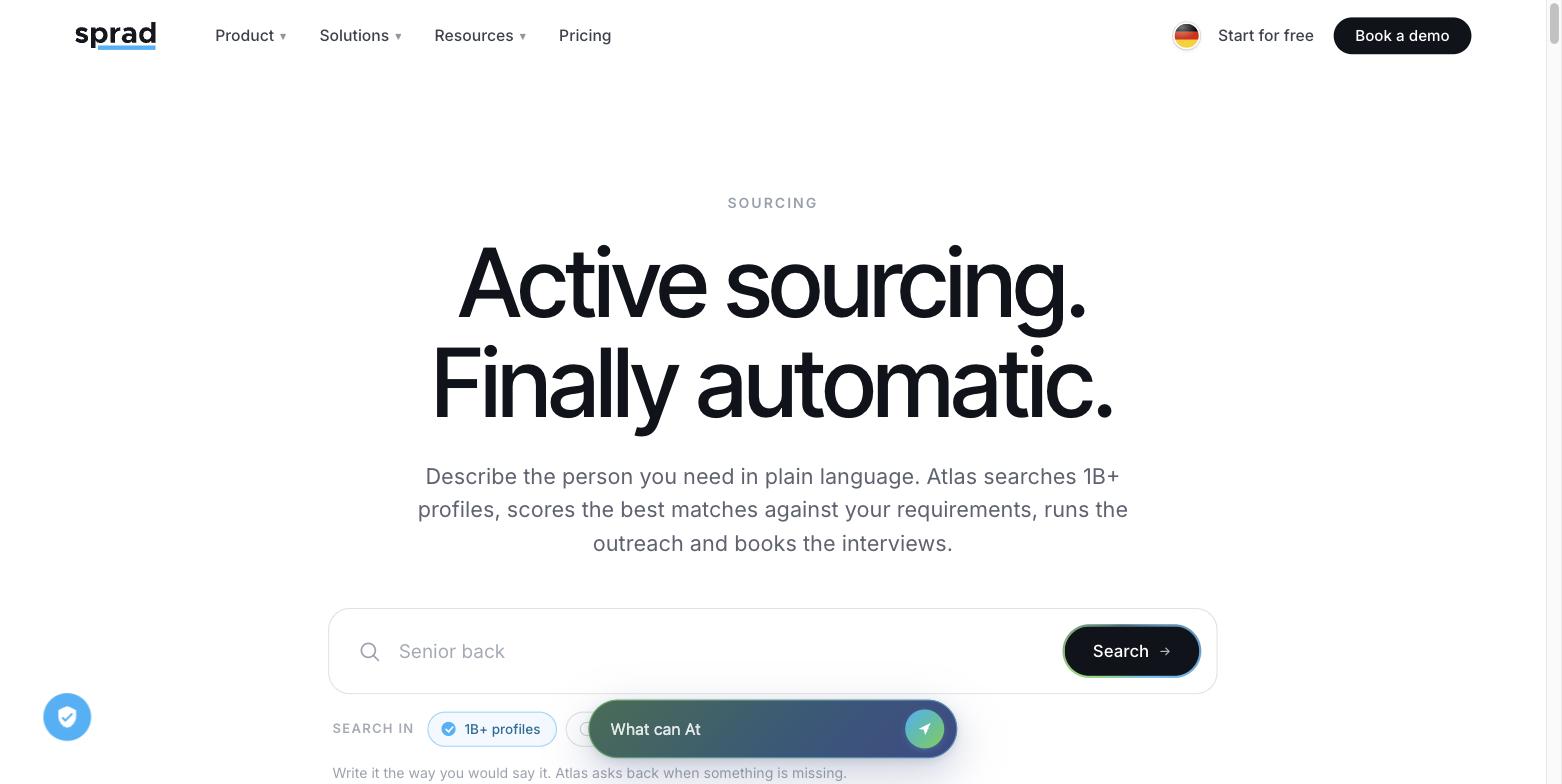
Sprad takes a requirement instead of a Boolean string. Atlas, the sourcing product, checks every profile individually against your requirements and returns a reason per requirement, so it also finds people whose profile is poorly maintained or lacks the “right” keywords. Sprad has built recruiting software for seven years, starting with employee referrals, which is the same job: matching profiles to requirements.
- One search over all sources: LinkedIn, GitHub, your own talent pool and the networks of your colleagues, in one of the largest profile databases (1B+ profiles worldwide). Deep Context finds companies first and then the people who worked there in a given period, for example a CFO who led an acquisition.
- LinkedIn and email in one inbox: automated outreach with follow-ups, InMails sent from Sprad (your own allowance can be used), AI templates you train with feedback and a pitch format where you store the selling points of the role. Per talent you see all communication in one place, and the system warns you if someone was already contacted, also by a colleague or for another role. That removes the double approach that marketplaces invite.
- Your data stays yours: the talent network and its live updates stay free after you stop paying; a full raw-data export is possible.
- Price: free start; Recruiter Lite 79 € per seat and month; Atlas Recruiter 299 € with unlimited (fair use) searches, 10 Deep Context searches per seat and month and one automated LinkedIn and mailbox account.
Honest limits: Sprad does not bring recruiters, so the work stays with you. There is no AI notetaker for calls and no placement reporting yet, no SMS channel (WhatsApp is available for talking to candidates), and the deep search takes a few minutes because far more AI runs per profile. Plans: sprad.io/pricing. More: Active Sourcing, and for agencies Sprad for recruitment agencies.
2. Dover — fractional recruiters at a flat range
Dover is the closest alternative if you want people, not software. It publishes a range per hire instead of a percentage, which makes a single 130,000 $ hire cost a fraction of a 20 % fee. Treat the numbers as Dover's own and check which services are included.
3. Contrario — managed marketplace, unpublished price
Contrario sits closest to Paraform in model. Because no rate card is public, you can only compare it after a quote. Ask for the percentage, the guarantee and who owns the candidate data.
4. BountyJobs — vendor panels for large employers
BountyJobs is built for employers that manage many search firms under one contract, not for a startup with three open roles.
5. Juicebox — plain-language search for lean teams
Juicebox publishes its prices and lets you search in plain language. In the recruiting area of the public PeopleSearchBench it published 65.7, a solid result. Details: Juicebox alternatives.
6. Pin — an agent that books the call
Pin pairs a free tier with an Autopilot mode that runs up to interview booking (vendor description). A low-risk way to try an agent before you decide between tool and marketplace.
7. A specialist or boutique agency
For executive or very niche searches, a retained or contingent agency can still be the right call. Typical third-party ranges are 15–30 % of first-year salary. In Germany, a success fee for placing a candidate rests on a brokerage contract; Section 652 of the German Civil Code (BGB) says the commission is only due once the contract actually comes about because of the broker's work. Check this in any agency agreement, whichever country you hire in.
Which alternative finds more matching candidates?
Search quality is the part of sourcing you cannot see on a pricing page. The open PeopleSearchBench runs real search tasks and scores relevance, coverage and data usefulness; we use its recruiting area. In our own re-measurement, converted to the published scale, Atlas comes to 73.5 of 100 in recruiting (Juicebox 65.7 as published).1 Sprad is the vendor of Atlas itself. In that re-measurement it returned almost always 15 matching profiles per search (14.2 on average). Paraform, Dover, Contrario and BountyJobs are marketplaces and did not take part, so the benchmark compares search tools only; for the marketplaces, quality depends on the individual recruiter.

In Sprad's own test (15 August 2026, three open roles, 218 profiles checked), Atlas returned 38 % of the hits against 9 % for the best of the other four tools. Sprad is the vendor of Atlas itself.
1 PeopleSearchBench (Recruiting), published by Lessie, October 2026. Other systems' scores as published in the benchmark; Atlas is our own re-measurement with the benchmark's open test procedure, converted to the published scale; not an official entry. Method and details.
What does it cost? A worked example for 5 engineering hires
Assumptions: you fill five software roles a year at the US median pay for software developers of 135,980 $ (US Bureau of Labor Statistics, May 2025 data). Paraform at 20–25 % costs 27,196 to 33,995 $ per hire, so 135,980 to 169,975 $ for five. Dover at its stated 2,000–8,000 $ per hire comes to 10,000 to 40,000 $. Sprad for a team of three recruiters: Recruiter Lite is 3 × 79 € × 12 = 2,844 € per year (deep search and contact data through credits); Atlas Recruiter is 3 × 299 € × 12 = 10,764 € per year with unlimited (fair use) searches. Currencies are not converted.
The comparison is not like for like: the marketplace fee buys the recruiters' time, while the tool cost assumes you already have recruiters. If you have none and fill only one or two hard roles a year, the success fee is the simpler deal. From about three or four hires a year with your own recruiters, the percentage fee overtakes the tool cost quickly. Annual prices are billed yearly, net of VAT.
Who should switch from Paraform, and who should stay?
- Stay with Paraform if you have no recruiting capacity, fill a few specialised roles a year and want to pay only on a hire.
- Switch to Sprad if you already have recruiters or hire repeatedly, if matching share and cost per hire are the pain, or if you are an agency that wants to search its own talent pool and your clients' roles in one tool.
- If you are a recruiter working through Paraform: a sourcing tool is how you find candidates faster on any marketplace, and the candidate network you build stays yours. Platform rules require you to disclose that you work through Paraform and not to approach employees of a client company.
- Combine is common: marketplace for the roles you cannot fill, a sourcing tool for everything else.
GDPR, EU AI Act and US rules: what applies
Both routes process personal data of people who have not applied. In the EU that usually rests on legitimate interest (Article 6(1)(f) GDPR) with an information duty towards the person (Article 14) and a right to object. If an external recruiter sources for you, ask who is controller and who is processor, and sign a data processing agreement (Article 28). The EU AI Act (Regulation 2024/1689) lists AI systems used to select or filter applicants as potentially high-risk (Annex III); that holds for a marketplace’s AI agents as much as for a tool, and the duties sit with you as employer, which is why a human must decide. In New York City, Local Law 144 requires a bias audit and notices for automated employment decision tools. Paraform's company page does not state where it operates or stores data, so ask before you share candidate data.
Typical mistakes when choosing
- Comparing a percentage fee with a seat price without counting your own recruiter time.
- Not asking who owns outreach history and candidate data after the search ends.
- Accepting a fee on “base salary” without clarifying bonus, equity and currency.
- Letting two recruiters or two tools contact the same candidate. One inbox with a warning prevents it.
- Judging a tool by a demo search instead of one of your own open roles.
How to choose
- You want to source yourself with the most matching candidates, LinkedIn and email in one inbox, your own pool and a published price: Sprad.
- You need external recruiters for a few hard roles: stay with Paraform, or compare Dover and Contrario quotes.
- You work alone on a tight budget: Juicebox or Pin.
- You run a large vendor panel: BountyJobs.
More comparisons: active sourcing tools compared, Juicebox alternatives.
FAQ
What are the best alternatives to Paraform?
Sprad if you want to source yourself with the most matching candidates and one inbox for LinkedIn and email; Dover, Contrario and BountyJobs if you still want external recruiters; Juicebox and Pin for small budgets; a specialist agency for niche or executive searches.
Who should switch from Paraform and who should stay?
Stay if you have no recruiting capacity and want to pay only on a hire. Switch if you have recruiters, hire repeatedly, or want to own the process and the candidate data.
How much does Paraform cost?
Paraform publishes no price list. Its own comparison page says roughly 20–25 % of first-year salary, charged only on a hire; third-party sources cite fixed bounties of 5,000–30,000 $. Get the number in writing.
How do the alternatives compare on GDPR?
Sprad hosts in the EU. For marketplaces and US tools we found no public EU-residency statement; ask for a data processing agreement and the data location before you share candidate data.
Which alternative finds more matching candidates?
In our own re-measurement in the recruiting area of the public PeopleSearchBench, Atlas by Sprad comes to 73.5 of 100, converted to the published scale. Marketplaces did not take part.
Can I try Sprad for free?
Yes. The free plan includes 100 credits per month; searches, screening and interviews run on them. Recruiter Lite starts at 79 € per seat and month.
Jürgen Ulbrich
Jürgen Ulbrich has more than a decade of experience in developing and leading high-performing teams and companies. As an expert in employee referral programs as well as feedback and performance processes, Jürgen has helped over 100 organizations optimize their talent acquisition and development strategies.