Lusha costs $0 on the Free plan (40 credits a month) and $37.45 to $299.95 a month on annual billing for the paid plans, with Scale priced on request. The usual recruiter plan, Pro, is $52.45 a month annually ($69.90 monthly) for 600 credits. An email costs 1 credit and a phone number 5, so one email-and-phone reveal costs about $0.52 on Pro. Lusha sells contact data, not candidate search, so most recruiters pay for it on top of a sourcing tool (status October 2026).
How much does Lusha cost per month or per year?
Lusha publishes four prices and one "contact us". These are the figures on Lusha's own pricing page, retrieved on October 30, 2026, in US dollars:
| Plan | Monthly billing | Annual billing (per month) | Credits per month | Cost per credit (annual) |
|---|---|---|---|---|
| Free | $0 | n/a | 40 | n/a |
| Starter | $49.90 | $37.45 ($449.10 per year) | 400 | about $0.094 |
| Pro | $69.90 | $52.45 ($629.10 per year) | 600 | about $0.087 |
| Premium | $399.90 | $299.95 ($3,599.10 per year) | 3,400 | about $0.088 |
| Scale | Custom quote via sales | Custom quote via sales | Custom | n/a |
Two points before you compare. First, the annual price saves about 25% against monthly billing, so always check which one a review quotes. Second, third-party sources disagree: some list Premium at $299.95 and others at $399.90, because the monthly price rose in March 2026 and many articles still show older numbers. When a price in a blog post differs from the vendor's page, the vendor's page wins.
For orientation on real spend, SpendHound's marketplace data reports an average of about $9,049 per year for small and mid-sized buyers and $28,332 for enterprises (third-party figures; they mix plan sizes and negotiated discounts).
What is included, and what costs extra?
Everything on Lusha runs on credits, and the credit rules decide your real bill:
- Email vs. phone. A verified email costs 1 credit, a phone number 5. Some third-party sources still report 10 for a phone number, so check the current rule in your account before you plan a phone-heavy campaign. One email plus one phone is 6 credits.
- Rollover. On monthly plans, unused credits roll over up to twice the plan's monthly limit. On annual plans, all credits are issued up front and expire at the end of the year.
- Seats. Teams of more than five users have to talk to sales. Adding seats or features means moving to a higher plan.
- Extra credits. You can buy more at any time in the account settings, so a busy month rarely stops you, but it raises the price per contact.
- Renewal. Plans renew automatically; cancelling takes effect at the end of the billing period.
- LinkedIn Recruiter. Lusha has an extension for LinkedIn Recruiter, but it has to be enabled through Lusha support.
What the price does not include: finding the right people. Lusha reveals the email or phone number of a person you already found. It does not search for candidates against a job brief or check whether a profile fits.
Is there a free plan or trial?
Yes. The Free plan is permanent: 40 credits per month, the browser extension, basic prospecting and CRM integrations. That is 40 emails, or 8 phone numbers, or a mix. It is enough to test data quality on your own target roles before paying. For comparison, Sprad's free plan gives 100 credits per month (200 in the first month), including web search at two credits per displayed profile, about 50 profiles a month.
Cost for 1, 5 and 15 recruiters
These are illustrations with stated assumptions. They use list prices, annual billing and USD, excluding tax. Lusha is a contact-data layer, so the fair comparison is the stack a recruiter actually needs: something to find people plus something to reach them.
One recruiter, 100 contacts a month with email and phone. That is 600 credits, exactly Lusha Pro: $52.45 a month. Add LinkedIn Recruiter Lite at $170 a month and the stack is $222.45 a month, or about $2,669 a year. On Sprad, Recruiter Lite is $95 a month and search is included. Contact data runs on credits at a €0.10 list price: 1 credit per email, 10 per phone number, charged only for what is found. For 100 emails plus 100 phone numbers that is at most 1,100 credits (€110). On contact data alone Lusha is clearly cheaper per phone number; the comparison changes once you count the search tool you would need anyway.
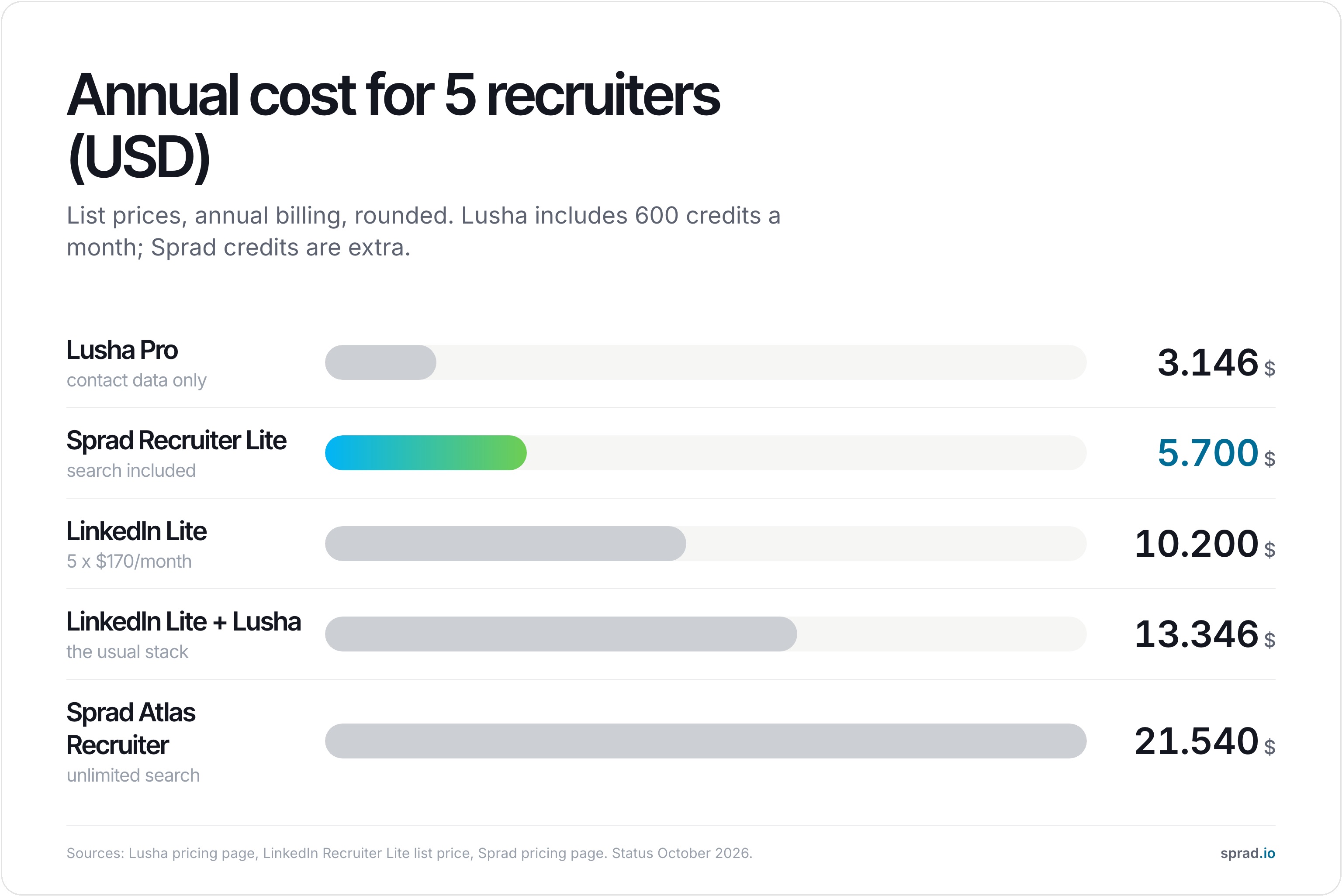
| Team | Lusha Pro | LinkedIn Lite + Lusha Pro | Sprad Recruiter Lite | Sprad Atlas Recruiter |
|---|---|---|---|---|
| 5 recruiters | 5 x $52.45 x 12 = $3,146 | 5 x ($170 + $52.45) x 12 = $13,346 | 5 x $95 x 12 = $5,700 plus credits | 5 x $359 x 12 = $21,540 |
| 15 recruiters | Over five users: quote. List-price equivalent: $9,437 (assumption) | About $40,037 at list price (assumption; Lusha part by quote) | 15 x $95 x 12 = $17,100 plus credits | 15 x $359 x 12 = $64,620 (from 3 seats: integrations and onboarding workshop) |
The LinkedIn Lite price is the published $170 per month on an annual plan; Corporate is quote-only. Sprad prices are list prices in USD billed annually (sprad.io/pricing, status October 2026). Recruiter Lite includes quick and normal search; deep search, company search and contact data run on credits. Atlas Recruiter includes unlimited search (fair use) and one automated LinkedIn-and-mailbox outreach account per seat.
A rule of thumb from practice: licence cost matters less than recruiter time. The U.S. Bureau of Labor Statistics lists a median of $72,910 per year for human resources specialists (May 2024). If contact data saves one recruiter two hours a week, a $52 plan pays for itself. The typical mistake is the opposite one: paying for credits that expire on an annual plan, or buying Premium for a team that reveals 300 contacts a month.
Is Lusha worth it for recruiting?
Lusha is worth it when you already have a list of named people (from LinkedIn, a conference or a job board) and mainly need their business email or phone. It is a good fit for a recruiter who sources a few dozen people a month and wants fast reveals inside the browser.
It is the wrong tool if you expect it to find candidates, because it has no requirement-based search and no AI check of each profile. Lusha has also not been measured in the PeopleSearchBench (Recruiting), which tests candidate search, not contact data. Practical limits we hear from teams: email hit rates vary by country and seniority, phone numbers are expensive in credits, and a credit spent on a wrong address is gone. Test it on 40 of your own target contacts on the Free plan before you commit.
Cheaper ways to source: Sprad and fair alternatives
Sprad has built recruiting software for seven years, starting with employee referrals and matching profiles to requirements; its sourcing tool Atlas has been live for about a year. For teams that need to find people and then contact them, three reasons matter:
- Better matches, measured. In the recruiting area of the public PeopleSearchBench, our own re-measurement puts Atlas at 73.5 of 100, converted to the published scale (Lessie 68.2, Juicebox 65.7 as published; see note below). Atlas checks each profile individually against your requirements and explains every result. Instant results usually mean keyword search; the deep check takes a few minutes.
- LinkedIn and email in one inbox. Outreach runs on both channels including follow-ups and InMails, with AI templates you can train. The inbox shows the full history per talent and warns about double contact.
- Contact data where you work. Business email costs 1 credit and a phone number 10, charged only when found, so you do not need a separate data subscription for most searches.
The search covers LinkedIn, XING, GitHub and your own talent pool across more than 1 billion profiles, and you keep your data and a free talent network if you cancel. Honest limits: no AI call notetaker, no placement reporting, no SMS (WhatsApp instead), a deep search takes a few minutes, and Atlas Recruiter costs more per seat than some seat tools. Phone numbers cost more credits at Sprad than at Lusha. See our comparison of active sourcing tools, the LinkedIn Recruiter alternatives, the Juicebox alternatives and our guide to AI sourcing pricing models. Product details: people search, pricing, benchmark.
Legal checks before you buy (EU and US)
Contact data tools sit in the most sensitive part of sourcing. Under Articles 6 and 14 GDPR, you need a legal basis for processing and must inform people whose data you did not collect from them, in general within one month. French regulator CNIL fined the contact-data provider Kaspr €240,000 in December 2024 for scraping and processing LinkedIn contact data without proper information and consent handling; the case shows that buying contacts does not remove your own duty. The EU AI Act lists AI systems that filter or evaluate candidates as high-risk (Annex III). In New York City, Local Law 144 requires a bias audit and notice for automated employment decision tools. Lusha states SOC 2 Type II and ISO 27001 and 27701 on its own trust pages; ask for the data processing agreement, the data source and the opt-out process in writing.
FAQ
How much does Lusha cost?
Free is $0 with 40 credits. Paid plans are $37.45 (Starter), $52.45 (Pro) and $299.95 (Premium) per month on annual billing, or $49.90, $69.90 and $399.90 monthly. Scale is quoted.
Is Lusha free?
There is a permanent Free plan with 40 credits per month, which covers 40 emails or 8 phone numbers.
How many credits does a phone number cost?
Lusha's pricing page lists 1 credit per verified email and 5 per phone number. Some third-party articles quote 10, so confirm it in your account.
Does Lusha charge per user?
Plans are priced per user and month; teams above five users go through sales, and Scale allows per-user credit limits. Ask before signing whether credits are shared across users.
Is Lusha cheaper than LinkedIn Recruiter?
Yes per seat, but they do different jobs. LinkedIn Recruiter Lite ($170 per month) is a search tool; Lusha reveals contact data. Many recruiters buy both.
What is a cheaper way to find and contact candidates?
For teams that source, Sprad: free start, Recruiter Lite at $95 per seat per month with search included, and email and phone credits on top. Compare it with your current stack, not only with Lusha.
Note on the benchmark: PeopleSearchBench (Recruiting), published by Lessie, October 2026. Other systems' scores as published in the benchmark; Atlas is our own re-measurement with the benchmark's open test procedure, converted to the published scale; not an official entry. Price sources: Lusha's pricing page (retrieved October 30, 2026), SpendHound, LinkedIn's published Recruiter Lite price, Sprad's pricing page.
Jürgen Ulbrich
Jürgen Ulbrich has more than a decade of experience in developing and leading high-performing teams and companies. As an expert in employee referral programs as well as feedback and performance processes, Jürgen has helped over 100 organizations optimize their talent acquisition and development strategies.