Paraform is worth it if you have no recruiting capacity and a few hard, specialised roles a year; it is rarely the cheapest route if you hire repeatedly. It is a marketplace: external recruiters submit candidates and you pay a percentage of first-year salary only on a hire. Independent reviews are thin, most positive material comes from Paraform itself, and the price list is not public. Teams that already have recruiters usually get more from a sourcing tool such as Sprad, which also publishes its prices.
What is Paraform, in one paragraph?
Paraform started in 2023 as a bounty marketplace for tech hiring; TechCrunch covered a 1.4 million dollar pre-seed round. Today it calls itself an “AI-native recruiting firm”: you describe the role, a talent strategist and AI agents refine the search, and selected recruiters submit candidates. You pay “a flat percentage of first-year base salary only upon hire”, with a free replacement search if the hire leaves within 90 days. Its company page names software, go-to-market and legal roles but no countries. For the model in detail and other marketplaces, see our Paraform alternatives.
What do users say about Paraform?
Honest answer first: there is little independent evidence. We read what is publicly available and weighted it by who wrote it.
| Source | What it shows | Weight |
|---|---|---|
| Trustpilot, Indeed | Very few entries, anonymous, mixed; one reviewer advises local firms for the strongest recruiters across all roles | Low: too small to rate the company |
| Paraform's own stories and comparison pages | Placements, speed, earnings; always positive | Low: marketing |
| TechCrunch (2023) and Fast Company | Founder claims: 10,000–15,000 $ earned per hire; about 600 companies, about 1,000 active recruiters, recruiters keep about 70 % of the fee | Medium: independent outlet, but numbers come from the company |
| Paraform help centre | Recruiters start at a 5.0 rating until enough candidates are submitted; the average sits around 4.7 | Medium: internal system, not a review |
Reading across these sources, the pattern is consistent. Recruiters who specialise in startup tech roles and move fast report good results; employers report variance. One caveat applies to every marketplace: outcomes depend on which recruiter picks up your role, not on the platform alone.
Strengths: what Paraform does well
- No upfront cost. No subscription or seat; you pay when someone is hired, so the fee always stands against a real result.
- Capacity you do not have. A startup without a recruiter gets people who source and screen for it.
- Replacement search. A hire who leaves within 90 days triggers a new search at no charge. It is a new search, not a refund.
- Speed on hard tech roles. Paraform reports faster interviews; the figure is self-reported, but the incentive structure (recruiters earn only on placement) does favour fast submissions.
Limits: where Paraform falls short
- No public price. Paraform’s own comparison pages say roughly 20–25 %; competitors cite 15–30 % or fixed bounties. You only learn your number in a sales conversation.
- Cost follows salary, not effort. A senior hire at 180,000 $ costs far more than a junior one for similar work.
- Quality varies. Only recruiters who opt in work on your role; there is no single standard of search.
- You do not own the process. The outreach history and candidate relationships sit with the recruiter and the platform, not in your own system.
- Narrow focus. Strongest for tech and go-to-market at startups; less proven for large enterprises or non-tech volume hiring.
What does Paraform really cost? A worked example
Assumptions: five software engineering hires a year at the US median pay of 135,980 $ (US Bureau of Labor Statistics, May 2025 data) and a fee of 20–25 %. The comparison with a tool is not like for like, because a fee buys recruiter time and a seat does not.
| Route | Cost for 5 engineering hires | What it buys |
|---|---|---|
| Paraform at 20–25 % | 135,980–169,975 $ (27,196–33,995 $ per hire) | External recruiters' time and network |
| Sprad Recruiter Lite, 1 seat | 1,140 $ per year (95 $ × 12) | Search tool; your recruiter does the work |
| Sprad Atlas Recruiter, 1 seat | 4,308 $ per year (359 $ × 12) | Unlimited (fair use) search, deep search, one LinkedIn and email account |
Break-even logic: the tool route wins when seat cost + the recruiter time you already pay for is lower than fee × hires. One 27,196 $ fee pays for about six years of an Atlas Recruiter seat. With no recruiter on staff and one or two hires a year, the fee is the simpler deal; from three or four hires a year with your own people, it overtakes the tool quickly. Sprad prices are in EUR on the site (79 € and 299 € per seat and month, billed annually, net); the dollar values are the USD list prices, as of October 2026.
Is Paraform worth it for you?
- Yes, if you are a startup or growth company, have no recruiter, fill one to three hard tech or go-to-market roles a year and want to pay only on success.
- Probably not, if you already employ recruiters, hire in volume, need a repeatable process, or want to keep the candidate network you build.
- Check first, if you hire in the EU: Paraform does not state which countries it serves or where data is stored, so ask before you share candidate data.
What if you are a recruiter on Paraform?
The 70 % share reported by Fast Company and the rating system make it a real income source for specialists. The risks are competition on each role and no ownership of the client relationship. A sourcing tool is how you find candidates faster on any marketplace, and the network you build there stays yours; platform rules also require you to disclose that you work through Paraform.
Alternatives that fit better
If you want to do the search yourself, Sprad is the option we recommend, and here is the reason: it checks every profile individually against your requirements instead of running a keyword search. In the open PeopleSearchBench (119 real search tasks), our own re-measurement puts Atlas at 73.5 of 100 in the recruiting area, converted to the published scale.1 Sprad is the vendor of Atlas itself. If results appear instantly, it is almost always a keyword search; Sprad’s deep search takes a few minutes for that reason.
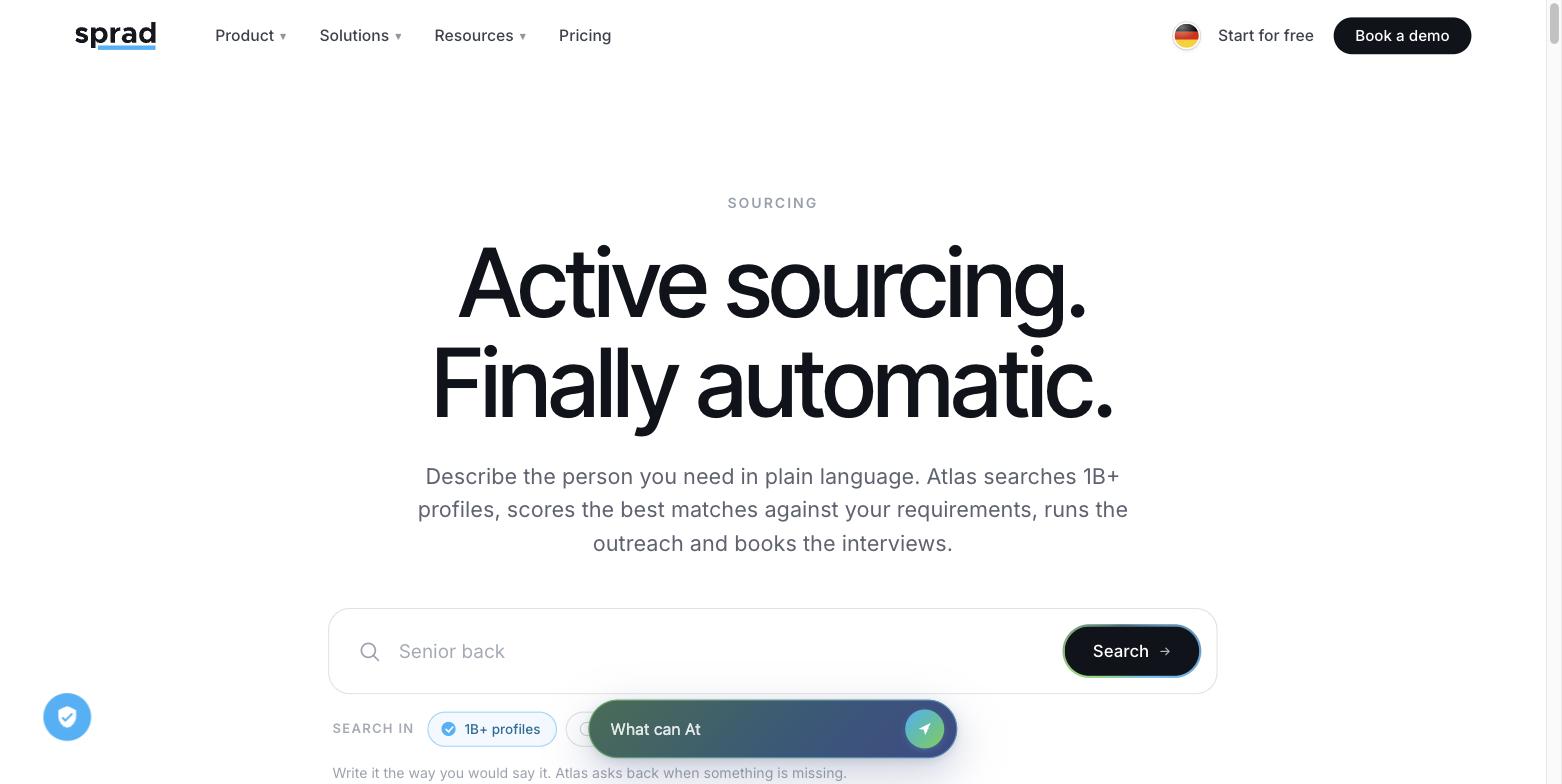

Outreach is the second reason. Sprad sends LinkedIn messages, InMails and email automatically with follow-ups, trains templates from your feedback, and keeps the whole conversation per talent in one inbox, with a warning if someone was already contacted by a colleague. In our experience that combination of channels, not search alone, drives the reply rate. It searches LinkedIn, XING, GitHub and your own pool, and your data and network stay with you if you stop paying. Honest limits: no AI call notetaker, no placement reporting, no SMS, and the deep search is slower than a keyword search. You start free (100 credits a month); Recruiter Lite costs 79 € per seat and month, and against separate LinkedIn and XING licences, teams save 30–80 %. More tools side by side: active sourcing tools compared, Juicebox alternatives. For agencies: Sprad for recruitment agencies; details on people search and pricing.
1 PeopleSearchBench (Recruiting), published by Lessie, October 2026. Other systems' scores as published in the benchmark; Atlas is our own re-measurement with the benchmark's open test procedure, converted to the published scale; not an official entry. Contact data came from the “find email” button. Method and details.
Using Paraform in Europe: what to check
Both routes process data of people who have not applied. Under the GDPR that usually rests on legitimate interest (Article 6(1)(f)) with an information duty towards the person (Article 14). If an external recruiter sources for you, clarify who is controller and processor and sign a data processing agreement (Article 28). The EU AI Act lists AI used to filter applicants as potentially high-risk (Annex III), so a human must decide. In New York City, Local Law 144 requires a bias audit for automated employment decision tools. In Germany, a placement fee rests on a brokerage contract; Section 652 BGB makes the commission due only if the contract comes about through the broker’s work.
Typical mistakes when buying
- Judging the fee by the percentage alone instead of asking for a written quote, the guarantee and what “base salary” includes.
- Comparing a percentage fee with a seat price without counting your own recruiter time.
- Not asking who owns outreach history and candidate data when the search ends.
- Letting two recruiters or two tools contact the same candidate.
FAQ
Is Paraform worth it?
Yes for startups with no recruiter and a few hard roles a year; usually not for teams that hire repeatedly and already have recruiters. Get the fee in writing first.
What do users say about Paraform?
Independent reviews are few and mixed. Specialist recruiters report good results; employers report variance. Most positive material comes from Paraform itself.
What are Paraform’s strengths and limits?
Strengths: no upfront cost, outside capacity, a 90-day replacement search. Limits: no public price, cost tied to salary, varying recruiter quality, no ownership of the process or the data.
How much does Paraform cost?
There is no public price list. Paraform’s own pages say roughly 20–25 % of first-year base salary, charged only on a hire; third parties cite 15–30 %. At the US median software developer pay that is about 27,000–34,000 $ per hire.
Which teams is Paraform right for, which not?
Right: startups and growth companies hiring a few specialised roles without a recruiter. Not right: teams with in-house recruiters, volume hiring, or those who want to own their candidate data.
Which alternatives fit better?
For doing the sourcing yourself: Sprad. For other marketplaces: Dover or Contrario. See Paraform alternatives.
Can I try Sprad for free?
Yes. The free plan includes 100 credits per month; searches, screening and interviews run on them.
Jürgen Ulbrich
Jürgen Ulbrich has more than a decade of experience in developing and leading high-performing teams and companies. As an expert in employee referral programs as well as feedback and performance processes, Jürgen has helped over 100 organizations optimize their talent acquisition and development strategies.