PIN is worth it if you are a solo recruiter or small agency hiring professional and technical roles in North America and want AI search plus email sequences for $100 to $179 a month; it is a weaker fit for hard or non-tech searches, LinkedIn-first outreach and EU data rules. Public ratings are very good (G2 4.8 out of 5), but they rest on 27 reviews, and PIN itself publishes the summary. Reviewers praise search precision and an easy start; they criticise missed candidates, thin coverage outside tech and bounced contact data (status October 30, 2026).
What do users say about PIN?
PIN (pin.com, founded 2024) is young, so the review base is small. The numbers below come from PIN's own review page, which cites third-party sites and was checked on September 28, 2026. We name G2 and Capterra as sources but do not link review portals.
| Source | Rating | Volume | Note |
|---|---|---|---|
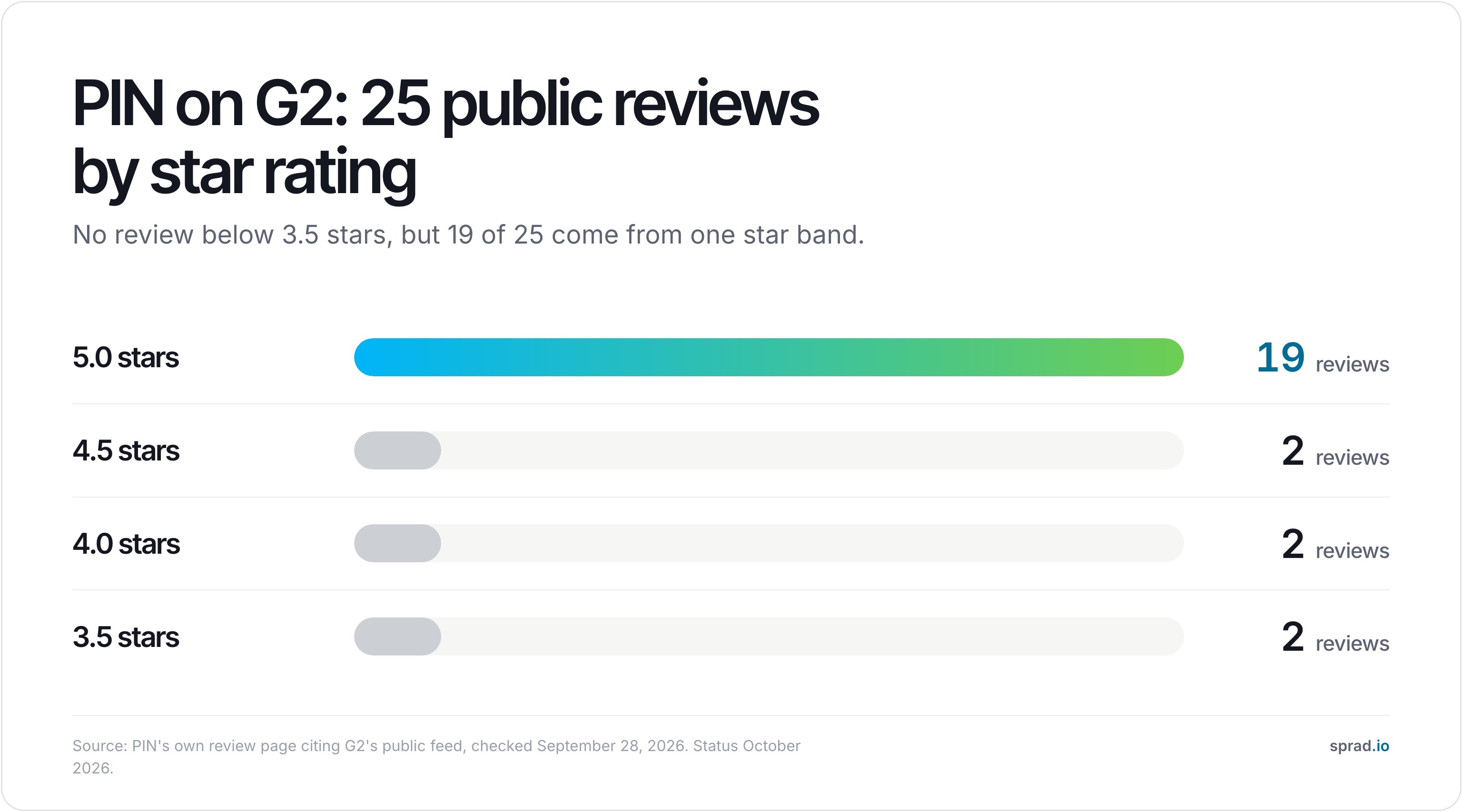
| G2 | 4.8 / 5 | 27 reviews, August 2024 to April 2026 | In the 25 public reviews: 19 at 5.0, 2 at 4.5, 2 at 4.0, 2 at 3.5; none lower |
| Capterra / GetApp / Software Advice | 5.0 / 5 | 2 reviews | The same two reviews appear on all three |
| Chrome Web Store | 5.0 / 5 | 8 ratings, about 4,000 users | Extension, updated September 2026 |
| PIN's own survey | 14-day average time-to-fill | 2,000+ organisations | Vendor survey, not an independent rating |
How reliable are these ratings?
Treat them as a positive signal, not proof. 27 reviews is a thin base, most reviewers work at small firms or agencies, and the page that summarises them belongs to the vendor. PIN's page also says one quoted reviewer sits on its advisory board. In the U.S., the FTC's rule on consumer reviews and testimonials (16 CFR Part 465) has covered fake and undisclosed insider reviews since 2024, which is a good reason to ask who wrote a review and what their relationship to the vendor is. A practical check from our side: read the three to four lowest ratings of any tool first, because that is where the limits show.
What are PIN's strengths?
- Search in plain language. Reviewers like describing a role with exclusions instead of building Boolean strings. One calls it "needle-in-a-haystack" precision.
- Candidates beyond LinkedIn Recruiter. One reviewer reports profiles that did not appear in LinkedIn Recruiter.
- Fast start. Small teams describe a quick set-up and little training. A free plan exists, so you can test before paying.
- Search and sequences in one tool. PIN ranks profiles, drafts outreach and runs email sequences from your Gmail or Outlook.
- Security basics. According to its trust centre, PIN holds a SOC 2 Type II report; it also lists 120+ ATS integrations.
What are PIN's limits?
- Missed or wrong candidates. Some reviewers say a search missed a known candidate; one says rejected profiles came back.
- Thin coverage outside tech. Two reviewers name construction as weak. PIN's own page says coverage is deepest for professional and technical roles in North America and Europe.
- Contact data. Two mid-market reviewers report bounced emails or wrong phone numbers. PIN advises verifying data before sequencing.
- LinkedIn and SMS are manual. In a sequence these steps are tasks you send yourself; only email steps send automatically.
- Credits cap volume. One credit reveals one email or phone number: 5 a week on Free, 500 a month on Solo, 1,000 per seat on Professional. A worked example is in our PIN pricing guide.
- Early bugs. A few late-2025 reviews mention bugs such as a campaign freezing when duplicated; reviews from April 2026 do not repeat them.
- Platform risk. PIN states that LinkedIn removed its company page and CEO profile in September 2026 and that the product remains fully operational. Check the current status if LinkedIn is central to your process.
Is PIN worth it? Who it fits and who it does not
PIN fits a solo recruiter, a founder who hires alone or a small agency with professional and technical searches, mostly in North America, where plain-language search and email sequences cover the job. At $135 per user a month on annual billing, five seats cost $8,100 a year (price list October 2026).
PIN fits less if you recruit in construction, trades or other non-tech fields, if your outreach must run on LinkedIn as well as email, if you need a system of record around the search, or if you work under EU rules (see below). The hardest test is your own open role, so run a pilot:
- Pick one hard role you already know well, so you can spot missed candidates.
- Run the same brief in PIN and one alternative and compare the first 25 profiles line by line against your must-haves.
- Reveal contacts for 20 people and count how many bounce. That bounce rate, not the star rating, tells you what a credit really buys.
A typical mistake from practice: judging a tool on its first impressive result. Count qualified profiles per hour of recruiter time, and count seats nobody opens after 60 days.
Is PIN usable in Europe? GDPR and the EU AI Act
Sourcing from public profiles still triggers duties. Under Article 14 GDPR you must inform people whose data you did not collect from them, in general within one month. Article 22 limits decisions based solely on automated processing; the Court of Justice applied it to automated scoring in case C-634/21 (SCHUFA), and PIN's own GDPR guide says tools that reject candidates without human review likely breach it. The EU AI Act lists AI systems that filter or evaluate candidates as high-risk (Annex III). PIN's trust centre names hosting on AWS in the United States, so EU teams need a transfer basis, for example the EU-US Data Privacy Framework, and a data processing agreement. In New York City, Local Law 144 requires a bias audit and candidate notice for automated employment decision tools. Ask every vendor, Sprad included, for hosting location and a processing agreement.
Which alternatives fit better?
For a price-led view see PIN pricing; for the full list see PIN alternatives and Juicebox vs PIN. Our pick for teams that need more matching candidates and outreach on two channels is Sprad. Sprad has built recruiting software for seven years, starting with employee referrals and the matching of profiles to requirements; its sourcing tool Atlas has been live for about a year.
| PIN | Sprad | |
|---|---|---|
| Search | 850M+ profiles, plain-language search | One search across LinkedIn, XING, GitHub and your own talent pool, 1 billion+ profiles; every profile checked against your requirements with a reason per result |
| Outreach | Email sequences automatic; LinkedIn and SMS manual | LinkedIn (incl. InMail) and email automated with follow-ups, trainable AI templates, pitch format; WhatsApp for candidate chat |
| Inbox | Shared inbox on Professional | One inbox per talent for LinkedIn and email, warning before double contact, import of existing contacts |
| After search | ATS integration (add-on on Solo and Professional) | Built-in ATS, CRM and talent network; voice, video, chat and agent pre-qualification |
| Price | Free; $100; $135 per user/month annual | Free start (100 credits a month); Recruiter Lite $95 (€79) per seat/month; Atlas Recruiter $359 (€299); 30 to 80% lower cost than separate LinkedIn and XING licences, depending on your set-up |
| Data after cancelling | Pipeline lives in PIN's CRM | Talent network stays free, raw-data export available |
Why we think Sprad finds more: in our own re-measurement in the recruiting area of the open PeopleSearchBench, Atlas comes to 73.5 of 100, converted to the published scale (Juicebox 65.7 as published)1. In a smaller test of Sprad's own on August 15, 2026, with three hard roles and 218 reviewed profiles, PIN's results overlapped 0% with what the other tools found, against 38% for Atlas. That is one run on one day by a vendor, so read it as a hint; for the Berlin backend role PIN returned 2 profiles meeting every must-have, against 12 for Juicebox. PIN is not part of PeopleSearchBench.
The second difference is outreach: LinkedIn and email run automatically in one inbox, so you see the full history per talent. We see email plus LinkedIn as the biggest lever for reply rates. Honest limits: no AI call notetaker, no placement reporting, no SMS (WhatsApp instead), deep search takes a few minutes because every profile is checked, and Atlas Recruiter costs more per seat than some seat tools. More in our comparison of active sourcing tools, the Juicebox alternatives, and the people search and pricing pages.
FAQ
Is PIN worth it?
For a solo recruiter or small agency hiring tech and professional roles in North America, usually yes: free plan, quick start, positive ratings. For hard searches, non-tech roles, LinkedIn-first outreach or EU compliance needs, test it against an alternative first.
What do PIN reviews say?
G2 shows 4.8 out of 5 from 27 reviews. Praise: search precision, easy start. Criticism: missed candidates, thin coverage outside tech, bounced contact data.
What are PIN's pros and cons?
Pros: plain-language search, email sequences, free plan, SOC 2 Type II. Cons: manual LinkedIn and SMS steps, contact credits, US hosting, small review base.
Does PIN have a free plan?
Yes: $0 with 3 searches a day and 5 contact credits a week. Paid plans start at $100 per month (Solo, annual billing).
Is PIN GDPR compliant?
PIN publishes a GDPR guide and a trust centre, but it lists US hosting. EU teams still need a transfer basis, a data processing agreement and human review of automated rejections.
What is the best PIN alternative?
It depends on the gap. Sprad suits teams that want every profile checked and LinkedIn plus email in one inbox; our PIN alternatives guide compares seven options.
1 PeopleSearchBench (Recruiting), published by Lessie, October 2026. Other systems' scores as published in the benchmark; Atlas is our own re-measurement with the benchmark's open test procedure, converted to the published scale; not an official entry. Sources: PIN review page, pricing page and trust centre (retrieved October 30, 2026), Sprad pricing page.
Jürgen Ulbrich
Jürgen Ulbrich has more than a decade of experience in developing and leading high-performing teams and companies. As an expert in employee referral programs as well as feedback and performance processes, Jürgen has helped over 100 organizations optimize their talent acquisition and development strategies.