Recruit CRM earns strong scores on both major review platforms — 4.8/5 from 113 reviews on G2 and 4.9/5 from 476 reviews on Capterra, both as of September 2026. Reviewers consistently praise the clean interface, fast support and flexible customization, but the same reviews point to a recurring pattern: duplicate-detection gaps, imprecise AI resume parsing, and a credit-and-add-on system that makes some features "a bit pricey" to actually use.
The scores, in detail
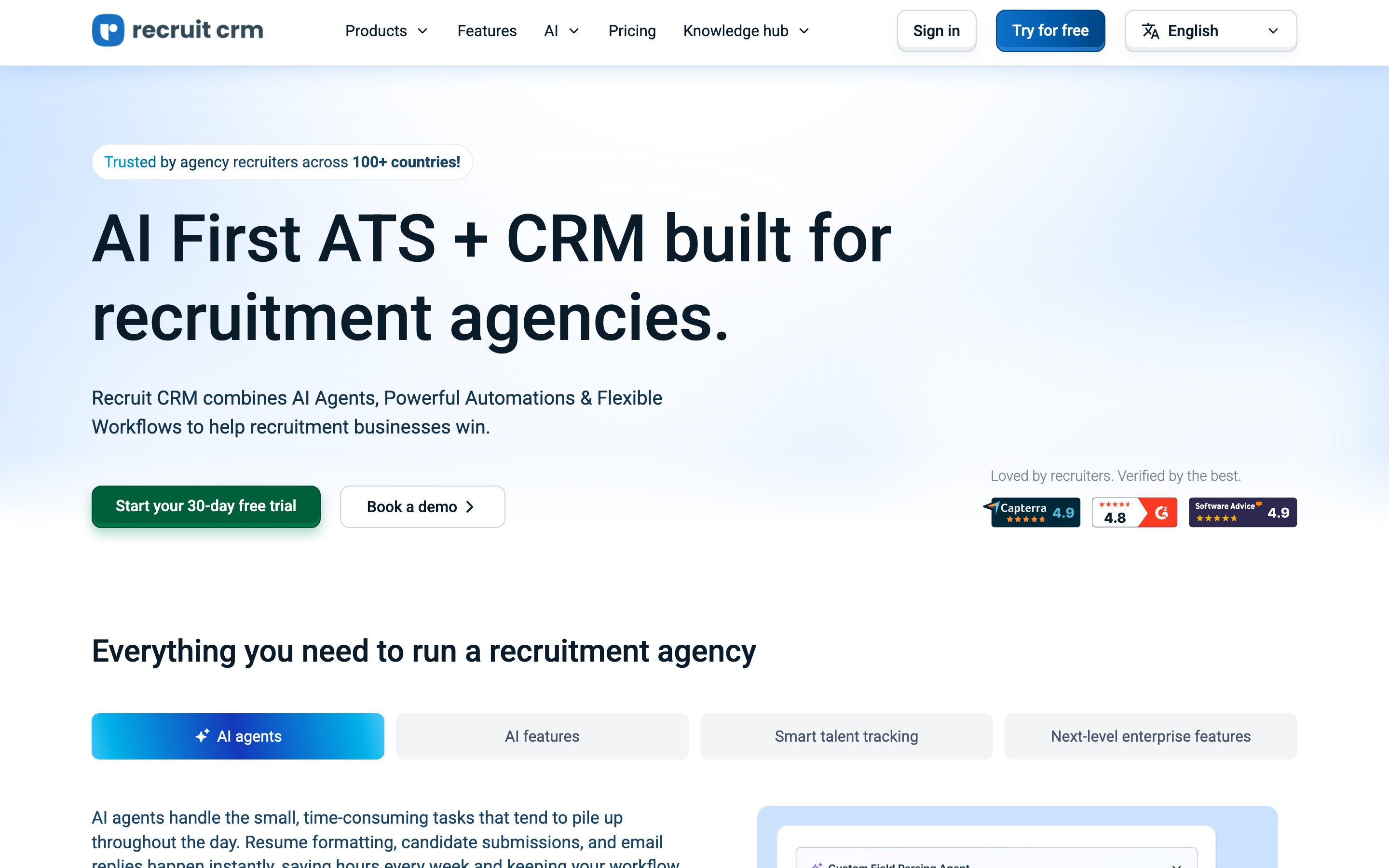
| Platform | Rating | Reviews | Date |
|---|---|---|---|
| G2 | 4.8/5 | 113 | September 2026 |
| Capterra | 4.9/5 | 476 | September 2026 |
Capterra's category breakdown is unusually consistent across the board: Customer Service leads at 4.9/5, Ease of Use at 4.8/5, Value for Money at 4.8/5 and Features close behind at 4.7/5 — and 94% of Capterra reviewers rate it as good-or-excellent value for money, a striking number for this category. That evenness across categories is itself a signal: this isn't a tool that wins on one axis and drags on the others.
What agencies actually praise
- Clean, intuitive interface. Reviewers on both platforms describe setup as fast and the day-to-day system as easy to navigate — one Capterra reviewer wrote that "the interface is clean and intuitive, which makes it easy for our team to navigate."
- Deep customization. Custom fields, pipelines and roles can be tailored well beyond a generic ATS template — "the level of customization is truly outstanding," per one reviewer.
- Responsive support. Support quality shows up in nearly every positive review: "the support team is extremely responsive, helpful, and professional."
- Fast, reliable data migration. Teams moving from another CRM cite migration speed as a standout: "the speed at which data is migrated or updated is second to none."
- The Chrome sourcing extension. Pulling LinkedIn profiles directly into the CRM without manual copy-paste is a frequently cited time-saver on G2, with users describing it as revolutionizing how they build candidate records.
What agencies actually criticize
- Duplicate detection is unreliable. Multiple Capterra reviewers flag "not being able to accurately detect duplicate candidate profiles" as a genuine data-hygiene problem, not a minor annoyance.
- AI resume parsing isn't fully precise. One reviewer put it directly: "CV parsing is not very precise, ai tools not very precise in feedback" — useful as a first pass, not a substitute for a human read.
- The credit-and-add-on system adds friction. Several features "take a few more credits" than expected, and one reviewer summed up the AI tools specifically: "the AI features are a bit pricey, so we rarely use them."
- Reporting gets expensive at team scale. Recruit CRM's own reporting is capable, but rolling advanced analytics out to a whole team costs an extra $25/seat/month — "reporting is super expensive to roll out to our team," as one reviewer put it.
- No native Calendly-style calendar sync. Teams that run scheduling through Calendly report they can't link it directly to Recruit CRM's calendar, forcing a manual workaround.
- Permissions are gated to higher tiers. Granular role permissions only unlock on the pricier plans, which frustrates smaller teams that still want tighter access control.
What stands out across both platforms is how consistent the pattern is: nearly 600 combined reviews, and the same handful of themes — praise for interface, support and migration; criticism of duplicate handling, AI precision and the add-on model — repeat whether the reviewer is on G2 or Capterra. That consistency is a stronger signal than either score in isolation.
Who Recruit CRM fits — and who it doesn't
Recruit CRM fits small-to-mid agencies of roughly 5-50 recruiters that want a full, flexible ATS/CRM at a lower seat price than most competitors, value responsive support highly, need deep customization of fields and pipelines, and are comfortable managing a credit-based add-on system for enrichment, LinkedIn messaging and reporting rather than paying one flat bundled fee.
It's a weaker fit for agencies whose main bottleneck is finding candidates they don't already have — Recruit CRM's own feature documentation doesn't list a built-in external candidate database, so sourcing runs through browser extensions and third-party integrations rather than a native search. It's also a weaker fit for teams that need airtight duplicate detection at volume, agencies that run scheduling through Calendly and expect a native sync, and teams that want granular permissions without upgrading to a pricier tier.
A useful gut check: if your agency's honest answer to "how do most candidates enter our pipeline" is "recruiters find them on LinkedIn and we import the profile," Recruit CRM's Chrome extension and pricing line up well. If the honest answer involves headhunting passive candidates who aren't easy to find on LinkedIn, the sourcing gap the reviews point at is real, not a minor inconvenience.
If the reviews make you look elsewhere
Sprad: built for the exact gap Recruit CRM's own reviewers point at
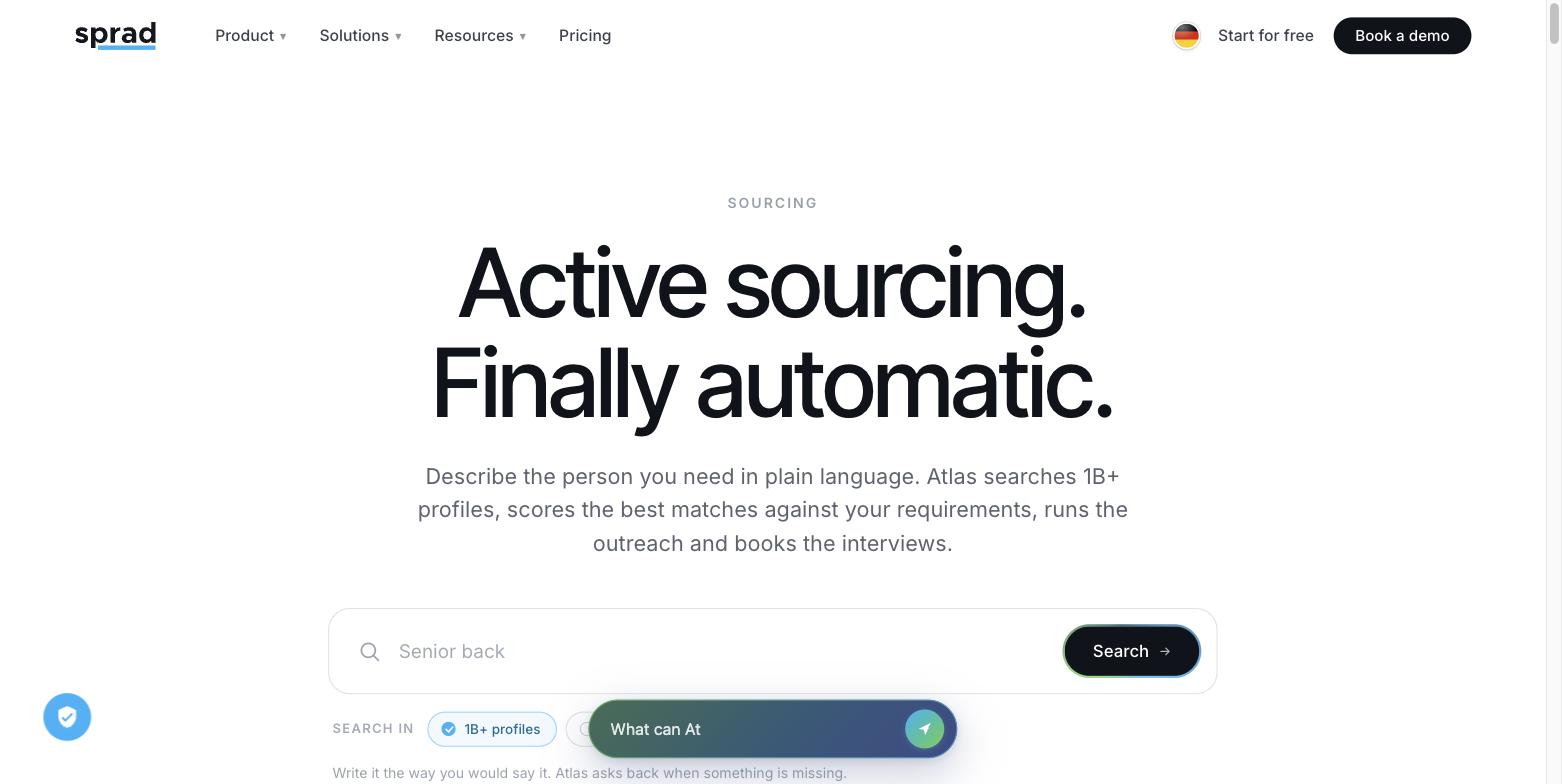
The two clearest patterns in Recruit CRM's reviews — AI parsing that "isn't very precise" and no built-in way to search beyond your own database — are precisely where Sprad is built differently. Sprad reads full candidate profiles against a requirement description you write in plain language, across both your own pool and more than a billion external profiles, instead of parsing resumes against keywords.
On a benchmark run in August 2026 across three real roles, Atlas — Sprad's sourcing engine — found 38% of the qualified candidates that other tools combined found, against 9% for the best single competitor tool. Pricing starts at 59 €/recruiter/month for the ATS and talent pool, plus 200 free credits every month, no credit card required. See it for your team size: sprad.io/industry/recruitment-agencies.
A fair second option
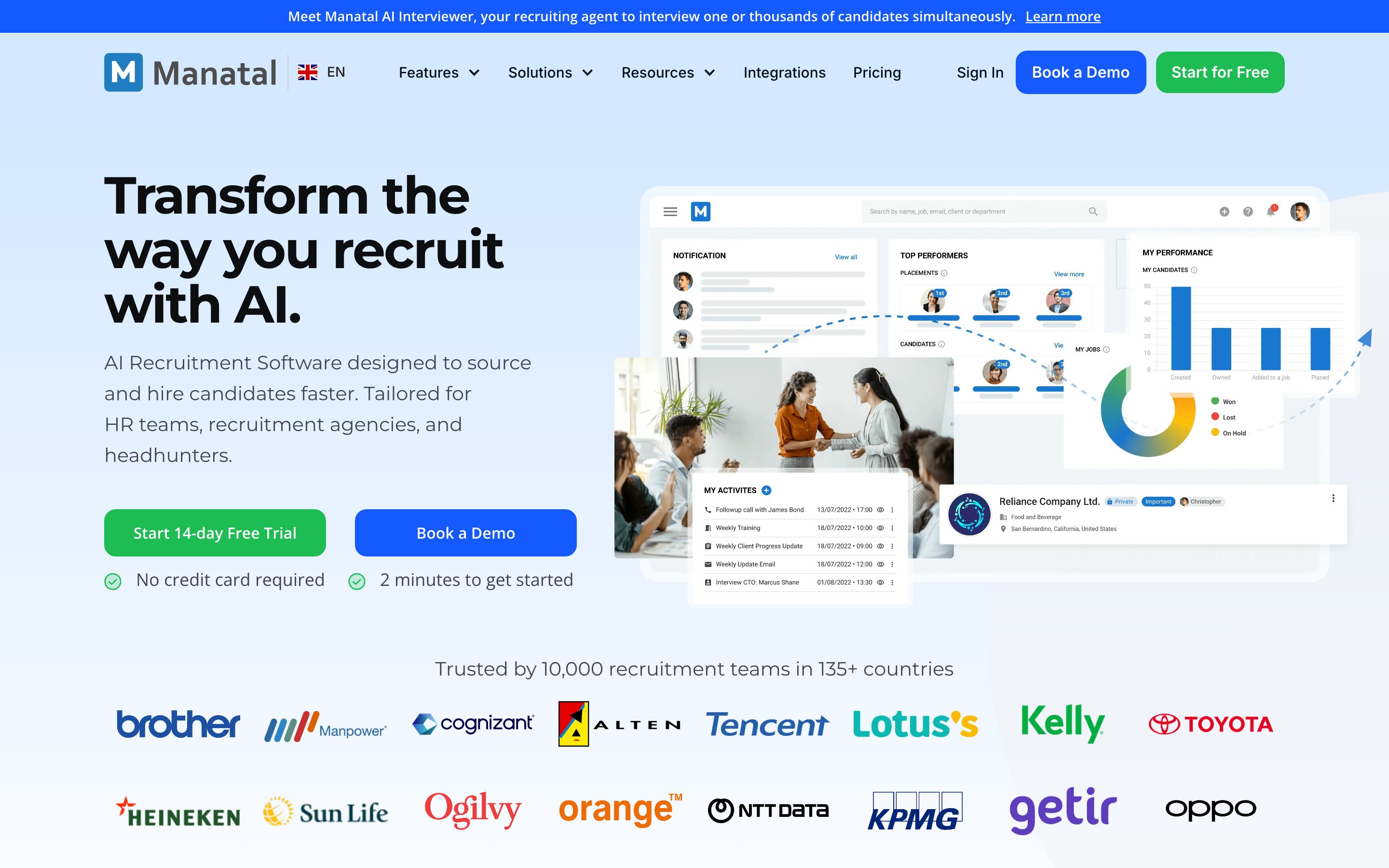
Manatal sits at a lower seat price (about €14/user/month) and adds AI-based candidate enrichment out of the box — worth a look if budget is the primary constraint. But its own reviewers report the same kind of gap as Recruit CRM's: AI suggestions that "often miss the mark" for nuanced hiring calls, and no native external sourcing beyond a browser extension. Full head-to-head: Recruit CRM vs. Manatal.
FAQ
Is Recruit CRM good?
Yes, for what it's built to do: it holds a 4.8/5 on G2 and 4.9/5 on Capterra as of September 2026, with 94% of Capterra reviewers rating it good-or-excellent value. It's a flexible, well-supported ATS/CRM, not a sourcing platform.
What do users complain about most with Recruit CRM?
Unreliable duplicate-candidate detection, AI resume parsing that isn't fully precise, a credit-and-add-on system that makes some features feel pricey to actually use, and expensive reporting once you roll it out to a full team.
Is Recruit CRM reliable for a growing team?
Reviewers describe it as scaling reasonably well up to around 50 recruiters, but permissions and advanced reporting require moving up to pricier tiers, and duplicate-detection complaints suggest data hygiene needs active management as the database grows.
Does Recruit CRM have good customer support?
Yes — support is the most consistently praised category across both platforms, with a 4.9/5 Customer Service score on Capterra and repeated mentions of fast, knowledgeable responses.
Is there a better alternative to Recruit CRM for sourcing?
If active candidate sourcing beyond your own database and browser imports is the priority, Sprad adds a requirement search across 1B+ external profiles that Recruit CRM doesn't have at any tier — see Sprad vs. Recruit CRM for the full comparison.
Are Recruit CRM's reviews trustworthy?
The review base is large enough to trust directionally — 113 reviews on G2 and 476 on Capterra, both dated September 2026 — and the same praise and criticism repeat across both independent platforms rather than clustering on one site, which is a good sign the pattern is real.
What the star rating doesn't tell you
A high review score reflects how happy people are running an ATS/CRM that manages candidates already in the system — it says little about how those candidates got found in the first place, or what happens to your network if you switch tools. Sprad's talent pool is built to stay with your agency: candidates give active consent and retain control of their profiles, hosted in Europe, searchable alongside more than a billion external profiles in the same workspace as your ATS. Explore it at sprad.io/talent-base.
Jürgen Ulbrich
Jürgen Ulbrich has more than a decade of experience in developing and leading high-performing teams and companies. As an expert in employee referral programs as well as feedback and performance processes, Jürgen has helped over 100 organizations optimize their talent acquisition and development strategies.