Recruiterflow and Recruit CRM both target recruitment agencies with an ATS/CRM core, but they split on price structure and depth: Recruiterflow costs more per seat and enforces a 3-seat minimum, in exchange for a more mature automation engine (Recipes) and multi-channel sequencing. Recruit CRM is cheaper with no published seat floor, but has thinner automation. Neither one searches for candidates outside your own database — that's the gap Sprad fills as a third option.
Recruiterflow, Recruit CRM and Sprad, side by side
| Recruiterflow | Recruit CRM | Sprad | |
|---|---|---|---|
| Price/seat/month | $99–159 (annual), 3-seat minimum | ~$95 (annual), no published minimum | 59 € base, no minimum, plus usage credits |
| Search outside your own DB | No — LinkedIn extension only | No — must integrate Lusha/Apollo/LinkedIn | Yes — 1B+ external profiles |
| Talent pool ownership | Your own pipeline data only | Your own pipeline data only | Owned by the agency, candidates self-consent |
| AI matching | Enterprise tier only ($159/seat) | Standard resume parsing, ChatGPT integration | Full-profile scoring against your criteria, included |
| Outreach | Email & SMS sequences (Pro+) | Email sequencing & templates | LinkedIn outreach agent only |
| CRM depth | Core CRM, automation-focused | Core CRM, flexibility-focused | Client context (beta), not a full sales CRM |
| DACH / German | No, English/USD only | No, English only | Yes |
| Migration | Not publicly documented | Not publicly documented | Free import of legacy data (Xing, CSV, old ATS) |
All prices reflect published vendor pages as of September 2026.
The real difference: automation depth versus price floor
Recruiterflow, in detail
Recruit CRM, in detail
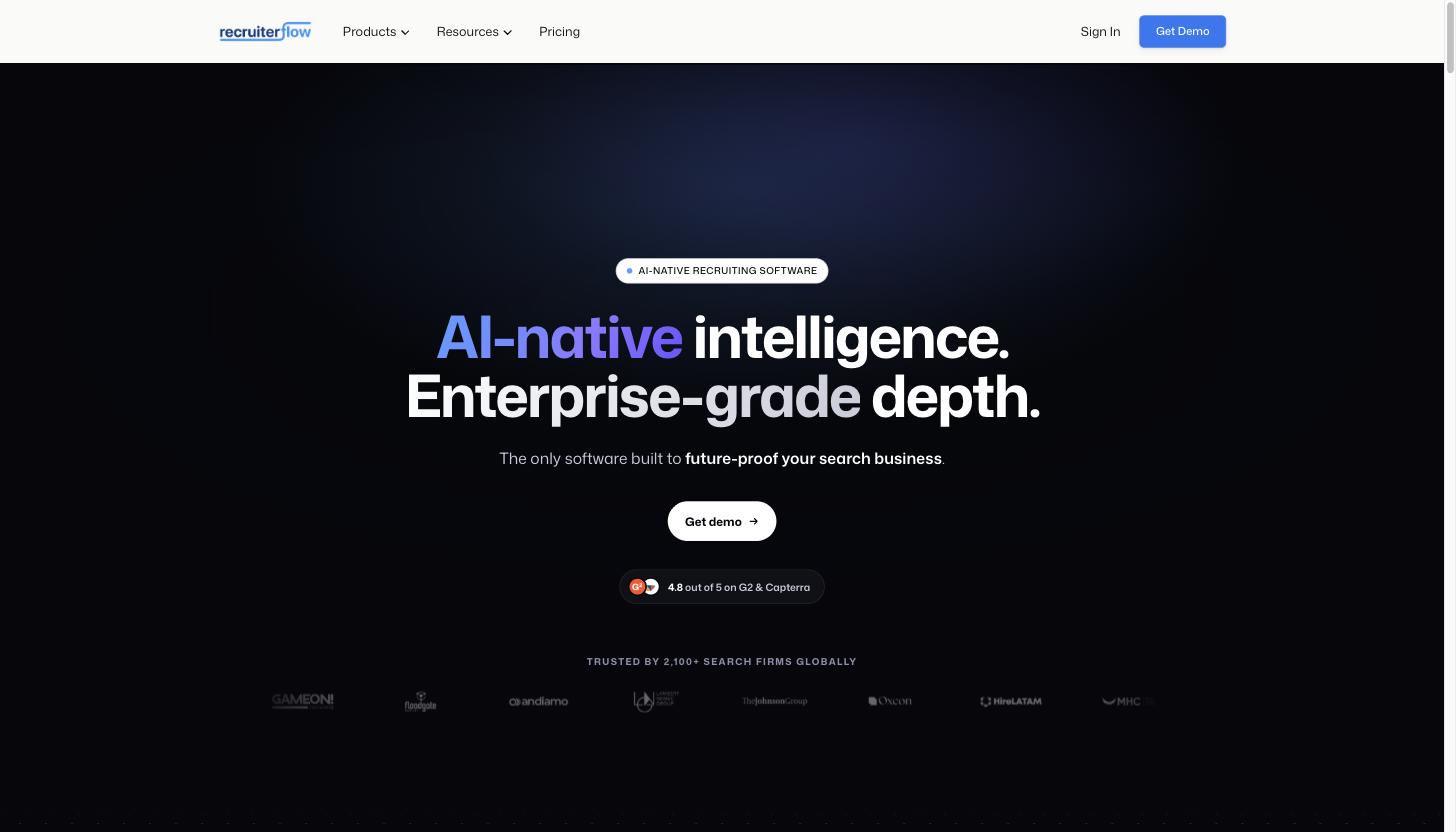
Recruiterflow's core pitch is process automation. Its Recipes engine — "when this happens, then do that" — is mature enough that reviewers on G2 describe dropping a separate Zapier subscription once it's running, and Pro-tier email-plus-SMS sequences give it a broader outreach channel than Recruit CRM's email-only sequencing. That capability comes at a real cost: every plan requires a minimum of 3 seats, so the effective entry price is $297/month even for a two-person shop.
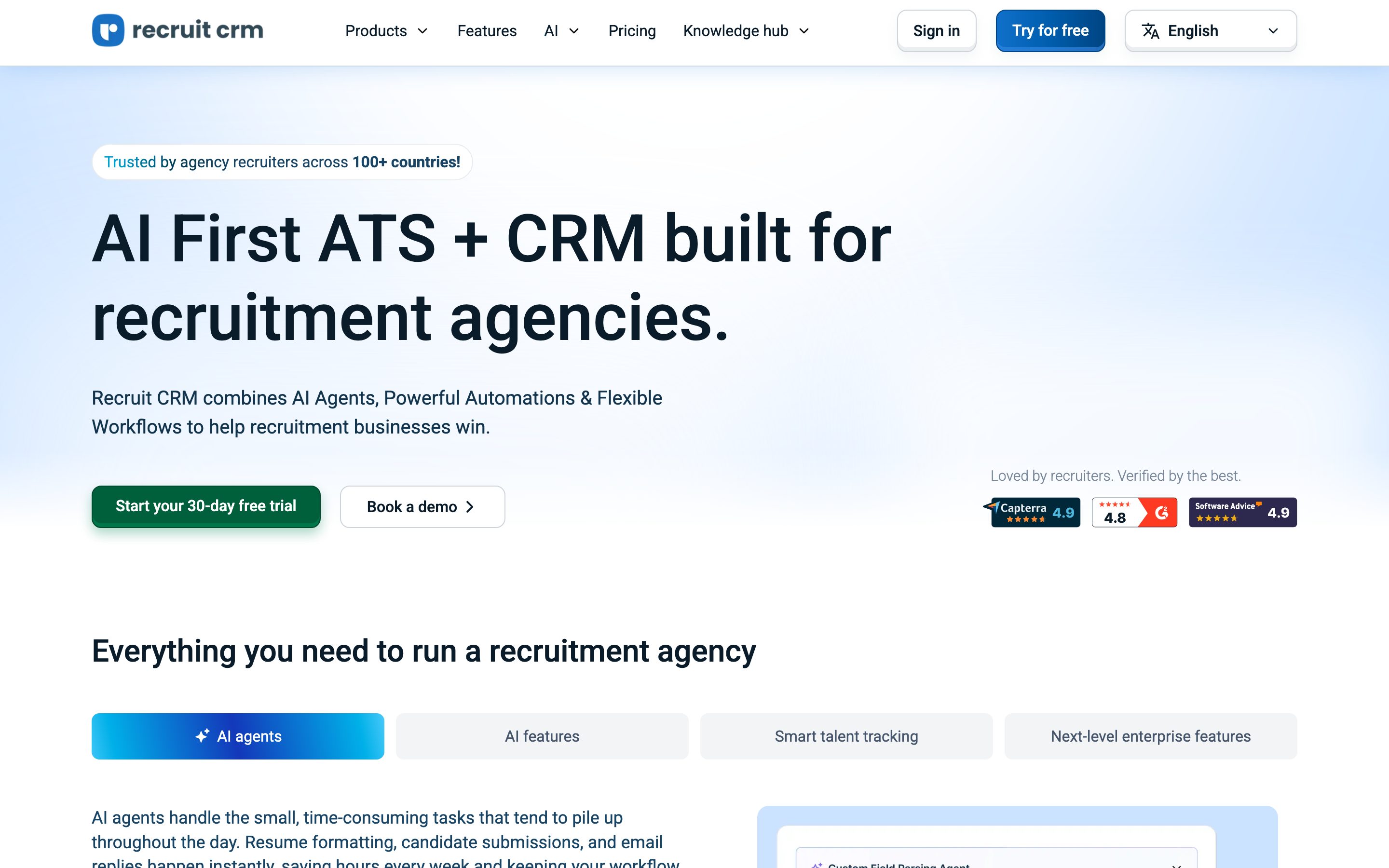
Recruit CRM's pitch is the opposite: fewer bells, lower friction. At roughly $95/user/month with no published seat minimum, it undercuts Recruiterflow's real entry cost by a wide margin, and its G2 rating of 4.8/5 and Capterra rating of 4.9/5 — both higher than Recruiterflow's — lean heavily on "value for money" and support as the reasons why. What it doesn't have is Recruiterflow's automation depth or SMS channel; its own AI features are limited to resume parsing and an emerging ChatGPT integration, not semantic candidate matching.
Neither tool solves the problem that shows up once your own pipeline runs dry for a role: both depend on candidates you already have, or ones reachable through LinkedIn. Building past that requires adding a separate sourcing tool — Lusha, Apollo, or a dedicated search platform — on top of either ATS.
The reviews on both sides are candid about where each product still falls short. Recruiterflow users flag awkward custom-report setup and cumbersome bulk imports even with the Chrome extension in place, plus limits on contract paperwork for high-volume temp staffing. Recruit CRM's own review pattern is thinner in a different way: several reviewers note the platform still feels young in places, with a learning curve on advanced features and less feature differentiation than a more automation-heavy tool like Recruiterflow — the tradeoff for its lower price and simpler setup.
What 5 recruiters pay on each
Five recruiters on Recruiterflow's base Recruit plan cost 5 × $99 = $495/month, or $5,940/year (about €5,465) — a number that already clears the mandatory 3-seat minimum. The same team on Recruit CRM costs roughly 5 × $95 = $475/month, or $5,700/year (about €5,245), with no seat floor to account for. The gap looks small at 5 seats, but it widens fast if a smaller team — one or two recruiters — needs either tool: Recruiterflow still bills for three seats regardless, while Recruit CRM scales down to what you actually use.
The third option: Sprad
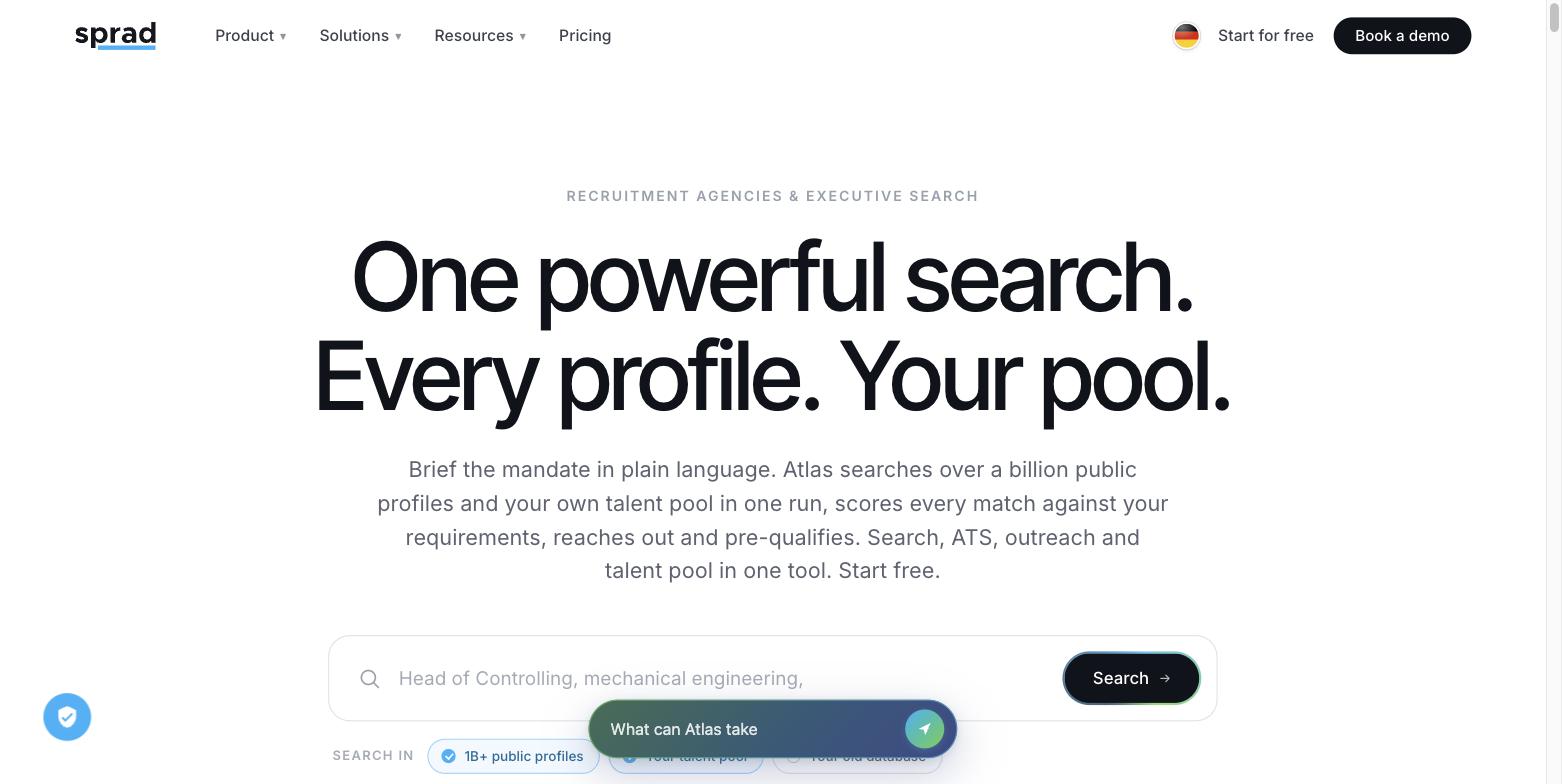
If what you actually want is neither tool's core strength — not more automation (Recruiterflow) and not a lower seat price alone (Recruit CRM), but a way to find candidates neither database already has — Sprad approaches the problem differently. Instead of a CRM you populate manually or a LinkedIn extension, Sprad's requirement search reads full candidate profiles against your role description across more than a billion external profiles. Every candidate found becomes part of a talent pool the agency owns, not a rented list that leaves when a subscription ends.
Pricing starts at 59 €/recruiter/month with no seat minimum, plus usage credits for search, outreach and interviews — 200 free credits every month, no credit card. It's not a feature-for-feature replacement for either tool's automation or CRM depth, but for an agency whose real bottleneck is candidate supply rather than process, it's a genuinely different answer.
See the full Sprad pricing, and how it compares directly to Recruiterflow in our Sprad vs. Recruiterflow guide.
Which one fits your agency
- You have a healthy pipeline and want deeper automation: Recruiterflow, if the 3-seat minimum and its price don't outweigh the Recipes engine and SMS sequencing for your team.
- You want the lowest CRM cost with no seat floor: Recruit CRM, especially for a small or budget-conscious team that doesn't need heavy automation.
- Your bottleneck is finding candidates, not managing the ones you have: Sprad, since neither Recruiterflow nor Recruit CRM searches outside your own database.
- You're a DACH-based agency: Sprad is the only one of the three with a German interface and EU hosting.
FAQ
Is Recruiterflow or Recruit CRM better?
Recruiterflow wins on automation depth (Recipes, SMS sequences) but costs more and enforces a 3-seat minimum. Recruit CRM wins on price and simplicity, with no published seat floor, but has thinner automation and AI features.
Which one is cheaper?
Recruit CRM, at roughly $95/seat/month annually with no seat minimum, versus Recruiterflow's real entry cost of $297/month for the mandatory 3 seats on its base plan.
Where can I see full pricing for each tool?
Our Recruiterflow pricing guide and Recruit CRM pricing guide break down every tier, seat rule and hidden cost for both tools.
Do either of these tools search for candidates outside my own database?
No. Both depend on your own pipeline or a LinkedIn-based workflow. Sprad is the option built specifically for external search, covering more than a billion profiles.
Which has better AI features?
Recruiterflow's AIRA (Enterprise tier only, $159/seat) is a more developed AI matcher than Recruit CRM's resume parsing and ChatGPT integration — but both sit behind Sprad's included full-profile scoring across external candidates.
Does either offer German or DACH pricing?
No — both Recruiterflow and Recruit CRM publish pricing and product only in English, with no DACH-specific plan. Sprad has a German interface and EU hosting.
Sprad, the agency's own pool, and the calculator
Cancel either Recruiterflow or Recruit CRM, and the candidate records built inside stay tied to a subscription you no longer control. Sprad's model starts from the opposite assumption: your search results become a pool that stays with your agency, searchable across more than a billion external profiles in the same workspace as your ATS. Start free with 200 credits a month, no credit card, at sprad.io/industry/recruitment-agencies.
Jürgen Ulbrich
Jürgen Ulbrich has more than a decade of experience in developing and leading high-performing teams and companies. As an expert in employee referral programs as well as feedback and performance processes, Jürgen has helped over 100 organizations optimize their talent acquisition and development strategies.