Sprad and Recruiterflow solve different problems: Recruiterflow is a mature ATS/CRM with strong workflow automation for agencies that already have a candidate pipeline, while Sprad pairs a leaner ATS with an external search across 1B+ profiles and a talent pool your agency owns. If your bottleneck is finding candidates outside LinkedIn, Sprad is the better fit; if it's automating an established process, Recruiterflow's Recipes engine is genuinely strong.
Where Recruiterflow is honestly better
It would be easy to write this as a one-sided pitch, but Recruiterflow earns its 4.6/5 on G2 and 4.7/5 on Capterra for real reasons, and some of them are things Sprad doesn't match today.
- Recipes automation. Recruiterflow's "when→then" workflow builder is mature and, per reviewers, actually gets used — several describe dropping a separate Zapier subscription once it's running. Sprad doesn't have an equivalent general-purpose automation layer.
- Multi-channel sequences, including SMS. On Recruit Pro and above, Recruiterflow runs email and SMS sequences together. Sprad's outreach agent today works over LinkedIn only — there's no email or SMS channel in Sprad's sourcing contact flow yet.
- A longer track record with agencies. 526 combined reviews across G2 and Capterra reflect years of use inside recruitment agencies specifically, with support named consistently as a strength. That's a depth of proven fit that a newer platform hasn't accumulated yet.
- LinkedIn-native profile capture. Recruiterflow's Chrome extension auto-creates a candidate record straight from a LinkedIn profile — a small but genuinely time-saving detail reviewers call out specifically.
Where Sprad is the stronger choice
| Recruiterflow | Sprad | |
|---|---|---|
| Price | $99–159/seat/month, 3-seat minimum | 59 €/seat/month, no minimum, plus usage credits |
| External candidate search | No — LinkedIn Chrome extension only | Yes — requirement search across 1B+ profiles |
| Talent pool ownership | Tied to your own pipeline data | Owned by the agency, candidates self-consent to stay |
| Voice/video interview screening | Not included | Yes, in 12 languages |
| AI matching | Enterprise tier only ($159/seat) | Included — full-profile scoring against your criteria |
| EU hosting / DACH | No, English/USD only | Yes |
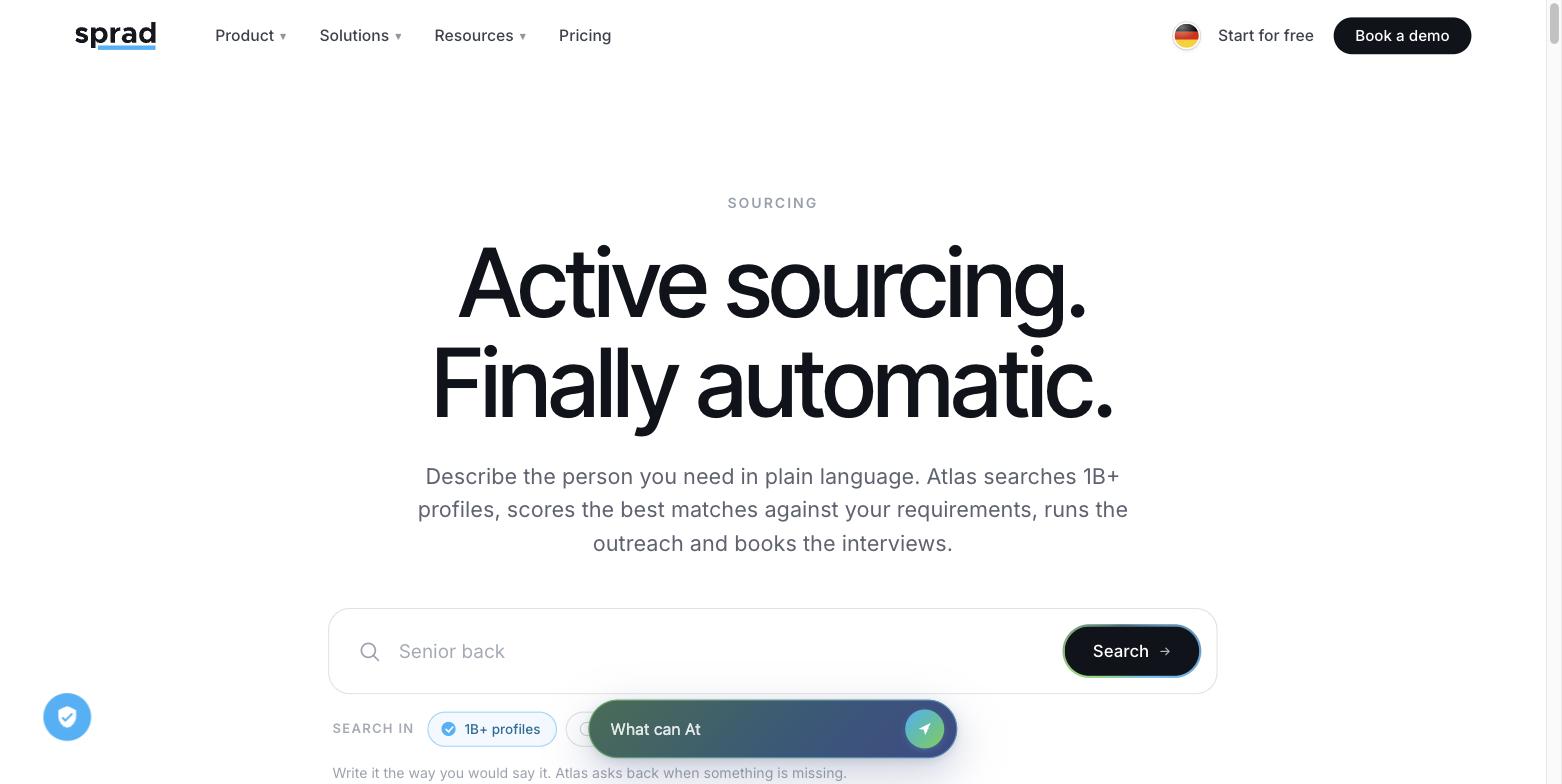
The clearest gap is sourcing: Recruiterflow depends on candidates already being reachable through LinkedIn or your own database, while Sprad's requirement search reads full profiles against your role description across more than a billion external candidates — a genuinely different starting point when your own pipeline is thin for a role. The pricing model is structurally different too: Recruiterflow's per-seat price is fixed no matter how much a recruiter uses it, and every plan forces a minimum of three seats, while Sprad's 59 €/month base has no seat floor and search, outreach and interviews scale with actual usage — rejected profiles cost nothing.
What the price difference looks like at 5 recruiters
Five recruiters on Recruiterflow's base Recruit plan cost 5 × $99 = $495/month, or $5,940/year (about €5,465) — and that's before any automation, since sequences and Recipes require moving up to Recruit Pro at $129/seat. The same team on Sprad's base plan costs 5 × 59 € = 295 €/month, or 3,540 €/year, with 200 free credits per account every month and search, outreach and interview costs added only as they're actually used. Neither number includes the other tool's genuinely different feature set — this is a starting-point comparison, not a like-for-like swap, since Recruiterflow's price buys automation depth that Sprad doesn't have, and Sprad's buys an owned pool and external search that Recruiterflow doesn't have.
A concrete difference: what happens when you cancel
Cancel Recruiterflow, and the candidate records live inside a subscription you no longer have full access to. Sprad's talent pool is designed the other way around: candidates give active consent, control their own profile, and the pool remains the agency's asset; the visible Talent Base fields can be exported, while a full raw-data export is not promised. That's a meaningfully different answer to the question every agency eventually asks — what did we actually build, versus what did we rent?
Which one fits your agency
Choose Recruiterflow if you're an established agency of 3–50 recruiters with a healthy pipeline already, and what you need is automation and multi-channel sequencing (including SMS) layered on top of a process that works. Its Recipes engine and support reputation are real, proven advantages for that specific situation — see the full breakdown in our Recruiterflow pricing guide and Recruiterflow reviews roundup.
Choose Sprad if your actual constraint is finding candidates — for hard-to-fill roles, thin niches, or a pipeline that's gone quiet — and you want the search results to become a pool your agency keeps, not a rented list. It's also the better fit for a DACH-based agency, since Recruiterflow has no German interface or EU-hosting story, and for a solo recruiter or two-person shop that doesn't want to pay Recruiterflow's forced third seat.
Some agencies genuinely need both: Recruiterflow's automation for an established, high-volume desk, and Sprad's sourcing for a specialist or executive-search desk running alongside it, where the candidate pool is thinner and every search needs to reach further than LinkedIn. Running both isn't unusual in practice — a Recruiterflow-based agency that opens a new, harder-to-fill specialty often adds a sourcing-first tool for that desk rather than replacing what already works for the rest of the business.
FAQ
Is Sprad cheaper than Recruiterflow?
Yes, at the base tier — 59 €/recruiter/month with no seat minimum versus Recruiterflow's $99–159/seat with a mandatory 3-seat floor. Sprad then adds usage-based credits for search, outreach and interviews.
Does Sprad have automation like Recruiterflow's Recipes?
No — Recruiterflow's general-purpose "when→then" automation builder is more mature than anything Sprad offers today. Sprad's strength is the search and screening pipeline, not general workflow automation.
Can Sprad send SMS or email sequences like Recruiterflow?
Not currently. Sprad's outreach agent for candidate sourcing works over LinkedIn only; Recruiterflow supports email and SMS sequences from Recruit Pro upward.
Which is better for finding candidates outside my own database?
Sprad. Its requirement search covers more than a billion external profiles; Recruiterflow's sourcing depends on a LinkedIn Chrome extension rather than a built-in external database.
Does either tool offer German-language support?
Sprad does, with a German interface and EU hosting. Recruiterflow's pricing page and product are published in English and US dollars only.
Is Recruiterflow's automation actually better than Sprad's?
For general workflow automation — reminders, task routing, "when X happens, do Y" rules — yes, Recruiterflow's Recipes engine is more developed. Sprad focuses its depth on the search, scoring and screening pipeline instead of a general automation builder.
The bigger picture
Both tools are honest choices for different problems. If your agency's real cost driver is a subscription full of automation you've outgrown but a pipeline still too thin for your open roles, that's worth solving directly rather than layering more sequences on top of a search that isn't finding anyone. Sprad starts free with 200 credits a month, no credit card — see the full pricing and what a requirement search across 1B+ profiles finds for your open roles at sprad.io/industry/recruitment-agencies.
Jürgen Ulbrich
Jürgen Ulbrich has more than a decade of experience in developing and leading high-performing teams and companies. As an expert in employee referral programs as well as feedback and performance processes, Jürgen has helped over 100 organizations optimize their talent acquisition and development strategies.