A recruiting campaign is a time-boxed push to fill a defined set of roles, with one goal, one target group, one or more channels and a fixed budget. The campaigns people remember (Eurowings on Tinder, IKEA's flat-pack job ads) won attention, but most publish reach and applications, not hires or cost per hire. For roles you must fill, plan backwards: decide how many hires you need, then work out the applications, budget and pre-screening to match. As of October 2026.
What counts as a recruiting campaign?
A recruiting campaign bundles every measure aimed at one role or role group into one plan with a start, an end and a budget. That separates it from an ongoing job posting: a posting waits for candidates, a campaign goes to find them. A complete campaign answers five questions:
- Goal: how many hires by when, for which role?
- Target group: who are they, where do they live, what do they need to hear?
- Channel: where is this group every day? For nurses, drivers and trades that is usually social media, not a job board. See our guide to frontline recruiting by phone and WhatsApp.
- Message and route: what is the offer, and how many taps does it take to apply?
- Budget and run time: how much, over how long, and what do you cut if it does not work?
Recruiting campaign examples: what is documented
Most "best campaign" lists repeat the same creative stories and leave out the numbers. The table shows what can actually be checked, and how solid each source is.
| Campaign | What they did | Published result | Source quality |
|---|---|---|---|
| Eurowings on Tinder (Germany and Austria, April to June 2018) | Branded profile cards on the dating app, "It's a match" led to the careers page | Reached 600,000+ users, 9.8 % engagement rate, careers page visits up by almost 40 % in Austria during the campaign | Trade press (TravelMole). No hires or cost published |
| IKEA Sweden, flat-pack job ads | Job descriptions in the style of assembly instructions, packed into furniture sold to customers | Widely quoted: 4,285 applications and 280 hires | Repeated by many blogs, no primary source found. Treat as illustration, not as benchmark |
| Amazon Career Day 2020 | Virtual career event | More than 300,000 attended and more than 380,000 applied for a job (company press release) | Company statement. Attendance and applications, no hires |
| Google Foobar challenge | Coding puzzles that appeared for certain search queries, to find strong programmers | No figures published | Described in industry write-ups. Good idea, unproven result |
Two things stand out. First, the published numbers measure reach, attendance or applications. None of the four shows cost per hire. Second, these are brand-building one-offs by companies with an employer brand people already want to join. They are not a repeatable plan for a regional logistics firm or a care home that needs six people by spring.
What the examples still teach
- Meet people where they already are. Eurowings used an app its target group opens daily rather than a career page they would never visit.
- Make the first step tiny. A swipe, a tap or one short form beats a CV upload.
- Be specific about the offer. The campaigns that travel are the ones that say plainly what the job is like.
What a campaign costs: real numbers
For paid social campaigns the best public data point is the 2026 benchmark from Boostpoint, a provider that manages Meta job ads. It analysed 891 campaigns (published 12 August 2026) and puts the median cost per applicant at $13.88 in the USA. The numbers are what advertisers paid for advertising only, and they count applications, not screened candidates or hires.
| Role family (USA, Meta ads) | Median cost per applicant |
|---|---|
| Caregiver / home care | $3.76 |
| CNA / nursing assistant | $7.72 |
| Warehouse / production | $9.83 |
| Skilled trades | $14.14 |
| Registered nurse | $19.08 |
| CDL truck driver | $26.86 |
Source: Boostpoint 2026 benchmark, as of October 2026. US data, German costs can differ, and the benchmark itself says that cost per applicant is not cost per hire.
Planning example: from budget to hires
Because nobody publishes cost per hire, you have to estimate it. The example below uses the measured median of $13.88 and three assumed funnel scenarios. The funnel rates are our planning assumptions, not benchmarks, so replace them with your own numbers after the first month.
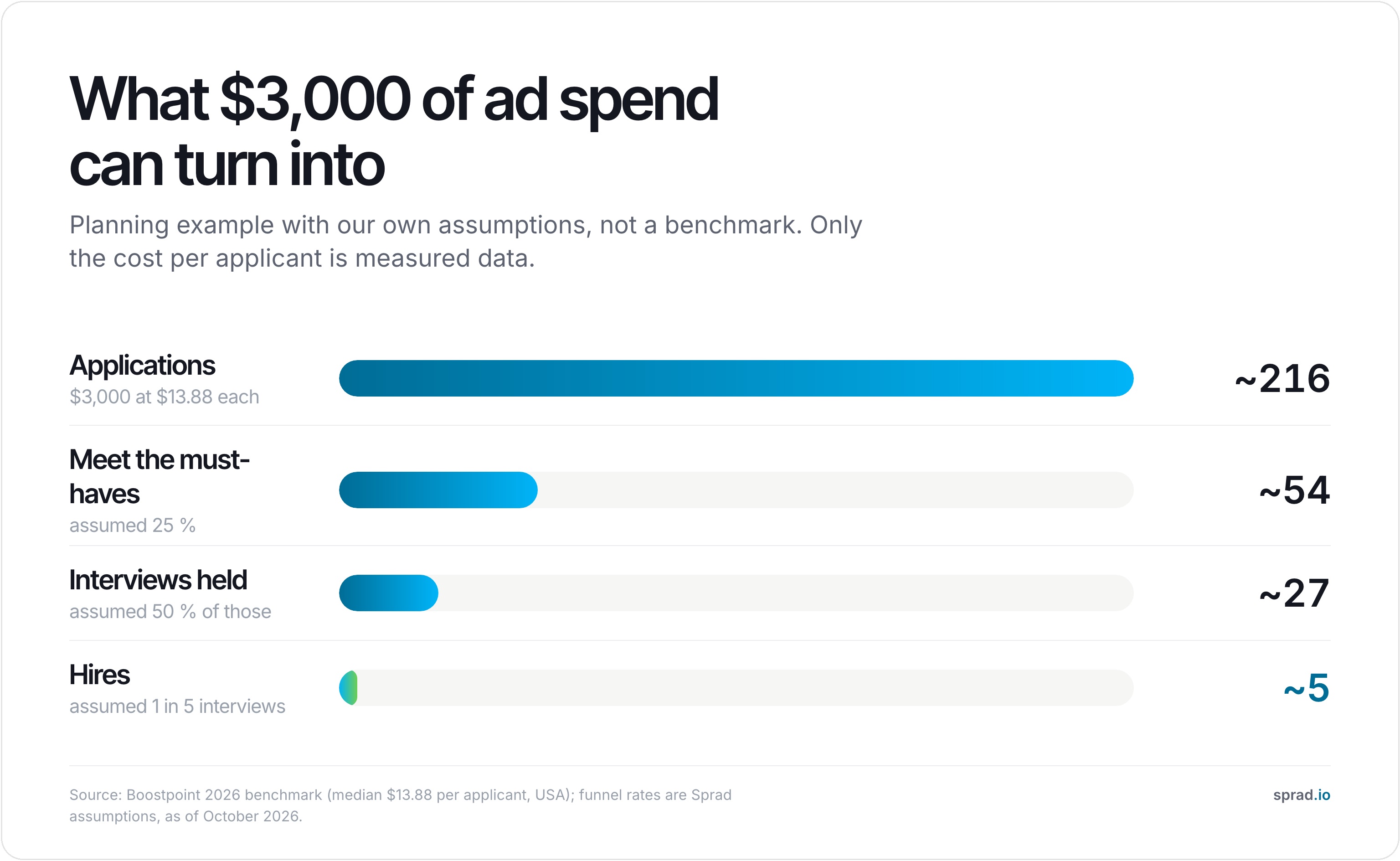
| Scenario ($3,000 ad spend) | Applications | Meet must-haves | Interviews | Hires | Ad cost per hire |
|---|---|---|---|---|---|
| Weak (10 % qualify) | 216 | 22 | 11 | 2 | about $1,500 |
| Base (25 % qualify) | 216 | 54 | 27 | 5 | about $600 |
| Strong (40 % qualify) | 216 | 86 | 43 | 9 | about $330 |
Assumed throughout: half of the qualified applicants reach an interview, one in five interviews ends in a hire. Ad cost only, recruiter time and any agency fee come on top. The spread between $330 and $1,500 shows where the money is: not in the click price, but in how many applicants actually fit.
How to plan a recruiting campaign step by step
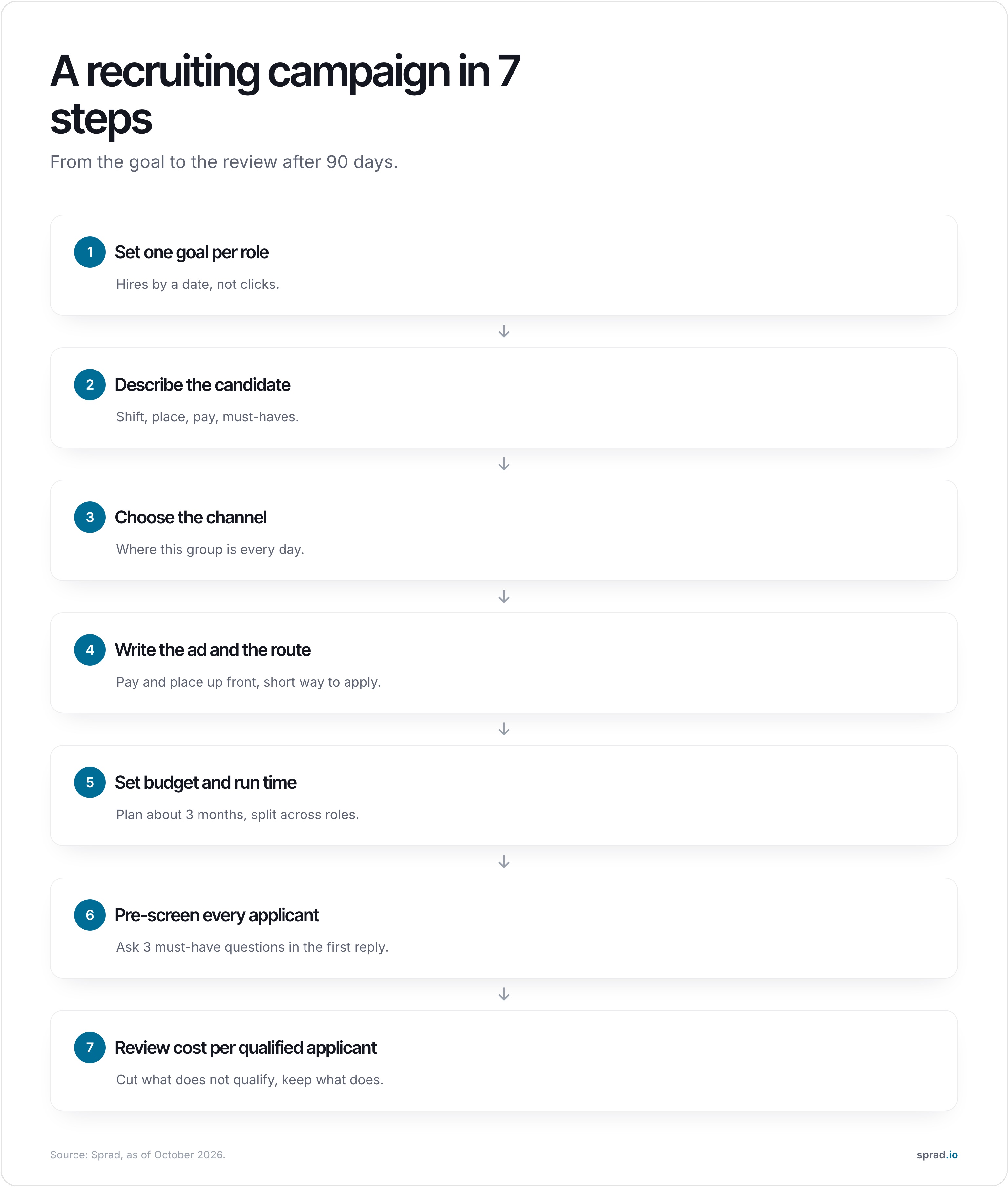
1. Set one goal per role
Write the goal as hires by a date, for example "four warehouse operatives by 1 March". Clicks and impressions are inputs, not goals.
2. Describe the candidate
Shift, place, pay and the three or four must-haves such as licence, certificate or availability. These later become the ad text and the screening questions.
3. Choose the channel
Pick the place where the group already spends time. For frontline roles that is Facebook and Instagram, plus WhatsApp for the conversation. Office roles may run better on LinkedIn or job boards. If you use Meta ads for a job, the "Employment" ad category limits targeting, so text and location do the filtering.
4. Write the ad and design the route
Put role, place and pay in the first line. Use a real photo from the site. Keep the route to apply to one minute on a phone. A long form with CV upload filters out exactly the people who never write CVs.
5. Set budget and run time
Plan about three months and split the budget across roles. Short bursts give the ad platform too little data to learn. Work backwards from the hire target with the planning example above.
6. Pre-screen every applicant
Reply within hours and ask the must-have questions straight away. Automating this first reply by WhatsApp, phone or web is where most campaigns are won or lost, because a candidate who hears nothing for three days has usually moved on. More on this in recruiting for logistics and production at volume.
7. Review after 30 and 90 days
Track three numbers: cost per applicant, share of applicants who meet the must-haves, and cost per interview. Switch off what does not qualify, keep what does, and store every applicant in a talent pool so the next campaign does not start from zero.
Common mistakes
- Judging a campaign by clicks or views instead of qualified applicants.
- Copying a viral stunt without the employer brand that made it work.
- Stopping after two weeks, before there is enough data.
- Leaving out pay, which is the strongest hook for shift and trade roles.
- Answering applications after days instead of hours.
- Paying for reach again for every role instead of building a talent pool.
Running the whole campaign without building it yourself
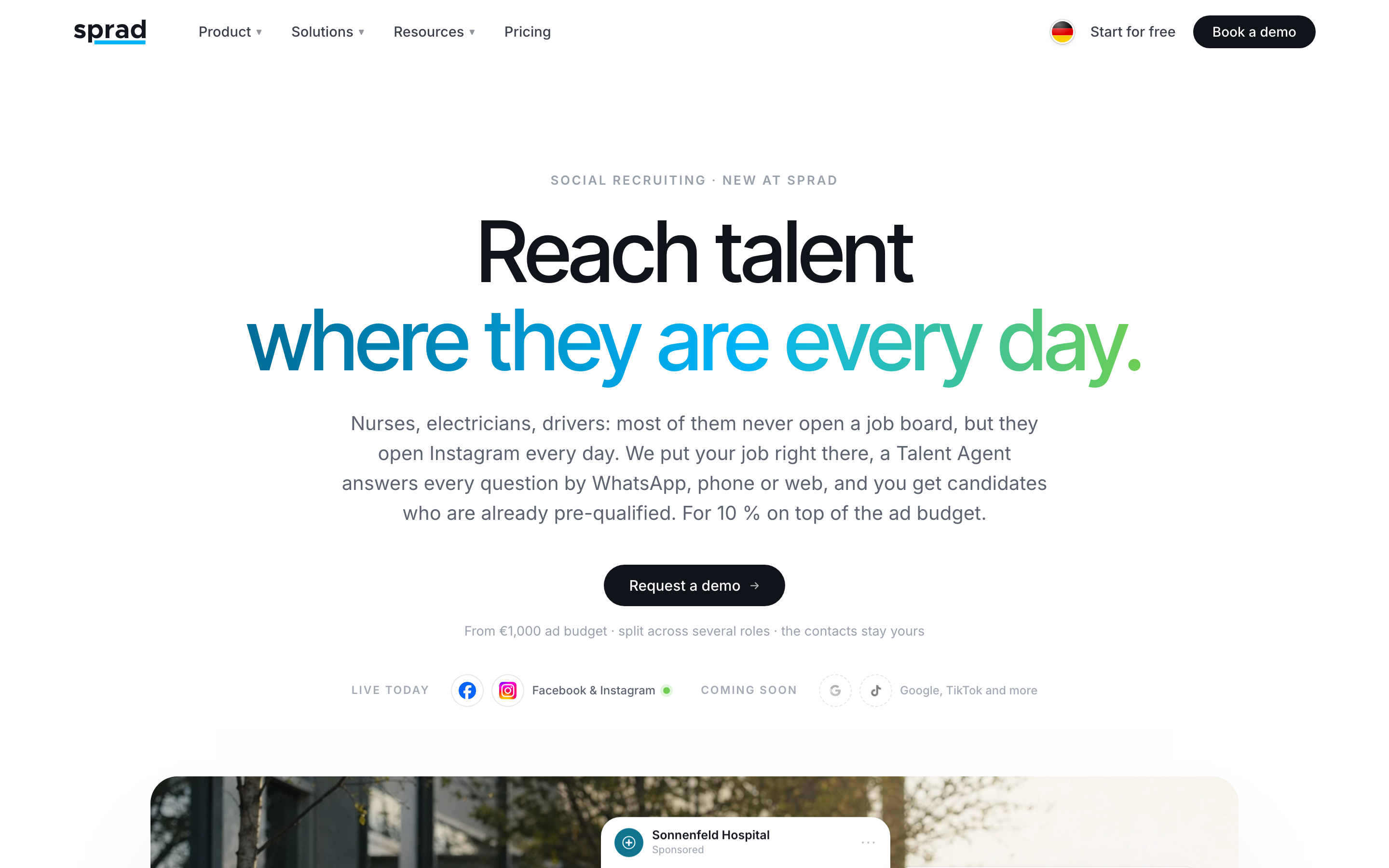
If you do not want to build ads, screening and talent pool yourself, Sprad Social Recruiting runs your roles on Instagram and Facebook, where nurses, tradespeople, drivers and other frontline workers spend time every day. An AI talent agent pre-screens every applicant via WhatsApp, phone or web, and every applicant lands in your own talent pool, so the relationships stay with you instead of a platform. Pricing is ad spend plus 10 %, from a €1,000 budget that can be split across roles. See how this works in logistics and healthcare.
Frequently asked questions
How long should a recruiting campaign run?
Plan about three months for paid social campaigns. Shorter runs often collect too little data to optimise. Sprad recommends three months as well.
How much budget does a recruiting campaign need?
Start from the hire target. With the US median of $13.88 per applicant and a base-case funnel, about $600 of ad spend per hire is a planning figure, with a range of $330 to $1,500 across our three scenarios. Add recruiter time and any fees on top.
What is the difference between a recruiting campaign and a job posting?
A job posting waits on a job board for people who are already searching. A campaign actively reaches people who are not searching, with a set goal, budget and run time.
Which recruiting campaigns actually worked?
Eurowings' Tinder campaign reached more than 600,000 users with a 9.8 % engagement rate, and Amazon's 2020 Career Day drew more than 380,000 applications. Neither published cost per hire, so judge your own campaign on qualified applicants and cost per hire.
Can a small employer run a recruiting campaign?
Yes. A clear offer, a one-minute application and a fast first reply matter more than a big creative idea. Social ads let you start with a budget of a few hundred to a few thousand euros.
Jürgen Ulbrich
Jürgen Ulbrich has more than a decade of experience in developing and leading high-performing teams and companies. As an expert in employee referral programs as well as feedback and performance processes, Jürgen has helped over 100 organizations optimize their talent acquisition and development strategies.