The recruiting trends that matter for frontline hiring in 2026 are: demand has cooled overall but stays tight in trades, logistics and care; applicants live on their phones and on Meta; speed and pre-screening decide cost more than the ad itself; AI in hiring is regulated later than planned; and owning your talent pool beats renting reach. Below, each trend comes with the number behind it and one step you can take this quarter. As of October 2026.
How we picked the trends
Most “recruiting trends 2026” lists are written for office roles: skills-based hiring, hybrid work, employer branding. For nurses, drivers, cooks, electricians and warehouse staff, different forces dominate. We kept only trends that have a published figure from a named source, and we say when that source is a vendor.
Two reading rules help. First, numbers from German and US sources are not interchangeable, so each figure carries its country. Second, vendor studies (marked below) are useful for direction but are not neutral.
1. Demand has cooled, but frontline shortages remain
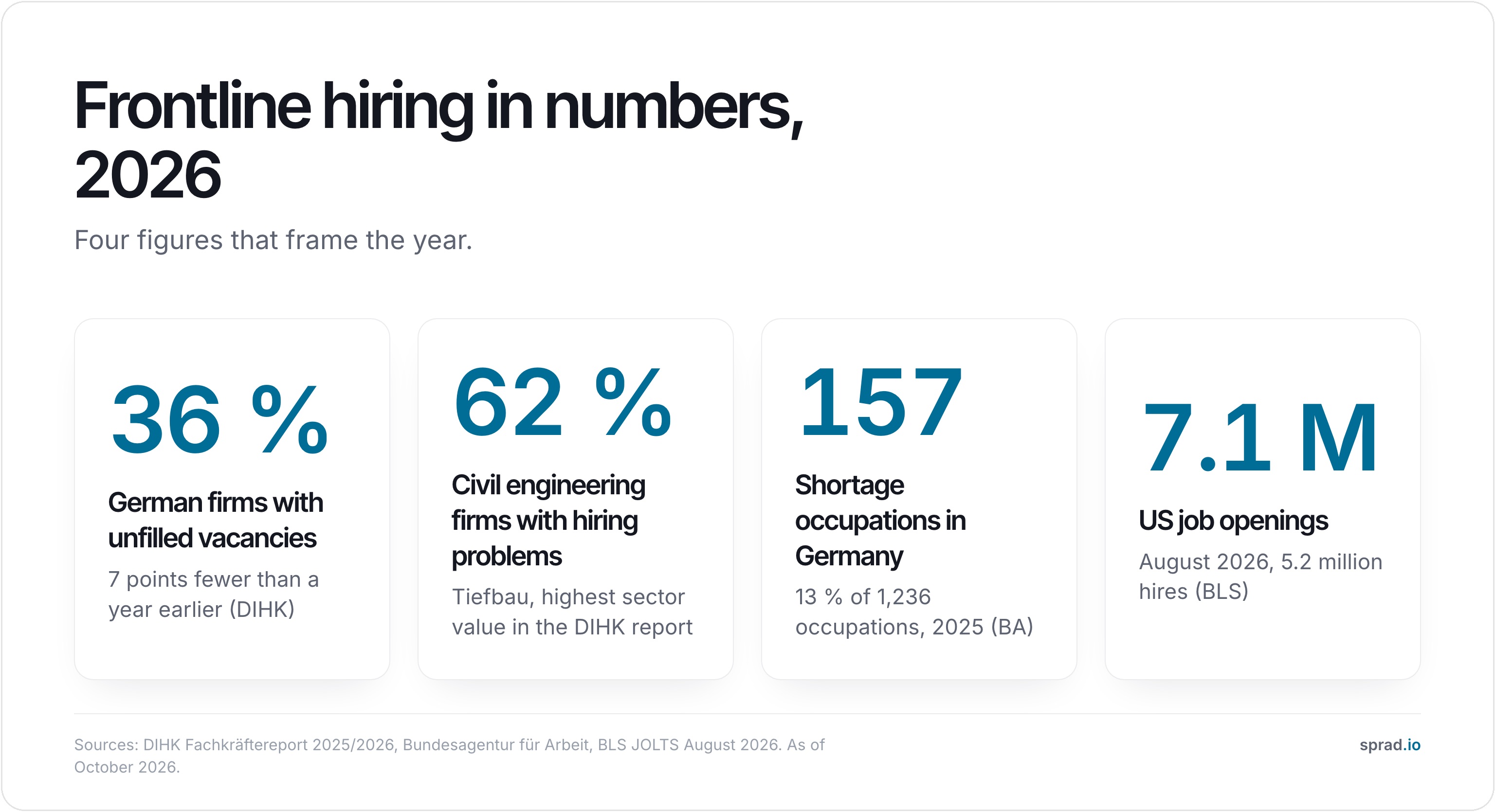
The German chamber of commerce (DIHK) reports in its Fachkräftereport 2025/2026 that 36 % of almost 22,000 responding companies cannot fill vacancies, at least in part, because they find no suitable staff. That is seven percentage points less than a year earlier, and 48 % of firms now report no hiring need at all, up from 44 %. The headline number falls because the economy is weak, not because the shortage is solved.
Inside the average, the picture is uneven. In civil engineering (Tiefbau) 62 % of firms struggle to fill jobs, in temp agencies 58 %, in road freight 54 % and in hospitality 40 %. Among service firms with unfilled jobs, 65 % of transport and warehousing companies and 62 % of hospitality companies also look for people without a vocational degree. The Bundesagentur für Arbeit (BA) counted 157 shortage occupations in 2025, 13 % of 1,236 occupations, after 163 in 2024 and 183 in 2023. Care, medical, construction and trades occupations lead, together with cooks, professional drivers and educators.
The US picture is looser but not loose: the BLS JOLTS release for August 2026 shows 7.1 million job openings and 5.2 million hires.
| Source | Figure | What it means for frontline hiring |
|---|---|---|
| DIHK Fachkräftereport 2025/2026 | 36 % of firms cannot fill vacancies (−7 points) | Fewer firms compete, but those that do still wait |
| DIHK, by sector | Tiefbau 62 %, temp work 58 %, road freight 54 %, hospitality 40 % | Competition for applicants is sector-specific |
| BA Engpassanalyse 2025 | 157 shortage occupations (2024: 163) | Care, trades, drivers and cooks stay on the list |
| BLS JOLTS, August 2026 (USA) | 7.1 million openings, 5.2 million hires | Openings still outnumber hires by about 1.9 million |
What to do: do not read the falling national figure as a reason to cut sourcing. Look up your own occupation in the BA shortage list and plan budget by role, not by company.
2. Candidates are on Meta, and companies follow
Pew Research Center found in its 2025 survey that 71 % of US adults use Facebook and 50 % use Instagram. Facebook peaks among 30- to 49-year-olds (80 %), Instagram among 18- to 29-year-olds (80 %). That is the age range of most frontline hires.
German employers have noticed. A Bitkom Research survey of about 600 companies with 20 or more employees (spring 2025) found that 62 % use social media to attract employees; 48 % run a Facebook profile and 35 % an Instagram profile. Many of those profiles are employer-branding channels, though. Paid job ads aimed at people who are not looking at job boards are a separate and smaller use.
What to do: run one paid campaign for one role on Facebook and Instagram together and let the data show which channel brings better applicants. Our guide to reaching frontline staff by phone and WhatsApp explains why e-mail does not work here.
3. Speed and pre-screening decide the cost
Boostpoint, a US social recruiting agency, analysed 891 of its own campaigns on Meta (published August 2026). The median cost per applicant was $13.88, the volume-weighted average $8.02. The surprise: 70 % of the difference between campaigns came from what happens after the click, meaning the application completion rate, and only 18 % from the price the ad auction charged. Boostpoint is a vendor and the data are US data, but the lesson carries over: a short route to apply and a fast answer matter more than a clever ad.
The same direction shows up in hiring technology. Fountain, a frontline hiring platform, reports that 74 % of about 2,000 surveyed frontline workers prefer dealing with AI over traditional methods during hiring (Fountain Frontline Report 2025, vendor data). In the same piece, Fountain cites Aptitude Research (early 2026): only 25 % of talent acquisition leaders rate their current technology as very effective at high-volume hiring. Many teams own tools that do not yet fix the slow part, which is the first conversation.
What to do: shorten the application to a few questions, reply the same day, and move the must-have questions (permit, licence, shift, start date) into an automatic first conversation by WhatsApp, phone or web.
4. Classic channels get more expensive
Appcast’s 2026 Recruitment Marketing Benchmark Report (released 17 February 2026, about 1,200 employers, 302 million clicks, 27 million applications) states that cost per application and cost per hire rose sharply in 2025, which it attributes to shifts in job board pricing and programmatic media models. Press coverage describes healthcare and other frontline roles as expensive and hard to fill. Appcast is part of the StepStone group, so read its framing with that in mind.
What to do: track cost per qualified applicant and cost per interview, not just cost per click. For a baseline on classic listings, our StepStone cost guide lists what they cost in Germany.
5. The rules are moving: AI Act, pay transparency, Meta categories
Three regulatory topics touch frontline recruiting, and each has a date.
- EU AI Act: AI that places targeted job ads, filters applications or evaluates candidates counts as high-risk. According to law-firm summaries of the Digital Omnibus on AI, the date for those obligations moved from 2 August 2026 to 2 December 2027. The ban on inferring candidates’ emotions at work has applied since 2 February 2025.
- Pay transparency: the transposition deadline of the EU directive passed on 7 June 2026. Germany has not yet adopted its law; a draft is expected for autumn or winter 2026. Applicants are to learn the salary or range before the first interview, so listing pay in the ad is the safe default.
- Meta’s Employment ad category: job ads cannot be targeted by gender or postcode, and age is fixed at 18 to 65+. The scope reaches beyond the US; check the current status for your country in the Ads Manager.
What to do: keep a list of which tools screen or rank applicants, and put the salary range in the ad. This is general information, not legal advice.
6. Own your pool instead of renting reach
When you pay a platform per posting, the reach disappears when the budget stops. The market is also consolidating: Appcast belongs to the StepStone group, and Workday announced the acquisition of Paradox in 2025. For employers, the consequence is dependency. A pool of people who already had a first conversation with you outlasts any single campaign. See how a talent base keeps candidates reachable for the next role.
What to do: every applicant who passes the pre-screen but is not hired this month should land in a pool you control, tagged by role and region, and be contacted again when the next role opens.
Trend check: what to act on first
| Trend | Strength of evidence | First step |
|---|---|---|
| Pre-screening before the human conversation | Strong (Boostpoint 70 %, vendor data; direction confirmed by several sources) | Three must-have questions by WhatsApp or web |
| Paid reach on Facebook and Instagram | Strong (Pew 2025, Bitkom 2025) | One role, one campaign, three months |
| Own talent pool | Logical, few published numbers | Tag every pre-screened applicant by role |
| Rising classic channel costs | Medium (Appcast, vendor data) | Measure cost per qualified applicant |
| AI Act and pay transparency | Legal, dates may still shift | Salary in the ad, inventory of tools |
Where Sprad fits
Sprad Social Recruiting runs job ads on Instagram and Facebook, where nurses, tradespeople, drivers and other frontline workers spend time every day. An AI talent agent pre-screens every applicant via WhatsApp, phone or web, and every applicant lands in your own talent pool, so the relationships stay with you instead of a platform. Pricing is ad spend plus 10 %, from a €1,000 budget that can be split across roles.
Frequently asked questions
What are the biggest recruiting trends for 2026?
For frontline roles: persistent shortages in trades, logistics and care despite a cooler economy, mobile and social channels, fast pre-screening, more regulation of hiring AI and a shift from rented reach to owned talent pools.
Is the labor shortage ending in 2026?
No. The DIHK figure fell to 36 % of firms, but partly because 48 % have no hiring need. The Bundesagentur für Arbeit still lists 157 shortage occupations, and it also notes that labor supply exceeds demand in many other occupations.
Which social channel works best for frontline hiring?
Facebook and Instagram reach most frontline age groups, according to Pew. Start with both in one campaign and compare applicant quality, not just cost.
Does the EU AI Act apply to recruiting tools?
Yes, as high-risk AI for ad targeting, application filtering and candidate evaluation. The date for those duties moved to 2 December 2027. The ban on emotion inference at work already applies.
How much should I plan for a frontline campaign?
Boostpoint’s 2026 benchmark shows half of all campaign-months ran below $334. Plan at least about $1,000 per role group over three months to get stable data, and see our logistics and healthcare pages for role examples.
Jürgen Ulbrich
Jürgen Ulbrich has more than a decade of experience in developing and leading high-performing teams and companies. As an expert in employee referral programs as well as feedback and performance processes, Jürgen has helped over 100 organizations optimize their talent acquisition and development strategies.