Social media recruiting means you publish job ads and content on platforms like Instagram and Facebook so that candidates come to you. Active sourcing means you search for specific people and write to them first. Use social media recruiting when you need many people for the same kind of job, especially frontline and shift roles, and active sourcing when one scarce specialist or manager is worth a personal approach. For most employers with hard-to-fill skilled jobs the answer is both, in a fixed order. As of October 2026.
The difference in one picture
The two terms overlap, which is why guides contradict each other. Sourcing on LinkedIn is active sourcing that happens on a social network. A paid Instagram job ad is social media recruiting that involves no personal search at all. The cleaner split is by who makes the first move.

With social media recruiting, you build the offer (ad, pay, place, shift) and let the platform find the audience. With active sourcing, you build the list and write each message yourself. Neither is better in general. They fit different jobs.
Which one fits which role
| Situation | Better fit | Why |
|---|---|---|
| 5 to 50 similar hires: warehouse, care assistants, drivers, helpers | Social media recruiting | These candidates scroll Instagram and Facebook daily, rarely keep a CV and rarely sit on LinkedIn |
| Skilled trades or nurses in a shortage region | Social ads first, sourcing second | Ads create a pool of interested people, sourcing approaches the profiles that match but never saw the ad |
| One senior specialist, engineer or manager | Active sourcing | The group is small, the profile is public, a personal first message beats a general ad |
| You need someone within days | Social media recruiting | An ad can run within days; building and answering a sourcing list takes recruiter hours |
| You have no recruiter capacity | Social media recruiting with automated pre-screening | Sourcing is manual work by definition |
What each approach costs
The two cost different currencies. Social media recruiting costs ad budget. Active sourcing costs recruiter time plus whatever tool you use to find profiles.
Social media recruiting. Boostpoint analysed 891 Meta campaigns in 2026 and found a median of $13.88 per applicant in the US, from $2.71 for customer service to $74.62 for therapy roles. At the median, a $1,000 budget yields roughly 70 applicants. An applicant is a completed form, not a hire, and your own numbers will differ. Plan at least about €1,000 per role group and three months of runtime.
Active sourcing. The search itself can be cheap. With Sprad people search, a matching profile costs 2 credits, and one credit is worth 6 to 8 cents, so 50 matching profiles are about 100 credits, or roughly €6 to €8. The real cost is the time to read profiles, write messages and follow up. We estimate that at several minutes per person for a personal message, but that is a planning estimate, not a measured benchmark. Outreach in Sprad people search currently runs via LinkedIn.
| Social media recruiting | Active sourcing | |
|---|---|---|
| Main cost | Ad budget | Recruiter time and credits |
| Example | $1,000 ≈ 70 applicants at the US median | 50 profiles ≈ 100 credits ≈ €6–8, plus time for messages |
| Speed to first candidates | Days | Days to weeks, depends on replies |
| Scales with | Budget | People on your team |
| Quality control | Pre-screening after the application | Selection before the first message |
The hidden cost on both sides: who gets the contact
The question most comparisons skip is what remains after the campaign. With a job board or an agency that books reach for you, the audience often belongs to the platform. When the budget ends, so does your access. The same happens when a sourcing list lives in one recruiter's spreadsheet.
The fix is the same for both: store every applicant and every contacted profile in a talent pool you own, with source, role and qualification. Then ads feed the pool, sourcing pulls from it, and the second opening starts with people you already know.
How to combine both in 4 steps
- Define the role mix. Split your open jobs into volume roles and scarce roles. Volume roles go to ads, scarce roles to your sourcing list.
- Start the ads for the volume roles. Employment ad category, clear first line with role, place and pay. See frontline recruiting by phone and WhatsApp for the reply side.
- Pre-screen everyone before a human spends time. Five questions on licence, shift, start date, location and pay. Qualified people go to the talent pool and the hiring manager.
- Source into the gaps. After two to three weeks you see which roles the ads do not fill. For those, search matching profiles and write personally. Details on the search side: people search.
Common mistakes
- Using sourcing for 30 identical warehouse jobs. The hours do not scale.
- Using a general ad for a role with five qualified people in the whole region.
- Judging ads by applications instead of by qualified applicants. See why blue-collar screening differs from white-collar.
- Keeping contacts in inboxes and spreadsheets instead of one pool.
- Waiting two days to reply. For shift roles, same day is the target.
Where Sprad fits
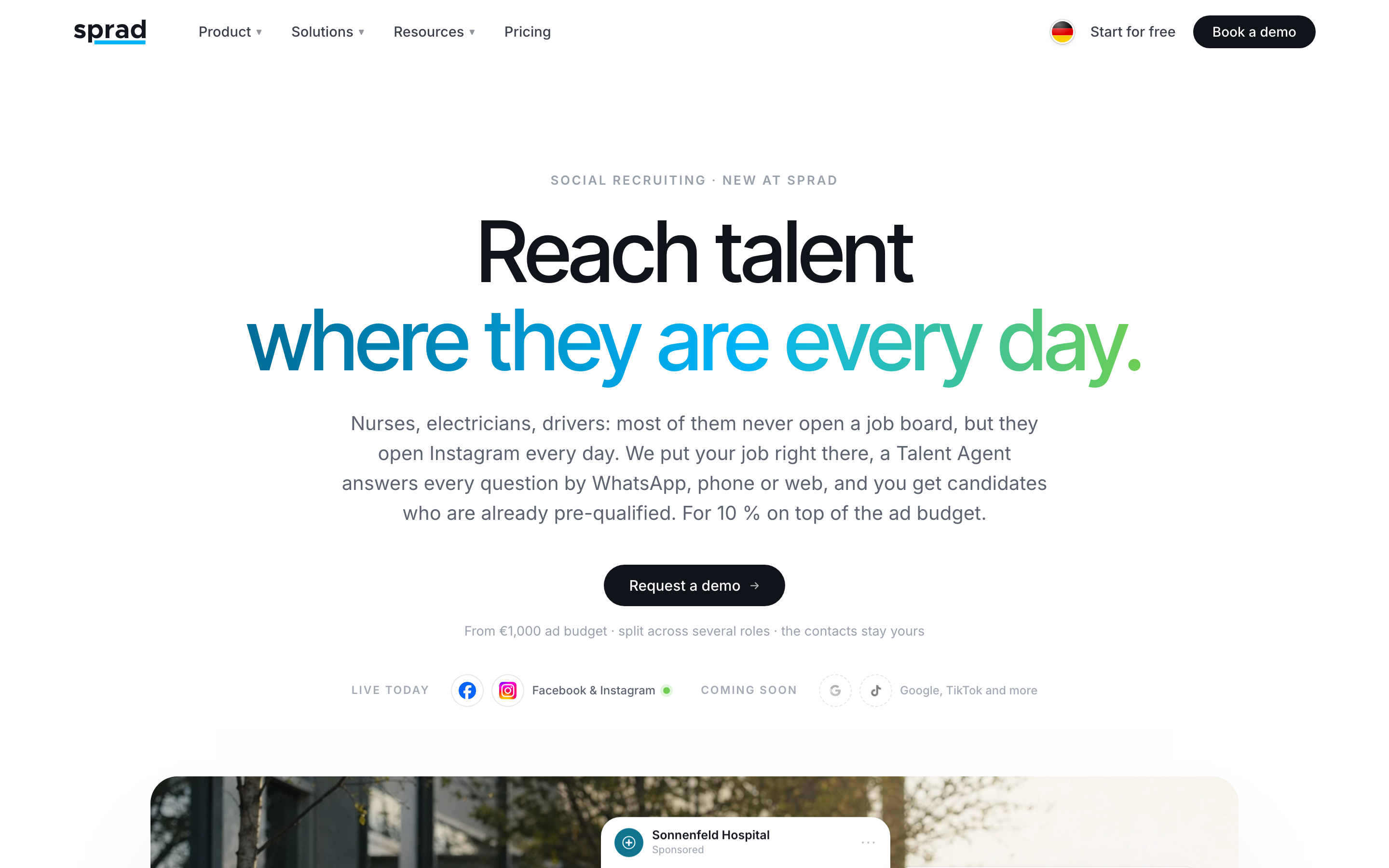
Sprad Social Recruiting runs job ads on Instagram and Facebook, where nurses, tradespeople, drivers and other frontline workers spend time every day. An AI talent agent pre-screens every applicant via WhatsApp, phone or web, and every applicant lands in your own talent pool, so the relationships stay with you instead of a platform. Pricing is ad spend plus 10 %, from a €1,000 budget that can be split across roles. For the scarce roles, people search finds matching public profiles from your requirements. See pricing for credits.
FAQ
Is active sourcing part of social media recruiting?
Partly. Sourcing on a social network such as LinkedIn is both. Paid ads and organic posts are social media recruiting without any personal search. The practical difference is who makes the first move.
Which is cheaper?
It depends on the currency. Ads cost budget and scale with it; sourcing costs recruiter time and scales with your team. For one hire, sourcing can be cheaper. For dozens of similar hires, ads usually win.
Which works better for blue-collar and shift roles?
Social media recruiting, because the audience is on Instagram and Facebook, applies by phone and rarely has a public professional profile to find. Pre-screening by WhatsApp or phone matters more than the channel.
Can I do both with a small team?
Yes, if you automate the pre-screening and limit sourcing to the few roles ads cannot fill. A shared talent pool keeps both from duplicating work.
Do I need to ask for consent when contacting people directly?
Rules differ by country and channel. In the EU, GDPR applies to storing and contacting candidates; for WhatsApp see contacting candidates by WhatsApp. This is not legal advice.
How long should I run ads before judging them?
Give them a few days before you judge, and measure cost per applicant, the share who fit and the cost per interview. Three months is the recommended runtime.
Jürgen Ulbrich
Jürgen Ulbrich has more than a decade of experience in developing and leading high-performing teams and companies. As an expert in employee referral programs as well as feedback and performance processes, Jürgen has helped over 100 organizations optimize their talent acquisition and development strategies.