Job boards reach people who are already searching, social media ads reach people who are not. For office and specialist roles, boards still work. For frontline roles such as drivers, nurses, warehouse staff and tradespeople, most of the people you want are employed or simply do not browse job boards, so an ad in the Facebook or Instagram feed finds candidates a listing never reaches. The best setup is rarely either/or: use the board for active seekers and social ads for the rest.
Social media recruiting vs. job boards: the core difference
A job board is a place where candidates come to look. Your listing competes with every other listing in the same search. Social media recruiting (the term for paid ads on platforms such as Facebook and Instagram, not social work) works the other way round: the ad appears in the feed of a person who matches your role and location, whether or not that person is looking.

That difference matters most where applicants are passive. A driver with a job does not check a board every week, but sees an ad between photos of friends.
Where do applicants really come from?
Hard numbers on this are scarce, and the best public ones are old. The German Institute for Employment Research (IAB) asked about 11,500 employers in the fourth quarter of 2016: 32 % of new hires came through personal contacts, 21 % through internet job portals, 11 % through the company's own website, 10 % through newspaper ads and 1 % through social media, as reported in 2017. A 2015 IAB survey found that for unskilled and apprenticed workers, personal contacts account for about 62 % of placements.
Two readings are fair. First, referrals beat every paid channel for frontline roles. Second, the 1 % for social media dates from before paid recruiting ads were common, so it cannot tell you what a well-run campaign delivers today. We found no newer, representative figure, and we do not invent one.
Are frontline workers on social media at all?
Yes, in large numbers. According to the Pew Research Center's 2025 survey of 5,022 US adults, 71 % use Facebook and 50 % use Instagram. An earlier 2023 survey showed Facebook use at 63 % among adults with a high school diploma or less, against 70 % among university graduates. Facebook is not a white-collar channel.
What each channel costs
| Job board listing | Social media ads | |
|---|---|---|
| Price logic | per listing, click or package | ad budget, plus a fee with a provider |
| Example price | StepStone about €199 to €2,399, standard listing from €1,449 for 30 days | Sprad: ad budget plus 10 %, from €1,000 |
| Who sees it | people searching right now | people matching role and region in the feed |
| Application effort | often a CV or account | short form or chat on the phone |
| Who owns the contacts | the board | you, if the applicants flow into your own pool |
| Risk | no application guaranteed | reach without fit if nobody pre-screens |
The StepStone figures come from a 2026 price comparison by jobjump, as of October 2026. Our guide to StepStone costs explains the packages, and the StepStone alternatives cover the cheaper boards. Indeed has no list price, it bills per auction.
Worked example: five roles
Five job-board listings at the standard StepStone price of €1,449 cost €7,245 for 30 days, with no application guaranteed. The same €7,245 as ad budget plus 10 % is a budget of about €6,586 (7,245 divided by 1.1), and it is yours to spread across roles and weeks. Both numbers are arithmetic on list prices. How many applicants either one brings depends on role, region and creative.
For orientation on cost per applicant, the Boostpoint benchmark 2026 reports a US median of $13.88 across 891 Facebook and Instagram campaigns, ranging from $2.14 for warehouse roles to $74.62 for therapy roles.
How to test both channels in 90 days
- Pick one role you hire repeatedly, for example warehouse staff in one region.
- Split the budget: one board listing and one social campaign with a similar spend.
- Use the same application path for both, so you compare channels and not forms.
- Pre-screen every applicant with the same five questions: availability, location, licence or qualification, shift model and start date.
- Compare after three months: spend divided by qualified applicants, and how many contacts you can reuse for the next vacancy.
This is a method, not a result: we publish no Sprad campaign benchmark until real campaigns are evaluated.
What social media ads cannot do
- Replace referrals: personal contacts remain the strongest channel for frontline hiring. Ask your employees first.
- Target freely: Meta restricts targeting by age, gender and postal code for employment ads in the US, Canada and certain European countries, see the overview. Check the rules for your country.
- Fix a weak offer: pay, shifts and location decide whether people apply.
When to use which
- Job board: specialist roles, roles with many active seekers, a single urgent vacancy with a standard profile.
- Social media ads: drivers, warehouse and production staff, care workers, tradespeople, shift roles, regions with few board applicants, continuous hiring.
- Both: run a board listing for visibility and a social campaign for reach, then compare cost per qualified applicant after three months.
More on reaching this group: why frontline recruiting works by phone and WhatsApp, not email, and why blue-collar screening differs from white-collar screening.
The Sprad approach: your own pool instead of rented reach
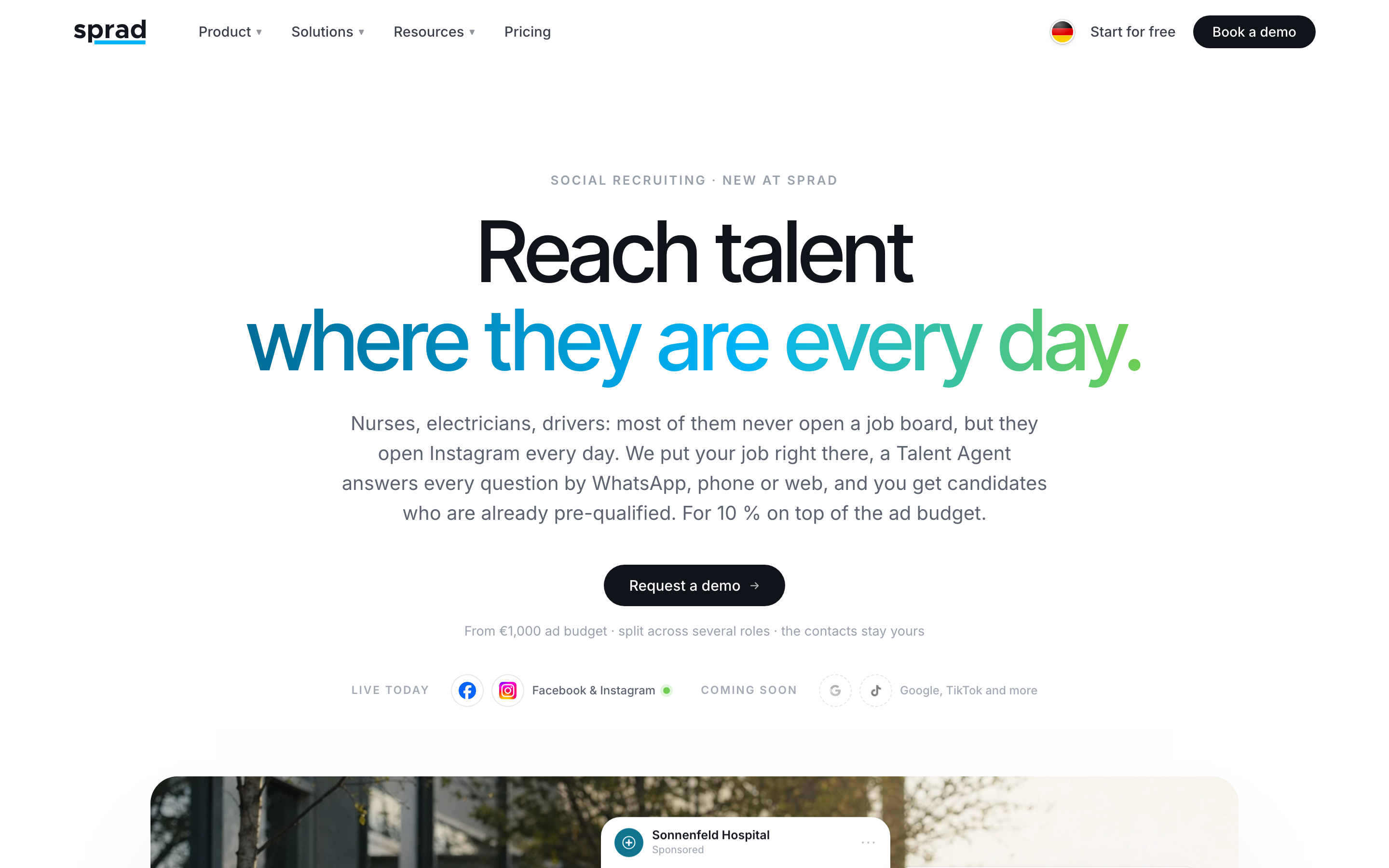
Sprad Social Recruiting runs job ads on Instagram and Facebook, where nurses, tradespeople, drivers and other frontline workers spend time every day. An AI talent agent pre-screens every applicant via WhatsApp, phone or web. Every applicant lands in the employer's own talent pool, so the relationships stay with the employer instead of a platform. Pricing is ad spend plus 10 %, from a €1,000 budget that can be split across roles. Learn more about Sprad Social Recruiting or see the logistics use case.
FAQ
Are social media ads better than job boards?
For frontline roles with passive candidates, usually yes in reach, because the ad finds people who do not search. For specialist roles with active seekers, a board is often enough. Compare cost per qualified applicant instead of clicks.
Where do blue-collar workers look for jobs?
Mostly through personal contacts. In the IAB survey, 62 % of placements for unskilled and apprenticed workers came through contacts. Social media is where you can reach those who are not searching.
How much do Facebook job ads cost compared to a job board?
A StepStone standard listing starts at €1,449 for 30 days. Facebook and Instagram ads are bought as budget; with Sprad you pay the budget plus 10 %, from €1,000.
Do I still need a job board?
Often yes, for visibility on Google for Jobs and for active seekers. Treat the board and social ads as two channels and measure both.
Can Meta target blue-collar workers by age or postal code?
Not freely. For employment ads, Meta limits age, gender and postal code targeting in the US, Canada and certain European countries. Role, interests and region still shape who sees the ad.
Jürgen Ulbrich
Jürgen Ulbrich has more than a decade of experience in developing and leading high-performing teams and companies. As an expert in employee referral programs as well as feedback and performance processes, Jürgen has helped over 100 organizations optimize their talent acquisition and development strategies.