Spott and Loxo solve different problems inside the same category. Spott is an AI-native CRM that gets more out of the candidates already in your database — a unified inbox, auto-updating records, AI notetaking. Loxo pairs a similar ATS with its own 1.2-billion-profile sourcing database. Neither is cheap, and neither ships a German interface. If your agency needs external sourcing plus an AI-native workspace without Loxo's annual-only pricing, Sprad is worth a third look.
Spott vs. Loxo vs. Sprad at a glance
All prices are per recruiter seat, per month, as published in September 2026.
| Category | Spott | Loxo | Sprad |
|---|---|---|---|
| Entry price | $119/mo annual (Core), $149 monthly | $149/mo annual (Core), annual billing only | €59/mo base + pay-per-use credits |
| Search beyond your own database | No built-in tool, third-party integrations only | Yes — Loxo Source, 1.2B bundled profiles | Yes — requirement search, 1B+ profiles |
| Owned talent pool after cancelling | Your existing records stay, no bundled external profiles | Your database plus sourced profiles stay | Consent-based pool stays with the agency |
| AI matching | Semantic search over your own records | Talent Graph semantic search (Professional plan) | Requirement search with a score and reason per criterion |
| Outreach | Email, LinkedIn, WhatsApp, SMS sequences (Pro plan) | Email sequences; deliverability issues reported | LinkedIn only, consent-based |
| Unified inbox / CRM | Yes, native, from Core | ATS/CRM core, no unified inbox documented | Client-context profile (beta), feeds the AI only |
| Voice/video interview screening | Not offered | Not offered | Yes, 12 languages |
| DACH / German-ready | No German interface | No German interface, US-focused | Built with DACH agencies in mind, EU-hosted |
| Migration | White-glove, "under four weeks" per case studies | Not publicly documented | Free import of legacy databases (CSV, generic import) |
Spott: an AI-native CRM for the pipeline you already have
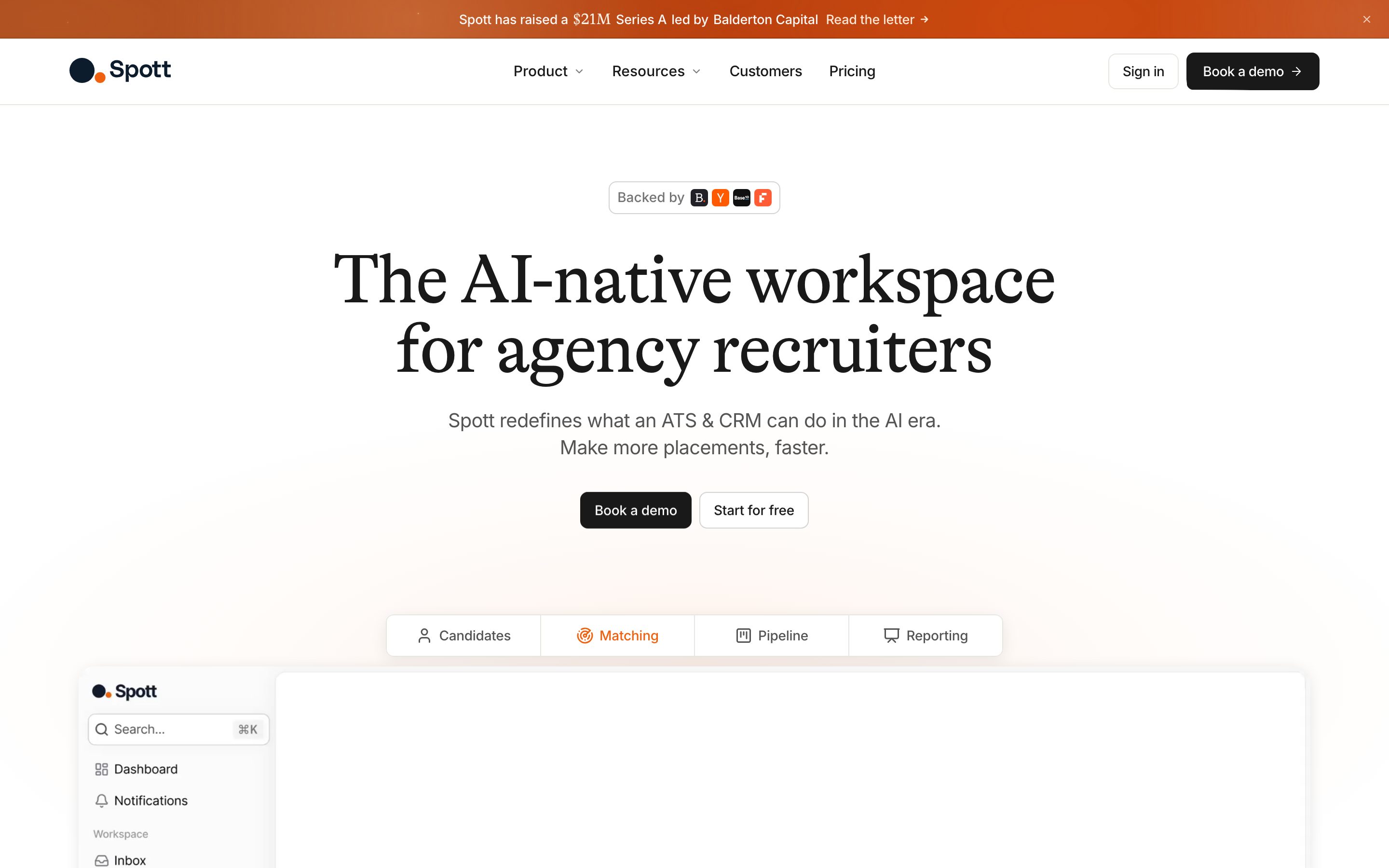
Founded in Leuven, Belgium in 2024, Spott's pitch is consolidation: a unified inbox for email, WhatsApp, SMS and calls, an AI notetaker that summarizes calls in under a minute, and semantic search across your own candidate and client notes. Its G2 reviews are almost uniformly enthusiastic, though the base is thin — 11 on G2, 2 on Capterra, at least one explicitly tagged "Source: G2 invite."
What's consistently missing, according to reviewers and independent editorial coverage, is a built-in way to find candidates who aren't already in your database — Spott is a database-enrichment tool, not a sourcing engine. Reviewers also flag a notetaker capped at roughly a minute (versus 45 minutes on some competitors) and no team-wide visibility into a colleague's LinkedIn messages.
Loxo: a sourcing platform with an ATS attached
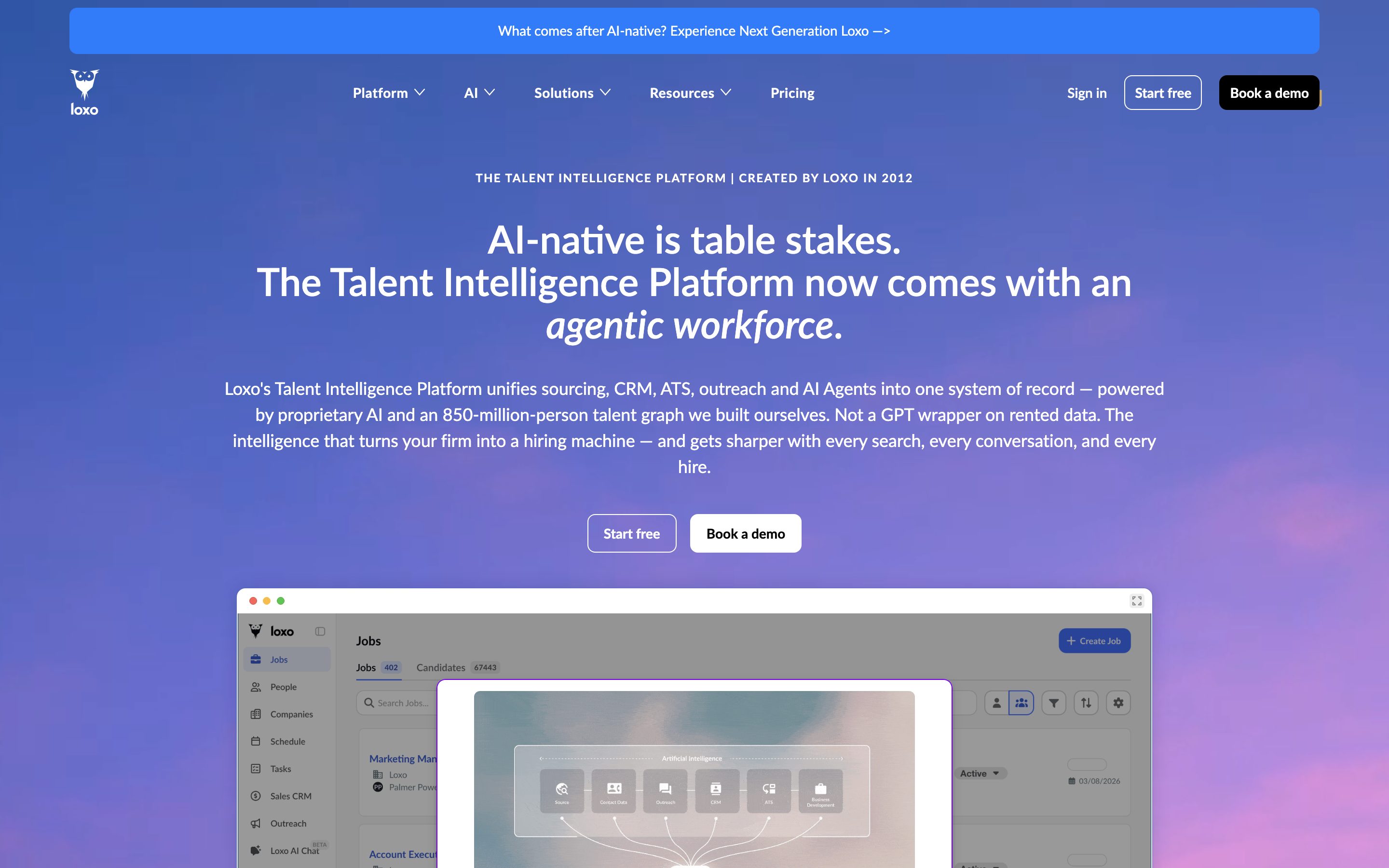
Founded in Denver in 2012 — a decade before Spott existed — Loxo's core asset is Loxo Source, a genuinely bundled database, not a reseller integration like most CRM-first tools rely on. On top sits a self-updating CRM plus an AI notetaker for Zoom, Teams and Google Meet calls. Its G2 reviews praise having "everything in one interface instead of a tool sprawl," and several say the Chrome extension "halves research time."
The recurring complaint is cost-to-value: multiple reviewers describe the feature set as "disappointing for the price," and both G2 and Capterra reviews mention email-automation outages and deliverability problems. Mobile is repeatedly called "terrible," and Loxo has no German interface or DACH-specific pricing.
The real difference: enrichment vs. sourcing
This is the axis that actually decides which tool fits: Spott makes your existing pipeline smarter and faster to work with; Loxo helps you find candidates you don't have yet. A Capterra reviewer who switched from Loxo to Spott put it directly: "Loxo was not only too expensive, but it was not meeting my functionality needs when it came to candidate matching." That's a real trade-off, not a marketing line — it just runs in the opposite direction if your bottleneck is finding new candidates rather than managing existing ones. An agency that already has a strong network and wants faster follow-up will lean Spott; one that needs to build reach into markets or niches it doesn't already cover will lean Loxo.
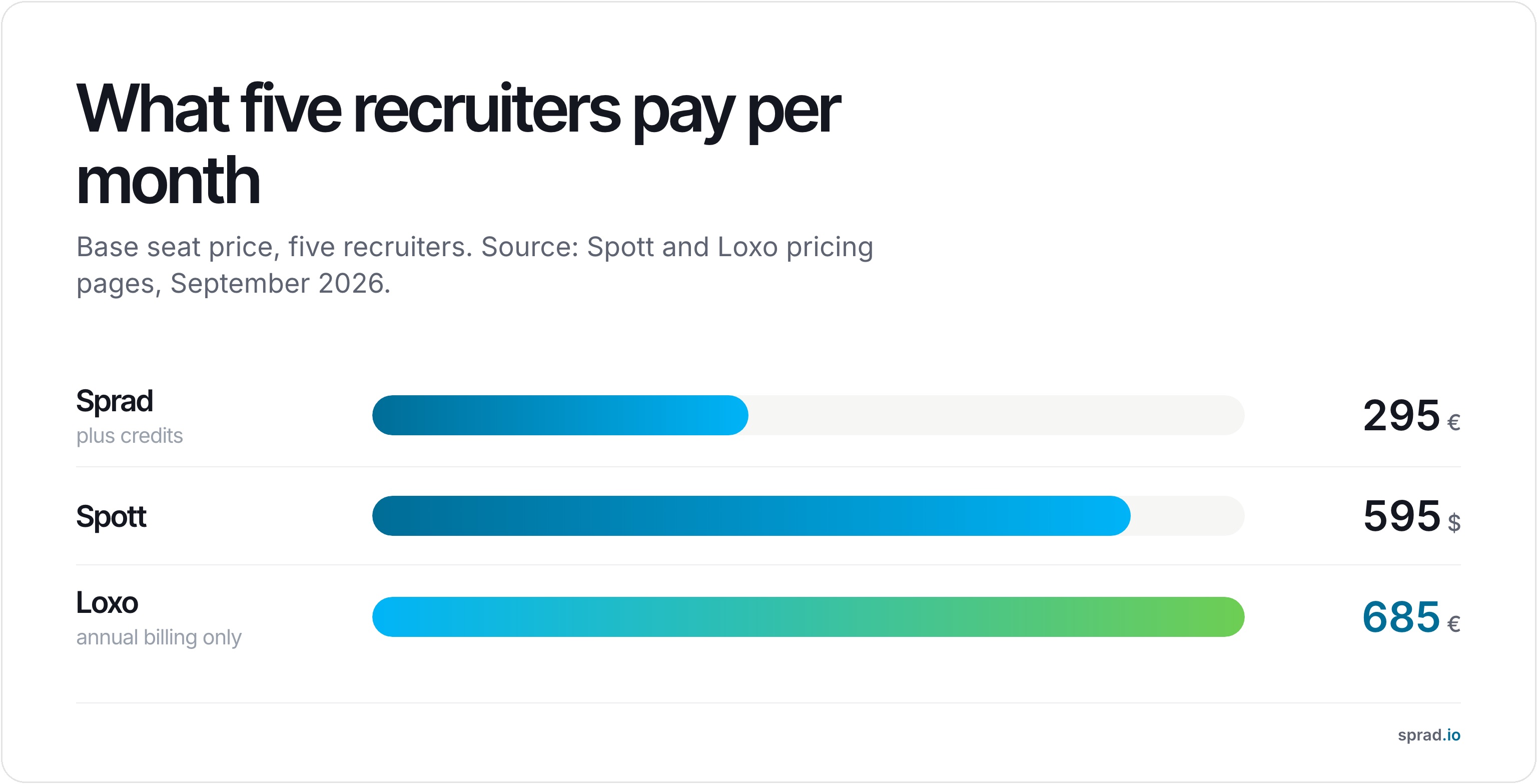
What five recruiters actually pay
On Spott's Core plan, five recruiters cost 5 × $119 = $595/month, or roughly €6,570/year at Spott's own published EUR rate of €109.50/seat. On Loxo's Core plan, the same team costs 5 × €137.08 = €685.40/month, or about €8,225/year — and Loxo bills annually only, so there's no lower monthly-commitment fallback. Neither figure includes Spott's separate enrichment credits or the cost of Loxo's Professional tier if the team needs Talent Graph AI search ($199/seat/month annual). On Spott's full pricing breakdown and on Sprad, the same five-recruiter team pays a €295/month base (€3,540/year) for the ATS and talent pool, then spends credits only on searches, outreach and interviews it actually runs — a full application review costs around 3 credits, an external search across the 1B+ profile pool costs 2 credits per profile that passes the check (at most 100 credits per run), and every account gets 200 free credits a month.
The third option: Sprad
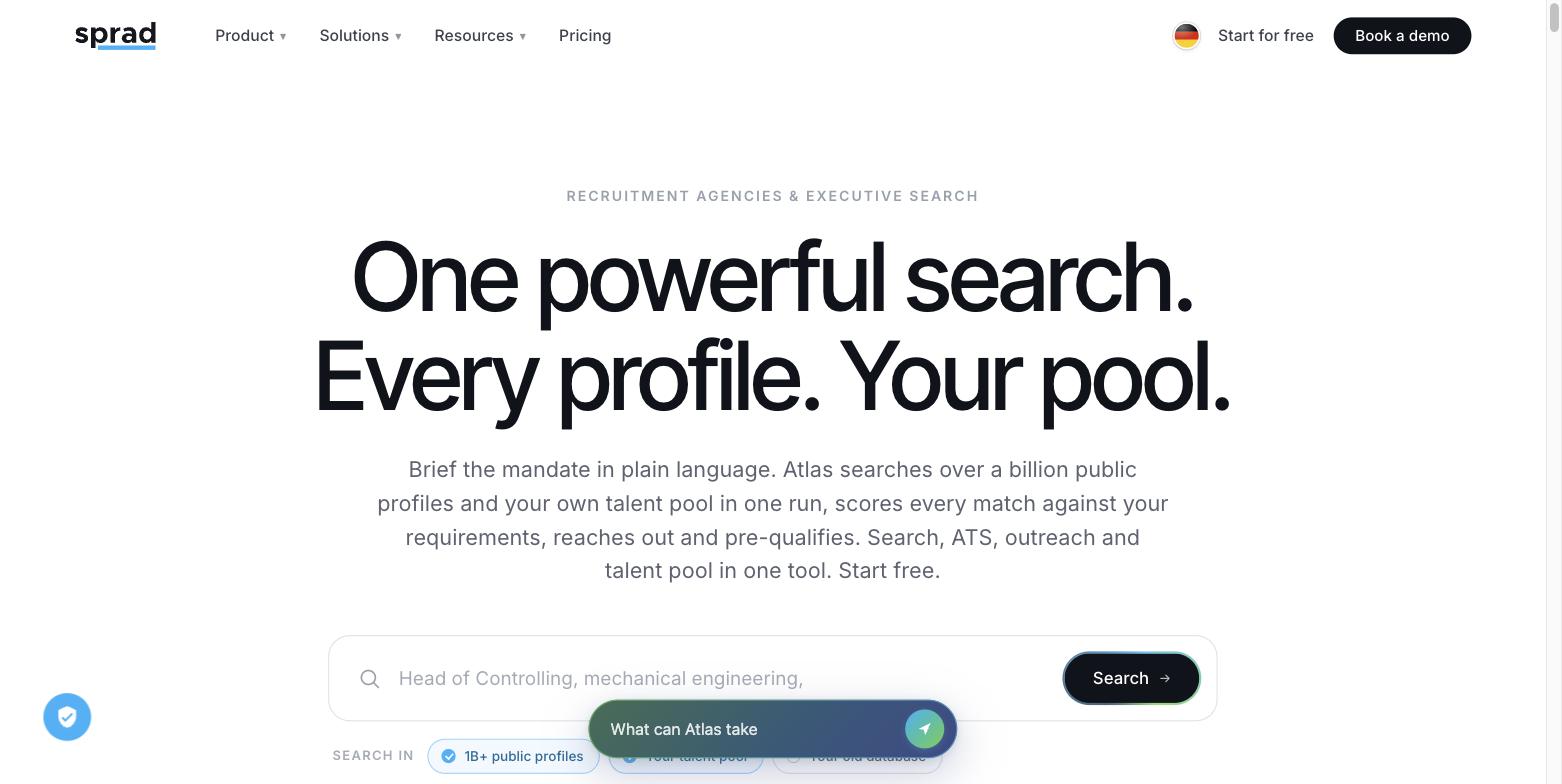
Sprad combines what Spott and Loxo each do separately: a requirement search across more than a billion external profiles — describe the role in plain language and get a score with a reason for each criterion — plus a talent pool that candidates actively consent to join and that stays with the agency after it cancels. In a benchmark run on 15 August 2026, Sprad's sourcing found 38% of the candidates the other tools combined found, against 9% for the best-performing alternative.
Sprad also adds voice and video interview screening in 12 languages, which neither Spott nor Loxo offers, and is EU-hosted with DACH agencies as a starting market.
Which one fits your agency?
- You have a strong existing network and want faster follow-up: Spott's unified inbox and notetaker save real time — accept that external sourcing isn't built in.
- You need to find candidates who aren't in any database you already own, and can commit to annual billing: Loxo's bundled 1.2B-profile search is the most complete built-in sourcing engine of the three.
- You need both — sourcing and a database you keep — without a US-only interface or a year-long contract: Sprad is built for that combination, with a talent pool and external search in the same workspace.
- You run contract or temp staffing with payroll needs: none of the three has a payroll module; look at a staffing-specific platform instead.
FAQ
Does Spott have its own candidate database like Loxo?
No. Spott enriches and organizes candidates you already have; external sourcing runs only through third-party integrations, not a bundled database. Loxo's 1.2-billion-profile Loxo Source is built in.
Is Loxo cheaper than Spott?
Not on the entry tier. Loxo's Core plan is $149/seat/month annual versus Spott's $119, and Loxo only offers annual billing — Spott at least publishes a (higher) monthly rate as a fallback.
Can an agency use Spott and Loxo together?
Nothing prevents it technically, but most agencies pick one as their system of record — running both means paying two per-seat prices for overlapping ATS/CRM functionality.
Which is better for a DACH-based agency?
Neither has a German interface or DACH-specific pricing as of September 2026. Sprad is built with DACH agencies as a starting market and is EU-hosted by default.
What does Sprad cost compared to Spott and Loxo?
€59 per recruiter per month for the ATS and talent pool, plus credits only for searches, outreach and interviews actually run — with 200 free credits every month. Spott and Loxo both charge a flat per-seat price regardless of usage. See the full breakdown at sprad.io/pricing.
Is Loxo's mobile app usable for recruiters in the field?
Multiple G2 and Capterra reviewers describe it as "terrible" as of September 2026 — worth testing directly if your team recruits on the move.
The bigger question behind the comparison
Every recruiting agency's real asset is its network, not its software license. Cancel a per-seat CRM and, in most cases, the reach you built inside it goes with the subscription. Sprad's approach keeps a candidate pool that stays yours, searchable alongside a requirement search across more than a billion external profiles — starting with 200 free credits a month and no credit card. See what that looks like for your team size at sprad.io/industry/recruitment-agencies.
Jürgen Ulbrich
Jürgen Ulbrich has more than a decade of experience in developing and leading high-performing teams and companies. As an expert in employee referral programs as well as feedback and performance processes, Jürgen has helped over 100 organizations optimize their talent acquisition and development strategies.