Loxo and Sprad both sell recruiting agencies a way to find candidates outside their existing network, but they charge for it in opposite ways: Loxo licenses access to a bundled 1.2B-profile database for a flat $149-199 per seat monthly, while Sprad charges 59 € per seat plus credits only for the searches, outreach and interviews that actually happen. Loxo fits agencies that search constantly and want unlimited access baked into the price; Sprad fits agencies whose search volume varies and who want to own the resulting talent pool rather than rent access to someone else's.
Provider snapshots
Loxo
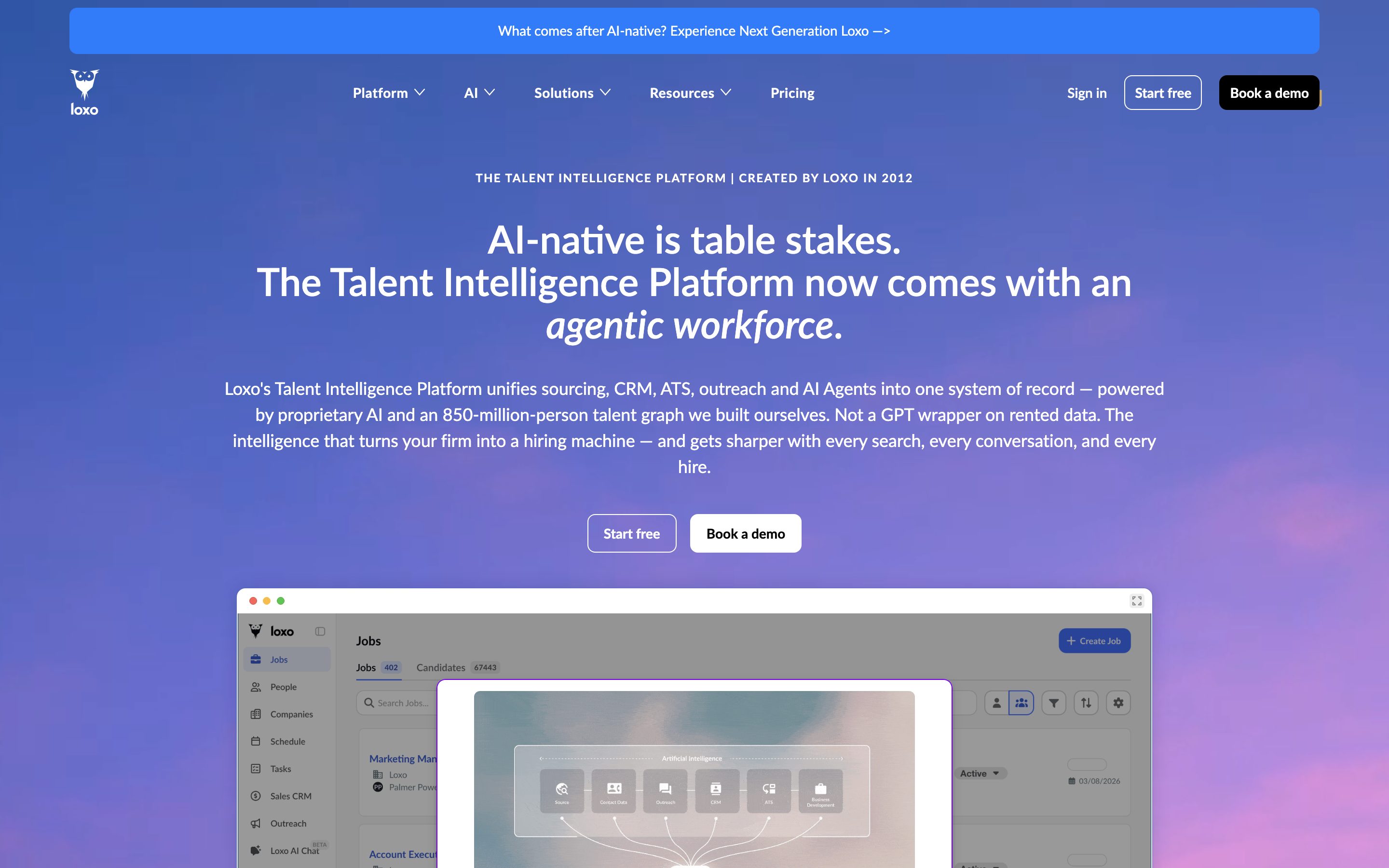
Loxo packages sourcing reach into a conventional annual seat licence. Its strongest case is frequent use: the more consistently every recruiter searches, the easier the fixed fee is to justify.
Sprad
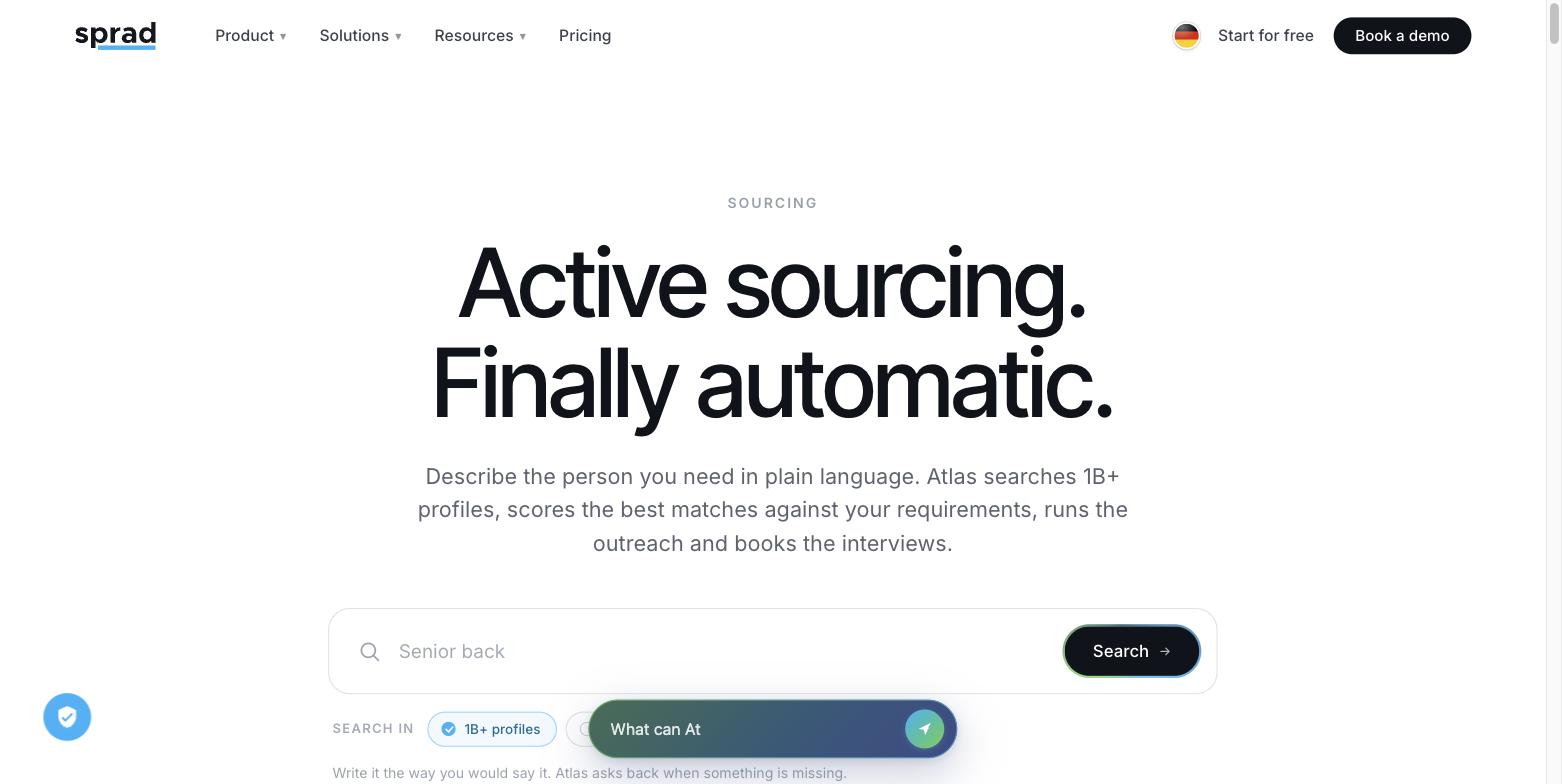
Sprad separates the workspace fee from actual usage. That makes the economics easier to scale down in quiet months while keeping the agency’s accumulated candidate pool.
Loxo vs. Sprad, side by side
| Dimension | Loxo | Sprad |
|---|---|---|
| Price | $149-199/seat/month, annual billing only | 59 €/seat/month + credits per search/outreach/interview |
| External search | Yes — 1.2B-profile Loxo Source, unlimited within the plan | Yes — requirement search across 1B+ profiles, usage billed by credit |
| Talent pool ownership | Licensed database access; candidate records live in Loxo | Agency's own pool, candidates give active consent, stays after cancellation |
| AI matching | Talent Graph (semantic), Professional plan and above only | Requirement-based scoring against full profiles, on every plan |
| Voice/video screening | Not offered | Yes, 12 languages, built into the same workspace |
| Outreach | Email sequences (documented reliability issues) | LinkedIn contact agent; no email sourcing outreach yet |
| DACH/German | English-only interface, US-focused database | EU-hosted, DACH go-to-market, English core interface |
| Free entry | None published; demo/quote only | 200 free credits/month; usage billed by credit |
Where the two differ in practice
What Loxo genuinely does better
Loxo's 1.2B-profile database is real and bundled — it's not a third-party integration bolted on, and for a US-heavy agency running dozens of searches a month, a flat-fee unlimited model can work out cheaper than paying per search. Loxo also has a decade-plus track record (founded 2012) and a self-updating CRM that automatically refreshes candidate location, title and company data from public signals without manual re-entry — a genuinely useful maintenance feature that Sprad's consent-based approach handles differently (candidates update their own profile actively, rather than the system scraping updates silently). If your agency is US-based, searches constantly, and doesn't need voice or video screening, Loxo's model is a legitimate fit.
Where Sprad's model changes the economics
Sprad's pay-per-use structure means a quiet month costs a fraction of Loxo's flat fee — a 5-recruiter team on Sprad's base pays 295 €/month versus roughly $745 (about €685) for Loxo Core, before either team runs a single search (full math in our Loxo pricing breakdown). And because Sprad's talent pool belongs to the agency rather than living inside a licensed database, canceling doesn't mean losing access to candidates the agency has already built a relationship with. Sprad also builds in voice and video interview screening across 12 languages, which Loxo doesn't offer at all — useful for agencies doing high-volume shortlisting rather than pure sourcing.
Being fair about the gaps
Sprad isn't the stronger choice everywhere. Its outreach today runs only through LinkedIn, not email sequences — Loxo (despite documented reliability issues) at least offers email automation as a built-in channel.
Sprad's client-facing CRM is explicitly in beta, while Loxo's core ATS/CRM has years of iteration behind it. And Loxo's database strength in the US market is more established than Sprad's newer external search, which runs through a single external API rather than an in-house database built over a decade.
Switching costs and getting started
Loxo's onboarding runs through a demo or a quote request — there's no published self-serve trial, so evaluating it means committing to a sales conversation before seeing real data in the product. Sprad includes 200 credits per month free and bills further usage by credit, so a team can test the workflow before deciding whether to move everyone over. On migration, Sprad also offers a free import of legacy contacts from Xing, Bullhorn or an Excel export — useful for an agency with years of accumulated relationships sitting in an old CRM export rather than a live Loxo account.
Which one fits your agency
- US-based agency, high search volume, wants unlimited database access: Loxo's flat-fee model can work out cheaper at real scale.
- Agency with variable search volume that wants to avoid paying for capacity it doesn't use: Sprad's pay-per-use credits fit better.
- Agency that wants voice or video screening in the same workspace as sourcing: Sprad is the only one of the two that offers it.
- Agency worried about what happens to its candidate data after canceling a subscription: Sprad's ownership model is built for exactly that concern.
- Agency needing mature, tested email outreach automation today: Loxo, though its own reviewers flag reliability problems worth weighing.
Some agencies genuinely run both during a transition — keeping Loxo's database for an existing US search practice while testing Sprad's requirement search and screening on new roles, before deciding where to consolidate. For the wider field beyond these two, see our roundup of Loxo alternatives.
FAQ
Is Sprad cheaper than Loxo?
For most agencies, yes — Sprad's 59 €/seat base plus pay-per-use credits usually costs less than Loxo's $149-199 flat fee unless the agency runs searches almost daily on every seat.
Does Sprad have the same database size as Loxo?
Both claim over 1 billion external profiles searchable — Loxo through its own licensed Loxo Source database, Sprad through a requirement search across an external profile API. Neither owns the underlying data as a proprietary in-house asset in the strictest sense; Loxo licenses its aggregated database, Sprad queries a third-party source live.
Does Loxo offer voice or video candidate screening?
No. Loxo's product is focused on sourcing, ATS and CRM. Sprad includes voice and video interview screening across 12 languages as part of the same workspace.
Can I keep my candidate data if I cancel Sprad or Loxo?
Sprad's talent pool is designed to stay with the agency; candidates opt in and the agency retains a view-level export of the pool. Loxo's database access is licensed — canceling the subscription ends access to Loxo Source, though your own added candidate records remain exportable from the CRM.
Which is better for a small agency with unpredictable search volume?
Sprad — its credit-based pricing means a quiet month costs less, whereas Loxo's flat per-seat fee runs the same whether the team searches once or fifty times.
Does Loxo or Sprad have a longer track record?
Loxo, founded in 2012, has more than a decade of iteration behind its ATS/CRM core. Sprad is the newer platform of the two, which is part of why its client-facing CRM is still explicitly in beta while its sourcing, screening and ATS core are live.
The honest bottom line
Loxo is a mature, US-strong database license at a flat monthly cost. Sprad is a newer, pay-per-use requirement search paired with voice/video screening and a talent pool the agency keeps.
Neither is universally better — the right pick depends on how often your team actually searches and how much data ownership matters to you. See Sprad's pricing for your team size at sprad.io/industry/recruitment-agencies.
Jürgen Ulbrich
Jürgen Ulbrich has more than a decade of experience in developing and leading high-performing teams and companies. As an expert in employee referral programs as well as feedback and performance processes, Jürgen has helped over 100 organizations optimize their talent acquisition and development strategies.