Metaview and Sprad (Atlas) both use AI in recruiting, but they start at different ends. Metaview began as an interview notetaker and has added agents for sourcing, application review and screening; its sourcing tier costs 100 $ (Pro) or 300 $ (Max) per user and month. Sprad starts with the search: it checks every profile individually against your requirements, runs LinkedIn and email outreach from one inbox and starts free, with Recruiter Lite from 79 € per seat and month. In the Recruiting area of the open PeopleSearchBench, Atlas reaches 73.5 out of 100 in our own re-measurement, converted to the published scale; in our own three-role test (Sprad, 15 August 2026) Atlas covered 38 % of what the other tools found, Metaview 5 %. Metaview is still the better pick if interview documentation synced to your ATS is the main job.
How does Sprad Atlas compare with Metaview?
Metaview statements below come from the vendor's public pages (pricing, sourcing, October 2026 product update), checked on 30 October 2026; Sprad prices are net of VAT, billed annually, as of October 2026.
| Sprad (Atlas) | Metaview | |
|---|---|---|
| What it is | Sourcing, outreach, pre-qualification, CRM/ATS functions and your own talent network | AI recruiting platform that grew out of interview notes; agents for sourcing, application review and screening |
| How it searches | You describe the person; AI checks every profile against the requirements, with a reason per requirement. Deep Context finds companies first, then the people who worked there in a given period | Agent builds a shortlist from a job description, notes or an intake call and learns from feedback; since October 2026 it can filter by employer funding stage, ownership and investors |
| Sources | 1B+ profiles worldwide: LinkedIn, XING, GitHub, your own pool, colleagues' networks and your uploaded LinkedIn network | The sourcing page names web search; it does not list profile sources |
| Outreach | LinkedIn (request, message, InMail) and email automated with follow-ups, trainable AI templates, pitch format; one inbox per talent with a warning against double contact | Separate outreach product; the sourcing page does not state channels |
| Interviews | Voice, video, chat and agent pre-qualification, multilingual; WhatsApp for candidate communication | Notetaker (since October 2026 also botless on the desktop), screening conversations incl. coding questions and role-plays |
| Price | Free start (100 credits/month); Recruiter Lite 79 € (95 $) per seat and month; Atlas Recruiter 299 € (359 $); flexible credits | Sourcing Free (first 100 profiles), Pro 100 $, Max 300 $ per user and month, billed monthly; full platform by quote |
| Benchmark | PeopleSearchBench (Recruiting): 73.5 out of 100 (own re-measurement, converted); own three-role test: 38 % coverage | Not part of the published PeopleSearchBench; 5 % coverage in our own three-role test (August 2026) |
| EU / GDPR | EU hosting, enterprise-grade data protection | US vendor; shows GDPR and SOC 2 Type II badges on its site (own claims); ask for the report and the data processing agreement |
| Where the other is better | No AI call notetaker, no placement reporting, no SMS (WhatsApp instead); deep search takes minutes | Mature interview notes with ATS sync, structured scorecards, 7,000+ customer organisations, fresh funding |
What is Metaview, and where does it fit?
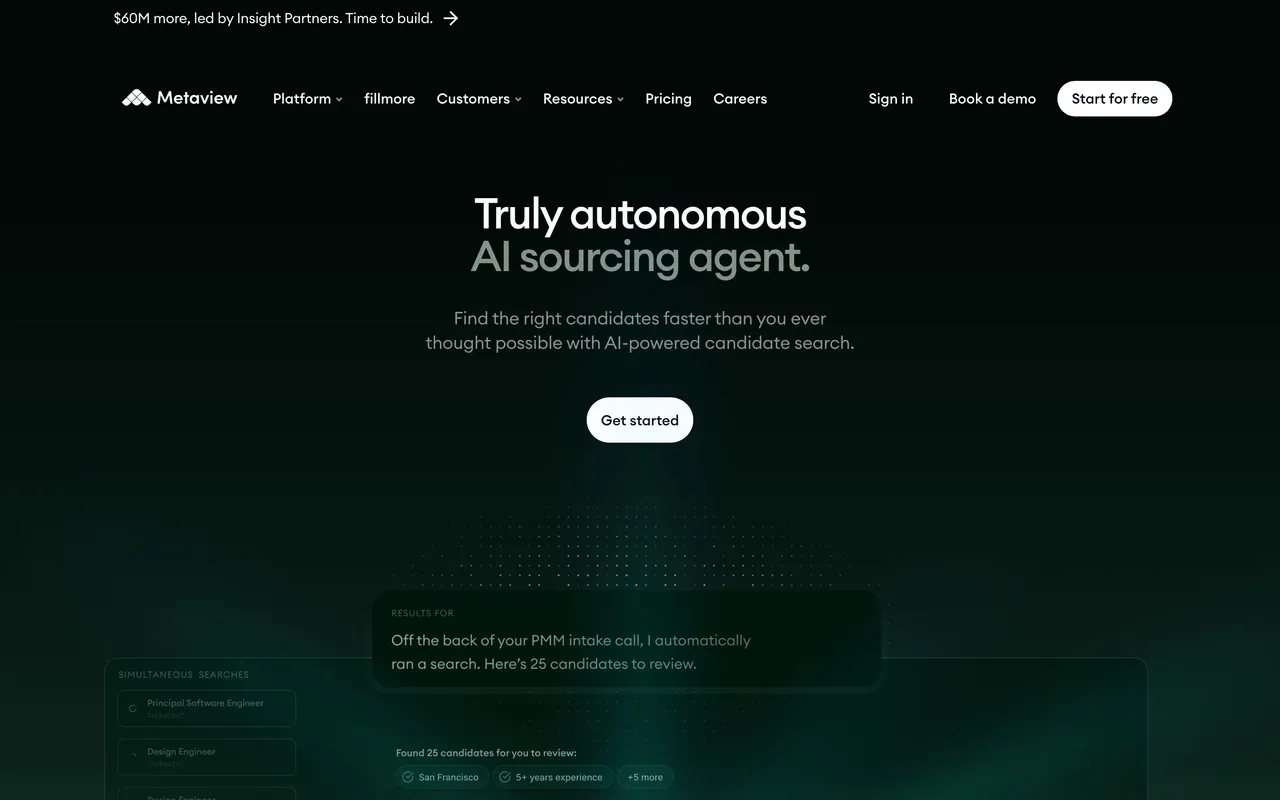
Metaview began with a narrow job: join a recruiter's interview, write the notes and fill the scorecard. It has since widened to an “agentic” platform. In September 2026 it announced a 60 million dollar Series C led by Insight Partners, more than 7,000 customer organisations and agents that source candidates before they apply and screen applications against the job brief (Reworked, 30 September 2026). The sourcing agent starts after the intake call and keeps searching, and in October 2026 the vendor made its sourcing and review agents faster and added employer filters such as funding stage and investors.
For a hiring team that interviews a lot, this is a coherent story: one vendor for notes, scorecards, screening and a sourcing agent. The question for a sourcing-heavy recruiter is different: how good is the search itself, and does it also run the outreach? The sourcing page we checked names web search as its source but not which profile databases, does not state outreach channels, and does not mention XING, which matters in DACH. More on Metaview in our Metaview alternatives for non-English interviews and Juicebox vs Metaview.
Which finds more matching candidates (PeopleSearchBench, Recruiting)?
In the Recruiting area of the open PeopleSearchBench, Metaview is not part of the published field, so there is no official Metaview score. Atlas reaches 73.5 out of 100 in our own re-measurement, converted to the published scale, and returns almost always 15 matching profiles per recruiting search (14.2 on average).1
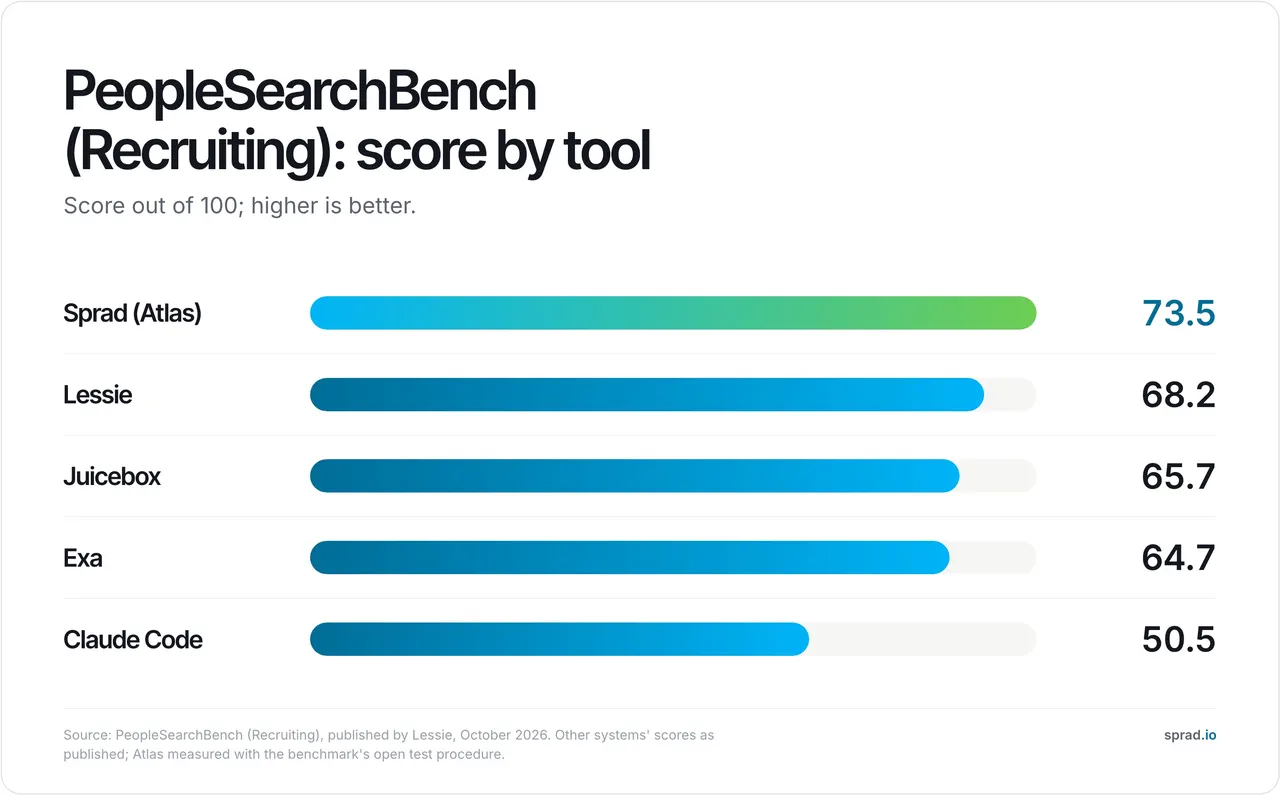
1 PeopleSearchBench (Recruiting), published by Lessie, October 2026. Other systems' scores as published in the benchmark; Atlas measured with the benchmark's open test procedure. Contact data came from the “find email” button. Method and details.
Our own test, with limits. On 15 August 2026 we put the same three open roles into four sourcing tools, among them Metaview, and into Atlas, and asked one question: of the people the others found, how many did each system find too? Atlas covered 38 %, Metaview 5 % (218 profiles reviewed, each system's own hits removed). Read it carefully: it is one run with three roles, it measures overlap rather than quality, and Metaview has changed since August (faster agents, new filters in October). Treat it as a reason to test your own role, not as a verdict.
Why does the method matter? In a keyword or semantic filter search a profile matches if the right words are on it, so a thinly maintained profile never surfaces. Atlas reads each profile against your requirements, which is why it also finds people without the “right” keywords. A practical test from our experience: if results appear instantly, it is almost always a filter or semantic keyword search. Sprad's Quick Search returns first results in about three seconds; the deep search takes a few minutes because far more AI runs per profile. Deep Context goes one step further and finds the companies first, then the people who worked there in a period, for example a CFO who led an acquisition or someone who built a start-up through Series A and B. Sprad has built recruiting software for seven years, starting with employee referrals, which is the same job: matching profiles to requirements. More on the method: Boolean vs requirement search.
How do outreach and the inbox compare?
Metaview sells outreach as its own product; the sourcing page does not say through which channels it writes. Check this in a demo: ask where a LinkedIn message is sent from, where the reply lands and whether a colleague is warned before contacting the same person.
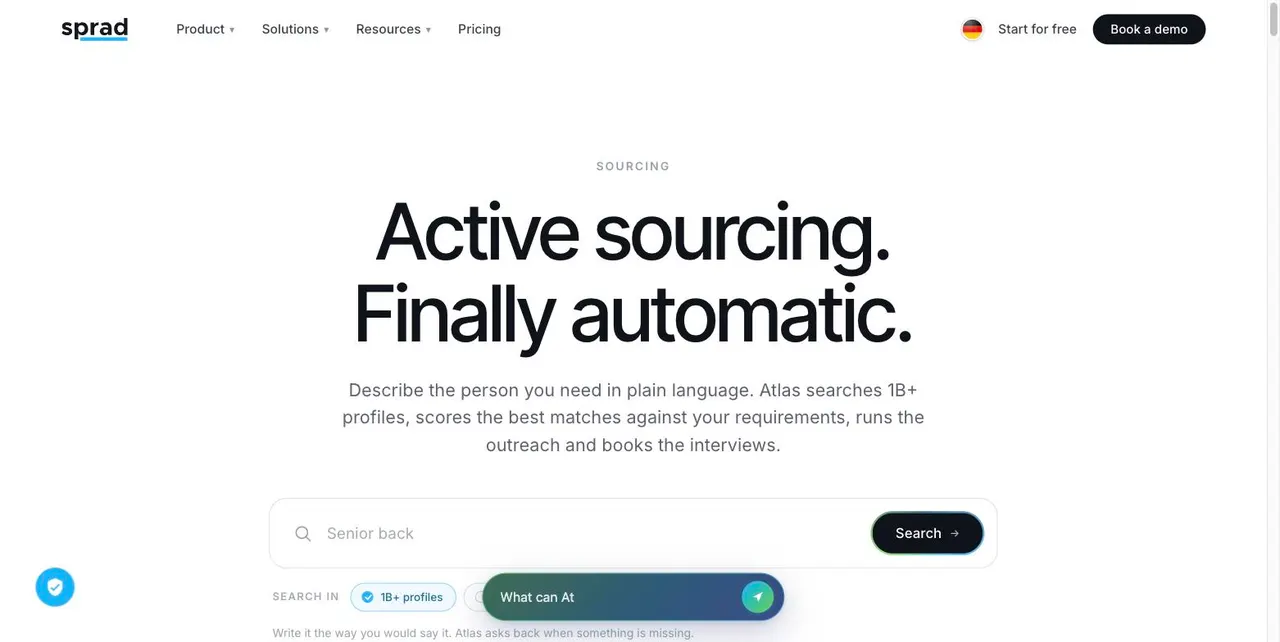
Sprad runs LinkedIn and email in one inbox: automated outreach with follow-ups, InMails sent from Sprad (your own allowance can be used), AI templates you train with feedback and a pitch format where you store the selling points of the role. We recommend the combination of email and LinkedIn because it is the biggest lever on reply rates. Per talent you see the whole conversation, and the system warns you if someone was already contacted, also by a colleague or for another role. Sprad also searches networks other tools do not see: your own LinkedIn network once uploaded, the networks of your employees and, for agencies, the connected networks of former candidates. WhatsApp is available for talking to candidates, but not for cold first contact, and there is no SMS channel.
How do price and credits compare?
Metaview lists its sourcing tiers per user and month, billed monthly: Free with the first 100 profiles, Pro at 100 $ with 200 profiles per month, Max at 300 $ with unlimited profiles, Enterprise by quote. Notetaker, application review and the full agent platform are not priced on that page (vendor pricing page, 30 October 2026). Sprad starts free with 100 credits a month, Recruiter Lite costs 79 € (95 $) per seat and month with 500 profiles and Quick and Normal searches included, and Atlas Recruiter costs 299 € (359 $) with unlimited (fair use) searches of every depth and one automated outreach account. Credits are for the whole company, not per seat.
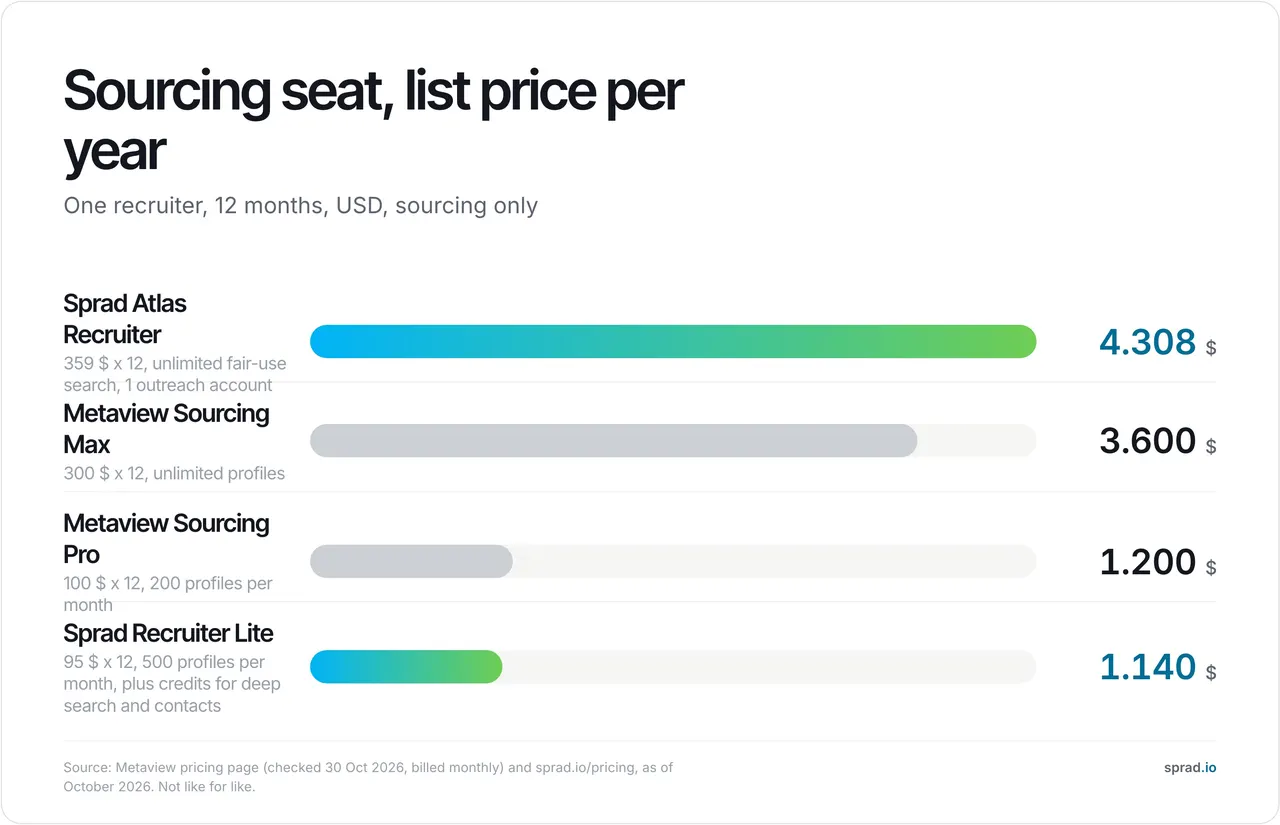
Worked example, list prices, no discounts. One recruiter, 12 months, sourcing only: Metaview Pro 100 $ × 12 = 1,200 $; Max 300 $ × 12 = 3,600 $. Sprad Recruiter Lite 95 $ × 12 = 1,140 $; Atlas Recruiter 359 $ × 12 = 4,308 $. Five recruiters on the entry tier: Metaview Pro 5 × 100 $ × 12 = 6,000 $ for 1,000 profiles a month in total; Sprad Lite 5 × 79 € × 12 = 4,740 € (about 5,700 $) for 2,500. Atlas Recruiter is dearer per seat than Metaview Max; the difference pays for 10 Deep Context searches a month and an included outreach account, which on the Metaview side is a separate product. Contact data on Sprad: an e-mail costs 1 credit, a phone number 10 credits, paid only if found (300 e-mails about 30 € at about 0.10 € per credit, assumption). The numbers are not like for like, because a Metaview “sourced profile” and a Sprad profile are counted differently; ask both vendors for a price on your seat count, your profile volume and the products you need alongside. Teams that currently pay separate LinkedIn and XING recruiter licences save 30–80 % with Sprad, depending on the licence mix. Current plans: sprad.io/pricing.
How do compliance and data compare?
Two different data flows are involved. Sourcing processes data of people who have not applied. In the EU that usually rests on legitimate interest (Article 6(1)(f) GDPR, see the EDPB guidelines 1/2024), brings an information duty (Article 14) and a right to object. Interview recording, Metaview's core, needs the consent or another legal basis of everyone on the call; in several US states all parties must agree, and in Germany secretly recording the spoken word is a criminal offence (§ 201 StGB). Tell candidates before you record. The EU AI Act lists AI systems used to select or filter applicants as potentially high-risk (Annex III), so a human decides and the tool should explain its results; in New York City, Local Law 144 requires a bias audit and notice for automated employment decision tools. Metaview is a US vendor and shows GDPR and SOC 2 Type II badges on its site; those are its own statements, so ask for the report, the data processing agreement and the storage location. Sprad is hosted in the EU and built to the data protection and IT security standards of enterprise, public-sector and insurance customers, valid for Europe and the US. This is orientation, not legal advice; see also active sourcing and GDPR.
When is Metaview the better choice?
- Your main pain is interview documentation: notes, scorecards and structured feedback written automatically and synced to your ATS. Sprad has no AI call notetaker.
- You want screening conversations and application review from the same vendor, for example coding questions or role-plays for technical and sales roles.
- You hire mostly in US tech and your volume is moderate: the free sourcing start and the 100 $ Pro tier are easy to try, and the vendor is well funded and widely used.
Who should choose Sprad, who should combine?
- Choose Sprad if the share of really matching profiles is the pain, if LinkedIn and email should run in one inbox without double contact, if you source in DACH and Europe where XING matters, or if you are an agency that wants to search its own talent pool and keep it after cancelling.
- Combine if Metaview already documents your interviews: keep it for that, run the search and outreach in Sprad and count how many of the first 15 profiles you would really contact.
Typical mistakes we see: buying a documentation tool and expecting a search engine; comparing profile allowances without checking how a “profile” is counted; not asking which channels the outreach really uses; recording interviews without telling candidates; letting two recruiters contact the same candidate from two tools. More comparisons: Juicebox alternatives and active sourcing tools compared. More on the product: Active Sourcing.
FAQ
How does Sprad Atlas compare with Metaview?
Metaview grew out of interview notes and added sourcing, review and screening agents. Atlas starts with the search: every profile is checked against your requirements, and LinkedIn and email run in one inbox. Atlas has no call notetaker.
Which finds more matching candidates?
In the Recruiting area of the PeopleSearchBench Atlas reaches 73.5 out of 100 in our own re-measurement, converted to the published scale; Metaview is not in that field. In our own three-role test (Sprad, 15 August 2026) Atlas covered 38 % of the others' finds, Metaview 5 %. Test both on one open role.
How do price, outreach and compliance compare?
Metaview sourcing: Free for the first 100 profiles, Pro 100 $, Max 300 $ per user and month; other products separate. Sprad: free start, Recruiter Lite 79 €, Atlas Recruiter 299 €. Sprad automates LinkedIn and email in one inbox and is hosted in the EU; for Metaview ask for the outreach channels, the DPA and its audit report.
When is Metaview the better choice?
When interview notes, scorecards and screening synced to your ATS are the main job and sourcing is a bonus.
Can I use Sprad and Metaview together?
Yes. Metaview can document interviews while Sprad finds candidates, contacts them on LinkedIn and email and keeps your talent network.
Jürgen Ulbrich
Jürgen Ulbrich has more than a decade of experience in developing and leading high-performing teams and companies. As an expert in employee referral programs as well as feedback and performance processes, Jürgen has helped over 100 organizations optimize their talent acquisition and development strategies.