A talent pool built from job ads is a database of applicants who did not get the job today but may fit the next one. To build it, ask for consent at the first contact, pre-screen every applicant with a few must-have questions, tag them by role, region and availability, and store them in a system you own. Every ad should feed this pool instead of ending in an email folder. As of October 2026.
Why most job ads waste their reach
A job ad on Facebook or Instagram buys attention once. When the role is filled, most setups throw that attention away: the applicants who did not fit this week sit in an inbox, a spreadsheet or a job board account you cannot take with you. The next vacancy then starts from zero, and you pay for reach again.
A simple, illustrative calculation shows the size of the loss. A US benchmark by Boostpoint, covering 891 Meta job campaigns in 2026, found a median cost of $13.88 per applicant. At that median, a $1,000 budget produces roughly 70 applicants. Say you hire one person and about a third of the rest fit similar roles and agree to be contacted. That is more than 20 pre-qualified people for the next opening, from a budget you have already spent. These are assumptions for illustration, not results, and an applicant is a completed form, not a hire.
What a talent pool is, and what it is not
- Talent pool: people who showed interest and were checked, stored with consent, ready to be contacted for future roles.
- Talent pipeline: the candidates currently moving through a specific hiring process. The pool feeds pipelines.
- An email folder or a spreadsheet: storage without tags, consent record or reminders. It cannot be searched, so nobody uses it.
- Rented reach: candidate pools that belong to a job board or platform. You see them while you pay, and lose them when you stop.
Most guides on this topic describe talent communities for office roles: career-site sign-up pages, alumni networks, LinkedIn outreach. For nurses, drivers, technicians or warehouse staff the main source is different. It is the applicants your ads already produce.
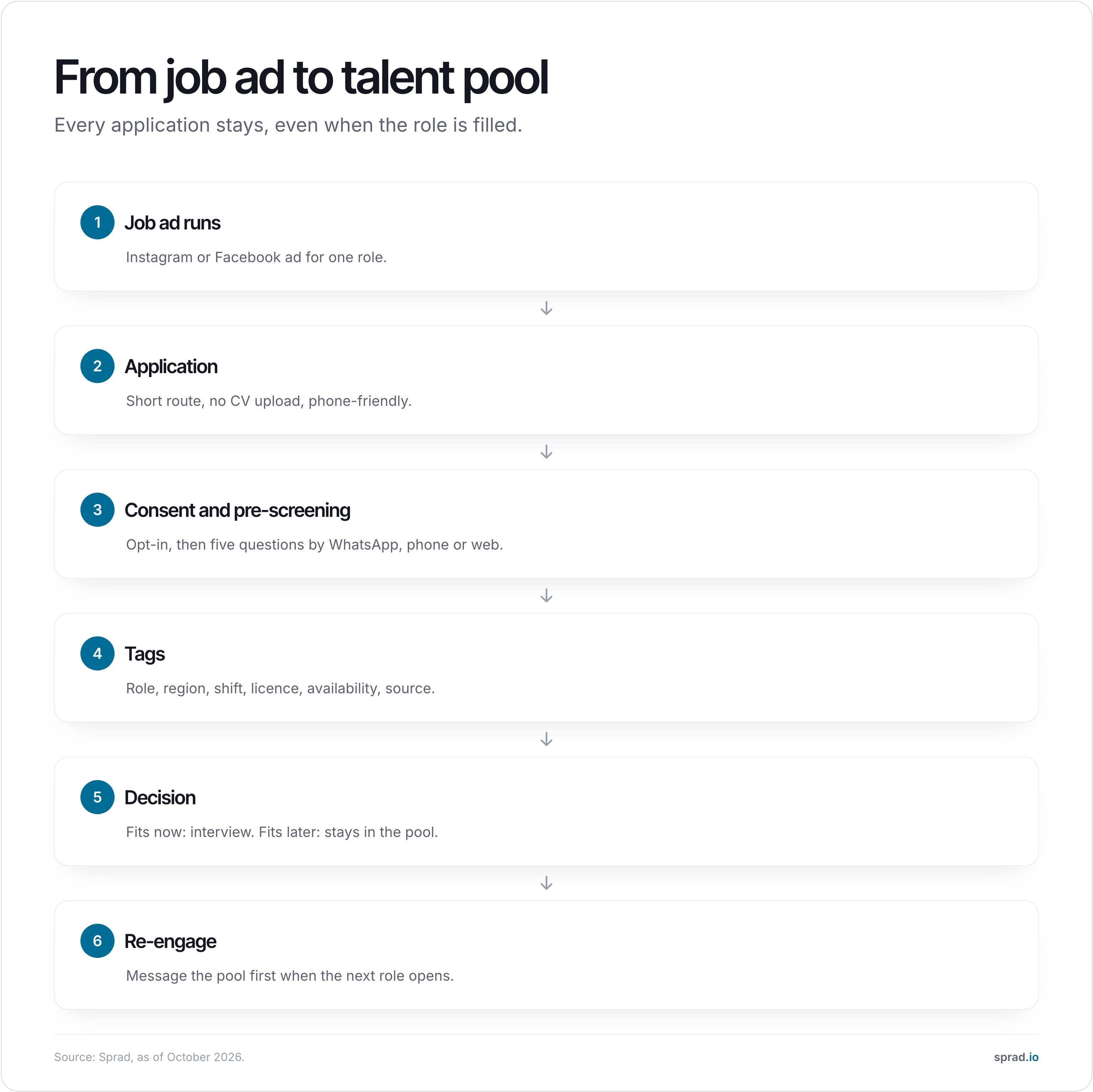
Six steps from job ad to talent pool
1. Run the ad for a role, and say that you keep applications
Write the ad for one concrete role, with place, pay and shift. In the application route, add one sentence: if the role is filled, you would like to keep the application for future openings. That sentence turns a one-off application into a pool entry and it is the basis for the consent in step 3.
2. Keep the application short
Frontline candidates apply on a phone. A form with three to five fields and no CV upload loses fewer people than a long one. The details are in our guide to frontline recruiting by phone and WhatsApp, not email.
3. Ask for consent in the first message
Do not add people to a pool silently. Ask for a clear opt-in, separate from the application itself, and record when and how it was given. Under the GDPR, consent must be demonstrable and revocable at any time. A short message works: "We can keep your details for up to 12 months and contact you about similar jobs. Reply YES to agree, or STOP at any time."
4. Pre-screen with five questions
A pool full of unchecked contacts is a list, not an asset. Ask the must-haves right away: licence or certificate, shift availability, region, earliest start, pay expectation. For high volumes this works best by chat, phone or web form; see screening frontline applicants the way you screen office roles. Everyone who answers is checked; people who do not fit today are not rejected silently but marked "fits later" or "does not fit".
5. Tag every candidate
Tags are what make the pool searchable. Keep them few and consistent:
| Field | Example values | Why it matters |
|---|---|---|
| Role family | nursing, driver, warehouse, electrician | First filter for any new opening |
| Region | city or radius around a site | Frontline candidates rarely relocate |
| Qualification | licence class, certificate, years of experience | Checks the hard requirements |
| Availability | shifts, notice period, earliest start | Decides whether a message is useful now |
| Source | ad campaign, referral, walk-in | Shows which channel fills the pool |
| Consent | date, wording, channel, expiry | Legal basis for every later contact |
6. Contact the pool first when the next role opens
Before you buy new reach, message the matching tags. A short WhatsApp message with role, place and pay costs almost nothing and reaches people who have already shown interest. Only when the pool does not deliver do you start a new campaign, and every new applicant again flows into the pool.
Data protection: consent and retention
This section is general information, not legal advice. Clear the details with your data protection officer.
- EU and UK: storing applications beyond the current process needs a legal basis. In practice that is the candidate's consent, given separately and for a stated period. Many employers use 12 months and ask again before it ends. Keep the record of consent and delete on request.
- Germany: claims under the General Equal Treatment Act (AGG) must be raised within two months after the rejection, which is why many employers delete unsuccessful applications after about six months unless the candidate agreed to stay in the pool.
- United States: federal rules require employers to keep hiring records for one year; state laws differ, and contacting people by text message needs their agreement.
Keeping the pool alive
A pool that nobody touches goes stale within months: people change jobs, phone numbers and plans. Three habits keep it useful.
- Contact each quarter with something relevant, such as a new opening in their region or a short question whether they are still looking.
- Refresh the data when someone answers. Update availability and region, and remove people who say no.
- Measure four numbers: pool size, share you can still contact, reply rate to a message, and share of hires that came from the pool.
Typical mistakes
- Saving every application "just in case" without consent or a deletion date.
- No pre-screening, so nobody knows who in the pool actually fits.
- Tags that differ by recruiter ("driver", "Driver", "CDL").
- Storing the pool on a platform that you lose when you cancel.
- Writing to the pool only when you are desperate, instead of every quarter.
What to look for in talent pool software
| Criterion | Question to ask |
|---|---|
| Ownership | Does the pool stay with you if you stop paying, and can you export it? |
| Intake from ads | Do applicants from job ads flow in automatically, with their source? |
| Consent | Is consent stored with date, wording and expiry, and can a candidate withdraw it? |
| Pre-screening | Can the tool ask must-have questions by WhatsApp, phone or web? |
| Search and tags | Can you filter by role, region, qualification and availability in seconds? |
| Handover | Can qualified candidates move into your ATS or HR system? |
| Hosting | Where is the data stored, and is there a data processing agreement? |
How Sprad builds the pool from your ads
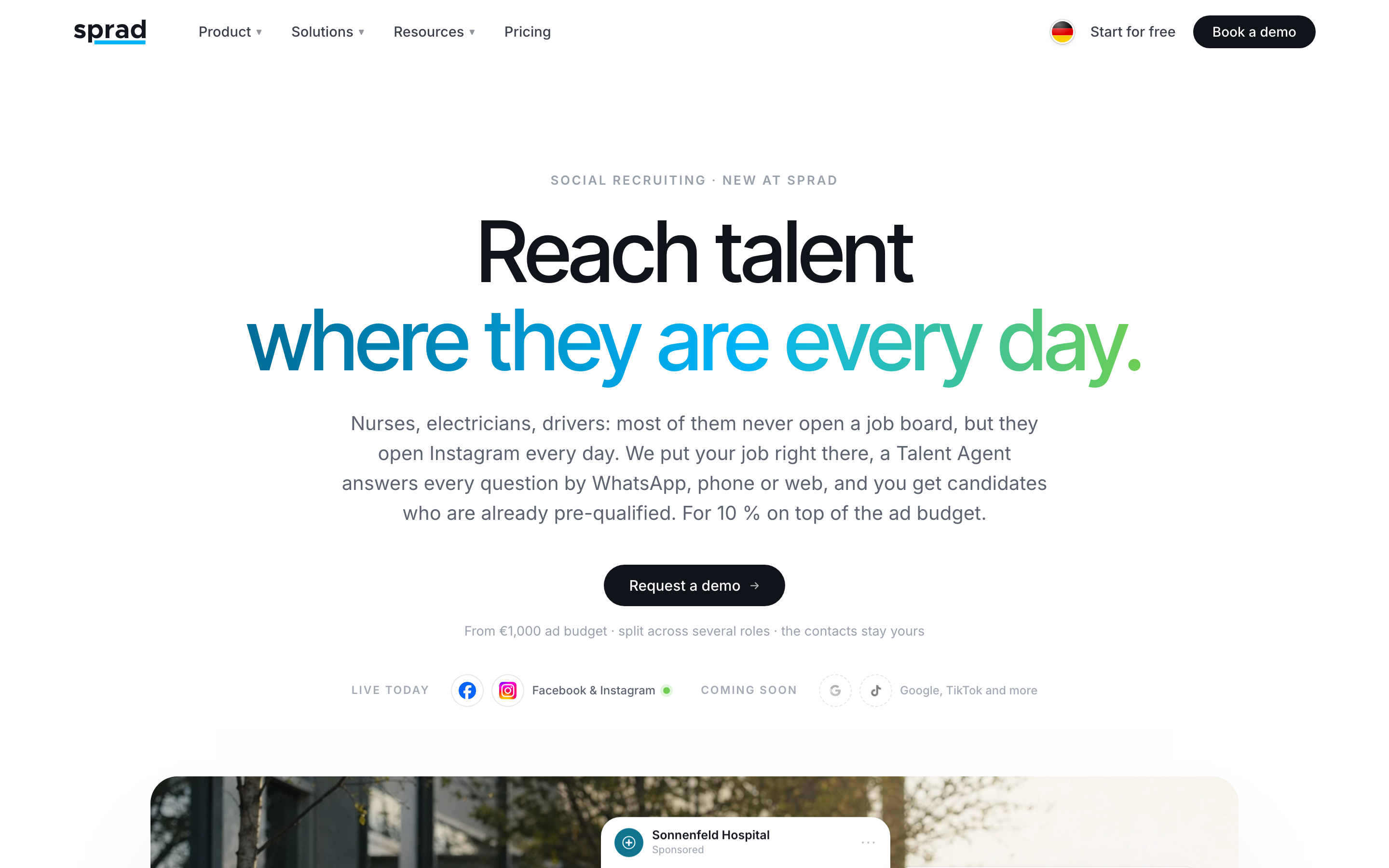
Sprad Social Recruiting runs job ads on Instagram and Facebook, where nurses, tradespeople, drivers and other frontline workers spend time every day. An AI talent agent pre-screens every applicant via WhatsApp, phone or web. Every applicant lands in your own talent pool, so the relationships stay with you instead of a platform. Pricing is ad spend plus 10 %, from a €1,000 budget that can be split across roles. For sectors such as healthcare or logistics, the second role then starts with people you already know. Details are on the Social Recruiting page.
FAQ
How big does a talent pool need to be?
There is no magic number. A pool of 100 tagged, consented and pre-screened people in one region is worth more than 5,000 unchecked contacts. Start with the roles you hire most often.
How long can I keep applicants in a talent pool?
Only as long as your legal basis covers. With consent, many employers use 12 months and renew the consent before it expires. Without consent, delete unsuccessful applications after the retention period that applies to you.
Is a talent pool the same as an ATS?
No. An ATS manages candidates in a running process. A talent pool keeps people for future processes. Good tools combine both, so a candidate can move from pool to process and back.
Can I build a talent pool without LinkedIn?
Yes, and for frontline roles you should. Applicants from Instagram and Facebook ads, referrals and walk-ins are the most relevant source, because these people applied to you.
Do I need consent to contact someone who applied?
For the role they applied to, you may contact them. For other, future roles, ask for consent first and record it. Rules differ by country, so check with your data protection officer.
Jürgen Ulbrich
Jürgen Ulbrich has more than a decade of experience in developing and leading high-performing teams and companies. As an expert in employee referral programs as well as feedback and performance processes, Jürgen has helped over 100 organizations optimize their talent acquisition and development strategies.