A thank-you email after an interview is a short message (80 to 150 words) that you send to every interviewer within 24 hours: thank them, name one specific thing from the conversation, say in one sentence why you fit, and close with the next step. In a Robert Half survey, 80% of HR managers said they take thank-you messages into account, yet only 24% of applicants send one. It will not rescue a weak interview, but it costs ten minutes and sets you apart from three out of four candidates.
Do you really need a thank-you email after an interview?
You do not need one, but you should send one. The best US data is older but still the clearest: an Accountemps survey of more than 300 HR managers (November 2017) found that 80% consider thank-you messages when deciding whom to hire, while applicants sent them in only 24% of cases (51% in 2007). A more recent Robert Half guide puts the effect more soberly: 27% of US hiring managers say that between equally qualified candidates, a thank-you message makes a positive impression that can tip the scales.
Read both numbers as what they are: US surveys, self-reported, not proof that a note gets you the job. From our side, after years of building recruiting software, the pattern is simple. A thank-you email rarely decides an offer. It matters in close calls, it keeps you in the interviewer's inbox while the team compares candidates, and a sloppy one can hurt. The risk of not sending is small, the risk of a careless one is real, so write it properly or keep it short.
When to send it
Within 24 hours is the standard in the US and UK, and Robert Half's 2012 survey of more than 500 HR managers says the same. In Germany and Austria, guides such as the one from karriere.at (updated March 2025) recommend 24 to 48 hours. Do not wait longer than two days: after that the note reads as an afterthought.
| Situation | When to send | Note |
|---|---|---|
| Interview in the morning | Same evening or next morning | Do not send it from the lobby; it looks pre-written |
| Interview in the afternoon | Next morning | Aim for before noon |
| Interview on Friday | Monday morning | Or Friday evening if it is a short, warm note |
| Panel with 3 to 5 people | Within 24 hours, one email each | Change one detail per person |
| Phone screen with a recruiter | Same day or next morning | Two to three sentences are enough |
| Final round, several days on site | After the last day | Thank the whole team, mention your next-step question |
| You forgot | Send it within 3 to 4 days | Keep it short, no apology essay |
How to write it, step by step
Use this structure. It fits on one screen and works for first rounds, panels and video calls alike.
- Subject line: plain and findable, for example "Thank you, [Role] interview on [day]". Not "Hi!" and not a slogan.
- Greeting: use the name and tone the interviewer used with you. "Dear Ms. Alvarez" if in doubt.
- Thanks plus one concrete detail: something only this conversation contained, such as a problem the team described or a tool they use. This is the sentence that proves the email is not a template.
- One sentence on fit: connect that detail to something you have done. Evidence, not adjectives.
- Next step: offer a work sample or answer to an open question, or say you look forward to the next step. Do not ask "when will I hear back?" here.
- Sign-off: name, phone, LinkedIn link if you have one. Proofread it aloud once.
Worked example of the detail sentence. Weak: "I enjoyed learning more about the role." Better: "You mentioned that onboarding for new warehouse leads takes eight weeks; at my last job I cut that to five by building a shadowing checklist, and I would be glad to share it." The second version gives the reader something to answer.
Thank-you email templates after an interview (copy and adapt)
Replace everything in brackets. A template that still contains a bracket, or the wrong company name from your last application, is the most common way these emails backfire.
1. After a first or standard interview
Subject: Thank you, [Role] interview on [day]
Dear [Ms./Mr. Name],
Thank you for taking the time to speak with me about the [Role] position today. I especially appreciated hearing how [specific topic from the conversation].
That is close to what I did at [previous employer], where [one result in numbers]. I would be glad to share more if useful.
I am very interested in the role and look forward to the next steps.
Best regards,
[Name], [phone]
2. After a panel or several interviewers
Subject: Thank you, [Role] interview
Dear [Name],
Thank you for the conversation today. Your question about [their question] made me think again about [topic], and I would add that [one sentence of substance].
I enjoyed meeting you and [colleague names] and am excited about the team's plans for [project].
Kind regards,
[Name]
Send each person their own email with a different detail. If you only have one address, write one email and address each person by name in a line of their own.
3. After a phone or video screen with a recruiter
Subject: Thank you for the call
Dear [Name],
Thank you for the call today and for the overview of the [Role] role and the process. I confirm my availability for [next step] on [date]. Please tell me if you need anything else from me, such as references or portfolio samples.
Best regards,
[Name]
4. After a final interview with a decision date
Subject: Thank you, final interview for [Role]
Dear [Name],
Thank you for the time you and the team invested in the final round. Our discussion about [topic] confirmed that I would like to work on [specific challenge]. If it helps your decision, I can send [reference, work sample or a 30-60-90 day outline].
I understand you plan to decide by [date] and look forward to hearing from you.
Kind regards,
[Name]
Follow-up email after the interview: how long to wait
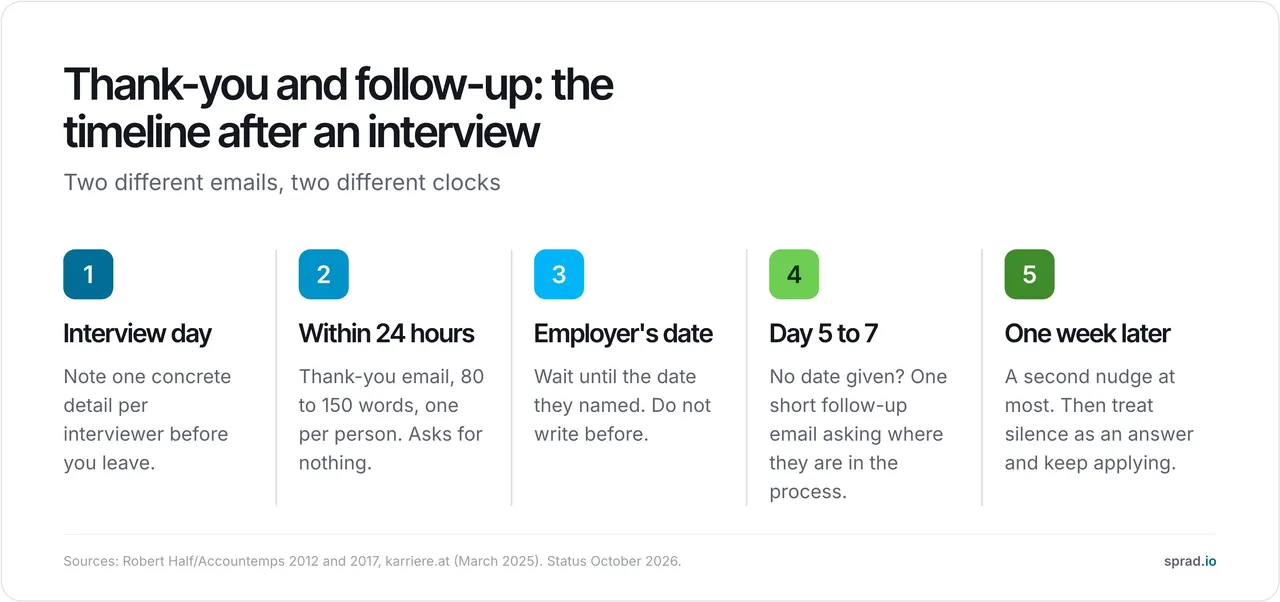
A thank-you email is not a follow-up. The thank-you goes out within a day; the follow-up asks for news. Wait until the date the employer gave you. If they gave none, Robert Half's advice is to follow up by email or phone after about a week without news, without overdoing it. In practice: one follow-up after 5 to 7 working days (or one working day after the promised date), a second after another week at most, then stop.
Subject: Following up, [Role] interview on [date]
Dear [Name],
I wanted to follow up on the [Role] position we discussed on [date]. I remain very interested and would be happy to provide anything that helps your decision. Could you tell me where you are in the process?
Thank you and best regards,
[Name]
Silence is common. In the Greenhouse 2024 State of Job Hunting report (2,500 workers in the US, UK and Germany), 61% of job seekers said they had been ghosted after an interview. After your second follow-up, treat no answer as an answer and keep applying elsewhere.
Mistakes that cost you the effect
- Wrong name or company from a copied template. Check the first line against the invitation.
- Generic text. If you can send it to any employer, it says nothing.
- Too long. More than about 150 words and nobody reads it. The interview was your pitch.
- Using the email to raise a new problem (salary, remote work) or to ask for feedback on your performance.
- Typos. Robert Half names errors as a top thing to avoid; a typo in a thank-you note undoes its purpose.
- A text message instead of an email, unless you already text with the interviewer.
- Pestering: three emails in four days, or contacting the interviewer on private channels.
- Waiting a week. The note no longer helps the team while it compares candidates.
Channel matters less than people think. In the 2012 survey, 87% of HR managers called email appropriate, 81% a phone call, 38% a handwritten note and 10% a text; email was also the way most thank-yous actually arrived (62%).
Thank-you emails in the US, UK and DACH
| Region | Tone | Timing | Language |
|---|---|---|---|
| USA | Warm, first names common once used by the interviewer | Within 24 hours | Short, confident, one result |
| UK / Ireland | Polite and understated, little self-praise | Within 24 hours | "Kind regards", no exclamation marks |
| Germany / Austria / Switzerland | Formal ("Sehr geehrte Frau …"), less common but welcome | 24 to 48 hours | Write in the language of the interview; avoid stock phrases |
These are conventions, not rules. Follow how the interviewer wrote to you.
How AI changes the thank-you email
AI is useful for the first draft and risky for the finished text. A chatbot cannot know what was said in the room, so unedited output is exactly the generic text hiring managers dislike. Use it the other way round: give it your notes and let it tighten.
Here are my notes from today's interview for [Role]: [3 to 5 bullet points: topics, their problems, names]. Write a thank-you email of at most 120 words in a friendly but professional tone. Use only facts from my notes, do not invent anything, include one concrete detail, end with the next step: [next step].
Then check three things: every fact comes from your notes, the detail is genuinely yours, and it sounds like you. Do not paste the interviewer's private data or confidential material from the interview (for example case-study numbers under an NDA) into a public tool. And never use AI during the interview itself; many employers forbid it. If you want to practise the conversation before it happens, see our guide on AI in candidate interviews and what is allowed in the EU.
Where Atlas fits: before the interview
Atlas Career writes no thank-you emails and sends nothing for you. It helps earlier, with the material your email needs: it searches 1.5M+ active jobs straight from employers' career sites, gives each role a match score with reasons and tailors a CV (and a cover letter on request) for every application, free and with no limit. The reasons behind a match score are a list of what the employer cares about. Keep them next to your interview notes and you will find the "specific detail" for your thank-you email in minutes.
Try Atlas, compare it with others in our best AI job search tools 2026 or read what an AI career agent is. Interview notes next: common interview questions with AI practice, and if an offer comes, our salary negotiation script and email templates.
FAQ
Should I send a thank-you email after every interview?
Yes, after every round with a person, including short recruiter calls. Keep it shorter for early rounds and more specific for the final round.
How soon after an interview should I send it?
Within 24 hours (US, UK) or 24 to 48 hours (Germany, Austria). A Friday interview can be answered on Monday morning.
What should the subject line say?
Something clear and searchable: "Thank you, [Role] interview on [day]". It helps the interviewer find the thread later.
Do I thank each interviewer separately?
Yes. Send each person an email with one different detail, as Robert Half also advises. If you cannot get all addresses, ask the recruiter to pass your thanks on.
Is a thank-you email the same as a follow-up email?
No. The thank-you goes out within a day and asks for nothing. The follow-up comes after the employer's date, or after 5 to 7 working days, and asks for news.
Can I write it with AI?
Yes, for the draft, if you feed it real notes and rewrite it so it sounds like you. Never send unedited AI text, and never put confidential interview content into a public tool.
Should I send a thank-you email after a rejection?
A short, gracious reply is worth it: thank them, ask to stay in touch, no argument. It keeps the door open for future roles at no cost.
Sources and dates: surveys linked above (Accountemps/Robert Half 2012 and 2017, Robert Half guide, Greenhouse 2024, karriere.at March 2025). The survey figures are US-based and self-reported. Templates are examples; adapt them to the interview.
Jürgen Ulbrich
Jürgen Ulbrich has more than a decade of experience in developing and leading high-performing teams and companies. As an expert in employee referral programs as well as feedback and performance processes, Jürgen has helped over 100 organizations optimize their talent acquisition and development strategies.