You are underpaid if your base salary sits clearly below what employers currently pay for the same job, at the same level, in the same labour market. To find out, compare your base pay with three independent sources: one official wage statistic, one salary database and at least five live job ads that state a pay range. If the middle of those ranges is more than 10% above your pay, it is worth raising. The check takes about five minutes and costs nothing.
What does "am I underpaid" actually mean?
Underpaid is not a feeling and not "less than my friend earns". It is a gap between your base pay and the market rate for your job. The market rate is a range, not a number: a job with a median of $85,000 can legitimately pay $75,000 for a newcomer and $98,000 for a specialist. So the real question is where you fall inside the range for your level, your city and your industry.
Three terms matter. Base pay is the guaranteed salary before bonus and equity. Total compensation adds bonus, commission, equity and benefits. The median is the middle value: half of comparable people earn more, half less. Compare base with base and total with total. Mixing them is the most common reason people think they are underpaid, or fairly paid, when they are not.
How to check step by step
Step 1: describe the job, not the title
Titles are unreliable. A "Marketing Manager" runs a team of six at one company and writes newsletters alone at another. Write down five duties, your years of relevant experience, your seniority (junior, mid, senior, lead) and whether you manage people or budget. You will use this description to filter every source below.
Step 2: pull three independent ranges
One source can be wrong or skewed. Three that agree are a result.
- Official statistics. In the US the Bureau of Labor Statistics publishes median and percentile wages for about 800 occupations in its Occupational Employment and Wage Statistics; the all-occupations median for May 2025 was $50,980 according to the Occupational Outlook Handbook. In Germany use the Federal Employment Agency's Entgeltatlas, in Switzerland the Federal Statistical Office's Salarium, in the UK the ONS Annual Survey of Hours and Earnings. Statistics are reliable but lag by months and are broad.
- Salary databases. Sites that collect self-reported pay (Glassdoor, Payscale, Levels.fyi for tech and similar) are fresh and detailed, but small samples and self-selection skew them. Use the range, not the single figure, and note the sample size.
- Live job ads that state pay. This is the freshest evidence, because it is what employers offer today. It has become much easier: several US states, including Colorado, California, New York and Washington, require pay ranges in job postings (US Department of Labor, Women's Bureau, as of March 2023; the list has grown since). In the EU, Directive (EU) 2023/970 requires employers to give applicants the starting pay or range before the interview, and bans asking about your pay history. Member states had to implement it by 7 June 2026, and national status still varies, so check your country.
Step 3: take the middle, not the maximum
Collect at least five ads for your job at your level and write down the midpoint of each range. Take the median of those midpoints. Do the same for the database range. Then average the three source medians. The highest ad you saw is a data point, not your benchmark.
Step 4: adjust for the things the data cannot see
Move your benchmark up or down for location (a big-city premium of 10% or more is common), company size, industry (software and finance pay more than non-profits), scarce skills and your actual scope. Do not adjust for how hard you work. Markets pay for the role and the skills, not for effort.
Step 5: read the gap
Divide your base pay by your benchmark. Our working rule, not an official threshold: at 95% or more you are fairly paid; at 90 to 95% it is a grey zone worth watching; below 90% it is worth a conversation or a search for other offers.
A worked example
These numbers are an illustration with assumed values, not market data. A mid-level product marketing manager in the US earns a base of $78,000. Her three sources:
| Source | What she found | Median used |
|---|---|---|
| Official statistic (occupation, her region) | $72,000 to $104,000, median $85,000 | $85,000 |
| Salary database (mid-level, her metro) | $74,000 to $96,000, median $84,000 | $84,000 |
| Six live ads with pay ranges | midpoints $80,000, $82,500, $85,000, $87,500, $90,000, $92,500 | $86,250 |
| Benchmark (average of the three) | $85,083 |
Her ratio is 78,000 / 85,083 = 91.7%, so she sits about 8% under the benchmark: a grey zone. That is about $7,000 a year, or $35,000 over five years before any raises. Her next move is not to demand $90,000. It is to collect two more data points (a recruiter call, a peer in the same field) and prepare for the conversation. Our guide to salary negotiation scripts and email templates covers what to say.
Which tools and templates help?
| Source type | Strength | Weakness | Use it for |
|---|---|---|---|
| Official statistics (BLS, ONS, Salarium, Entgeltatlas) | Large samples, free, neutral | Lags, broad occupation groups | The anchor figure |
| Salary databases (self-reported) | Fresh, filter by city and level | Small samples, self-selected | The range for your level |
| Job ads with stated pay | What employers offer right now | Offers, not what current staff earn; top of range is optimistic | Reality check on today's market |
| Recruiters and peers | Context, total package | Anecdotal, biased | Confirming a hunch |
| Your own offers | The only price that counts | Takes time | Final proof |
A simple template is enough: a sheet with one row per source, columns for range, median, date and link, and one cell at the bottom for your ratio. Save the date. Pay data older than 12 months is stale in a fast-moving field.
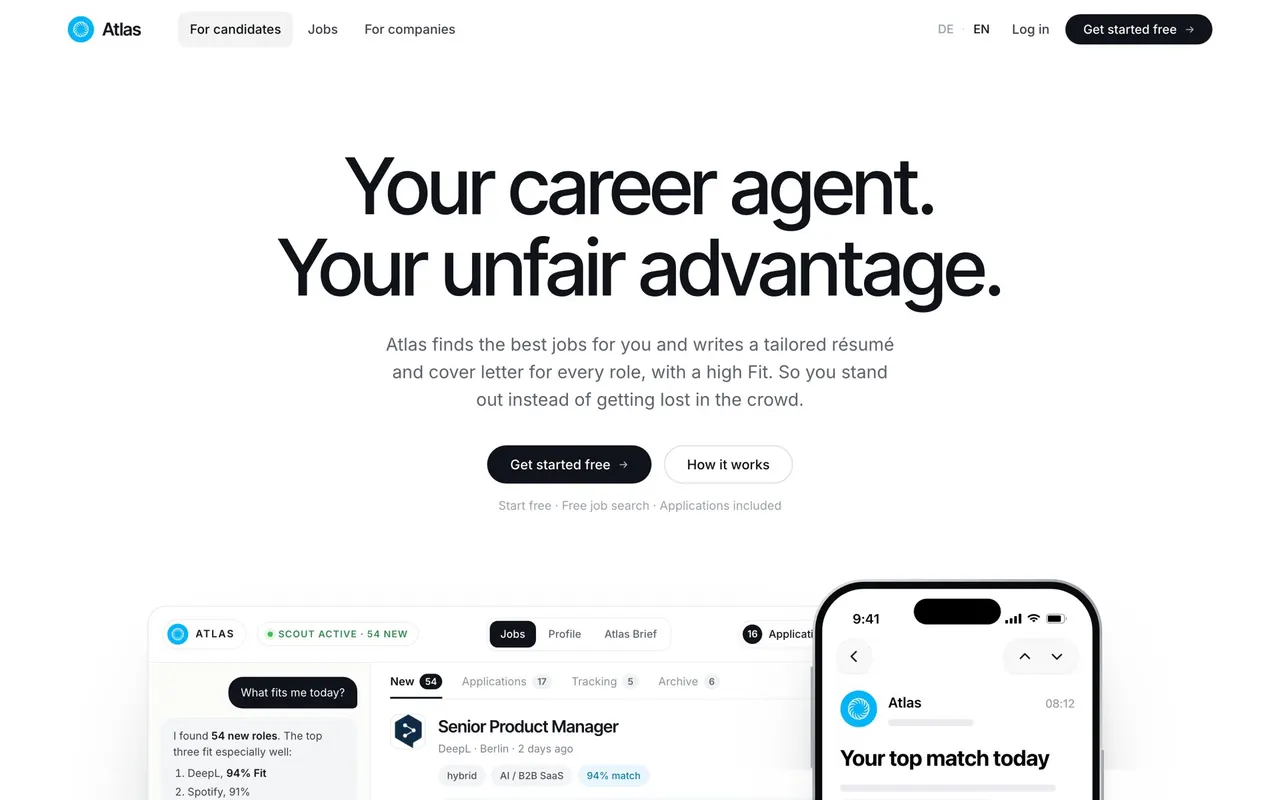
Live job ads are the step most people skip because they are tedious to collect. This is where Atlas Career helps. It is a free AI career agent that searches 1.5M+ active jobs straight from employers' career sites, shows a match score with reasons for each role, and lets you read what each ad states. Atlas is not a salary calculator: it shows pay only where the ad itself names it, so treat it as a source of Step 2 evidence, not a verdict. You review everything and apply directly to the employer.
Which mistakes should I avoid?
- Comparing with the all-occupations median. The $50,980 US figure above covers every job from cashier to surgeon. It tells you nothing about yours. Always filter by occupation.
- Mixing base and total pay. If an ad says "$95,000 OTE", that includes commission. Compare it with your base plus the commission you actually earn.
- Trusting one number. One database can show $110,000 for a job another puts at $82,000. Three sources shrink that error.
- Ignoring the date. A figure from 2023 understates pay in a market that has moved since.
- Comparing with a colleague only. Peers may be underpaid too. In the US, discussing wages with co-workers is protected under Section 7 of the National Labor Relations Act for most private-sector employees; in the EU, Directive 2023/970 gives workers a right to information on average pay for comparable work. Use both, but do not rely on either alone.
- Treating the result as a verdict. The check is a reason to talk, not proof for an ultimatum.
How does AI change the check?
AI helps with the slow parts: collecting and filtering many live ads, spotting that two titles describe the same job, and summarising a pay range from messy text. It does not know your employer's pay bands, and general chatbots often state a salary with false confidence and no source. Use AI to gather evidence you can link to, not to produce a number from memory. Our overview of what an AI career agent is explains what these tools can and cannot do, and the best AI job search tools of 2026 compare the options.
What should I do if I am underpaid?
First, decide what you want: a raise now, a raise at the next review, or a new job. If you have a grey-zone gap, ask for a review and bring your table. If the gap is over 10%, compare it with what your job search turns up: an offer at the market rate is the strongest argument and the best fallback. Either way, the market data from this check goes straight into your CV and interview preparation.
FAQ
How do I know if I am paid fairly?
Compare your base pay with the median of three independent sources for your occupation, level and location. Within about 5% of the median is fair; more than 10% below is worth acting on.
What is the best salary checker?
No single one. Official statistics give the anchor, databases give the range for your level, and live ads with stated pay show today's offers. Use all three and write down the dates.
Are salary comparison sites accurate?
They are good for a range and poor for a precise figure. Samples are small and self-reported, so always check the number of data points.
How much should I earn for my experience?
It depends on occupation, location and level, not on years alone. Two people with eight years of experience can differ by 30% if one manages a budget and the other does not.
Can I ask my employer what colleagues earn?
In the EU, Directive 2023/970 gives you the right to request your pay level and average pay for comparable work, once your country has implemented it. In the US you may discuss pay with co-workers, but there is no general right to see their salaries.
Is it rude to ask for a raise based on market data?
No. Asking with sources, a clear figure and your recent results is a normal, professional conversation.
Pay figures: US Bureau of Labor Statistics, Occupational Outlook Handbook, May 2025. Legal information as of October 2026, not legal advice.
Jürgen Ulbrich
Jürgen Ulbrich has more than a decade of experience in developing and leading high-performing teams and companies. As an expert in employee referral programs as well as feedback and performance processes, Jürgen has helped over 100 organizations optimize their talent acquisition and development strategies.