Talent mapping is the practice of researching a labour market before a role opens: you list the employers, job titles, locations and people that match a profile you will need, and keep that list current. The result, a talent map, tells you how many suitable people exist, where they work and whom to approach first. Recruiting fills one vacancy; talent mapping prepares the ground for the next ones.
What is the difference between talent mapping and similar terms?
Talent mapping is often mixed up with its neighbours. The cleanest way to separate them is to ask what each one produces and who is in it.
| Term | Question it answers | Who is in it | Output |
|---|---|---|---|
| Talent mapping | Who exists in the market for this profile, and where? | People you have not contacted yet | A structured map: employers, titles, locations, named people, priority |
| Sourcing | Who do I approach for this open role today? | A shortlist for one vacancy | Conversations and candidates |
| Talent pipeline | Who is already in conversation with us? | People you have contacted or who showed interest | Stages from first reply to offer |
| Talent pool | Whom do we already know? | Past applicants, silver medallists, referrals, alumni | A searchable database |
| Workforce planning | Which roles will we need, and how many? | Roles, not people | A hiring plan by quarter |
In practice the talent map is the front of the funnel: map first, then source from the map, then move the people who respond into your pipeline and pool. For the details of the later stages, see what a talent pipeline is and building a talent pool.
What goes into a talent map?
A useful map is small and specific. For one role family it holds:
- The profile: the three to five requirements that really decide fit (skills, level, language, location), kept apart from the nice-to-haves.
- Target employers: companies where people with this profile already work, including competitors, suppliers, customers and adjacent industries.
- Titles and variants: the different names the same job has (for example "Backend Engineer", "Software Developer Java", "Java Entwickler").
- Named people: from public profiles or your own database, with source, date found and the reason they fit.
- Priority: A (strong fit, approach first), B (partial fit), C (watch list).
- Market notes: typical salary range, how many employers hire the same profile, how scarce the role is.
How to do talent mapping in 6 steps
- Choose the role family, not the vacancy. Map roles you expect to hire at least twice in the next 12 months. A single one-off role does not justify a map.
- Write the profile in requirements. Must-have versus nice-to-have, in plain sentences. This is the filter for every later step; see how sourcing and recruiting split the work.
- Set the market boundary. Location or remote range, languages, industries. Wider boundaries find more people but dilute the fit.
- List target employers. Start with 15 to 30 companies. Add the ones your own employees and recent hires came from.
- Collect and rate the people. Search by requirement across public profiles and your own pool, and rate each person A, B or C against the profile. Record the source and date. A requirement-based sourcing search saves most of the manual list building here.
- Refresh on a fixed rhythm. Every quarter for scarce roles, every six months otherwise. Remove people who changed roles or asked not to be contacted.
Worked example: senior Java developer in Munich
The numbers below are assumptions for illustration, not market statistics. Replace them with your own.
| Step | Assumption | Result |
|---|---|---|
| Target employers listed | 25 companies in the Munich region | 25 |
| Matching profiles found per employer | 12 on average | 300 people |
| Fit after checking against the requirements | 40 % rated A or B | 120 people |
| Replies to a personal first message | 20 % | 24 conversations |
| Conversations that reach a first interview | 50 % | 12 interviews |
With these assumptions one map yields about 12 first interviews. If you expect three such hires a year and need roughly four interviews per hire, the map covers the demand once, and the quarterly refresh keeps it from going stale. If the map yields only three interviews, you know early that the market is too small and that you should widen location, accept remote or retrain adjacent profiles. That decision is cheaper before a vacancy is open than after.
When does talent mapping pay off?
- Scarce roles. The Federal Employment Agency counts 157 occupations with a skills shortage for 2025. Where few candidates exist, knowing them early is the advantage.
- Repeated hiring. Several hires in the same family per year share one map.
- New location or market. A map shows before a decision whether enough people exist there.
- Passive talent. Gallup's World Poll found that about half of employees worldwide are watching for or actively seeking a new job. Many are not applying, which is why a map beats a job ad for those people; see how to find passive candidates.
It does not pay off for high-volume roles with plenty of applicants, or for a one-time vacancy that you must fill next month.
What does the law say about talent maps?
A map with names is a collection of personal data, so GDPR applies. Three rules matter in practice (not legal advice):
- Legal basis: recruiting contact is usually based on legitimate interest under Art. 6(1)(f) GDPR, which requires a documented balancing test.
- Information duty: if you did not collect the data from the person, Art. 14(3)(a) requires you to inform them, at the latest within one month. Your first message is the natural place.
- First contact: email or phone approaches without consent can breach § 7 UWG in Germany; check the channel before writing. More in the active sourcing guide.
Keep only what the purpose needs, record the source, and delete people who object or who have not been relevant for a defined period (for example 12 months).
Which tools help with talent mapping?
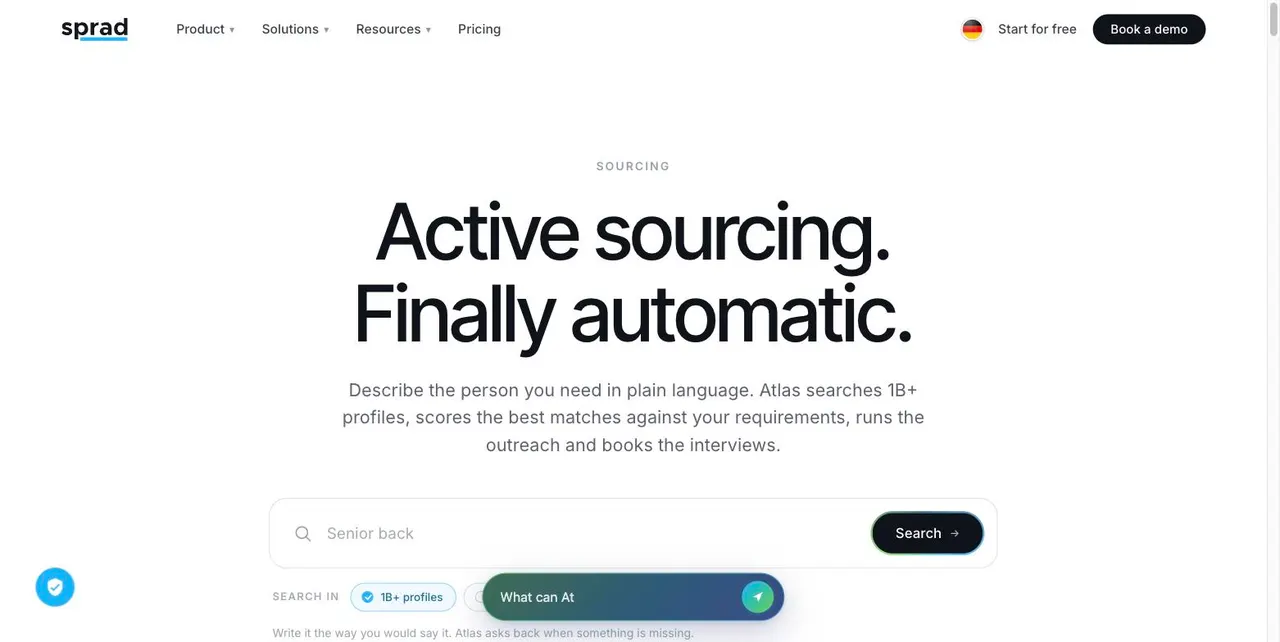
A spreadsheet is enough for one role family and about 100 people. Beyond that you need search by requirement and a place where the list lives. Sprad's Active Sourcing searches public profiles and your own network by requirement and explains the fit of each result; lists in the Talent Network hold the mapped people with notes and priority. A free account includes 100 credits per month, a profile shown in a web search costs 2 credits, and current prices are on the pricing page. Sprad is itself a vendor, so compare it with an ATS module or a spreadsheet for your case.
FAQ
What is the difference between talent mapping and a talent pipeline?
A talent map contains people you have not contacted; a pipeline contains people who are already in conversation with you. People move from the map into the pipeline when they reply.
How often should a talent map be updated?
Every quarter for scarce roles and every six months for the rest. People change employers, and a stale map sends messages to the wrong people.
How many people should a talent map contain?
Enough for the interviews you need. Work backwards: interviews needed, divided by your reply and interview rates, gives the number of A and B rated people. In the example above that is about 120.
Is talent mapping legal under GDPR?
Yes, when you have a documented legitimate interest, inform people within one month and delete data you no longer need. Details depend on country and channel.
Who does talent mapping?
Sourcers and recruiters in internal teams, and consultants in executive search. Hiring managers add the employers they know.
Jürgen Ulbrich
Jürgen Ulbrich has more than a decade of experience in developing and leading high-performing teams and companies. As an expert in employee referral programs as well as feedback and performance processes, Jürgen has helped over 100 organizations optimize their talent acquisition and development strategies.