What Juicebox is
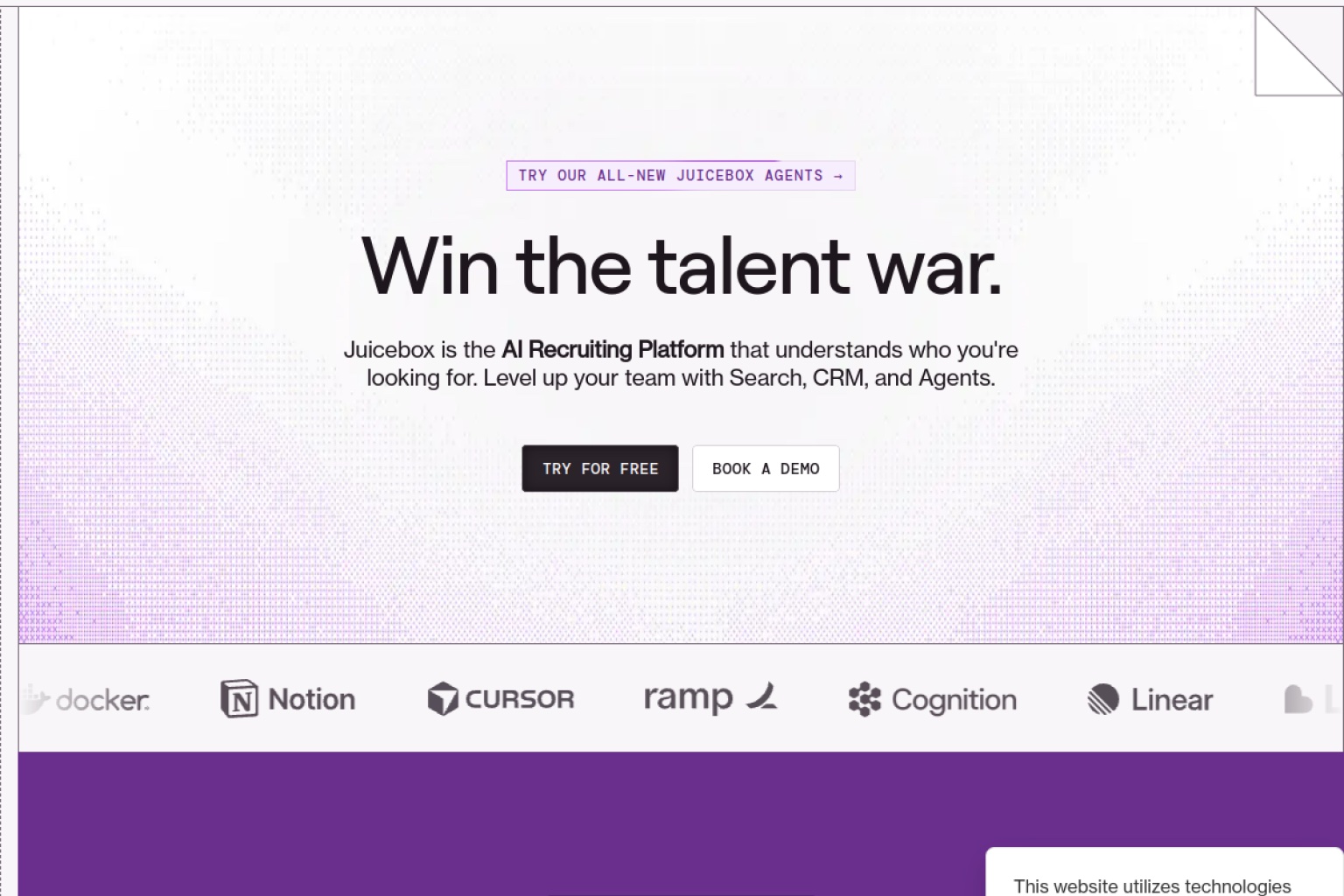
Juicebox is a specialised sourcing layer for recruitment teams. Its PeopleGPT product lets users describe a target profile in natural language, review the resulting profiles, prioritise candidates, and then export or contact them. It is not a complete recruiting suite: its public trust centre places the product before the application stage and says Juicebox neither makes nor contributes to candidate decisions. That boundary can be useful for organisations with an established ATS: sourcing and first contact are added, while applications, interviews, and hiring decisions remain in the existing system. Source: Juicebox Trust Center, accessed 20 August 2026.
Juicebox is a good choice where the bottleneck is at the top of the recruiting funnel. A recruiter may need to define a difficult talent profile, turn a large body of public profile data into a workable longlist, and move into controlled outreach without stitching several tools together. Its public packaging is especially relevant to individual recruiters, small recruiting teams, agencies, and startups; Growth is presented for small teams, agencies, and startups, while Business is positioned for larger businesses and agencies. Source: Juicebox Pricing, accessed 20 August 2026.
| Criterion | Juicebox position |
|---|---|
| Category | AI-enabled active sourcing, candidate research, and recruiting outreach; not a full native ATS. |
| Target market | Recruiters, search firms, and hiring teams looking for hard-to-find or passive talent. |
| Pricing model | Per-seat monthly pricing, a free tier, monthly or annual billing for Starter and Growth, a custom Business plan, and a separate Agent add-on. |
| Public price | Free: US$0; Starter: US$99 annually billed or US$119 monthly; Growth: US$179 or US$199 per seat/month. Business: not public and annual-only. Agent: an additional US$199 per agent/month. Source: Juicebox Pricing, accessed 20 August 2026. |
| Language coverage | The public material describes global candidate data, but does not substantiate a German-language interface or DACH-specific localisation. |
| Hosting and privacy | Juicebox states GDPR and SOC 2 Type II compliance. Its trust centre lists AWS in North Virginia and Google Cloud Platform in Iowa, both in the United States, and says hosting can be changed on request. A specific EU-hosting option was not publicly documented. |
| Integrations | Vendor-stated 41 ATS and 21 CRM integrations, including Personio, Greenhouse, Workday, Teamtailor, Salesforce, HubSpot, and Pipedrive; CSV, Gmail, and Outlook are also listed. ATS/CRM integration is assigned to Business on the pricing page. |
| Organisation size | From individual users, through teams of up to five paid seats on Growth, to larger organisations and agencies on custom Business terms. |
Sources for the fact table: Juicebox Pricing and Juicebox Trust Center, accessed 20 August 2026.
How the search and automation work
PeopleGPT does not necessarily eliminate Boolean search, but it changes the starting point to a plain-language brief. The official pricing page describes an AI search builder that creates a query without Boolean logic, plus AI filters for requests such as a list of companies in a sector. Independent testing by SelectSoftware Reviews also describes Boolean input, manual filters, job-description upload, and a Find Similar Profiles function. A team can therefore start with a role brief and then make the results more precise with structured constraints rather than accepting an opaque result list. Sources: Juicebox Pricing and SelectSoftware Reviews, accessed 20 August 2026.
For semantic search, Juicebox’s trust centre describes proprietary large language models and vector embeddings. It says the PeopleGPT dataset is trained on people data from more than 30 public sources and over 800 million candidate profiles, including work experience, skills, and education. Those are vendor statements about scale and data foundations, not proof that every function, country, or seniority level has equally useful coverage. A buying team should test representative roles, locations, seniority requirements, and exclusions rather than infer local quality from a global profile count. Source: Juicebox Trust Center, accessed 20 August 2026.
Results are intended to be more than a name list. Juicebox describes Smart Profiles with linked data sources, AI-inferred skills, and technical or expert details, while AI Spotlight is intended to show why a candidate matches a search. This can speed up first review, but it does not replace recruiter judgement. Juicebox itself notes that complete explainability is a structural challenge for large language models. A fit explanation or score should therefore be treated as a search and prioritisation aid, not as evidence of suitability, motivation, availability, or future job performance. Sources: Juicebox Pricing and Juicebox Trust Center, accessed 20 August 2026.
Automation has several levels. Without an Agent, users can search, manage projects and shortlists, reveal contact data with credits, export records, and send email through connected Gmail or Outlook accounts. The separately priced Juicebox Agent is described as running in the background and can be set to auto-shortlist or auto-email candidates. It includes unlimited contact and email credits; that does not necessarily mean unlimited exports or organisational approval. Before enabling it, a team should define role criteria, exclusions, message approval, sender identity, frequency limits, escalation paths, and human sampling. Source: Juicebox Pricing, accessed 20 August 2026.
The structural limit is the product boundary. Juicebox connects research, prioritisation, and first outreach, but its public materials do not document native applicant management, interview scheduling, or complete post-application workflow control. Independent analysis characterises it as focused on sourcing and outbound recruiting rather than full-funnel workflows and notes the absence of a native ATS. Teams seeking one system of record for applications, interviews, offers, and compliance workflows should first evaluate the ATS or recruiting-suite category instead. Source: SelectSoftware Reviews, accessed 20 August 2026.
Pricing, credits, and the real procurement calculation
Published prices are a useful starting point, but they are not the full cost model. Starter and Growth include unlimited searches, while usable contact data and exports have monthly limits. A contact credit relates to email addresses and phone numbers; the pricing matrix lists one credit each for personal and professional email and three credits for phone numbers. Export credits are a separate allowance that applies to CSV, ATS, and CRM exports. A team that both reveals candidates and moves records into an ATS needs to model both allowances, not just the seat price. Source: Juicebox Pricing, accessed 20 August 2026.
| Plan | Public price and billing | Included | Procurement limit to check |
|---|---|---|---|
| Free | US$0 per seat/month. | Limited free searches, AI email templates, and Agent setup. | The plan matrix lists only five one-off contact credits and no exports, so it is usually too small for a representative production trial. |
| Starter | US$99 per seat/month when billed annually, or US$119 monthly. | Unlimited searches and projects, 500 contact credits and 500 export credits per month, outreach, and one mailbox. | Built for individuals. The public pricing page does not state an additional-credit price. |
| Growth | US$179 per seat/month when billed annually, or US$199 monthly. | 1,500 contact and 1,500 export credits per seat/month, Talent Insights, up to five paid seats, and three mailboxes per seat. | Cost rises with every seat; the higher allowance is not an unlimited contact-data model. |
| Business | Not public; explicitly annual-only. | Onboarding, training, unlimited contact credits, analytics, hiring-manager seats, ATS/CRM integration, network sourcing, and six mailboxes per seat. | Its export limit is customisable, but there is no published total price. Price, minimum commitment, and implementation scope need a proposal. |
| Juicebox Agent | An additional US$199 per agent/month. | Unlimited contact and email credits plus auto-shortlisting or auto-emailing; available as an add-on to paid plans. | An incremental cost on top of seats; governance and quality control remain the buyer’s responsibility. |
Source for all pricing and entitlement details: Juicebox Pricing, accessed 20 August 2026. The page advertises 15% off annual billing. It explicitly calls only Business annual-only; cancellation terms, commitment length, credit rollover, and any overage pricing for Starter and Growth should be confirmed in writing before purchase.
A practical decision rule is volume-based rather than based only on headcount. An individual recruiter expecting fewer than 500 contact reveals and 500 exports per month can compare Starter with the actual manual research workload. Once the recruiter regularly exceeds either limit, needs three mailboxes, or collaborates on shortlists, Growth is functionally more relevant; that does not automatically make it more economical. An Agent needs a separate test: divide US$199 by the organisation’s fully loaded recruiter-hour cost to find the minimum monthly hours it must save. With an explicitly illustrative internal cost assumption of US$50 per hour, that is just under four hours. That formula is not a vendor claim and should not be a business case without testing result quality, replies, and manual clean-up.
Frequently missed costs include seats and Agents, any contractually offered extra-credit consumption, time spent building effective search patterns, contact-data quality checks, ATS-data hygiene, and compliant, brand-safe outreach operations. Email sending can also affect deliverability and sender reputation. These are not claimed Juicebox fees; they are operational costs and risks that any automated outreach workflow should budget separately.
When Juicebox is a good choice – and when it is not
| Use case | When Juicebox is a good fit | When it is not the right fit | Alternative category to evaluate |
|---|---|---|---|
| Hard-to-find passive candidates | When recruiters want natural-language search, candidate prioritisation, and contact workflows in one sourcing process. | When the main issue is handling inbound applications or scheduling interviews. | Applicant tracking system or recruiting suite |
| Small recruiting team or search firm | When one to five users need to collaborate on recurring searches, shortlists, and outreach. | When complex global permissions, procurement controls, and highly bespoke integrations dominate requirements. | Enterprise talent-intelligence or recruiting-CRM platform |
| Complementing an existing ATS | When discovery, shortlisting, and first contact are the bottleneck and the Business integration has been validated. | When the buyer wants to replace the ATS or run the whole application process in one product. | ATS with native CRM and sourcing modules |
| DACH or EU-sensitive use | When data flows, transfers, works-council questions, and human control can be assessed contractually and operationally beforehand. | When documented EU hosting or German localisation is a non-negotiable requirement. | EU- or DACH-focused sourcing software with documented regional hosting |
| Automated outreach | When the organisation can define approvals, sender rules, and ongoing quality checks for Agents. | When outreach must operate with no human oversight or the team has no capacity to govern it. | Recruiting-outreach or sales-engagement software with stronger governance controls |
This is a product-category decision aid, not a claim that one software type is universally better. Sources for product scope and plan assignment: Juicebox Pricing and SelectSoftware Reviews, accessed 20 August 2026.
What users and independent reviewers report
Public feedback is particularly positive on search usability. On access, the G2 seller page displayed 23 reviews and a 4.8/5 average. An organic review dated 27 July 2026 praised faster sourcing and filters for career stages or prior startup roles; another review highlighted funding-stage, investor, and average-tenure filters. The latter was labelled vendor-invited and incentivised. These are useful workflow observations, not proof that every role, geography, or data source will deliver the same result. Source: G2: Juicebox Products, accessed 20 August 2026.
The documented criticism is less about one isolated feature than durable adoption. An organic G2 review by a Head of Talent Acquisition, dated 16 February 2026, says reduced cognitive load helped less experienced recruiters, but that longer-term impact depended on consistency and recruiter trust in day-to-day use; its short evaluation did not establish incremental benefit. SelectSoftware Reviews also cites the sourcing-and-outbound focus and lack of a native ATS. The right proof-of-concept question is therefore not only whether the first shortlist looks strong, but whether recruiters can understand, correct, and keep using the results after several weeks. Sources: G2 Pros and Cons, accessed 20 August 2026, and SelectSoftware Reviews, accessed 20 August 2026.
DACH, privacy, hosting, and the EU AI Act
For DACH buyers, operating and data architecture matter more than a global profile number. Juicebox states that it is GDPR compliant and SOC 2 Type II compliant. Its trust centre lists a Data Processing Addendum, a Data Protection Impact Assessment, and further documentation as available on request. Its privacy policy identifies an EU representative in Dublin and says international transfers to the United States and other jurisdictions use adequacy decisions or contractual safeguards. These are vendor statements and documents to be assessed for the buyer’s actual processing, not a substitute for that assessment. Sources: Juicebox Trust Center and Juicebox Privacy Policy, accessed 20 August 2026.
The public trust centre lists AWS in North Virginia and Google Cloud Platform in Iowa for cloud infrastructure, and says data hosted by LLM foundation-model providers is in the United States. Juicebox also says it can switch server hosting for customers on request. No named EU region, German hosting option, or public EU data-residency commitment was found in the reviewed sources. Buyers should obtain storage locations, subprocessor details, transfer mechanisms, deletion schedules, and access arrangements in their contractual documentation rather than infer them. Source: Juicebox Trust Center, accessed 20 August 2026.
A German-language interface or DACH-specific product support is not evidenced in the reviewed public materials. Global candidate data is not the same as reliable coverage of German job titles, regional employers, or local contact routes. German and English searches, DACH target lists, and real role briefs should therefore be included in the proof of concept.
No explicit EU AI Act conformity statement or Juicebox risk classification was found in the reviewed public trust-centre material. Juicebox says the tool does not make hiring or selection decisions, but the intended deployment, including automatic shortlisting, needs separate assessment. The EU AI Act places AI systems intended for recruitment and candidate selection in its high-risk area; classification depends on intended purpose and actual use. This directory profile is not legal advice. Sources: Juicebox Trust Center and Regulation (EU) 2024/1689, EU AI Act, accessed 20 August 2026.
Eight questions to ask Juicebox in an evaluation
- Which public data sources and measured coverage do you provide for our target roles in Germany, Austria, and Switzerland?
- How does Juicebox show the provenance of a profile, skill, and contact detail, and how can recruiters correct inaccurate data?
- Which ATS or CRM integration is included in our intended plan, which fields move, and in which direction?
- How do contact and export credits apply to our typical search, phone, and export workflow, and what do overages or unused credits cost?
- What commitment, cancellation, payment, and monthly-to-annual billing terms apply to Starter, Growth, Business, and Agents?
- What approvals, audit logs, frequency caps, stop rules, and manual controls apply before auto-shortlisting or auto-emailing?
- Which data is stored or processed in which regions, which subprocessors are involved, and what EU-hosting arrangement can be committed contractually?
- What documentation can Juicebox provide for GDPR, the EU AI Act, bias testing, human oversight, and automated candidate prioritisation in our intended use case?
Frequently asked questions
Is Juicebox an ATS?
No. Its public positioning and independent analysis focus on sourcing and outbound recruiting. A team still needs an ATS or recruiting suite for applicant management, scheduling, and the full hiring workflow.
What does Juicebox realistically cost for one recruiter?
Starter publicly begins at US$99 per month when billed annually, or US$119 monthly. Whether that is sufficient depends principally on whether 500 contact credits and 500 export credits cover the real workflow; Agents and additional seats are extra.
Are searches unlimited?
Paid plans list unlimited searches. Contact reveals and exports remain credit-based, so unlimited searching is not the same as unlimited productive outreach.
Can an Agent contact candidates without approval?
The pricing page lists auto-email and auto-shortlisting as configurable Agent functions. Buyers should establish the available technical approval and stop controls, then compare them with their organisation’s own governance requirements before activation.
Is Juicebox unsuitable for DACH on privacy grounds?
That cannot be concluded from public sources alone. Juicebox makes GDPR statements but lists US hosting and international transfers; suitability depends on the contract, data flows, and the buyer’s governance model.
Does an AI fit score replace human selection?
No. Juicebox describes the tool as pre-application and says it does not make or contribute to hiring decisions. Its outputs should be reviewed as research and prioritisation assistance by a recruiter.
Our own take: we also publish an editorial comparison for buyers weighing this tool against alternatives — read it here.