Automatic pre-screening means that every applicant answers a few must-have questions by WhatsApp, phone or web, and software compares the answers with your criteria before a recruiter spends time. It saves hours when applications come in at volume, and it works for frontline roles where nobody sends a CV. It should prepare the decision, not make it: a person decides who is invited. As of October 2026.
What AI candidate screening means, and which kind this is
The term covers three different things, and mixing them up leads to the wrong tool:
| Type | What it does | Fits best for |
|---|---|---|
| CV parsing and ranking | Reads documents, scores them against the job description | Office roles with many CVs |
| One-way video or assessment | Candidate records answers or takes a test on their own time | Roles where communication or skills are tested |
| Conversational pre-screening | Asks must-have questions in a chat, call or form and checks the answers | High-volume and frontline roles, applications from ads |
This guide covers the third type. Most results for this keyword describe tools that read CVs. For nurses, drivers, cleaners or warehouse staff that misses the point: many applicants have no current CV, and they answer a message faster than an email.

The process in six steps
1. Define the must-haves before you switch anything on
Pre-screening is only as good as the criteria. Write down three to five requirements that are truly mandatory for the job, such as a licence class, a certificate, shift availability, region and earliest start. Keep nice-to-haves out: they filter good people away.
2. Choose the channel
| Channel | Strength | Watch out for |
|---|---|---|
| WhatsApp or chat | Fast, familiar, candidates answer on the way to a shift | Opt-in required, use the business platform, not a private phone |
| Phone (AI voice) | Reaches people who do not type, gives a natural conversation | Say that an AI is calling, offer a human alternative |
| Web form or link | Easy to embed in ads and career pages | Long forms lose people, keep it under a minute |
For frontline roles, phone and WhatsApp usually beat email. The reasoning is in frontline recruiting by phone and WhatsApp, not email. You can run all three at once and let the candidate choose.
3. Start with consent and an AI notice
The first message should do two things: ask for agreement to the data processing and tell the candidate that an AI assistant asks the questions. A short template:
Hello Sam, thank you for applying for the warehouse role in Leeds. I am an AI assistant of Example Ltd. and will ask you five short questions. We process your answers only for this application. Reply YES to start, or tell me if you prefer a call from a person.
4. Ask five questions, and only these
- Do you hold the licence or certificate the role requires?
- Which shifts can you work (days, nights, weekends)?
- Where do you live, and can you reach the site?
- When could you start?
- What pay do you expect?
What not to ask: age, family situation, nationality, religion, health, pregnancy. These questions invite discrimination claims and are not needed to judge fit. Ask about requirements of the job, not about the person.
5. Let people review, and decide with a human
The software sorts answers into "meets must-haves", "unclear" and "does not meet". A recruiter looks at the first two groups and at a sample of the third. Under the GDPR, people have the right not to be subject to a decision based solely on automated processing that significantly affects them, and a rejection in a job process is such a decision. So the AI prepares, the human decides.
6. Invite, or keep in the pool
Candidates who fit are invited to an interview, ideally within a day. Candidates who do not fit today but are interested go into your talent pool with their consent; see how to build a talent pool from your job ads.
Rules you should know
This is general information, not legal advice.
- EU AI Act: AI systems used to filter applications or evaluate candidates are listed as high-risk in Annex III. That means requirements such as human oversight, documentation and transparency. Check the current application dates with your legal adviser.
- New York City: Local Law 144 requires a bias audit and a notice to candidates for automated employment decision tools used on NYC residents.
- Bias: Automated filters can screen out qualified people with gaps or non-standard careers. Question-based screening on job requirements is easier to check than a score you cannot explain.
How to measure whether it works
- Time to first contact: minutes or hours instead of days.
- Qualified share: the share of applicants who meet all must-haves.
- Completion rate: how many start and finish the questions. Below 70 % usually means the route is too long or the first message too cold.
- Recruiter hours per hire: the number that pays for the tool.
Typical mistakes
- Too many questions, so candidates drop out halfway.
- Nice-to-haves treated as must-haves.
- No human check before a rejection.
- No notice that an AI asks the questions.
- Throwing away everyone who does not fit today instead of keeping them in a pool.
Pre-screening with Sprad
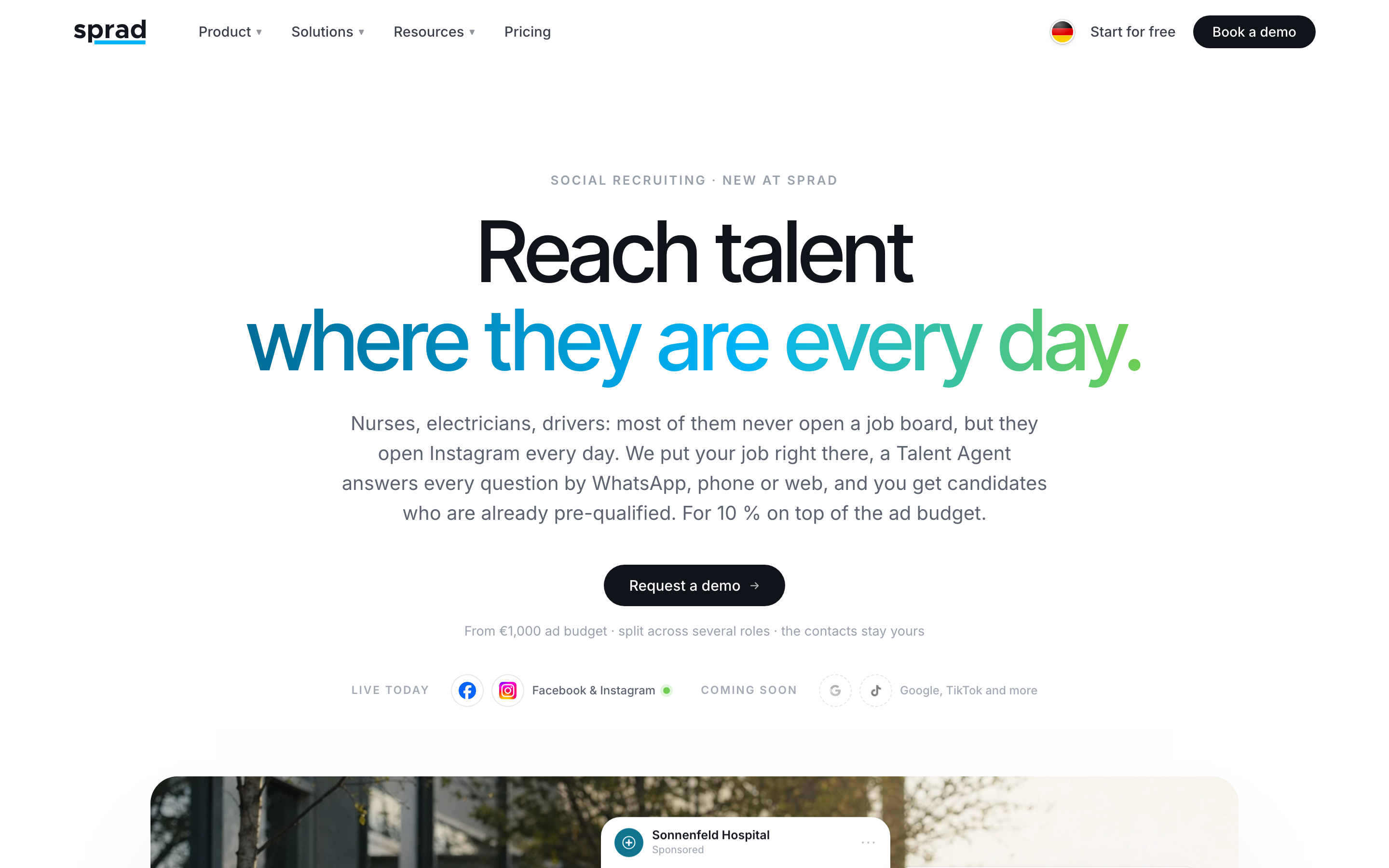
Sprad Social Recruiting runs job ads on Instagram and Facebook, where nurses, tradespeople, drivers and other frontline workers spend time every day. An AI talent agent pre-screens every applicant via WhatsApp, phone or web. Every applicant lands in the employer's own talent pool, so the relationships stay with the employer instead of a platform. Pricing is ad spend plus 10 %, from a €1,000 budget that can be split across roles. Details are on the Social Recruiting page; the pool is described under Talent Base.
FAQ
What is automatic pre-screening of applicants?
It is a first check in which applicants answer a few must-have questions, and software compares the answers with your criteria. A recruiter only reads the applications that pass or need a second look.
Can AI reject applicants on its own?
It should not. In the EU, a solely automated rejection is restricted by Article 22 of the GDPR, and the AI Act adds oversight duties. Let the AI sort, and let a person decide.
Does pre-screening work for hourly and frontline jobs?
Yes, if it happens where these candidates are: on the phone and in chat, with a short route. CV-based tools often miss this group, because many have no current CV.
How many questions should a pre-screening have?
Five to eight. Each additional question loses candidates, so keep only those that decide whether someone can do the job.
Do candidates have to be told that an AI is involved?
Yes. Say so in the first message. It builds trust, and transparency duties apply in many jurisdictions.
Jürgen Ulbrich
Jürgen Ulbrich has more than a decade of experience in developing and leading high-performing teams and companies. As an expert in employee referral programs as well as feedback and performance processes, Jürgen has helped over 100 organizations optimize their talent acquisition and development strategies.