An AI career coach is a chatbot or app that answers career questions, helps you set goals, rewrites your CV and rehearses interviews with you. The free ones are good for structure, drafts and practice, available at 11 p.m. on a Sunday. A human career coach is worth paying for when the problem is you rather than the paperwork: a career change, a layoff, burnout, or a decision with real consequences. In 2026 the sensible answer for most job seekers is both, in that order: start free with AI, add a human for the hard parts.
What an AI career coach actually is (and the three types you will meet)
"AI career coach" is used for three very different things, and mixing them up is the most common reason people are disappointed:
- General chatbots (ChatGPT, Claude, Gemini and similar): free tiers exist, they talk about anything, but they know nothing about you unless you paste in your CV and goals, and they forget between chats unless you save context.
- Coaching apps built for career questions: guided questionnaires, goal tracking, check-in reminders. Many are free for a few sessions, then paid. Check the renewal terms before you enter a card.
- Career agents that do the job-search work itself: they search live jobs, score the fit and tailor your documents. This is less "coach" and more "assistant who does the legwork". What an AI career agent is explains the difference.
What does the evidence say: does AI coaching work?
There is real research, and it is more nuanced than vendor pages suggest. In a 2022 study in PLOS ONE, two randomised trials over 10 months compared a human coach, an AI chatbot coach and a control group. Both coaching groups reached their goals clearly more than the control, and the AI group did not differ significantly from the human group. The authors point out why it may have worked: the bot always asked about progress and made people write their goals down. They also stress the limits, since the participants were university students, goal attainment was self-reported, and AI still lacks empathy and the ability to read a complex personal situation (Terblanche et al., PLOS ONE, 2022).
Our reading: AI coaching is good at what coaching has in common with project management, which is clear goals, small next steps and someone asking "did you do it?". It is weak at what makes human coaching special, which is noticing what you are not saying.
AI career coach vs human coach: the honest comparison
| Criterion | Free AI coach | Human career coach | Public career service |
|---|---|---|---|
| Cost | 0 (free tiers), paid plans vary | Average fee about $244 per hour worldwide (ICF 2022) | Free |
| Availability | 24/7, no booking | Appointments, often weeks ahead | Office hours or helpline |
| Best at | Goals, CV drafts, interview practice, brainstorming | Career change, confidence, layoffs, burnout, negotiation | Orientation, training and funding options |
| Weak at | Empathy, context, accountability that sticks | Cost, coach quality varies a lot | Depth, individual time |
| Knows the job market? | Only if connected to live jobs | Depends on the coach | Yes, regional knowledge |
| Privacy | Check what happens to your CV data | Confidentiality by professional norms | Public-sector rules |
The fee row comes from the largest industry survey. According to the International Coaching Federation's 2023 study, the average fee per one-hour session in 2022 was $244 worldwide, $272 in North America and $277 in Western Europe, with a range from $114 in Latin America to $277 (ICF Global Coaching Study 2023, executive summary). These are averages across all coaching types, so career-only coaches can sit below or above.
What does a human career coach cost? A worked example
Assume a typical engagement of six one-hour sessions over three months, priced at the ICF Western Europe average of $277 per hour (our assumption; real packages are often cheaper per hour but sold as a bundle):
- 6 sessions × $277 = $1,662
- Add one CV review and LinkedIn rewrite as a separate package: often a few hundred dollars more.
- A free AI coach for the same three months: $0 for the 20 or 30 short sessions you will realistically use.
That gap is why a staged approach makes sense: use AI for the 80 percent that is structure and drafts, and book one or two human sessions for the questions where a person's judgement is the product.
When a free AI coach is enough
- You know roughly what you want and need a plan, a deadline and nudges.
- You need a first draft of a CV, a cover letter or a LinkedIn "About" section.
- You want interview practice at any hour. Our guide to AI mock interviews has a five-day plan.
- You are exploring options. A career quiz plus a chatbot conversation is a decent start.
When you need a human
- Career changes with real risk, such as a change at 40 or 50 with a mortgage. See career change at 40 with AI for what AI can contribute.
- Layoff, burnout or loss of confidence. A chatbot will give you a tidy list; a person notices that you have not mentioned your family once.
- Salary and promotion negotiations where politics matters.
- When you keep abandoning your plan. Accountability from a person who expects you next week works differently than a notification.
Free human help exists too, and it is underused. In Germany, the Agentur für Arbeit offers free career counselling, and under § 45 SGB III it can issue an Aktivierungs- und Vermittlungsgutschein, a voucher that lets people who are unemployed or at risk of unemployment use an approved provider, in some cases a coach, at the agency's cost. It is a discretionary decision by your caseworker, so ask rather than assume. In England the National Careers Service gives free, impartial advice, and in the US the Department of Labor's CareerOneStop lists free career tools and local American Job Centers.
How to use a free AI coach step by step
- Give it context. Paste your CV and write three sentences: what you do now, what you want, what you refuse (commute, travel, on-call).
- Ask for questions first. Prompt: "Interview me with ten questions about my work history before you suggest anything."
- Demand a plan with dates. "Turn this into a four-week plan with three actions per week."
- Ask it to argue against you. "Give me the three strongest reasons this goal is a mistake." This is the cheap substitute for a critical human.
- Check in weekly. Paste what you did and what you skipped. The 2022 trial above suggests this loop is where the benefit comes from.
Mistakes we see (and how to avoid them)
Sprad has built recruiting software for seven years, so we see the other side of the table: what recruiters do with the documents that arrive. The patterns that hurt candidates most are:
- One generic AI-written CV sent everywhere. Recruiters recognise the polished, empty phrasing. Tailor each application to the posting, with your real achievements.
- Invented achievements. A chatbot will happily invent a "30 percent increase". If you cannot explain a claim in an interview, delete it.
- Treating flattering feedback as truth. Chatbots lean towards praise. Ask for a score and for the weakest point.
- Pasting sensitive data without thinking. Under the GDPR you have rights over your personal data, including erasure (Regulation (EU) 2016/679, Art. 17). Check the provider's privacy terms and strip things like national ID numbers.
- Never talking to a person. Most jobs still come through conversations, not documents.
How does AI change career coaching?
Three shifts are visible: coaching becomes cheap and always available, the "plan and check-in" part is automated, and the human coach moves towards the hard conversations. At the same time, job search itself is being automated, with agents that find and rank roles and tailor your documents. That is the part free AI is genuinely better at than a human hour: reading 1,000 postings is a machine job, deciding what you want is yours.
Where Atlas Career fits
Atlas Career (atlas.now) is not a coaching chat. It covers the legwork that coaches usually leave you with at home. You describe what you want in a short voice conversation (role, level, salary, location, no-gos), and Atlas searches over 1.5 million active jobs straight from employers' career sites, shows a match score from 0 to 100 with reasons for each role, and writes a tailored CV and, on request, a cover letter for every application. It is free with no limit. You review everything and apply yourself; Atlas sends nothing on your behalf. Data is hosted in the EU, never sold and not used to train other AI models.
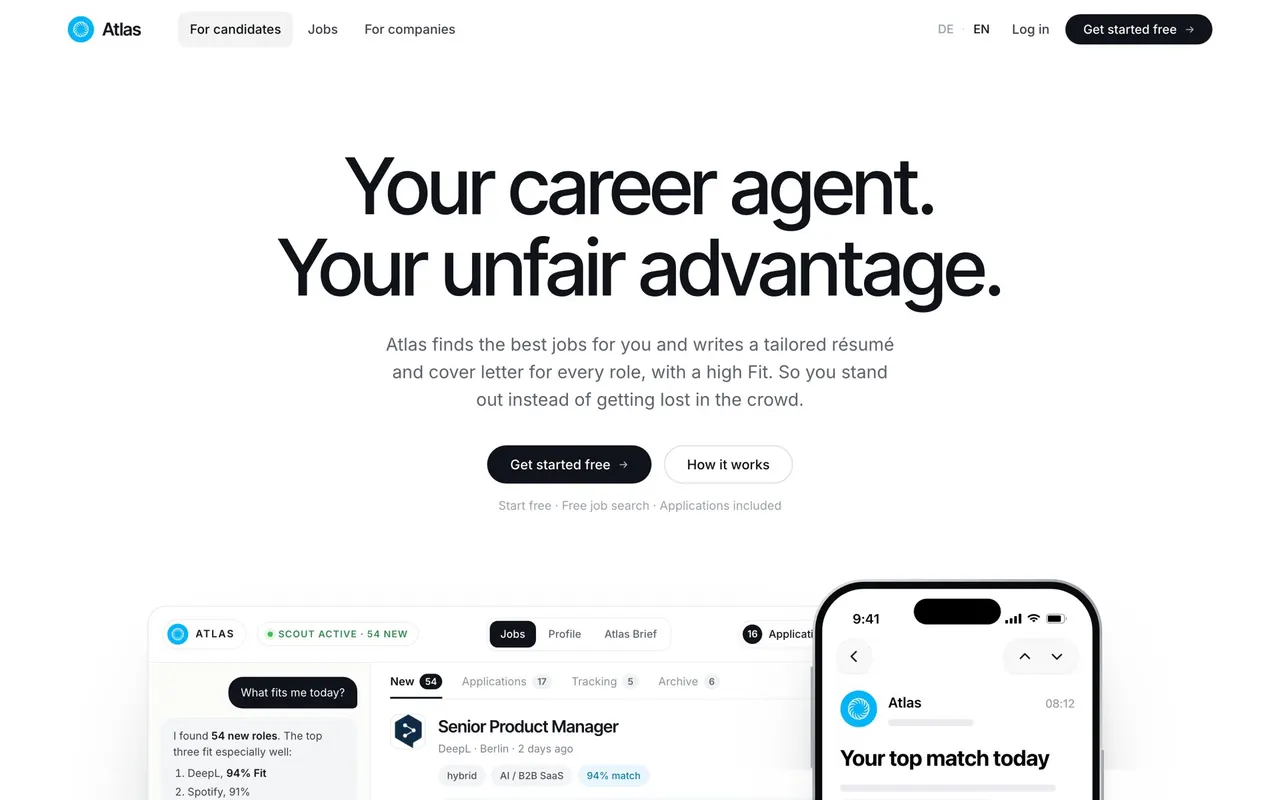
Honest limits: Atlas will not talk you through a career crisis or negotiate your salary, and it does not replace one honest conversation with a person. It does give a human coach better material to work with, because you arrive with a clear profile and a shortlist.
FAQ
Is there a free AI career coach?
Yes. General chatbots have free tiers, several coaching apps offer a few free sessions, and Atlas Career is free without limit for job search and application documents. Free is enough for planning, drafts and practice; it is not a substitute for human support in a crisis.
Can an AI career coach replace a human coach?
For goal setting and check-ins, a trial found no significant difference between AI and human coaching. For empathy, complex personal situations and accountability, humans remain better, and the same study's authors say so.
How much does a career coach cost?
The ICF reports an average of $244 per one-hour session worldwide in 2022 ($272 North America, $277 Western Europe). Packages of several sessions cost from a few hundred to a few thousand dollars.
Is a career coach worth it?
It is worth it when the decision is large and unclear: a career change, a layoff, a promotion negotiation. For routine tasks such as a CV draft, free AI plus a human review of the final version is usually enough.
Can I get a career coach paid by the state?
In Germany possibly: the Agentur für Arbeit or the Jobcenter can issue an Aktivierungs- und Vermittlungsgutschein under § 45 SGB III. It is discretionary, so ask your caseworker. England and the US have free public advice services as listed above.
What should I ask an AI career coach?
Ask it to interview you first, then to produce a dated plan, then to argue against your plan. Avoid asking it for facts such as salaries without a source; verify those yourself.
Is my CV safe in an AI coach?
It depends on the provider. Read the privacy terms, look for EU hosting and a promise not to train models on your data, and use the deletion right under GDPR Art. 17 if you want your data removed.
Stand: October 2026. Fee figures from the ICF Global Coaching Study 2023 (reference year 2022).
Jürgen Ulbrich
Jürgen Ulbrich has more than a decade of experience in developing and leading high-performing teams and companies. As an expert in employee referral programs as well as feedback and performance processes, Jürgen has helped over 100 organizations optimize their talent acquisition and development strategies.