A career change at 40 means moving into a different occupation, not just a different employer, and it is realistic if you plan it as a bridge rather than a leap. Employers do contact occupation switchers less often: in Swiss public-employment data, switchers received 7% fewer contacts than comparable insiders, and 16.4% fewer when the old and new job were far apart. The way around that is a plan that keeps one asset (your industry, your skills or your seniority), tests the new field cheaply, budgets for a temporary pay dip and uses AI for the slow parts of the search. Below: seven steps, a worked salary example, ideas, tools, mistakes and how AI changes the job search (figures dated October 2026).
What does a career change at 40 mean in practice?
There are three different moves, and they carry very different risk:
| Move | Example | Risk | Typical effort |
|---|---|---|---|
| New employer, same job | Accountant moves from a retailer to a software firm | Low | Updated CV, a few weeks of search |
| Same field, new role | Nurse becomes clinical trainer or care coordinator | Medium | A short course or internal move |
| New occupation | Sales manager becomes data analyst | High | Retraining, proof project, pay dip |
Only the third row is a real career change, and it is the one this guide plans for. It is also less unusual than it feels. In the US Bureau of Labor Statistics survey that follows people born 1957 to 1964, they held an average of 12.9 jobs between ages 18 and 58, more than 40% of them before age 25 (release of August 2025; a job here is not the same as an occupation, so read it as proof that change is normal, not that occupation switches are common).
Is 40 too late? What the data and the law say
No, but the evidence is mixed in an instructive way. The RFBerlin Research Insight 31/26 (August 2026), built on Swiss employment-service data, found occupation movers get 7% fewer employer contacts than otherwise identical incumbents, and 16.4% fewer when they have no experience in the vacancy's field. Relevant experience roughly halves the gap and a recognised qualification shrinks it further. In tight labour markets the contact rate for outsiders rose from about 11% to 17%.
The study is about switching, not about age, but the message transfers: the closer the new job sits to what you can already prove, the smaller the penalty. That is the logic behind the bridge move in step 5.
On age itself, the law is on your side. In the US the Age Discrimination in Employment Act protects people aged 40 or older at employers with 20 or more employees, including in hiring, and neutral rules can be unlawful if they hit older applicants without a reasonable factor other than age. In Germany the General Equal Treatment Act (AGG), section 1, bars discrimination because of age, among other grounds. Rights do not remove bias, but they let you name it.
How do I plan a career change at 40, step by step?
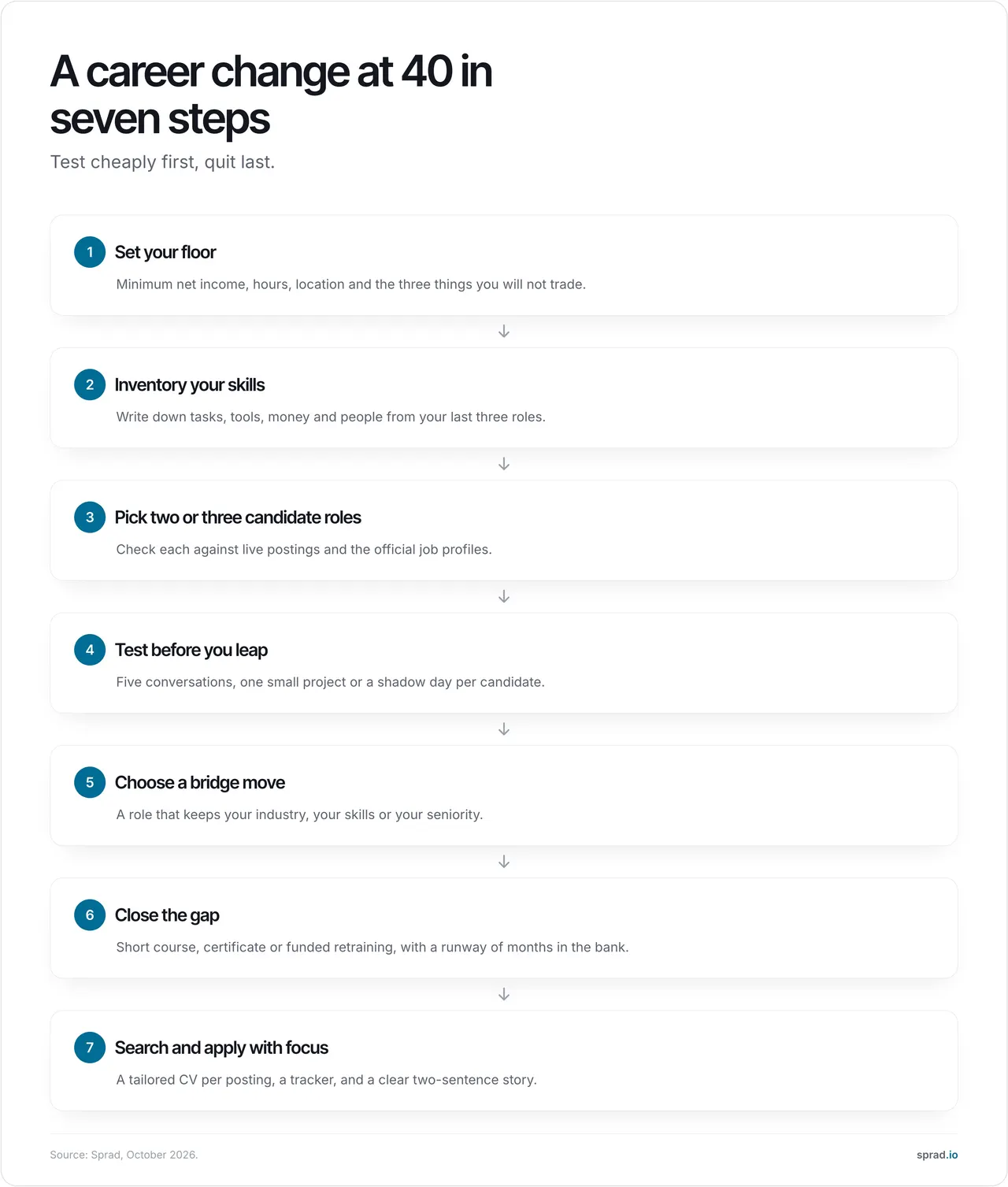
1. Set your floor
Write down the minimum monthly net income, working hours and location you can live with, plus the three things you will not trade (for example a four-day week, a commute under 40 minutes, no shift work). Every option in the next steps gets tested against this list. People who skip it end up comparing job titles instead of lives.
2. Inventory your skills
List your last three roles and write what you did in terms of tasks, tools, money and people: "ran a 14-person team", "managed a 400,000 EUR budget", "handled 30 customer escalations a week". The US O*NET database and Germany's Berufenet show the typical tasks and skills of each occupation, which gives you the target field's vocabulary.
3. Pick two or three candidate roles
Open 20 live postings per candidate role. Note what appears in at least half of them: required tools, certificates, years. This is your gap list. A role whose postings you can already half-match is a bridge candidate; one where you match almost nothing is a long project.
4. Test before you leap
For each candidate: talk to five people who do the job (ask what they dislike, not what they like), do one small project or a shadow day, and read three months of the field's job ads. One afternoon of this is cheaper than a failed retraining. A career quiz can seed the list, but it cannot replace the test (see what quizzes can and cannot tell you).
5. Choose a bridge move
A bridge move changes one big thing and keeps the others: same industry with a new function (a hospital administrator becomes a healthcare data analyst), same function in a new industry (a recruiter moves into a software company) or same seniority in a neighbouring field. From our side of the table, as a team that has built recruiting software for seven years, this is the profile that gets interviews: the hiring manager can see which part of the job you already do.
6. Close the gap and fund it
A short course, certificate or portfolio project closes most gaps. In Germany the Federal Employment Agency can fund retraining: section 81 SGB III covers training that is needed to reintegrate into work or avoid unemployment, requires prior counselling and an approved provider, and has no age limit. Employees can get cost support under section 82 SGB III; at employers under 500 staff the employer share can be waived from age 45. Conditions and discretion apply, so ask your local agency before you enrol. In the US, check employer tuition benefits first and community-college certificates second.
7. Search and apply with focus
Write one target in a two-sentence story ("I moved from retail operations into supply planning; I just finished X and ran Y"). Then tailor the CV per posting (our career change resume guide shows how), track every application and aim at adjacent roles first. Scattershot applications to ten different job titles read as "unsure", and recruiters notice.
What does a career change at 40 cost? A worked example
Most plans fail on money, not motivation. Two rules: (1) runway = savings ÷ monthly expenses, and plan for several months of search plus any training period (a rule of thumb many career advisers use is 6 to 12 months of expenses, not a research result); (2) compare the new salary curve with your current one.
Illustration with assumptions, not forecasts: current gross salary 70,000 EUR, flat; the new role grows 6% a year.
| Scenario | Start salary | Year 1 gap | Back at 70,000 EUR | Total gap until then |
|---|---|---|---|---|
| Adjacent move (start −8%) | 64,400 EUR | 5,600 EUR | Year 3 | about 7,300 EUR |
| Distant move (start −25%) | 52,500 EUR | 17,500 EUR | Year 6 | about 54,000 EUR |
The point is not the exact numbers but the ratio: in total, the distant move costs about seven times more than the adjacent one, and it takes twice as long to pay off. Add course fees and months without income, then decide whether the long-term gain justifies it. If it does, a bridge move first and a second step later often costs less than one big jump. In USD the logic is identical.
Which career change ideas are worth a look?
Demand matters more than passion alone. The BLS projects these as the fastest-growing US occupations for 2025 to 2035 (Occupational Outlook Handbook, page updated August 2026). The last column is our illustrative suggestion for who could bridge, not an official statement.
| Occupation (US) | Projected growth 2025-35 | Median pay 2025 | Possible bridge from |
|---|---|---|---|
| Nurse practitioners | 41% | $132,300 | Nurses, clinical staff (needs graduate study) |
| Solar photovoltaic installers | 37% | $53,140 | Electricians, construction trades |
| Data scientists | 35% | $120,230 | Analysts, finance, operations |
| Wind turbine service technicians | 30% | $64,120 | Mechanics, technicians |
| Medical and health services managers | 24% | $123,860 | Clinicians, administrators, project managers |
In DACH, skilled trades, healthcare, sales and tech are the four areas with the most open vacancies on Atlas's industry job portals. Whatever you pick, check the formal entry route first: some roles need a licence, others only a portfolio.
How do career changes differ at 30, 40 and 50?
| At 30 | At 40 | At 50 | |
|---|---|---|---|
| Main advantage | Little to lose, cheap to restart | Proof of results, network, seniority | Deep expertise, authority |
| Main risk | Thin track record | Fixed costs (housing, family) | Short horizon to recoup a pay dip |
| Best strategy | Try, then specialise | Bridge move plus targeted course | Seniority-based roles, consulting, advisory |
Which tools and templates help?
| Need | Free tool or template | Watch out for |
|---|---|---|
| Find the target field's vocabulary | O*NET (US), Berufenet (DE) | Official wording is formal; check it against live postings |
| CV format for Europe | Europass CV editor | Many employers prefer a custom layout |
| Search many jobs and score fit | Atlas Career (free) | It finds and scores jobs; the decision is yours |
| Plan and track | A spreadsheet with columns for floor, gap list, tests and applications | Update weekly or it is useless |
A simple scorecard helps with step 3: rate each candidate role 1 to 5 on pay vs. floor, skill overlap, demand, cost to close the gap and day-to-day fit from your five conversations. Anything under 15 of 25 stays on the list only if one score is a deal-breaker you can fix.
How does AI change a career change?
Used well, AI shortens the slow parts. General-purpose chat assistants can translate your old job titles into the new field's terms, draft a gap list from a pasted posting and run mock interviews. Job-search tools can scan far more postings than you can, and CV tools can adapt your document to each ad. Used badly, they invent achievements and produce generic text, which recruiters spot quickly. Rule: AI drafts, you verify every line.
Also know the employer side. Recruitment AI is regulated in Europe: the EU AI Act (Regulation 2024/1689) classes systems used for recruitment and selection as high-risk, which brings transparency and human-oversight duties. In the US, the EEOC page above notes that neutral rules can still be unlawful if they disadvantage applicants aged 40 or older without a reasonable factor other than age, which is the test an automated screening rule would face too.
One free option is Atlas Career (atlas.now), built by Sprad in Vienna. A short voice conversation sets up your career profile (role, level, salary, location, no-gos). Atlas then searches 1.5M+ active jobs straight from employers' career sites, over 100,000 of them in DACH, gives each role a match score from 0 to 100 with reasons and keeps searching. For each application it tailors a CV and, on request, a cover letter, in the language and format of the ad. It is free with no limits; you review everything and apply directly to the employer yourself. It does not choose your new career or replace a course, and it shows salaries only where the ad states them. For a career changer the per-job tailoring is the useful part, because every posting needs a different emphasis.
More on the topic: the best AI job search tools in 2026, what an AI career agent is and free AI resume builders without limits.
What mistakes should I avoid?
- Quitting before testing. Run the five conversations and one small project while you are still employed.
- Chasing a title instead of tasks. "Product manager" means different work in every company; read ten postings.
- Hiding the switch. A CV that reads as if nothing changed makes recruiters hunt for the catch. Name the target in your summary.
- Applying everywhere. Three bridge roles with tailored applications beat thirty generic ones.
- Underselling. Accepting a junior title and pay without testing whether your seniority counts.
- Ignoring the money maths. Run the table above with your own numbers before you sign anything.
- Letting AI write unchecked claims. Interviews test every line.
FAQ
Is 40 too old to change careers?
No. There is no legal or practical cut-off, but employers contact switchers less often, so a bridge move and a visible proof project matter. Laws such as the US ADEA (from 40) and Germany's AGG protect you against age discrimination.
What is the best career change at 40?
The one that reuses most of what you can already prove and passes your floor from step 1. Fast-growing fields (health, energy, data) are a good start, but fit and entry route decide.
How long does a career change take?
Plan several months for testing and searching, and 12 to 24 months if retraining is needed. That is a planning assumption, not a statistic; your field and market change it.
Can I get a career change funded?
In Germany, often yes: sections 81 and 82 SGB III cover training with no age limit, subject to counselling, approval and discretion. In the US, look at employer tuition benefits and community-college programmes.
Which career change ideas work without a degree?
Trades such as solar installation, sales, customer success and operations roles often accept proof of skills over degrees. Check each posting's real requirements.
Is there a career change quiz that works?
Quizzes are good for generating ideas and bad for deciding. Use one to seed your list, then run the tests from step 4.
How can AI help with a career change at 40?
It translates old job titles, scans and scores postings, tailors your CV and cover letter and prepares interviews. It does not decide for you, and you must verify every claim it writes.
Jürgen Ulbrich
Jürgen Ulbrich has more than a decade of experience in developing and leading high-performing teams and companies. As an expert in employee referral programs as well as feedback and performance processes, Jürgen has helped over 100 organizations optimize their talent acquisition and development strategies.