ATS screening is the part of an applicant tracking system that sorts incoming applications before a recruiter reads them: it parses the resume, applies knockout questions and rules you configure, ranks or scores what is left, and, in newer systems, adds an AI rating. Only the knockout and rule steps can remove an application automatically, and a person configures them; ranking and AI scores should decide the order of review, not who is rejected. In the EU a rejection must not rest solely on automated processing (GDPR Art. 22). As of November 2026.
What does ATS screening actually do?
An applicant tracking system manages jobs, applications, communication and hiring stages. Its screening functions are a set of filters between the application form and the recruiter's inbox. Most systems combine four stages, and it matters which of them your system really runs, because each fails in a different way.
| Stage | What it does | Can it reject on its own? | Where it fails |
|---|---|---|---|
| 1. Parsing | Turns the CV into fields (roles, dates, education, skills) | No | Columns, tables, scans and unusual formats produce wrong or empty fields |
| 2. Knockout questions and rules | Checks yes/no or numeric answers, such as work permit, location, shift availability | Yes, if you configure it so | Too many hard rules remove good candidates; answers are only as honest as the form |
| 3. Match score or ranking | Compares CV text with the job ad and sorts the queue | Usually no, it sorts | Keyword matching rewards wording, not ability; AI-written CVs match perfectly |
| 4. AI rating | Reads meaning, rates each requirement, writes a summary | Should not | Needs visible evidence per rating; otherwise a score nobody can check |
Further reading on the first stage: CV parsing: how it works and where it fails.
Does an ATS automatically reject resumes?
Mostly not, and this is the most common misunderstanding. Public sources from ATS vendors and career advisers disagree about keyword filters, and few of their percentages are backed by a method. What is consistent: the clearest automatic gate is a knockout question or rule that someone in the company has set up. Everything else decides the order in which people are read. If you are an applicant looking for CV tips, our ATS resume checker guide covers that side; this article is for the team that configures the system.
Be careful with figures such as "75 % of resumes are rejected by the ATS" or "99 % of recruiters use keyword filters": the pages we checked in November 2026 give them without a date or method, and most come from vendors of resume checkers or ATS products. We do not quote them here.
Why does classic ATS screening miss good candidates?
- Keywords are a weak proxy. A match score counts words. A strong candidate may describe the same work differently, and an AI-written CV can contain every phrase without recent, relevant experience.
- Parsing errors are silent. A wrongly read date or a skills block lost in a column does not raise an error; the person just ranks lower. Check a sample of CVs field by field.
- Rules freeze yesterday's assumptions. "At least five years in the industry" removes career changers who would have done the job.
- A single score hides the reason. If nobody can see why a profile ranked 80th, nobody can correct it.
In our conversations with recruiting teams, the most common configuration mistake is the same one: requirements marked as nice-to-have although they are in fact mandatory (or the reverse), which makes the ranking unreliable. How to set them is covered in CV screening criteria: must-have, nice-to-have, knockout.
What does the law require for ATS screening?
This is general information, not legal advice.
- GDPR Art. 22: Article 22 restricts decisions based solely on automated processing that significantly affect a person. In the SCHUFA ruling of 7 December 2023 (C-634/21) the CJEU treated even an automatically generated score as a decision where a third party relies on it heavily. A rejection by rule is therefore a risk; a human needs real authority to deviate.
- EU AI Act: Systems that analyse or filter applications or evaluate candidates are high-risk under Annex III, point 4. After the Digital Omnibus (Regulation (EU) 2026/1744, in force since 27 July 2026) the high-risk duties apply from 2 December 2027. Transparency duties under Article 50 apply from 2 August 2026; the ban on inferring emotions in the workplace has applied since 2 February 2025.
- United States: New York City Local Law 144 requires a bias audit and notice to candidates for automated employment decision tools used on candidates in the city. Relevant only if you hire there.
- Germany: § 87 BetrVG (co-determination for technical systems) and § 95 para. 2a BetrVG (selection guidelines created with AI) involve the works council. Under § 22 AGG the employer carries the burden of proof if there are indications of discrimination, so documented criteria help you.
How much time does screening save? A worked example
Assumptions (replace with your own numbers): 400 applications per month, six minutes for a first read, 40 € loaded hourly cost.
- Manual first read: 400 × 6 min = 40 hours = 1,600 € per month.
- Screening with a flat price per application, for example Sprad's 0.49 € (CV screening, chat interviews, candidate portal; as of 29 October 2026, excl. VAT): 400 × 0.49 € = 196 €.
- What stays human: reading the ranked profiles, borderline cases and the decision. The tool moves this time; it does not remove it.
How to test the screening in your ATS in five steps
- Take 50 real applications from a role you have already filled and define the criteria before you look at any score.
- Check parsing field by field on at least 20 CVs, including column layouts, scans and non-German or non-English names.
- List which applications were removed or pushed down automatically, and count how many of them you would have interviewed.
- Change one relevant detail in a CV and see whether the output moves sensibly.
- Check what the system writes back and whether a recruiter can override it and log the reason.
ATS module or a connected screening tool?
A screening module inside your ATS is the leanest choice for simple workflows. A connected tool makes sense if you want evidence per requirement and a conversation before the interview. In our conversations with recruiting teams, data protection is usually a checkpoint, not a blocker, once hosting, retention, deletion and consent are answered concretely.
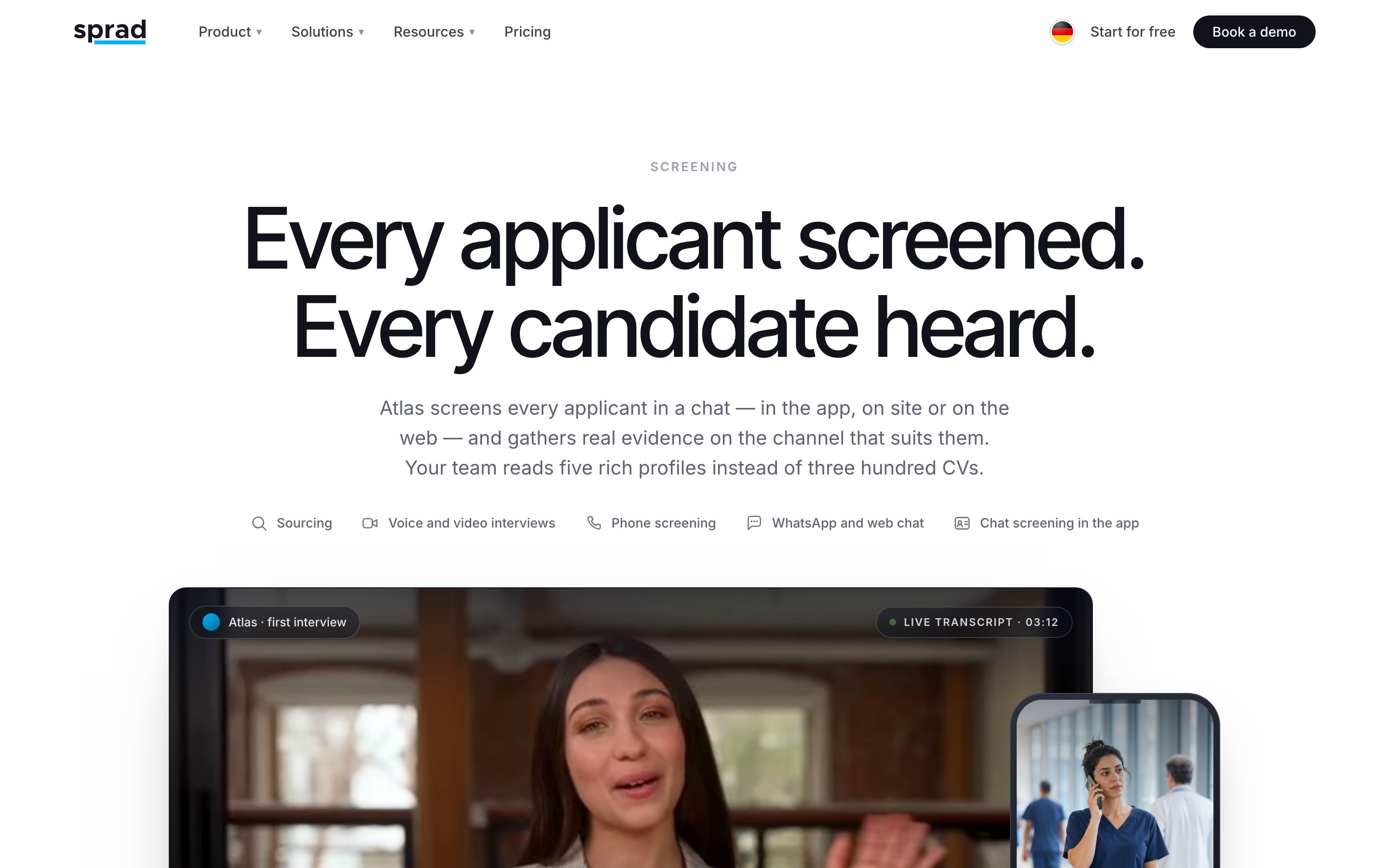
Sprad Atlas rates each requirement of your job, marks it certain or likely, and shows the exact sentence from the CV or conversation behind it; if the quote cannot be found in the original, the point turns to unclear, and unclear never counts against a person. Nobody is rejected automatically: every rejection waits for confirmation by someone on your team. Results flow back into your existing ATS; Ashby, d.vinci and Personio are connected, other systems with an API can be added. Limits: every assessment uses credits or flat volume, and the result never replaces a conversation. Sprad is the provider of this page. More on tool choice in CV screening software: how to choose.
FAQ
What is ATS screening?
The filtering and ranking of applications inside an applicant tracking system: parsing, knockout rules, match scores and, increasingly, AI ratings.
Is ATS screening legal in the EU?
Yes, with conditions. A solely automated rejection with significant effect is restricted by GDPR Art. 22; recruiting AI is high-risk under the AI Act from 2 December 2027.
Does an ATS reject applications without a human?
Only if someone configured knockout questions or rules to do so. Ranking alone changes the reading order.
What is a knockout question?
A yes/no or numeric question with a defined threshold, such as work permit or shift availability. See automating knockout criteria.
Can ATS screening be biased?
Yes. Criteria and parsing errors can disadvantage unusual formats, names or career paths. Use job-related criteria, regular samples and a documented review.
Is it true that most CVs are rejected by the ATS before a human sees them?
No reliable evidence supports a single figure. Parsing errors and knockout rules can remove applications silently, which is why the test above counts the good candidates your system pushed down.
How do I add AI screening to the ATS I already use?
Ask for the data path: which fields and statuses are written back. Details in ATS integration for screening.
Jürgen Ulbrich
Jürgen Ulbrich has more than a decade of experience in developing and leading high-performing teams and companies. As an expert in employee referral programs as well as feedback and performance processes, Jürgen has helped over 100 organizations optimize their talent acquisition and development strategies.