Sprad (Atlas) and Juicebox both let you describe a candidate in plain language, but they differ in what happens next. Juicebox is a self-serve search tool with published dollar prices (Starter 99 $ per month on annual billing) and credit limits for contacts and exports. Sprad checks every profile individually against your requirements, runs LinkedIn and email outreach from one inbox and starts free, with Recruiter Lite from 79 € per seat and month. In the Recruiting area of the open PeopleSearchBench, Atlas reaches 73.5 in our own re-measurement, converted to the published scale (Juicebox 65.7 as published). Juicebox is still a sound pick for a solo recruiter who wants to start within an hour.
How does Sprad Atlas compare with Juicebox?
Juicebox statements below come from the vendor's public pricing page and documentation, checked on 18 October 2026; Sprad prices are net of VAT, billed annually, as of October 2026.
| Sprad (Atlas) | Juicebox | |
|---|---|---|
| What it is | Sourcing, outreach, pre-qualification, CRM/ATS functions and your own talent network | AI people search with outreach sequences and optional agents; no native ATS |
| How it searches | You describe the person; AI checks every profile against the requirements, with a reason per requirement. Deep Context finds companies first, then the people who worked there in a given period | Natural-language search over a large profile index; the vendor names 800M+ profiles from 30+ sources |
| Sources | 1B+ profiles worldwide: LinkedIn, XING, GitHub, your own pool, colleagues' networks and your uploaded LinkedIn network | Web and professional sources; your own pool only through imports |
| Outreach | LinkedIn (request, message, InMail) and email automated with follow-ups, trainable AI templates, pitch format; one inbox per talent with a warning against double contact | Email sequences from a connected mailbox; LinkedIn steps and calls are created as tasks (vendor documentation) |
| Pre-qualification | Voice, video, chat and agent pre-qualification, multilingual; WhatsApp for candidate communication | Not part of the product |
| Agents | Automated agents for outreach and pre-qualification; included in Atlas Recruiter | Agent add-on, 199 $ per agent |
| Price | Free start (100 credits/month); Recruiter Lite 79 € (95 $) per seat and month; Atlas Recruiter 299 € (359 $); flexible credits | Starter 99 $ (annual) or 119 $ monthly; Growth 179 $ or 199 $; Business by quote |
| Contact data | E-mail 1 credit, phone 10 credits, paid only if found | E-mail 1 credit, phone 3 credits, from the monthly contact pool |
| Benchmark | PeopleSearchBench (Recruiting): 73.5 (own re-measurement, converted) of 100 | PeopleSearchBench (Recruiting): 65.7 (published) |
| EU / GDPR | EU hosting, enterprise-grade data protection | US vendor; ask for the data processing agreement and storage location |
| Where the other is better | No AI call notetaker, no placement reporting, no SMS (WhatsApp instead); deep search takes minutes | Fast self-serve start, simple dollar price ladder, a focused tool for small teams |
Which finds more matching candidates (PeopleSearchBench, Recruiting)?
The open PeopleSearchBench runs 119 real search tasks. In the Recruiting area Juicebox scores 65.7 on the published scale; Atlas scores 73.5 in our own re-measurement, converted to the published scale, and returns almost always 15 matching profiles per recruiting search (14.2 on average).1 Read the difference with care: in recruiting it is about eight points between a converted re-measurement and a published value, so Juicebox is not a weak tool for this job.

1 PeopleSearchBench (Recruiting), published by Lessie, October 2026. Other systems' scores as published in the benchmark; Atlas measured with the benchmark's open test procedure. Method and details.
Why does the method matter? In a keyword or semantic filter search a profile matches if the right words are on it, so a thinly maintained profile never surfaces. Atlas reads each profile against your requirements, which is why it also finds people without the “right” keywords. A practical test from our experience: if results appear instantly, it is almost always a filter or semantic keyword search. Sprad's Quick Search returns first results in about three seconds; the deep search takes a few minutes because far more AI runs per profile. Deep Context goes one step further and finds the companies first, then the people who worked there in a period, for example a CFO who led an acquisition or someone who built a start-up through Series A and B. Sprad has built recruiting software for seven years, starting with employee referrals, which is the same job: matching profiles to requirements. More on the method: Boolean vs requirement search.
How do outreach and the inbox compare?
Juicebox sends email sequences from a connected mailbox and stops a sequence when a candidate replies. According to its documentation, LinkedIn connection requests, InMails and calls are created as tasks inside a sequence, and InMail replies are only detected if LinkedIn's notification mails arrive in the same mailbox. Anyone who works several channels therefore still does part of the work by hand.
Sprad runs LinkedIn and email in one inbox: automated outreach with follow-ups, InMails sent from Sprad (your own allowance can be used), AI templates you train with feedback and a pitch format where you store the selling points of the role. We recommend the combination of email and LinkedIn because it is the biggest lever on reply rates. Per talent you see the whole conversation, and the system warns you if someone was already contacted, also by a colleague or for another role. Sprad also searches networks other tools do not see: your own LinkedIn network once uploaded, the networks of your employees and, for agencies, the connected networks of former candidates. WhatsApp is available for talking to candidates, but not for cold first contact, and there is no SMS channel.
How do price and credits compare?
Juicebox publishes its prices in dollars: Starter 99 $ per month billed annually (119 $ monthly) with 500 contact credits, Growth 179 $ (199 $ monthly) with 1,500 credits per seat, an Agent add-on at 199 $ per agent, Business on request (vendor pricing page, 18 October 2026). Searches are not capped on paid plans; contacts and exports are. Sprad starts free with 100 credits a month, Recruiter Lite costs 79 € (95 $) per seat and month with Quick and Normal searches included, and Atlas Recruiter costs 299 € (359 $) with unlimited (fair use) searches of every depth and one automated outreach account. Credits are for the whole company, not per seat.
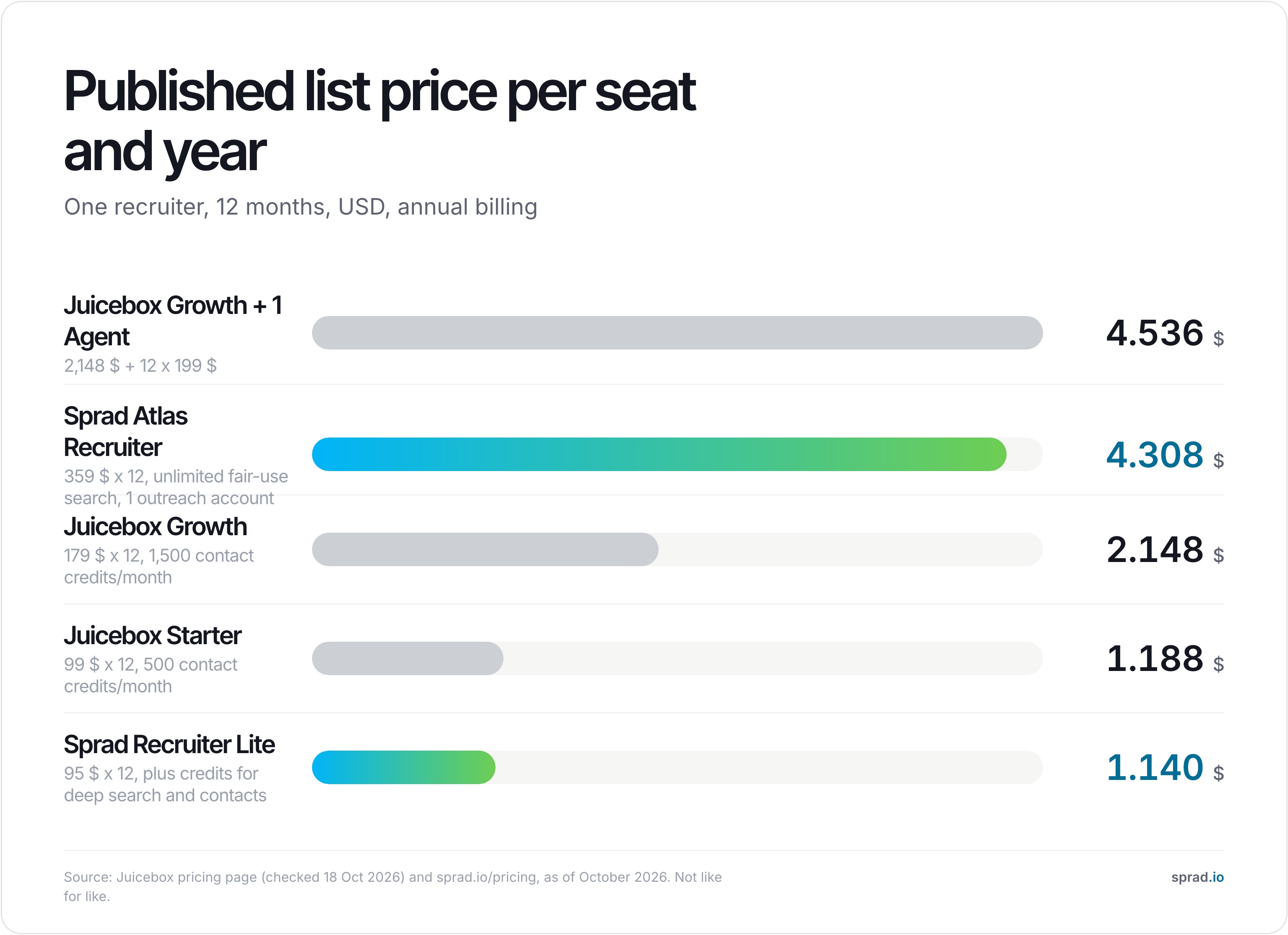
Worked example, list prices, no discounts. One recruiter, 12 months: Juicebox Starter 99 $ × 12 = 1,188 $; Growth 179 $ × 12 = 2,148 $; Growth plus one agent (2,148 + 12 × 199) = 4,536 $. Sprad Recruiter Lite 95 $ × 12 = 1,140 $; Atlas Recruiter 359 $ × 12 = 4,308 $. Five recruiters: Juicebox Growth 5 × 179 $ × 12 = 10,740 $; Sprad Lite 5 × 79 € × 12 = 4,740 €, Atlas Recruiter 5 × 299 € × 12 = 17,940 €. Atlas Recruiter is therefore dearer per seat than Juicebox Growth; the difference pays for unlimited deep searches, 10 Deep Context searches a month and an included outreach account that Juicebox sells as an agent. Contact data: on Sprad 300 e-mails found cost about 300 credits (roughly 30 € at about 0.10 € per credit, assumption), on Juicebox 300 of the 500 monthly contact credits. A phone number costs 10 Sprad credits or 3 Juicebox credits. The numbers are not like for like; the point is to ask both vendors for a price on your seat count and your contact volume. Teams that currently pay separate LinkedIn and XING recruiter licences save 30–80 % with Sprad, depending on the licence mix. Current plans: sprad.io/pricing; Juicebox in detail: Juicebox pricing explained.
How do compliance and data compare?
Sourcing means processing personal data of people who have not applied. In the EU that usually rests on legitimate interest (Article 6(1)(f) GDPR, see the EDPB guidelines 1/2024), brings an information duty (Article 14) and a right to object. The EU AI Act lists AI systems used to select or filter applicants as potentially high-risk (Annex III), so a human decides and the tool should explain its results. In Germany, § 7 UWG restricts unsolicited electronic advertising; whether a first recruiting message counts as advertising is judged differently, so have your approach checked. Juicebox is a US vendor: ask for the data processing agreement, the storage location and the transfer basis, which can be the EU-US Data Privacy Framework (check its current legal status). Third-party reviews mention GDPR and SOC 2 claims; ask for the report instead of relying on them. Sprad is hosted in the EU and built to the data protection and IT security standards of enterprise, public-sector and insurance customers, valid for Europe and the US. This is orientation, not legal advice; see also active sourcing and GDPR.
When is Juicebox the better choice?
- You are a solo recruiter or a team of one to three who wants plain-language search running within an hour, with a published price and no sales call.
- Your roles sit mainly in US talent pools and you do not need XING or a searchable pool of your own colleagues' networks.
- You work email-first and are happy to handle LinkedIn steps by hand, or already run a separate outreach tool.
Who should choose Sprad, who should combine?
- Choose Sprad if the share of really matching profiles is the pain, if LinkedIn and email should run in one inbox without double contact, if you source in DACH and Europe where XING matters, or if you are an agency that wants to search its own talent pool and keep it after cancelling.
- Combine if Juicebox already works for you: keep it, run the same open role in Sprad and count how many of the first 15 profiles you would really contact.
Typical mistakes we see: judging a tool by a demo instead of one of your own open roles; comparing a plan's search allowance and ignoring the contact credits; forgetting that an agent is priced like a second seat; letting two recruiters contact the same candidate from two tools; not asking what happens to your candidate data after cancelling. More comparisons: Juicebox alternatives, Juicebox vs LinkedIn Recruiter and active sourcing tools compared. More on the product: Active Sourcing.
FAQ
How does Sprad Atlas compare with Juicebox?
Both search in plain language. Atlas checks every profile against your requirements, runs LinkedIn and email in one inbox and starts free; Juicebox is a self-serve search tool with email sequences and credit limits.
Which finds more matching candidates?
In the PeopleSearchBench (Recruiting) Atlas reaches 73.5 in our own re-measurement, converted to the published scale (Juicebox 65.7 as published). Test both on one open role.
How do price, outreach and compliance compare?
Juicebox starts at 99 $ per month (annual), Sprad at free, Recruiter Lite 79 €. Sprad automates LinkedIn and email; Juicebox creates LinkedIn steps as tasks. Sprad is hosted in the EU; ask Juicebox for its data processing agreement.
When is Juicebox the better choice?
For a solo recruiter or small, email-first team that wants a fast self-serve start at a published dollar price.
Can I use Sprad and Juicebox together?
Yes. Keep Juicebox where it works and use Sprad for requirement search, one-inbox outreach and your own talent network.
Jürgen Ulbrich
Jürgen Ulbrich has more than a decade of experience in developing and leading high-performing teams and companies. As an expert in employee referral programs as well as feedback and performance processes, Jürgen has helped over 100 organizations optimize their talent acquisition and development strategies.