A cover page and a third page are optional in a job application. Germany's Federal Employment Agency (Bundesagentur für Arbeit) writes in its 2026 application guide that a cover page is “no longer required”, because most applications are now uploaded to a portal or sent by email. It still helps for speculative applications and paper folders. A third page is worth adding only when it shows something that fits neither in the CV nor in the cover letter. Structure, copy-and-paste templates and the right order are below.
Do I need a cover page for my application?
No. The Federal Employment Agency's application guide says a cover page “can be useful” if it is clearly laid out and supports the first impression, for example in speculative applications. Its leaflet “Praktische Bewerbungstipps” calls it “optional” and “not a must”. Nobody is rejected because it is missing, while a badly made one can hurt more than help.
The decision depends on how you apply:
| Situation | Cover page? | Why |
|---|---|---|
| Online form or career portal | No | You upload CV and attachments separately. A cover page is an extra page with no job to do. |
| Email application (one PDF) | Usually no | In its sample application the agency notes that an email application can skip the cover page; the choice is yours. |
| Speculative application | Yes, can help | No job ad frames you. The cover page tells the reader in one glance which role you are offering yourself for. |
| Paper folder by post | Yes, customary | It protects the documents and bundles role, name and contact. |
| Leadership, creative fields, apprenticeships | Can help | If it is cleanly designed and matches the CV. Otherwise skip it. |
Note: a German “Deckblatt” is not what English speakers call a “cover letter”. The cover letter is the Anschreiben. The cover page, as a separate sheet, is mainly a German-speaking custom.
What goes on a cover page?
As little as possible. According to the agency: a heading such as “Bewerbung” (application), the job title, the company name, your contact details, optionally a photo and a short list of attachments. Its tip: do not use the cover page to repeat your CV; highlight two or three key skills or qualifications that matter most for the job.
Template to copy (Word or Google Docs)
Application as Registered Nurse (m/f/d)
Example Hospital, Internal Medicine ward
Reference: 2026-114Maria Example
Sample Street 1, 12345 Sample City
+49 123 456789 · maria.example@example.comThree reasons I fit:
– 8 years on internal medicine wards
– Practice-instructor qualification (2024)
– Comfortable with shifts from 6 am to 8 pmAttachments: CV, three employer references, nursing diploma, training certificate
The example is fictional. Keep everything as real text, not graphics or text boxes, because applicant tracking systems (ATS) read text and skip images. More on that below.
Should the photo go on the cover page?
A photo is voluntary. The agency's leaflet states that since the German General Equal Treatment Act (AGG) a job ad may not explicitly demand a photo. The 2026 guide says: “A photo is voluntary, but still customary.” It can sit on the cover page or on the CV; on the cover page it may be larger (9 × 13 cm at most). If you have no professional, recent photo, leave it out. The agency also warns about AI-edited photos: they often look artificial, and hiring managers often notice and react with scepticism. In the US and UK, no photo is the norm; that is practice, not law.
What is the third page and when does it pay off?
The third page (“dritte Seite”) is an optional page after the CV. According to the agency you can put there “what fits neither in the CV nor in the cover letter” and what you believe helps you. There are no formal rules. It pays off in four cases:
- The ad explicitly asks for a motivation letter.
- Your CV does not obviously match the job, for example a career change.
- You have volunteering or projects that prove fit but do not belong in the CV.
- It is a speculative application and you have to explain yourself without an ad.
In every other case, skip it. A page that repeats the cover letter and the CV costs the reader time and gains you nothing.
What do I write on the third page? (example)
The agency lists volunteering, commitments during training, studies or parental leave, and skills that do not belong to the job directly but show drive and motivation. Suggested headings include “What speaks for me?”, “My professional range” and “What else you should know about me”. Do not title it “Page 3”. The heading should tell the reader what they get.
Template to copy
What else you should know about me
Why your ward. I have worked 8 years in internal medicine and want to join a team that truly lives practice instruction. Your ad says you plan apprentices firmly into the rota. That is exactly what I built on my last ward.
What I bring, concretely.
– Wrote an onboarding plan for new colleagues in 2024; new hires have since stayed beyond probation on average.
– Part of the rota team, solving shift conflicts in direct conversation.Outside work. Volunteer first aider at a sports club since 2019.
The template is fictional. It has three building blocks you can transfer: a motivation paragraph that refers to the ad, two or three provable strengths as a list, and a short paragraph outside work. Length: one A4 page at most; around 15 lines of prose is usually right. Put date, place and name as in the cover letter so the page stands on its own.
In which order do I send everything?
For the classic folder the agency describes: cover letter on top, then the cover page if there is one, otherwise the CV, then the third page, then certificates. For an email application the same order applies in a single PDF.
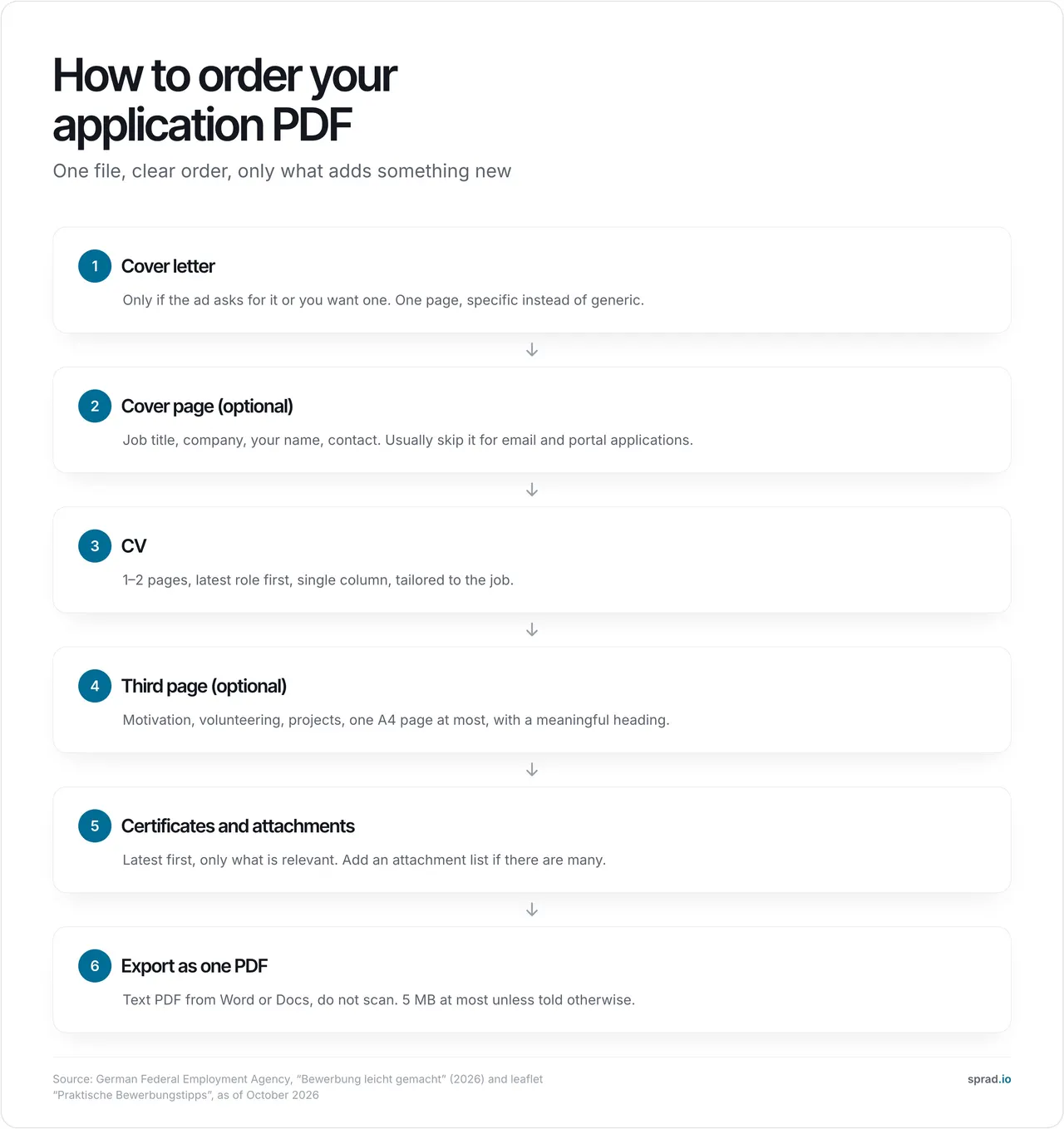
Practical rules from the agency: always export the PDF from your word processor, never print and scan. Combine cover letter, CV and certificates in one PDF, 5 MB at most unless stated otherwise. A separate attachment list is only recommended with very many attachments. Name the file so it can be identified, for example “Application_Example_Maria.pdf”.
Worked example: how fast do 5 MB fill up?
Assumptions (typical values, not a measurement): a phone-scanned certificate weighs about 0.8 MB per page, a cover page with a large uncompressed photo 2 to 3 MB, cover letter and CV as text PDF together under 0.3 MB. With six scanned certificate pages (4.8 MB) and a photo cover page (2.5 MB) you end up around 7.6 MB. The email bounces or the company rejects the attachment. Without the cover page and with certificates exported at lower resolution you stay under 5 MB. Check the size before sending.
Cover page and third page in an ATS
Many companies first read applications with software. The agency's guide says these programs read the CV automatically before a person sees it. Its tips apply to every page of your PDF: clear headings, simple formatting, no nested tables, no playful graphics or coloured backgrounds, personal data not in the header, images embedded in the text instead of laid over it.
From our experience with recruiting software at Sprad over seven years: the risk is rarely the cover page itself but what is on it. Name and contact placed in a text box or inside an image are often not read by the parser, so your profile in the system has no name or email. That is experience, not a measurement. Put everything important in plain text and, if you use a portal, skip the cover page.
Which mistakes should I avoid?
- Cover page and CV repeat each other. Use the cover page for the job and two or three strengths, not for positions.
- Third page as a hobby list. “Reading, travelling, sports” says nothing. Name what fits the job and prove it.
- Clichés. Without a link to the ad every third page reads the same.
- Mixed layouts. Cover page, CV and third page need the same font, colour and header.
- Old contact details. Check that address, phone and email match on all pages.
- Oversized file. See the worked example.
- A photo that does not fit. Better none than an outdated or AI-edited one.
Free templates: Word, Google Docs or Atlas
You do not need a paid template. A one-page Word or Google Docs file in a standard font (the agency names Arial, Calibri or Helvetica) is enough, and you can paste the templates above straight in. Free online builders exist too; make sure the file exports as a text PDF, that the export is not behind a paywall, and read the terms before uploading your data.
If you apply to many jobs, the work is not the layout but the tailoring. Atlas Career is a free AI career agent from Sprad in Vienna. It searches 1.5M+ active jobs straight from employers' career sites, over 100,000 of them in the DACH region, and gives every role a match score from 0 to 100 with reasons. For every application Atlas tailors a CV and, on request, a cover letter, with no limits and no cost. The language follows the ad: with a photo for the DACH version, as is customary there, without for the US.
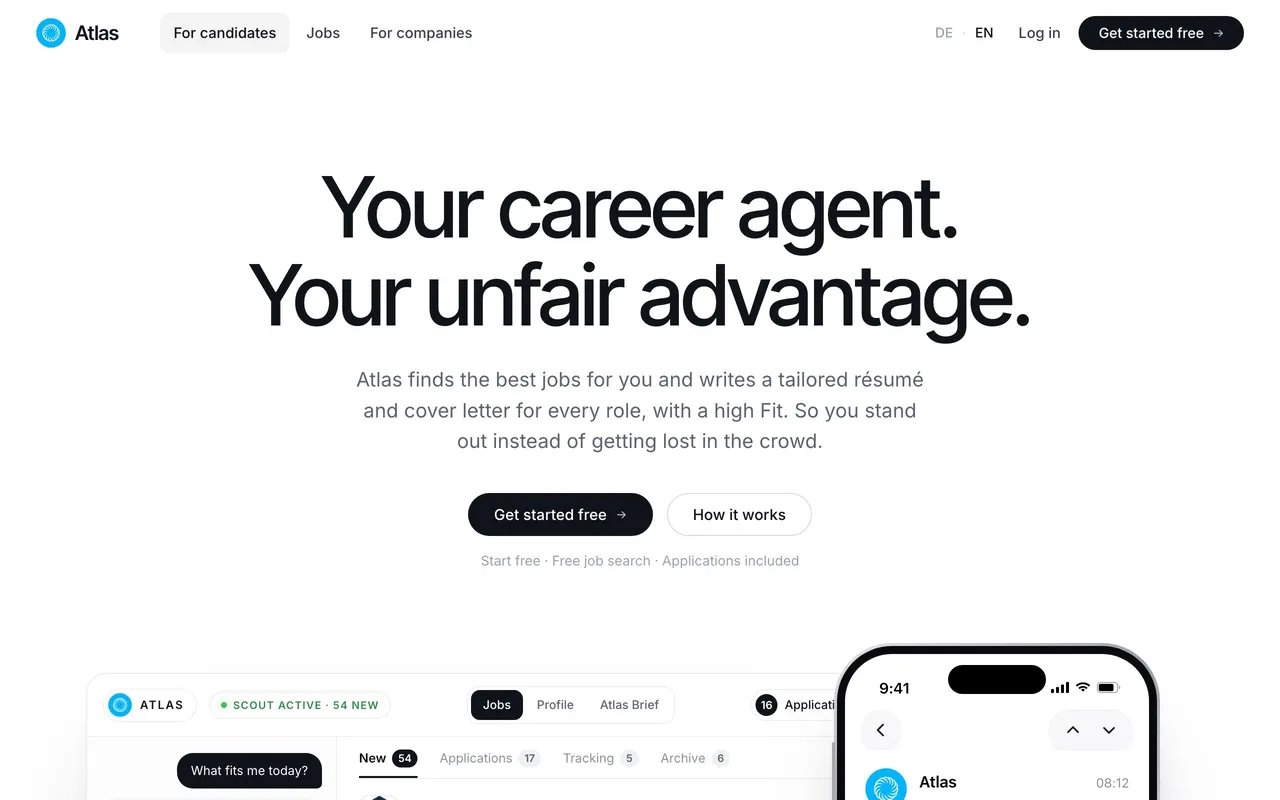
Atlas does not send anything itself. You review everything, download it as a PDF and apply directly to the employer. The reasons behind the match score are good raw material for your third page: they show which points of the ad you can prove from your own experience. EU hosting, GDPR, never sold, no training of third-party AI models, deletable any time. You can also start in the job search.
What does AI change about cover and third pages?
AI takes over the writing, not the choosing. It can turn your CV and the ad into a draft for the third page; you decide whether it is true. Give the model the ad, your CV and the instruction to use only provable points and no invented numbers, then read the result line by line. If you use a chatbot, do not upload data you would not want shared. The GDPR requires data minimisation (Art. 5), a sensible yardstick for you as a user too: address and date of birth do not belong in a prompt.
More on this: tailor your CV with AI, AI for cover letters and the best AI tools for applying in Europe. For readability in the system try the ATS score checker guide, and for a second template the cover letter for career changers and entry-level applicants. How DACH and the US differ is in AI for job applications in Europe.
Frequently asked questions
Does an application need a cover page?
No. The agency calls it optional and “no longer required”. If the ad does not ask for one, it is your call.
Is a third page mandatory?
No, there are no formal rules. Use it only if it holds arguments that have no other place.
How long can the third page be?
One A4 page at most. About 15 lines of prose is a good guide; bullet lists can sit in between.
What is the difference between the third page and the cover letter?
The cover letter answers why you apply for this exact job. The third page adds what else speaks for you, such as volunteering or projects. They should not repeat each other.
Can I create the cover page and third page with AI?
Yes, as a draft. Give the AI only true information and check every statement. Never apply with facts you cannot back up in an interview.
Does a US application need a cover page?
Not by common practice, and no photo either. That is practice, not law. There, resume and cover letter count, and the cover letter is the Anschreiben.
As of October 2026. Sources: German Federal Employment Agency (application guide 2026, leaflet “Praktische Bewerbungstipps”), AGG, GDPR.
Jürgen Ulbrich
Jürgen Ulbrich has more than a decade of experience in developing and leading high-performing teams and companies. As an expert in employee referral programs as well as feedback and performance processes, Jürgen has helped over 100 organizations optimize their talent acquisition and development strategies.