Bullhorn is the enterprise-grade choice for agencies that need deep integrations and can absorb custom AI pricing; Recruit CRM is the value-for-money pick for small-to-mid agencies that want a full ATS/CRM without Bullhorn's add-on costs. Neither one gives you a way to search beyond your own database or a candidate pool that stays valuable after people move on — that gap is where a third option, Sprad, sits. Figures below are current as of September 2026.
Bullhorn vs. Recruit CRM at a glance
Bullhorn is the legacy full-stack platform with hundreds of integrations; Recruit CRM is a leaner, highly-rated ATS/CRM built around affordability and support. Sprad adds what both are missing: requirement-based external search and a talent pool that survives cancellation.
| Criterion | Bullhorn | Recruit CRM | Sprad |
|---|---|---|---|
| Starting price | $99/user/mo (Starter), $165/mo (Core) | ~$95/user/mo billed annually | Free to start (100 credits/month); Recruiter Lite €79/seat/month, Atlas Recruiter €299/seat/month |
| Search beyond your own database | Boolean "AI Search" only on Pro/Max (custom quote) | None documented; sourcing relies on integrations like Lusha or Apollo | Requirement search across 1B+ profiles (LinkedIn, XING, GitHub) plus your own pool and employee networks; every profile checked individually by AI |
| Talent pool that survives cancellation | Candidate records exportable, no dedicated re-engagement layer | Standard candidate database, no pool concept | Candidate consent is captured; the agency-owned pool and all data stay with you after cancelling, with full raw-data export |
| AI matching | Add-on, Pro/Max tier only, custom priced | AI-assisted resume parsing, not semantic/vector search | Full-profile scoring against your own criteria, with reasoning per criterion |
| Outreach | Email sidebar (Core+); sequences not publicly documented | Email sequencing and templates included | LinkedIn (incl. InMail) and email, automated with follow-ups and AI templates, in one inbox per talent |
| CRM depth | Full client CRM (Pro/Max) | ATS/CRM core, workflow automation | Client context profile that feeds AI search; full sales CRM is in beta |
| DACH / German | English UI; SOC 2/GDPR, US-based | English UI only | EU-hosted, German-speaking support |
| Migration | Established but reportedly slow onboarding for large setups | Straightforward, well-supported onboarding per reviews | Free import of old databases (CSV, spreadsheets) |
Bullhorn profile
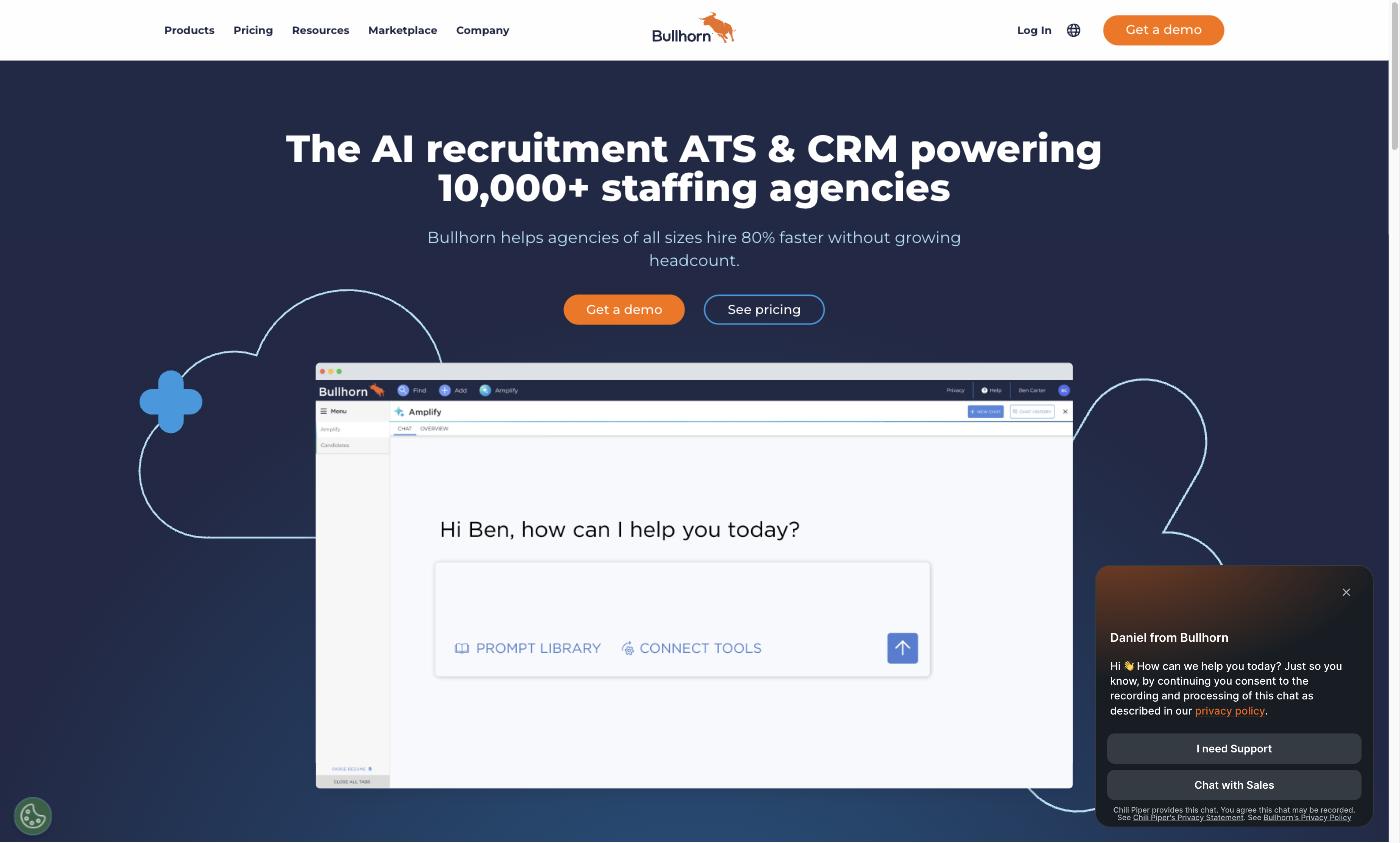
Bullhorn offers the deepest established integration ecosystem in this comparison and suits agencies with complex, mature workflows. Its lower tiers exclude the AI and automation features that often motivate the comparison in the first place.
Recruit CRM profile
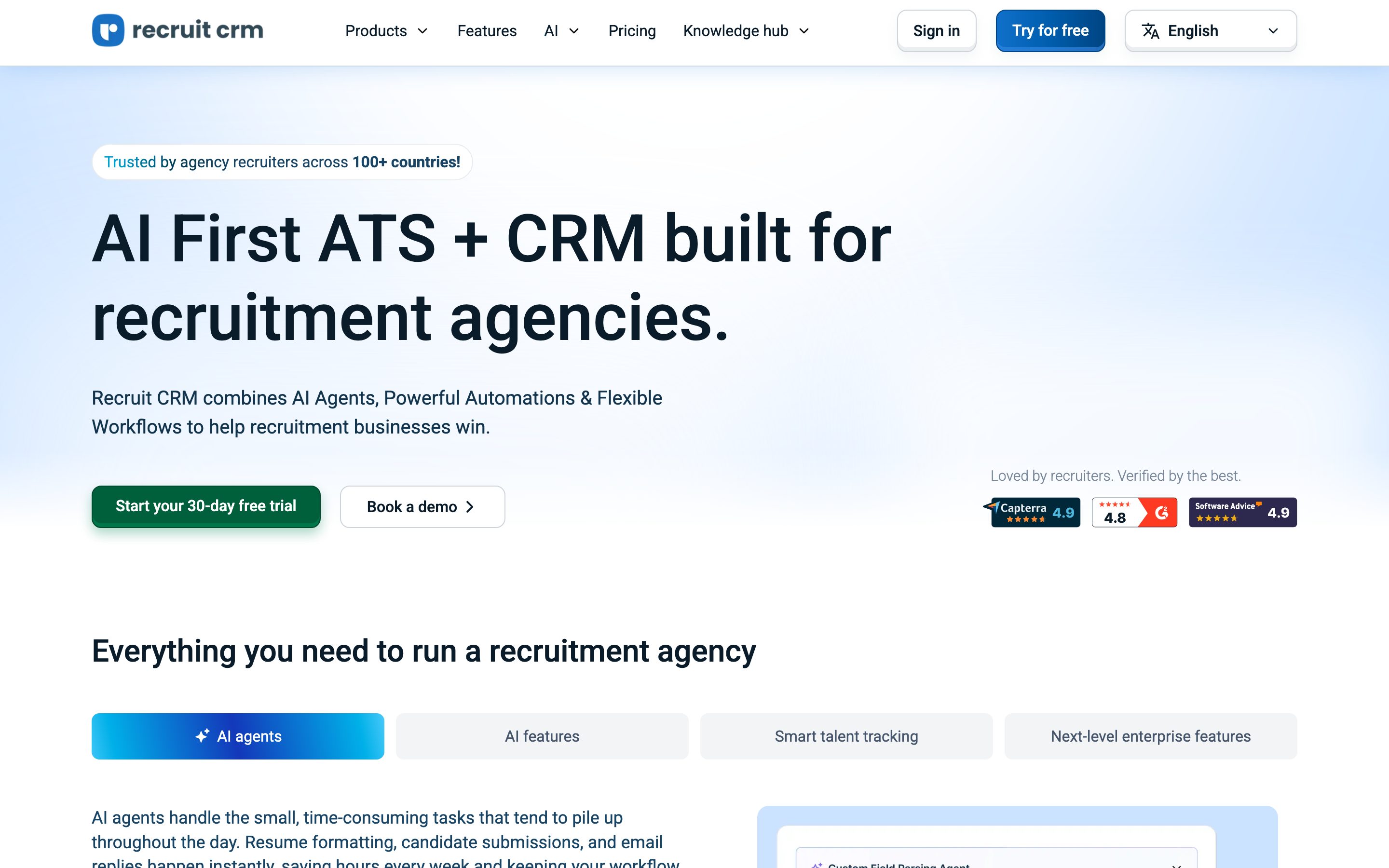
Recruit CRM is the more economical all-rounder and has markedly stronger review scores. Its boundary is sourcing: finding candidates outside the database still depends on separate tools.
Where the two actually differ
Feature tiering vs. one straightforward plan
Bullhorn locks AI search, automation, call transcription and analytics behind a custom-quoted Pro or Max tier — the affordable Starter and Core plans don't include them, according to Bullhorn's pricing page. Recruit CRM takes a flatter approach: AI-powered resume parsing and a ChatGPT integration ship as part of its regular plans, without a separate enterprise gate. That's a meaningfully different buying experience even before you compare the actual feature depth.
The review gap is unusually wide
Recruit CRM holds a G2 rating of 4.8/5 (115 reviews) and a Capterra rating of 4.9/5 (475 reviews, Value for Money 4.8/5) — among the highest of any tool in this comparison series. Bullhorn sits at 4.2/5 on G2 (1,242 reviews) and 4.0/5 on Capterra (1,023 reviews), with its weakest category being Value for Money at 3.7/5, driven by add-on costs and implementation fees "running into the thousands." That's not a small gap — it points to two very different buying experiences, not just two different price points.
Sourcing: neither has a native external database
Recruit CRM's own feature documentation doesn't list a built-in external candidate database — sourcing runs through integrations with tools like Lusha or Apollo rather than an in-app search across public profiles. Bullhorn's AI Search is Boolean-based and gated to Pro/Max, per Spott's own comparison research. If your agency's main pain point is finding candidates you don't already have, neither vendor solves that inside the core product.
Scale and complexity vs. lean and supported
Bullhorn's integration count (300+ partners) and its Heidrick & Struggles ownership make it a fit for agencies with complex, established workflows willing to negotiate custom pricing. Recruit CRM's reviewers consistently cite "value for money" and support quality as the reasons they stay — it's built for small-to-mid agencies (roughly 5-50 recruiters) that want a complete ATS/CRM without Bullhorn's add-on math, but neither the 1.2-billion-profile scale of a dedicated sourcing platform nor deep customization for complex multi-branch operations.
The third option: Sprad
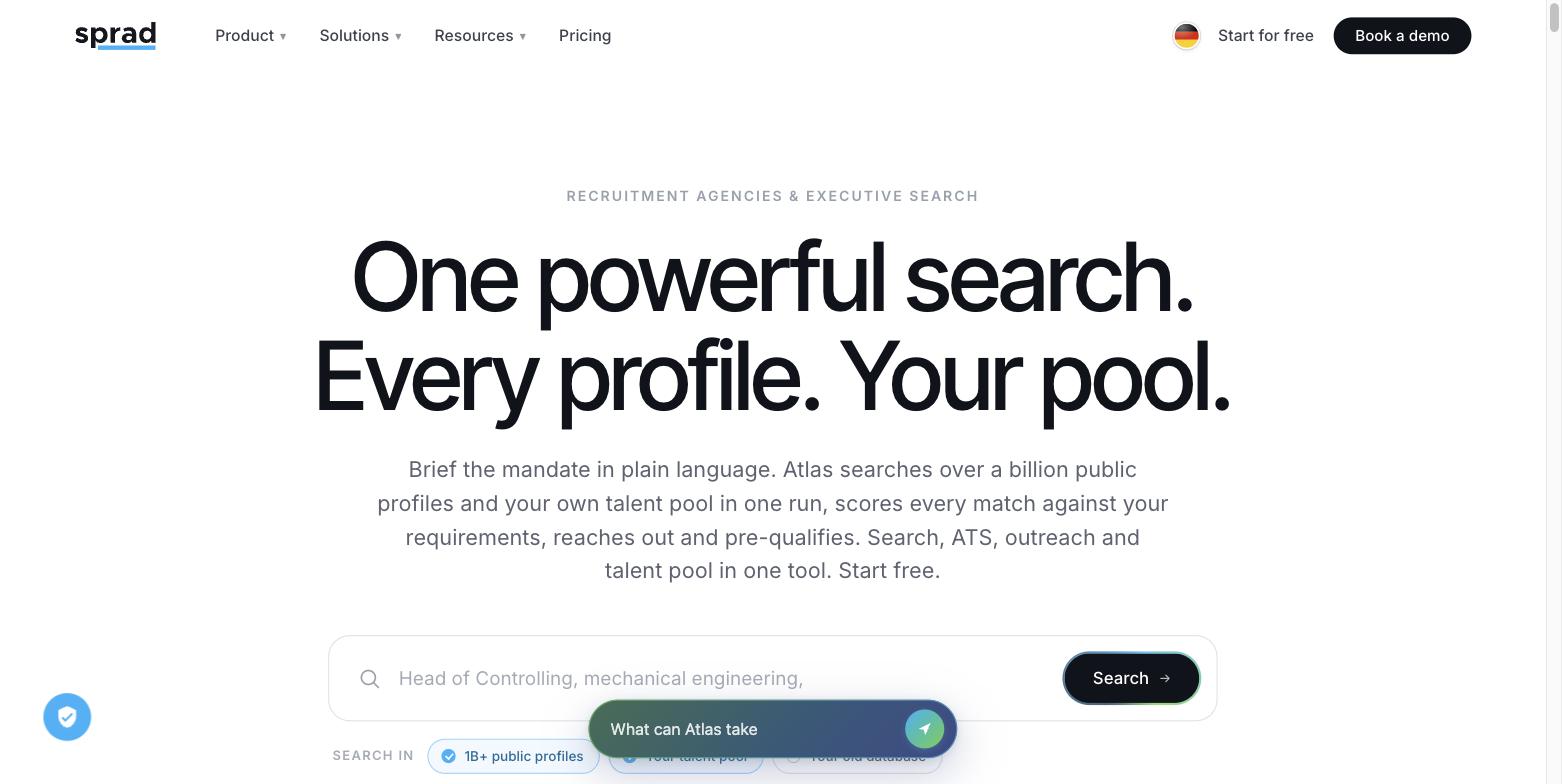
Sprad covers a different decision axis: the ATS and talent pool sit beside requirement-based search across external public profiles and the agency's own records.
Pricing starts free with 100 credits per month (200 in the first month); Recruiter Lite costs €79 per seat and month, Atlas Recruiter €299 per seat and month, and usage beyond that is charged in credits.
In the recruiting area of the open PeopleSearchBench, four systems have published scores (Lessie 68.2, Juicebox 65.7, Exa 64.7, Claude Code 50.5); our own re-measurement of Atlas, converted to that scale, comes to about 73.5 and is not an entry in the benchmark's table (published by Lessie, October 2026). In our own measurement (Sprad, as of 15 August 2026, method), Atlas found 38 % of the candidates that four other systems found; the best of those came to 9 %. Sprad's full client sales CRM is still in beta, so the fit is strongest when sourcing and candidate workflow are the bottleneck.
One search covers LinkedIn, XING, GitHub, your own talent pool and, where employees share their network, theirs. Atlas checks every profile individually against your requirements and gives a reason per criterion, so it also finds people whose profile is thin or lacks the "right" keywords. Deep Context search (included in Atlas Recruiter) goes a step further: find companies first, then the people who worked there in a given period, for example a CFO who led an acquisition.
Outreach runs over LinkedIn (including InMail) and email, automated with follow-ups and AI templates, in one inbox per talent; the system warns when someone has already been contacted. Your data stays with you after cancelling, with a full raw-data export, and hosting is in the EU.
How to tell real AI search from keyword search: if results appear instantly, it is almost always a (semantic) keyword search. A real AI check reads every profile against your requirements, which is why a deep search in Atlas takes a few minutes, while Quick Search returns first results in about 3 seconds.
Which one fits your agency?
- Large, established agency already deep in Bullhorn's 300+ integrations: the switching cost usually outweighs the add-on pricing pain — negotiate the Pro/Max quote instead of migrating.
- Small-to-mid agency (5-50 recruiters) that wants a well-supported, affordable ATS/CRM without heavy sourcing needs: Recruit CRM's price and review scores make it a solid default.
- Agency of any size where the real bottleneck is finding candidates you don't already have: neither Bullhorn's Boolean AI Search nor Recruit CRM's integrations solve that natively — Sprad's requirement search across 1B+ profiles is built for exactly this.
- DACH-based agency: neither Bullhorn nor Recruit CRM offers a German interface; Sprad is EU-hosted with German-speaking support.
FAQ
Is Bullhorn or Recruit CRM cheaper?
Bullhorn's Starter tier ($99/user/month) and Recruit CRM's roughly $95/user/month (annual billing) are close, but Bullhorn's AI and automation features require the separately-quoted Pro or Max tier, while Recruit CRM includes AI-assisted resume parsing in its regular plans.
Does Recruit CRM have external candidate sourcing built in?
No. Recruit CRM's documented feature set relies on integrations with enrichment tools like Lusha or Apollo for external candidates, rather than a native search across an outside database.
Which tool has better reviews, Bullhorn or Recruit CRM?
Recruit CRM rates noticeably higher on both G2 (4.8/5) and Capterra (4.9/5) than Bullhorn (4.2/5 and 4.0/5 respectively), with Value for Money as Bullhorn's specific weak point.
Can I migrate from Bullhorn or Recruit CRM to Sprad without losing candidate data?
Yes — Sprad imports existing databases (CSV exports, spreadsheets) for free, so agencies moving off either tool keep their candidate history.
Does either tool support German-speaking agencies?
Neither Bullhorn nor Recruit CRM publishes a German interface. Sprad is EU-hosted and offers German-speaking support.
A third path worth testing before you commit
A per-seat ATS price only tells half the story if your real problem is finding candidates you don't already have. Bullhorn gates that behind a custom Pro/Max quote, and Recruit CRM leaves it to third-party enrichment tools. Sprad's pricing is built around the opposite idea: your network becomes a searchable talent pool that stays with your agency, alongside a requirement search across a billion external profiles — starting free with 100 credits a month.
See what that looks like for your team size at sprad.io/industry/recruitment-agencies.
Jürgen Ulbrich
Jürgen Ulbrich has more than a decade of experience in developing and leading high-performing teams and companies. As an expert in employee referral programs as well as feedback and performance processes, Jürgen has helped over 100 organizations optimize their talent acquisition and development strategies.