Automotive mechatronics technicians (Kfz-Mechatroniker, the German job title for a car mechanic) earn a median of €3,755 gross per month in Germany working full-time, with the middle 50 % between €3,098 and €4,701 (German Federal Employment Agency, Entgeltatlas, 2025 evaluation). Under the collective agreement for the Hamburg car-repair trade, a journeyman's standard wage has been €22.85 per hour since 1 August 2026, and a master craftsman starts at €4,256 a month. Where you land depends on collective agreement, employer, region and experience.
How much does a car mechanic earn in Germany?
The most reliable figure is the Entgeltatlas of the German Federal Employment Agency. It covers full-time employees subject to social insurance and reports the median: half earn more, half earn less. The chart also shows the quartiles, the limits below and above which a quarter of earners sit.
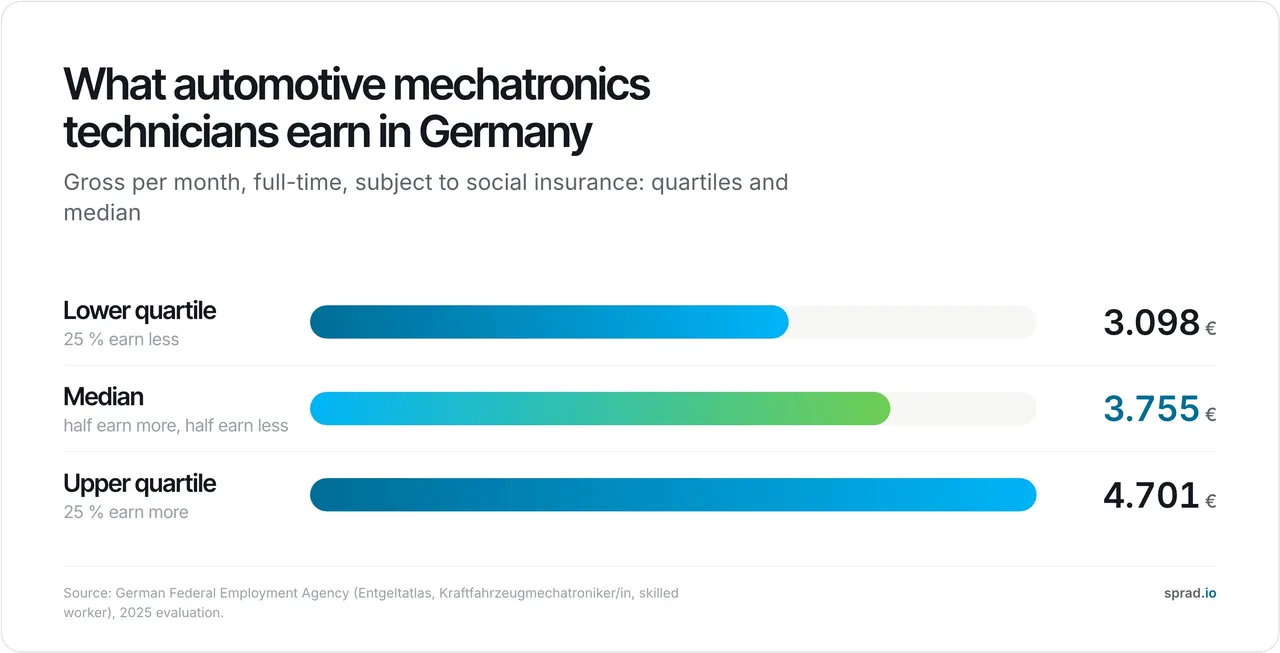
Three points help you read it. First, the median counts full-time jobs only, so part-time, mini-jobs and self-employed owners are missing. Second, the Entgeltatlas lists the specialisations system and high-voltage technology and commercial vehicles with the same €3,755 median, so the figure describes the occupational group, not your specialisation. Third, €3,755 a month works out to about €45,060 a year (12 × €3,755, before bonuses; that is arithmetic, not a statistic).
Why do salary websites quote different numbers?
Open a few portals and German car mechanics range from about €2,560 a month (Jobted) to €3,755 (Entgeltatlas); Jobvector quotes an average near €37,500 a year (August 2026), Jobjump about €38,600 (July 2026). The gap comes from three things: the data basis (reported payroll data versus job ads and user input), the calculation (median versus average, full-time only versus everyone) and the year. The Entgeltatlas showed €3,588 for its 2024 evaluation and shows €3,755 for 2025, about 4.7 % more. Check the year and the source behind every number.
Kfz-Mechatroniker or Kfz-Mechaniker: is there a difference?
Not in pay. "Kfz-Mechaniker" is the old, colloquial title. Since the 2003 overhaul the training occupation is called Kraftfahrzeugmechatroniker; it replaced the occupations of car mechanic and car electrician, and training takes three and a half years. Salary sites list both titles separately but mostly describe the same jobs. If an ad asks for a "Kfz-Mechaniker", what counts is the actual work and the pay group in your contract, not the label.
What do you earn as a newcomer?
The most reliable entry figures come from collective agreements. In the Kfz trade the metalworkers' union IG Metall has agreed the same pattern in its regions: 2.3 % more from July 2025 and another 3.3 % from August 2026, plus €80 a month more for trainees and the option to convert money into up to five extra days off (IG Metall, Kfz settlement 2025; the pay tables run until the end of May 2027 according to the Bavarian announcement). Table values differ by region. Hamburg serves as the example here, taken from the IG Metall Küste pay table.
| Group (Hamburg) | from 1 Jul 2025 per hour | from 1 Aug 2026 per hour | approx. gross/month 2026* |
|---|---|---|---|
| Journeymen, straight after training | €20.88 | €21.57 | €3,552 |
| Journeymen, from month 7 after training | €21.28 | €21.98 | €3,619 |
| Journeymen, from year 2 (standard wage, 100 %) | €22.12 | €22.85 | €3,763 |
| Pay group IV, qualified journeymen | €24.32 | €25.12 | €4,136 |
| Pay group V | €25.64 | €26.49 | €4,362 |
Source: IG Metall Küste, Kfz-trade settlement Hamburg, July 2025. *Own calculation assuming 38 weekly hours (× 52 ÷ 12), before allowances.
Trainee pay in Hamburg from 1 August 2026 is €1,126 in the first and €1,384 in the fourth year (2025: €1,090 to €1,340). A collective agreement only applies if your employer is bound by it, for example through the trade guild, or adopts it in your contract. Ask.
Worked example: from hourly wage to monthly salary
Assumption: 38 hours a week, Hamburg, status 1 August 2026. A month averages 52 ÷ 12 = 4.33 weeks, so you count 38 × 4.33 = 164.7 hours. At the standard wage of €22.85 that is about €3,763 gross, at the entry rate of €21.57 about €3,552. Moving from entry rate to standard wage adds roughly €211 a month (+5.9 %); moving up to pay group IV at €25.12 adds about €374 on top of the standard wage (+9.9 %). At 40 instead of 38 hours the standard wage would be €3,961. Always ask for the contractual weekly hours before you compare an hourly wage with a monthly salary.
If your employer is bound by the agreement, the 3.3 % of August 2026 applies directly: on €3,763 that is about €124 more a month. Without it, your contract decides.
What does a Kfz-Meister (master craftsman) earn?
Under the agreement masters have their own pay groups. In Hamburg from 1 August 2026:
| Master group (Hamburg) | from 1 Jul 2025 gross/month | from 1 Aug 2026 gross/month |
|---|---|---|
| M1 (works foreman assistant master) | €4,120 | €4,256 |
| M2 | €4,757 | €4,914 |
| M3 | €5,443 | €5,623 |
Compared with the journeyman standard wage (about €3,763 a month), the first master group is roughly €493 or 13 % higher. Outside the tariff the quoted figures scatter widely: portals give between about €39,500 (Jobted) and €56,400 a year (Jobjump, July 2026) for masters. The spread mostly shows how differently employers cut the role, from team lead to workshop manager with budget responsibility. The state supports the master course through Aufstiegs-BAföG with grants and loans; check which support applies to you before you enrol.
What does your pay depend on?
- Collective agreement: Bound employers pay by table, others negotiate freely. The difference shows at entry and at every raise.
- Employer and vehicle type: Brand dealerships, independent workshops, commercial-vehicle and fleet operators often pay differently. Compare several offers before you commit.
- Region: Pay differs noticeably between city and countryside and between tariff regions. Use the table for your region, not the national median.
- Qualification: High-voltage, diagnostics and driver-assistance skills are your strongest argument. They are not an automatic premium, though: the Entgeltatlas shows the same median for the specialisations. Negotiate them actively.
- Form of pay: Hourly wage, monthly salary or performance pay with bonus. Ask how allowances, holiday and Christmas bonuses are handled, because they are often not part of the base wage.
- Working time: Weekly hours, shifts, on-call duty and overtime rules change the hourly value of your pay.
What do car mechanics earn in Austria, Switzerland and the US?
The figures are not like for like: currency, deductions, number of payments per year and training route differ.
| Country | Value | Source, date |
|---|---|---|
| Germany | median €3,755 gross/month, middle 50 %: €3,098 to €4,701 | Entgeltatlas, 2025 evaluation |
| Austria | no reliable single figure; pay by collective agreement, 14 payments | Chamber of Commerce collective agreement database |
| Switzerland | median about CHF 70,100/year (CHF 57,800 to 89,200) | comparison site lohncheck.ch, 2026; no official figure |
| USA | median $50,620/year | BLS, May 2025 |
In Austria pay follows the collective agreement for the motor-vehicle trade; you find the tables in the collective agreement database of the Chamber of Commerce. We found no reliable single figure and therefore quote none. Fourteen payments a year are usual, which matters when you compare with a German monthly salary. In Switzerland the comparison site lohncheck.ch gives a median of about CHF 70,100 a year for automotive mechatronics technicians, within a range of CHF 57,800 to 89,200 (2026). Over 13 payments that is about CHF 5,400 a month, a calculation under that assumption; official wage statistics come from the Swiss Federal Statistical Office. In the US the Bureau of Labor Statistics reports a median of $50,620 a year for automotive service technicians (May 2025) and expects employment to grow 5 % from 2025 to 2035. A non-degree postsecondary award is the typical entry route there.
Gross or net: what is left?
Every figure above is gross. In Germany, net pay depends on tax class, child allowances, church tax and your health insurer's additional contribution. Use the Federal Ministry of Finance's official income tax calculator instead of a flat percentage, and use the monthly pay your contract actually states, including allowances but without irregular bonuses.
How do you get more, and which mistakes should you avoid?
- Know your benchmark. Use your region's table or the Entgeltatlas as an anchor, not a single portal.
- Have your pay group checked. If you take on diagnostics, high-voltage work or team tasks, you often belong in a higher group than when you were hired.
- Negotiate the package. Besides base pay, allowances, training (such as high-voltage courses), tools, work clothing and time off instead of money count.
- Do the maths before the master course. Weigh the roughly 13 % premium of the first master group against the cost and time of the course.
Typical mistakes: comparing hourly and monthly pay without the weekly hours, reading allowances as base pay, trusting the first number without asking about group and step, and looking only at pay when you switch. A step-by-step guide is in How to Negotiate Salary: Script, 6 Email Templates and a Worked Example.
Does the salary have to be in the job ad?
In Germany not across the board so far. The EU Pay Transparency Directive 2023/970 requires that applicants learn the starting pay or range before the interview and that employers may no longer ask about your previous salary. The transposition deadline ran out on 7 June 2026; check how far your country has come. Either way you can ask for the range before you invest time in a conversation.
How do you find jobs with the right pay?
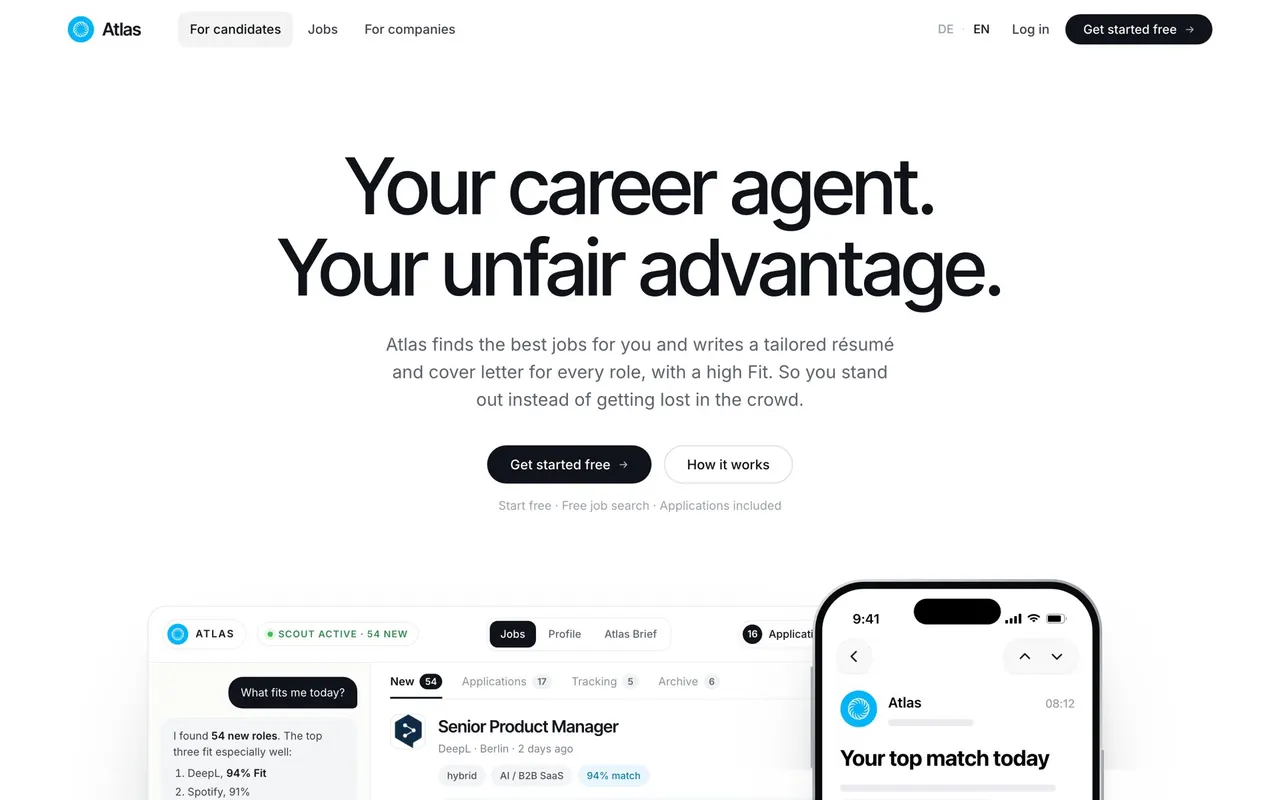
Only some ads state a salary, so a benchmark alone does not help. One approach is to scan many jobs at once and pre-sort the fitting ones. Atlas (Atlas Career, free and without limits) searches over 1.5 million active jobs straight from employers, more than 100,000 of them in the DACH region, and has its own portal for the trades, including automotive and metal. For each role Atlas shows a match score with reasons. It shows a salary only where the ad states one; it makes no salary forecasts of its own. In a short voice conversation at the start (the "Atlas Brief") you set role, level, target pay, location and no-gos, and Atlas keeps searching. You review everything yourself and apply directly to the employer.
What does AI change about comparing pay?
Language models give you a number on request, but without a cut-off date, collective agreement or region. Use AI to find jobs and tailor documents, and settle the numbers yourself with the sources above. More in our comparison of AI job search tools and in What is an AI career agent?. For matching documents see the free AI resume builder guide.
Frequently asked questions
How much does a car mechatronics technician earn per month?
A median of €3,755 gross full-time; the middle 50 % earn between €3,098 and €4,701 (Entgeltatlas, 2025 evaluation).
What does a Kfz-Mechatroniker earn at career start?
Under the Hamburg Kfz-trade agreement it is €21.57 per hour straight after training (from 1 August 2026), about €3,552 gross a month at 38 weekly hours. Without a collective agreement pay is negotiated.
What does a Kfz-Mechaniker earn?
The same as a Kfz-Mechatroniker: "Kfz-Mechaniker" is the older title for the occupation that has been called Kraftfahrzeugmechatroniker since 2003.
How much does a Kfz-Meister earn?
Under the Hamburg Kfz-trade agreement between €4,256 (M1) and €5,623 (M3) a month (from 1 August 2026). Outside the tariff portals quote €39,500 to €56,400 a year.
How much does a car mechanic earn in Switzerland and the US?
In Switzerland a comparison site gives a median of about CHF 70,100 a year (2026); in the US the BLS reports $50,620 a year (May 2025).
How can I earn more?
Move to an employer bound by the collective agreement, have your pay group checked, qualify in high-voltage or diagnostics and negotiate the whole package instead of base pay alone.
Jürgen Ulbrich
Jürgen Ulbrich has more than a decade of experience in developing and leading high-performing teams and companies. As an expert in employee referral programs as well as feedback and performance processes, Jürgen has helped over 100 organizations optimize their talent acquisition and development strategies.