A CV for Switzerland is a tabular CV with a photo on two pages at most, sent together with a cover letter and work references as an application dossier. In Austria the structure is similar, but the photo is optional and only name and contact details are mandatory. Below you find a filled-in sample for both countries, the differences to Germany, the mistakes we see most often and what AI can take off your plate. The guide is for applications in German-speaking Switzerland and Austria, including in English.
What does a "CV for Switzerland" actually mean?
It is a CV that follows the habits of Swiss employers. According to EURES, the European job mobility portal, an application dossier usually consists of a motivation letter, a CV with photo and copies of diplomas and work references. The CV is two A4 pages at most and ideally tabular, the cover letter should not exceed one A4 page.
Austria is similar but looser: oesterreich.gv.at asks for a clear, logically structured CV without gaps, with the skills that matter for the job at the front. If you apply in both countries you do not need two CVs from scratch, just one base with a few adjustments.
Switzerland, Austria and Germany compared
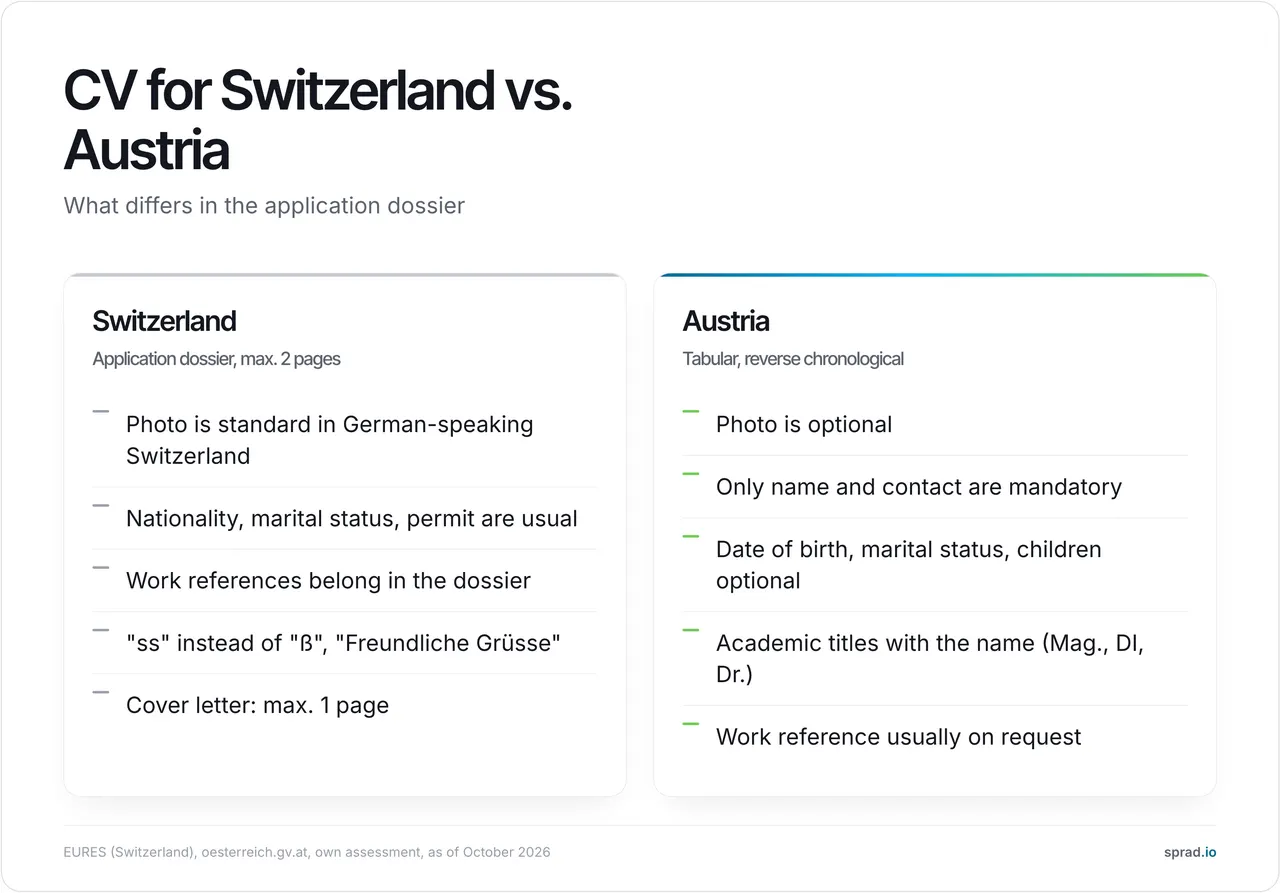
The differences are small, but they stand out immediately when they are wrong. Where there is no official rule the table says "usual": that is practice, not law.
| Point | Switzerland | Austria | Germany (for comparison) |
|---|---|---|---|
| Photo | standard in German-speaking Switzerland | optional | optional, still common |
| Length | two pages at most | usually 1 to 2 pages | two pages at most |
| Personal data | no legal duty; usual: nationality, marital status, permit | name, titles, contact | name, contact |
| References | part of the dossier (Arbeitszeugnis) | Dienstzeugnis on request | references as attachments |
| Spelling | "ss" instead of "ß" | "ß" as in Germany | "ß" |
| Closing | "Freundliche Grüsse" | "Mit freundlichen Grüßen" | "Mit freundlichen Grüßen" |
| Cover letter | Motivationsschreiben, 1 page | Bewerbungsschreiben, 1 page | Anschreiben, 1 page |
Step by step: your CV for Switzerland
- Read the ad and settle the language. In German-speaking Switzerland you write standard German. For companies working in English use an English CV, see our guide CV in English.
- Header with the details that are usual in Switzerland: name, address, phone, email, nationality, marital status and, if you have one, your residence permit (for example B, or G for cross-border commuters). This is practice, not a duty. Without it the employer has to ask.
- Add a photo: professional and recent, top right, no selfie and no booth picture. It is not required, but expected in German-speaking Switzerland.
- Profile: two to three sentences with role, experience and what you bring to this job.
- Experience in reverse order: latest first, with period (month/year), role, company, place and three to five bullets that end in a result. The title must match your reference, because mismatches stand out in reference checks.
- Education: degree, subject, institution, year. A foreign degree often needs a short note because the Swiss education system is built differently.
- Languages and IT: language levels on the European framework (A1 to C2).
- Check Swiss spelling: "ss" instead of "ß" ("Strasse", "Grüsse"), "Zivilstand", "Bewerbungsdossier", "Beilagen".
- Attach references separately: work references and diplomas as their own files, saved as PDF with your name in the file name.
Filled-in sample for Switzerland and Austria
The sample is fictional and only shows where the countries differ. Structure and bullets stay the same, the differences sit in the header, the attachments and the spelling.
| Section | Switzerland (example) | Austria (example) |
|---|---|---|
| Header | Mara Muster, Musterstrasse 1, 8000 Zürich, nationality: DE, marital status: single, permit: B, photo top right | Mag. Mara Muster, Musterweg 1, 1010 Vienna, photo optional, date of birth optional |
| Profile | 2 to 3 sentences: role, industry, focus | Same, if space allows |
| Experience | 03/2021 – present, Customer Service Team Lead, Muster AG, Zurich: 3 to 5 bullets with results | 03/2021 – present, Customer Service Team Lead, Muster GmbH, Vienna: 3 to 5 bullets with results |
| Education | BSc Business Administration, ZHAW, 2017 – 2020; explain equivalents of local diplomas only if needed | Mag. (FH) Business Administration, FH Wien, 2015 – 2020; Matura, 2014 |
| Languages and IT | German (native), English C1, French B1 | German (native), English C1 |
| Attachments | Work references and diplomas, as separate files | Work references and diplomas on request |
A bullet in the experience section looks the same in both countries: "Grew the customer service team from 8 to 12 people, cut response time from 24 to 6 hours." A task list ("responsible for customer requests") tells the reader less than a result with a number.
CV for Austria: what is different?
According to oesterreich.gv.at a photo is optional. Only first and last name with any titles and a way to contact you are mandatory; citizenship, date of birth, place of birth, marital status and children are optional. Academic titles such as Mag., DI or Dr. belong to the name and are more common than in Switzerland.
The law protects you: the Austrian Equal Treatment Act prohibits discrimination in hiring on grounds of sex, marital status, children, ethnic origin, religion or belief, age and sexual orientation. A CV without a photo must therefore not count as incomplete. In practice a photo still helps more in customer-facing roles and for career starters, and less in technical and scientific jobs.
References: in Austria the work reference is called Dienstzeugnis. Under § 39 Angestelltengesetz the employer must issue a certificate of duration and type of work on request at the end of employment, and remarks that make finding a new job harder are not allowed. You usually send it only on request.
The Swiss work reference: why it belongs in the dossier
EURES stresses that Switzerland places great value on diplomas and work references and wants a career path without gaps. The basis is Art. 330a of the Swiss Code of Obligations: you can ask at any time for a reference covering the type and duration of the employment as well as performance and conduct. On special request it is limited to type and duration (the "Arbeitsbestätigung").
Practical tip: request the reference at every job change, while the cooperation is fresh. If it is missing later, the gap is noticed faster than in Germany.
Which mistakes should you avoid?
Sprad has built recruiting software for seven years and sees the same patterns in application documents again and again. These are experience values, not statistics:
- "ß" in a Swiss dossier. A small mistake that shows the CV was copied from Germany.
- Photo missing or a selfie for a Swiss job where it is expected.
- Permit and residence missing. Applicants from abroad leave the employer guessing whether they may work at all.
- Job titles differ from the reference. "Head of" in the CV and "team lead" in the reference costs trust.
- Three pages instead of two. The limit applies in Switzerland; in Austria universities allow up to three, but two is better.
- Marital status, children or religion in too much detail. Optional in Austria, no qualification in either country.
- One CV for every job. The ad decides which bullets go first.
Which tools and templates help?
A Word template or a sample from a university or authority is enough to start. The overview, including limits:
| Option | Cost | Strength | Limit |
|---|---|---|---|
| Word or Google Docs template | free | full control over layout | you must know the country rules yourself |
| Samples from cantons, universities, AMS | free | checked by authorities or schools | one sample for all, not tailored per job |
| Europass | free | standardised, multilingual | often feels too formal and uniform in Switzerland |
| Atlas Career | free, no limits | a tailored CV per job, language and format follow the ad | you check every line; country details like "ss" are yours to verify |
Worked example: how much time does tailoring cost?
Assumptions: you apply to eight jobs, three in Switzerland, three in Austria and two in Germany. Tailoring header, profile and bullets properly takes about 45 minutes by hand. That is 8 × 45 = 360 minutes, six hours.
With a checked base version and ready-made country blocks (header, attachments, spelling) it drops to about 20 minutes per job, 8 × 20 = 160 minutes or a bit over two and a half hours. The times are estimates, not measured, but the principle holds: filing the country differences cleanly once saves time on every further application.
What does AI change about your CV?
AI takes over the legwork: tailoring bullets to the ad, adjusting language and format, drafting a cover letter. It does not replace your check, because it does not know every country detail. Whether "ss" is used, the permit is right and the title matches the reference is yours to verify.
Atlas Career is a free option: Atlas writes a tailored CV for every job and a cover letter on request, with language and format following the ad, without limits. You review everything, download it as PDF and apply directly to the employer. Atlas Career also searches 1.5 million+ active jobs straight from employers, over 100,000 of them in the DACH region, and gives each one a match score with reasons. More in our guide how to tailor your CV with AI.
On data and law: Atlas is built by Sprad in Vienna, hosted in the EU and follows the GDPR; data is never sold, no third-party AI models are trained on it and you can delete everything at any time. On the employer side, some companies use AI to screen. In the EU the AI Act (Regulation (EU) 2024/1689) classes AI systems for selecting applicants as high-risk in Annex III. In Switzerland it does not apply directly, but many employers work similarly: a clean text-based PDF without columns and graphics is read most reliably.
If you want a quick first draft: creating an Atlas account is free. More templates in CV template and examples, wording help in 75 AI prompts for job applications.
And the cover letter in Switzerland and Austria?
In Switzerland it is the Motivationsschreiben, one A4 page at most, explaining why you choose this job and this company. The usual closing is "Freundliche Grüsse". Name a salary expectation if the ad asks for it. In Austria it is the Bewerbungsschreiben, also one page, closing with "Mit freundlichen Grüßen". Both times: refer concretely to the job instead of using a standard text. According to EURES a standard letter is hardly noticed, especially in speculative applications.
FAQ
Do I need a photo in a Swiss CV?
It is not required, but usual in German-speaking Switzerland. EURES lists the "CV (with photo)" as part of the dossier. Use a professional, recent picture.
How long may a Swiss CV be?
Two A4 pages at most. Career starters usually manage with one.
Do I have to state nationality and marital status?
In Switzerland it is usual but not a legal duty. In Austria citizenship, date of birth, marital status and children are explicitly optional according to oesterreich.gv.at.
What is a Bewerbungsdossier?
The Swiss word for the complete application documents: cover letter, CV, diplomas and work references.
What is the difference between Arbeitszeugnis and Arbeitsbestätigung?
The Arbeitszeugnis assesses performance and conduct, the Arbeitsbestätigung only states type and duration of the job (Art. 330a OR).
Can I use the same CV for Germany, Austria and Switzerland?
As a base yes, but not unchanged: spelling ("ss"), header details, photo and attachments differ by country.
May I create my CV with AI?
Yes, as long as the content is true. You are responsible for every line and check titles, dates and numbers before sending it.
As of October 2026. Country conventions are practice, not legal advice; when in doubt, follow the job ad. The samples are fictional.
Jürgen Ulbrich
Jürgen Ulbrich has more than a decade of experience in developing and leading high-performing teams and companies. As an expert in employee referral programs as well as feedback and performance processes, Jürgen has helped over 100 organizations optimize their talent acquisition and development strategies.