In the US and Canada a resume is a short, tailored summary of one to two pages, and a CV (curriculum vitae) is a long, complete record used mainly in academia and research. In the UK, Ireland, Australia and New Zealand, "CV" is simply the everyday word for the document you send with a job application, usually two A4 pages. So the right choice depends on where you apply and for what kind of job, not on a fixed definition. If the ad says "send your CV" and the employer is outside North America, send a tailored one- to two-page document; if it is a university post or grant, send the long form. Conventions as of October 30, 2026.
Is a CV the same as a resume?
Often yes, sometimes no. The words overlap in everyday use, which is why the question is so common. The split that matters:
- Resume: a short, targeted document for a specific job. Career centers at US universities describe it as usually one page; Tufts' career center contrasts it with a CV that "is often two pages or longer".
- CV (long form): a complete record of education, positions, publications, grants, teaching and awards. Emory's career center says it is traditionally used for academic jobs, grants and fellowships. It has no fixed length and grows with your career.
- CV (everyday use abroad): in the UK and much of the Commonwealth the same word means the tailored application document. TARGETjobs gives two A4 pages as the standard maximum for a graduate CV and says to use "either one or two full pages".
CV vs resume: the comparison by country and purpose
These are conventions drawn from career-center and careers-press guidance, not legal rules. Where an employer gives instructions, those win.
| Where / what for | Word to use | Typical length | Content focus | Photo |
|---|---|---|---|---|
| USA, Canada (industry) | Resume | 1 page; 2 with long experience | Achievements for this job, keywords from the ad | No. The EEOC says employers should not ask for one |
| USA, Canada (academia, research, medicine) | CV | No limit, 2+ pages | Publications, grants, teaching, presentations | No |
| UK, Ireland | CV | 2 A4 pages (1 for a first job) | Personal statement, reverse-chronological jobs, education | Not usual |
| Australia, New Zealand | CV (resume also understood) | 2–3 pages | Similar to the UK, often with referees | Not usual |
| Germany, Austria, Switzerland | Lebenslauf (CV in English-language ads) | 1–2 pages | Tabular, gap-free, dates month by month | Common, optional |
| EU-wide | Europass CV or your own | 2 pages is a sensible target | Standard sections, 31 languages | Optional |
The Australia/New Zealand row is the least firmly sourced of these; check the ad and the employer's own guidance. The photo column for Germany, Austria and Switzerland is explained below.
Which one should you use? A 60-second decision
- Read the ad's own word. "Resume" or "CV" is usually chosen for a reason; mirror it in the file name (
Name_CV.pdf), not the content. - Who is the employer? A university, institute or hospital research post means the long-form CV. A company means the short, tailored version.
- Where is the job? North America: one-page resume without photo. UK/Ireland: two-page CV. DACH: Lebenslauf, tabular.
- How will it be read first? Many large employers pass it through an applicant tracking system (ATS). Use one column, real text and standard headings such as "Experience" and "Education".
How to turn a CV into a resume (step by step)
A common case for people who move between markets: a two-page UK CV that has to become a one-page US resume. A worked example, with assumptions (the numbers are illustrations, not measurements):
- Start from a master document. Keep one full list of every role, project and result. Assumption: it holds 14 years of work and about 900 words.
- Cut by relevance, not by date alone. Keep roughly the last 10–15 years and only the roles that support this job. Assumption: this brings it to about 550 words.
- Rewrite bullets as results. "Responsible for the onboarding process" becomes "Cut onboarding time from 6 to 4 weeks for 40 new hires" (only if it is true).
- Drop the UK-style extras. Personal statement becomes a two-line summary or goes; remove photo, date of birth, marital status and referees ("references available on request" is no longer needed).
- Mirror the ad's keywords honestly. If the ad says "stakeholder management" and you did it under another name, use their term.
- Save as PDF or .docx, as the employer asks, and check that you can select and copy the text.
Going the other way, from resume to UK CV, you add a short personal statement, spell out education, and let the document fill two pages without padding. The same master-document logic applies to a German Lebenslauf; see how to choose a resume ATS checker to test that the result stays readable.
What goes wrong most often (mistakes to avoid)
- Sending an eight-page academic CV for a company job. A recruiter skims a document in seconds; the important lines are buried.
- Sending a one-page resume for a research post. Publications and grants are the evidence there; leaving them out reads as having none.
- Keeping a photo for US applications. The EEOC says employers "should not ask for a photograph of an applicant"; a photo adds risk for them and nothing for you.
- Using one generic file for every job. In our experience with recruiting software, a file that does not speak to the ad costs more than choosing the wrong label.
- Fancy layouts. Columns, icons and text inside images can confuse parsers. Test by copying the text into a plain editor.
- Inconsistent dates and spelling. Pick UK or US spelling to match the market, and one date format throughout.
Which templates and tools help?
For an EU-wide format, the official Europass CV builder lets you create, store and share CVs in 31 languages, using one profile for many CVs. It is a good base, but the output is generic; most UK and US employers are happier with a plain, tailored document. For templates, a single-column Word or Google Docs file with standard headings beats any decorative design.
For tailoring at scale, an AI tool saves the repetitive work. Atlas Career is built for exactly this step: you keep one profile, and for each job it writes a CV and, on request, a cover letter in the format the ad and country call for. See also our guides on how to tailor your CV with AI and which AI resume builders are really free.
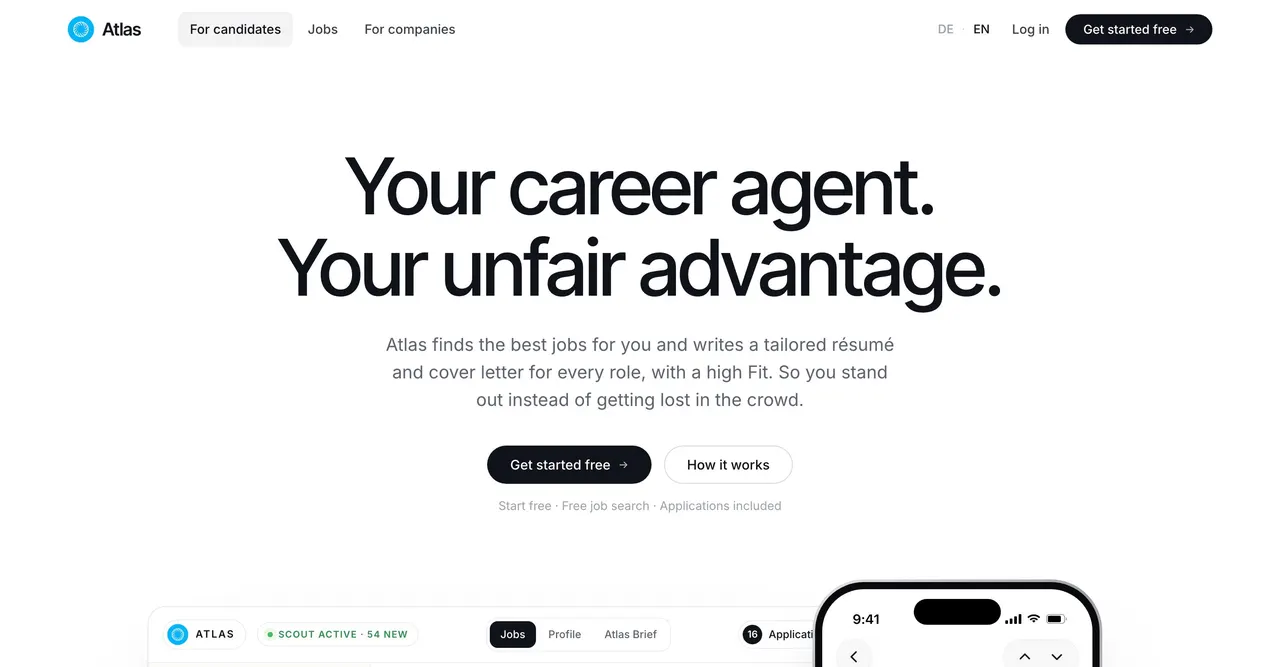
Atlas Career (built by Sprad in Vienna, a team with seven years in recruiting software) is a free AI career agent. It searches 1.5M+ active jobs straight from employers' career sites, shows a match score from 0 to 100 with the reasons, and tailors the CV per job; language and format follow the ad, for example a photo for a German job, none for a US one. Atlas sends nothing for you: you review, download the PDF and apply directly to the employer. It is free, with no plans or quotas.
Honest limits: Atlas does not replace your judgment about which version a research committee or a creative studio expects, and it will not invent experience you do not have. For a long academic CV with a full publication list, you still maintain the master list yourself.
How does AI change the CV vs resume question?
Two things. First, tailoring is now cheap: what used to take an evening per application takes minutes, so a generic file is harder to defend. Second, more employers use software to screen. In the Harvard Business School and Accenture study "Hidden Workers" (September 2021; 8,000+ job seekers and 2,250+ executives in the US, Germany and the UK), 88% of the US hidden workers surveyed believed their applications were filtered out even though they could do the job. Plain, parseable documents reduce that risk.
Regulation is following: the EU AI Act classes AI systems used to recruit and filter candidates as high-risk, which means strict duties for employers. If you upload your CV to any tool, check where data is stored and whether it is used to train models. Atlas is hosted in the EU, follows the GDPR, never sells your data and does not train other AI models on it; you can delete it any time.
FAQ
What is the difference between a CV and a resume?
Length and purpose. A resume is a short, job-specific summary of one to two pages; a long-form CV is a complete academic record without a page limit. Outside North America, "CV" usually means the short, tailored document.
Which is better, a CV or a resume?
Neither is better. Use the word and format the employer and country expect: resume in the US and Canada, CV in the UK and Ireland, long-form CV for academic and research roles.
Do I use a CV or a resume in the UK?
A CV. Aim for two A4 pages, reverse-chronological, with a short personal statement and no photo. One page is fine for a first job.
How long should each be?
Resume: one page, two with long relevant experience. UK CV: two pages. Academic CV: as long as your record needs, with the most relevant items first.
Should I put a photo on it?
Not for the US or UK. In Germany, Austria and Switzerland it is still common but optional. Follow the ad, and keep a version without a photo.
Can I use one file for CV and resume?
Keep one master document and create a tailored version per job. The master is for you; what you send should be cut to fit the job and the market.
What is a Europass CV?
The EU's free online CV format, available in 31 languages. It suits applications across Europe, but a tailored plain CV often performs better for individual jobs.
Can AI write my CV or resume?
Yes, for the heavy lifting: tailoring wording to a job ad and adjusting format by country. Always read it, keep every claim true and remove anything you could not defend in an interview.
Jürgen Ulbrich
Jürgen Ulbrich has more than a decade of experience in developing and leading high-performing teams and companies. As an expert in employee referral programs as well as feedback and performance processes, Jürgen has helped over 100 organizations optimize their talent acquisition and development strategies.