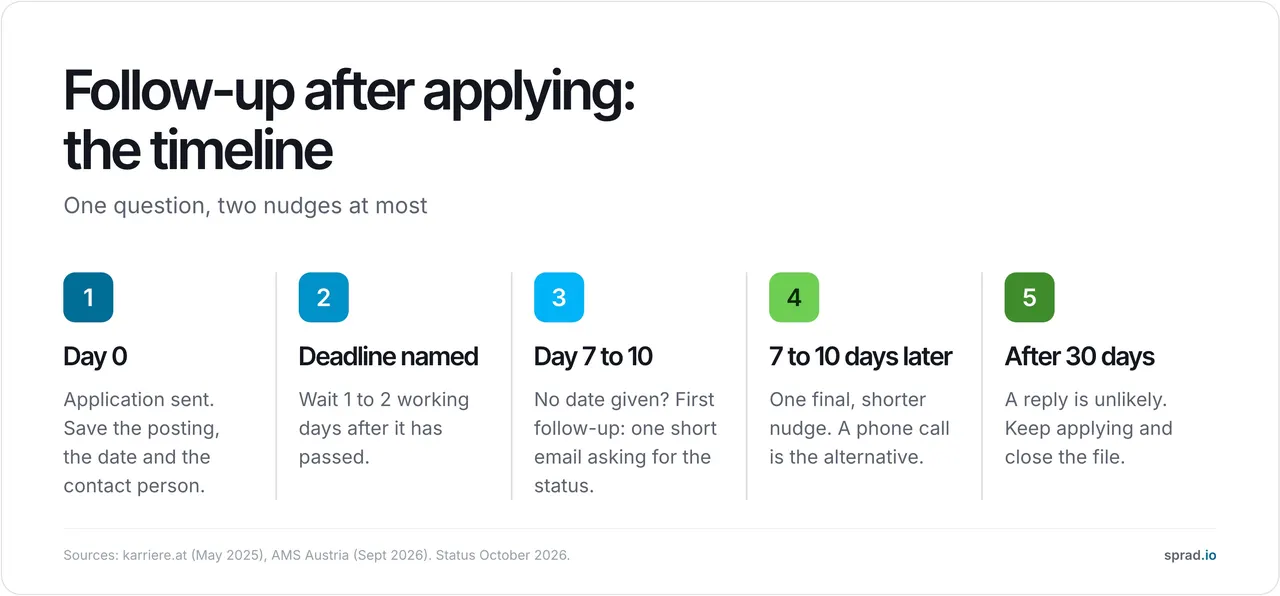
A follow-up email after a job application is a short message (three to five sentences) that you send once, about 7 to 10 working days after applying, to ask where your application stands. Name the role and your application date, ask one concrete question about the status, and add one line of interest. If the posting names a deadline, wait until one or two working days after it has passed. Send it once, plus at most one final nudge, and then keep applying.
What does a follow-up email after an application mean in practice?
It is a status request, not a sales pitch. You are not repeating your CV and you are not asking for a favour. You are asking a practical question that a recruiter can answer in one line: has a decision been made, and when will you hear back?
Do not confuse it with the thank-you note after an interview. That one is sent within a day and asks for nothing; we cover it in our guide to the thank-you email after an interview. The follow-up after an application comes earlier, when you have heard nothing at all.
Silence is common, so it helps to know what you are dealing with. An iHire study reported in December 2025 found that 53% of applicants had been ghosted during their search, and the Greenhouse State of Job Hunting report (December 2024; US, UK, Germany) found that 61% had been ghosted after an interview. Both are self-reported surveys, so read them as a direction, not a precise rate. The practical conclusion: a missing answer rarely means "no". Often it means nobody has looked at your file yet.
When should you follow up?
Not before the application window has had time to close. Guides differ by a few days, but they agree on the shape:
| Situation | When to follow up | Source |
|---|---|---|
| No deadline in the posting | 7 to 10 working days after applying | karriere.at (updated May 2025) |
| Deadline named in the posting | 1 to 2 working days after the deadline | karriere.at (May 2025) |
| Public-sector or large employer with a fixed process | 2 to 3 weeks after the deadline at the earliest | AMS Austria (updated 30 September 2026) |
| Employer promised a date | 1 to 2 days after that date | karriere.at (May 2025) |
| Nothing after the first follow-up | One final nudge after 7 to 10 days | karriere.at (May 2025) |
| More than 30 days of silence | Treat the file as closed | karriere.at (May 2025) |
The two Austrian sources (karriere.at and the public employment service AMS) are German-language, but their timing matches what English-language career guides recommend: one to two weeks. In the US and UK, "7 to 10 working days" is a safe default. In Germany, Austria and Switzerland, add a few days if the posting has a deadline, because many employers only start reading once it has closed.
How to write the email, step by step
- Check the basics first. Look in your spam folder for an automatic confirmation, check the address you used, and log in to the employer's portal if there is one. Many "no answer" cases are a status you can already see.
- Find a named person. The recruiter or hiring manager from the posting is better than a generic info@ address. If there is no name, write to the HR address from the posting.
- Write a clear subject line. Role and date do the work: "Question about my application of 3 November: Marketing Manager". Add the job reference number if the posting has one.
- Open with the facts. Role, application date, one sentence of context. No apology for writing.
- Ask one question. "Could you tell me where my application stands and when I can expect an update?" One question gets one answer.
- Add one line of interest and close. Say what attracts you to the role in a sentence, offer to answer questions, sign with your phone number. Do not attach the CV again unless asked.
Follow-up email templates you can copy
Template 1: standard follow-up (no deadline).
Subject: Question about my application of [date]: [role]
Dear [Name],
I applied for the [role] position on [date] and wanted to ask how the process is going. Could you tell me where my application stands and when I can expect an update?
I am still very interested in the role, especially because [one concrete reason from the posting]. I am happy to answer any questions.
Kind regards,
[Name], [phone number]
Template 2: after the deadline has passed.
Subject: Application [role], deadline [date]
Dear [Name],
the application deadline for the [role] position ended on [date]. I would like to ask whether a decision has been made or when you plan to get back to candidates.
Thank you for your time.
Kind regards,
[Name]
Template 3: final nudge (7 to 10 days after the first).
Subject: Re: Question about my application of [date]: [role]
Dear [Name],
I wrote to you on [date] about my application and wanted to check once more whether there is an update. If the position has been filled, a short note would help me plan my search.
Kind regards,
[Name]
Template 3 does the polite thing for both sides: it makes a "no" easy to give. Many recruiters answer a final message precisely because it lets them close the case in one line.
Email, phone or LinkedIn?
Email first. It is documented, you can word it carefully, and the recruiter can reply when it suits them. The karriere.at guide recommends an email first and a call only if there is no response after a few days, ideally between 9:30 and 11:30. German-language advice such as the Karrierebibel guide suggests the opposite order (phone first), so the sources disagree. Our view: for most roles, a written question is easier to answer and harder to ignore. Use the phone when the posting lists a number for questions, or when the role is time-critical.
A LinkedIn message works if you already know the recruiter by name. Keep it to two sentences and do not send both a LinkedIn message and an email on the same day.
A worked example with real dates
You apply on Tuesday 3 November 2026. The posting has no deadline.
- First follow-up: ten working days later is Tuesday 17 November. Send it in the morning.
- Final nudge: 7 to 10 working days after that is between Thursday 26 November and Tuesday 1 December.
- Close the file: from about 3 December (30 days) onward you assume no answer is coming, and your effort goes into the next application.
That is two emails across four weeks. Not five, not one every other day. From the recruiting side, we have seen how silence usually comes about: the role is on hold, a panel has not met yet, or the file sits in a queue behind several hundred others. Applicants who write once, politely and precisely, are easy to deal with. Applicants who write every three days are the ones who get remembered for the wrong reason.
Mistakes to avoid
- Following up too early. Before the deadline, or within the first week, it reads as impatient.
- Several channels at once. Email, LinkedIn and a call on the same day.
- Complaining or hinting at other offers. Even a mild "I have other options" shifts the tone. Karrierebibel lists threats and accusations among the most damaging mistakes.
- A vague question. "Any news?" is harder to answer than "Has a decision been made, and when will you inform candidates?"
- Resending the whole application. If the file was lost, say so and offer to send it again; do not attach it by default.
- No tracking. If you apply to 20 roles, you will forget which ones are due. Keep a list with date, role, contact and status.
Differences between the US, UK and DACH
| US / UK | Germany / Austria / Switzerland | |
|---|---|---|
| Typical first follow-up | 1 to 2 weeks after applying | 7 to 10 working days; after the deadline if there is one |
| Salutation | "Hi [first name]," or "Dear [Name]," | "Sehr geehrte Frau [Name]," (formal) |
| Preferred channel | Email, LinkedIn | Email; phone is more accepted than in the US |
| Legal angle | No duty for the employer to answer | Rejection starts the two-month AGG deadline; GDPR information and deletion rights |
The legal row matters in the EU. Under Section 15(4) of the German General Equal Treatment Act (AGG), the two-month period for compensation claims starts when the rejection reaches you. Silence does not start it, which is one more reason to ask for a clear answer. Under Articles 15 and 17 of the GDPR you can ask an employer what data it holds about you and, once it is no longer needed, ask for it to be deleted. This is general information, not legal advice.
How AI changes the follow-up
AI is useful for the boring parts: drafting in the right tone, shortening, translating, and keeping track of dates. It is not useful for sending dozens of identical nudges, which recruiters recognise instantly. A prompt that works:
Write a follow-up email of at most 80 words in [language, formal/informal]. Facts: role [X], applied on [date], contact [name], no answer yet. Ask exactly one question about the status. Use only these facts and do not invent details.
Check every draft against your notes. AI tends to add flattery and invented specifics, both of which weaken the message.
On the employer side, AI is also changing what happens to your file. Under the EU AI Act, recruiting systems fall under Annex III (high risk), and those obligations apply from 2 December 2027 under Regulation (EU) 2026/1744. Until then you will often not know whether software or a person read your application, one more reason to keep your follow-up neutral and factual.
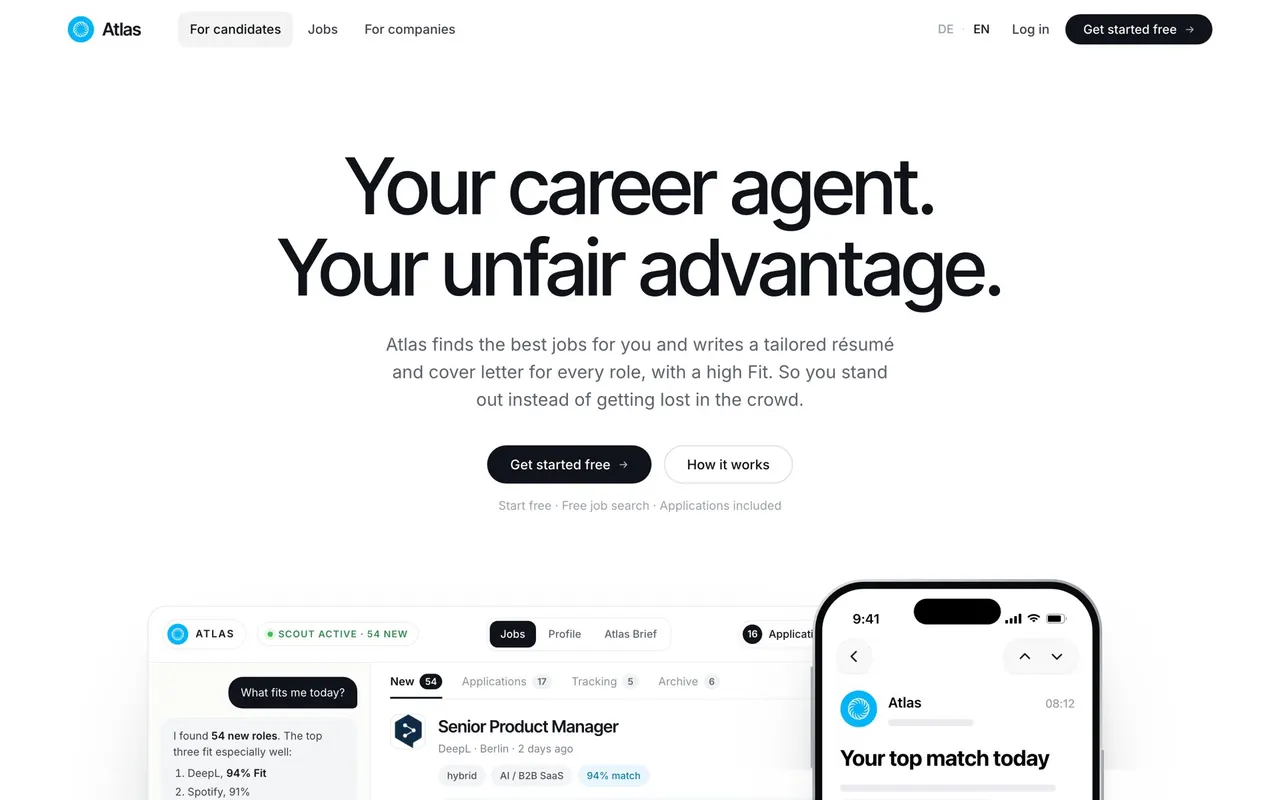
For keeping track, Atlas Career is a free option. Atlas is an AI career agent that searches more than 1.5 million active jobs straight from employers' career sites, shows a match score with reasons for each role, and tailors a CV (and a cover letter on request) for every application, with no limits. You review everything and apply directly to the employer; Atlas sends nothing for you. It keeps the status of each application in tracking, so you can see at a glance which ones are due. It does not write or send your follow-ups, and it will not replace the personal note. See our comparison of AI job search tools and what an AI career agent is for the wider picture.
FAQ
How long should I wait before following up on a job application?
Wait 7 to 10 working days if there is no deadline, or 1 to 2 working days after the deadline in the posting. For large or public employers, two to three weeks after the deadline is realistic.
Is it okay to follow up twice?
Yes: one follow-up and one short final nudge 7 to 10 days later. After that, stop writing and keep applying.
What should the subject line say?
Role and application date, for example "Question about my application of 3 November: Marketing Manager". Add the job reference number if there is one.
Should I call instead of writing?
Email first is the safer default. Call if the posting gives a number for questions or if your email stays unanswered for a few days.
What if I get no answer after a month?
Assume the process has moved on. A reply after 30 days is unlikely, so put your time into new applications.
Does AI help or hurt a follow-up email?
It helps with wording and reminders. It hurts when the message is generic or contains invented details, so give it only your own facts and read the result before you send.
Do I have a right to an answer?
In most countries an employer is not obliged to respond to an application. In the EU you can request information about your stored data (GDPR Article 15) and ask for deletion once it is no longer needed (Article 17).
Jürgen Ulbrich
Jürgen Ulbrich has more than a decade of experience in developing and leading high-performing teams and companies. As an expert in employee referral programs as well as feedback and performance processes, Jürgen has helped over 100 organizations optimize their talent acquisition and development strategies.