The fastest way for a contractor to hire construction workers is to stop waiting for people to search and meet them where they already are: an ad in the Instagram or Facebook feed that names trade, pay and site location, an application by text or WhatsApp without a résumé, and a short pre-screening before an estimator or foreman spends any time. This guide is for employers, not for homeowners looking for a contractor. It covers the construction labor market in numbers, how to build the ad, five pre-screening questions, a budget example and what to adjust by city.
The construction labor market in numbers
Demand is not the problem, supply is. Associated Builders and Contractors (ABC) estimates that the US construction industry must attract about 349,000 net new workers in 2026 just to keep supply and demand in balance. That is the smallest gap in four years, down from 439,000 in 2025, and ABC expects it to climb back to 456,000 in 2027. A majority of the 2026 need comes from retirements rather than growth. The US Bureau of Labor Statistics (BLS) counts about 1.67 million construction laborers and helpers in 2025, with a median pay of $22.44 an hour, projected growth of 6 % through 2035 and about 137,000 openings a year.

The practical consequence: you are not hiring once. You are refilling crews as people retire, move on or finish a project, and your competition is every contractor in your radius. Entry-level laborer jobs require no formal credential, while skilled trades need tickets, licences or years of experience, so the first question in any application is whether the person fits the trade.
Where construction workers are, and how they apply
Tradespeople are on site early, tired in the evening and on their phone for everything. They rarely keep a professional-network profile, but they are on Facebook and Instagram. A portal with 20 required fields loses them. Three routes work better than a classic posting:
- Feed ads on Instagram and Facebook. They reach people who are not searching today but would react to a better crew, closer sites or better pay. Meta treats job ads as a special ad category called employment, with restricted audience options in the US and the EU. Check the current rules in Meta's business help centre before you start, and do not plan around targeting by age, gender or ZIP code. A radius around your jobsites is the targeting that matters.
- Text or WhatsApp instead of a form. A reply within minutes beats a long application. See frontline recruiting by phone and WhatsApp, not email.
- Your own crews' referrals. Good tradespeople know other good tradespeople. A referral bonus with a link in the same message that goes into the crew chat is cheap and strong.
For orientation on cost, the Boostpoint 2026 social job advertising benchmark reports a median of $14.14 per applicant for 45 skilled trades campaigns, with the middle half between about $6 and $17. A broader data set of 146 trades campaigns from October 2025 to September 2026 shows a median of $15.87. In the same data, only 9.1 % of people who clicked went on to complete an application, the lowest rate of any vertical tracked, which is the strongest argument for a short path: two or three questions, not a form. These figures describe applications, not hires, and they come from a vendor's own campaigns, so treat them as a rough range and measure your own.
The ad: a worked example for a crew
A good feed ad answers a tradesperson's questions in three seconds: what, where, when, how much. Skip phrases like "join our growing family" and be concrete. As a template for a contractor:
Carpenters and laborers, jobsites within 40 minutes of Springfield
Steady work through spring, paid overtime, $[amount] an hour depending on experience. Truck or tool allowance, health insurance after 60 days, a foreman who stays on the site. Apply in 60 seconds by text, no résumé.
The pattern: one line for the trade and radius, one for the work outlook, one for the money, one for the benefits, one for how to apply. A real photo of your crew on a real site beats stock imagery. Name the pay in the ad, because for hourly workers the number is the first filter, and several US states and cities require pay ranges in job ads anyway.
Five pre-screening questions before a foreman spends time
Most applicants are fine, and a few clearly are not a fit, for example because the trade or the travel radius does not match. Five short questions sort them without a call. An AI talent agent can ask them by WhatsApp, phone or web at any hour, so the applicant who writes at 10 pm gets an answer at 10 pm and not three days later.
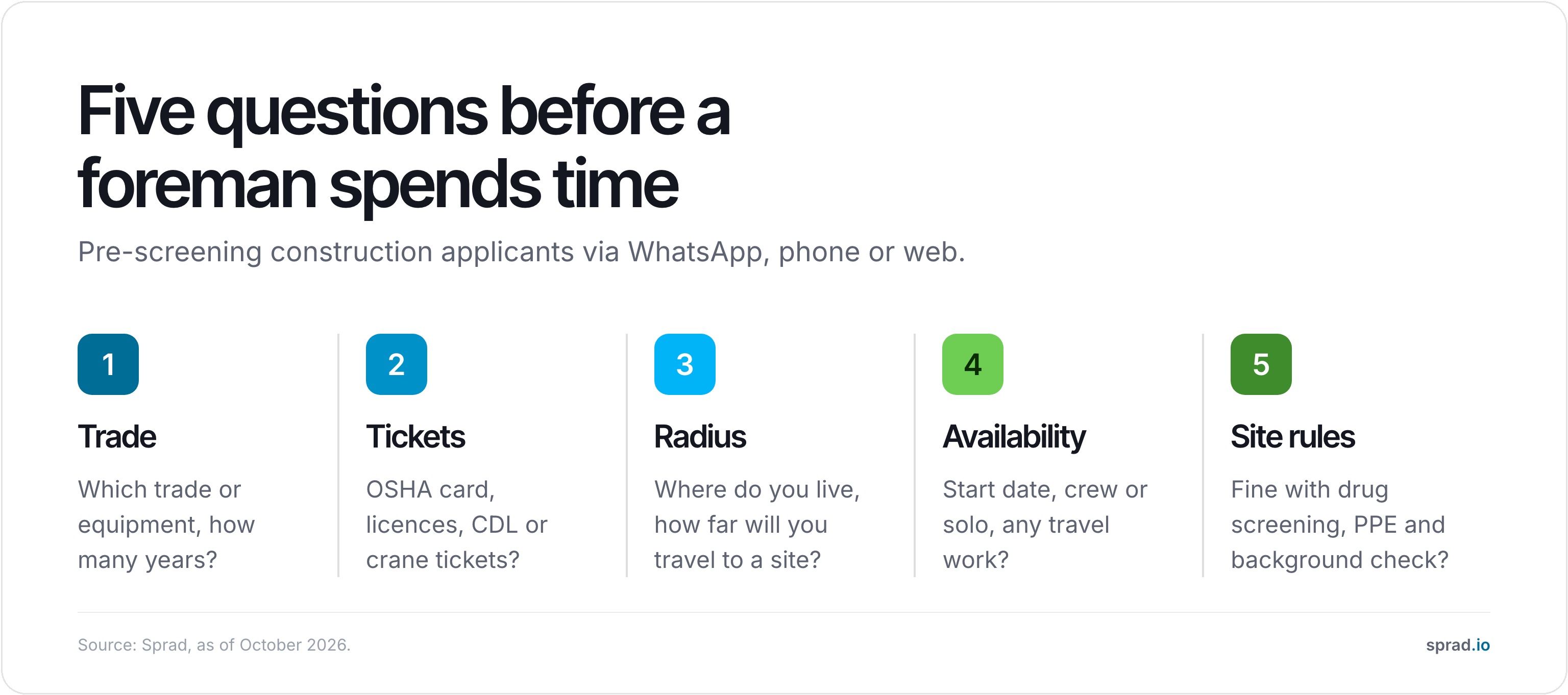
Write down the minimum answers in advance, for example "OSHA 10 required" or "must hold a valid driver's licence". The first reply then tells you who goes to the foreman today and who stays in the pool for the next project. Formal checks such as licences, drug screening and background checks come after this step, depend on your state and client, and are not replaced by it.
Sprad Social Recruiting for construction
Sprad Social Recruiting runs job ads on Instagram and Facebook, where tradespeople spend time every day. The AI Talent Agent pre-screens every applicant via WhatsApp, phone or web. Every applicant lands in your own talent pool. In construction this is the point: the electrician you could not hire this season, or the laborer who is free in March, stays in your pool instead of disappearing on a platform, so the next project does not start from zero. More on the trades use cases on the trades page.
Budget example
Sprad charges ad budget plus 10 %, from a €1,000 budget that you can split across roles, with three months recommended. The figures below are plain arithmetic, not a promise of applicants:
| Example | Ad budget (3 months) | 10 % fee | Total |
|---|---|---|---|
| Small contractor, one crew role | €1,000 | €100 | €1,100 |
| Mid-size contractor, 3 roles (laborer, carpenter, equipment operator) | €3,000 | €300 | €3,300 |
| General contractor, 5 roles across two regions | €6,000 | €600 | €6,600 |
To estimate applicants, divide budget by your cost per applicant, then multiply by the share that passes pre-screening. As an illustration only: at $14.14 per applicant, $1,000 of ad spend buys about 71 applications. If one in four passes your five questions, that is roughly 18 conversations. Your real cost per applicant will differ by region, trade and ad. The budget planner on the product page gives a guide value, never a guarantee.
Cities: what to adjust
Construction hiring is local, and the commute to the site decides. Run ads in a radius around your jobsites and adapt the message:
- Houston: large industrial and commercial pipeline, so name the area of the site instead of "Greater Houston".
- Phoenix and Las Vegas: heat shapes the day, so early starts and shade or water on site are strong lines.
- Dallas and Fort Worth: heavy competition from large projects, so pay and overtime belong in the first line.
- Atlanta: distances between sites are long, so say whether a truck or mileage allowance is included.
- Denver: weather and season matter, so state how steady the work is through winter.
These are starting points, not measurements. Your campaign shows which message works.
Common mistakes
- Asking for a résumé when the job does not need one.
- Leaving the pay out of the ad.
- Replying after two days. An applicant who wrote on Tuesday has often accepted another offer by Thursday.
- Judging a campaign after one week. Three months are recommended, because crews turn over and the pipeline never closes.
- Writing one ad for every trade. A carpenter and a laborer look at different things.
FAQ
How do I hire construction workers quickly?
Run a feed ad on Instagram and Facebook that names the trade, pay and radius, accept applications by text or WhatsApp without a résumé, and answer the same day.
Where do I find construction workers?
The common channels are employee referrals, job boards, trade schools, unions and social ads. Social ads reach people who are not searching, and a talent pool keeps the ones who are not available yet.
What does social media recruiting for construction cost?
With Sprad you pay ad budget plus 10 %, from €1,000, split across roles. For the market range per applicant, see the Boostpoint benchmark above.
How do I pre-screen construction applicants without a phone call?
Ask five short questions by WhatsApp, text or web: trade and experience, tickets and licences, travel radius, availability and site requirements. Set minimum answers before the campaign starts.
Can I message applicants on WhatsApp?
Someone who contacts you after your ad made the connection themselves. Outreach to people who did not contact you has tighter rules that differ by country and state, so ask your counsel. This is not legal advice.
Sprad Social Recruiting in short
Sprad Social Recruiting runs job ads on Instagram and Facebook, where nurses, tradespeople, drivers and other frontline workers spend time every day. An AI talent agent pre-screens every applicant via WhatsApp, phone or web. Every applicant lands in the employer's own talent pool, so the relationships stay with the employer instead of a platform. Pricing is ad spend plus 10 %, from a €1,000 budget that can be split across roles. See how Sprad Social Recruiting works.
Jürgen Ulbrich
Jürgen Ulbrich has more than a decade of experience in developing and leading high-performing teams and companies. As an expert in employee referral programs as well as feedback and performance processes, Jürgen has helped over 100 organizations optimize their talent acquisition and development strategies.