To hire skilled tradespeople in Germany in 2026, combine two routes. Active sourcing reaches journeymen and installers who have a profile on LinkedIn or XING: you search by requirements and message them personally. Paid Instagram and Facebook ads reach the larger group that holds a job, has no profile and does not read job boards. Both lead to the same finish: a quick pre-screening, ideally on WhatsApp after the person has agreed, and a talent pool you own.
The situation: where trades jobs stay open
According to an analysis by the Cologne Institute for Economic Research (IW; 2024 average, based on Federal Employment Agency and IAB data, as reported by Deutsche Handwerks Zeitung), electrical installation alone had on average 18,342 unfilled positions, automotive technology 16,238 and plumbing, heating and cooling 12,046. Only healthcare has more unfilled positions than construction and finishing trades. The Vocational Training Report 2026 adds that over 16,000 apprenticeship places in the trades went unfilled.
In a survey of more than 1,100 businesses, 54 % called recruiting skilled workers a major challenge for the first half of 2026. For your business that means you do not compete with a job board but with the firm down the road where your future journeyman works today.

Active sourcing for the trades: does it work?
Yes, for the part of the workforce you can find. Active sourcing means you look for suitable people yourself and approach them directly instead of waiting for applications. The limit is reach: in a representative YouGov survey (May 2025, 2,033 adults) 13 % of Germans use LinkedIn and 7 % use XING. No study we found breaks that down for journeymen, so treat any share for the trades as unknown. Many installers, roofers and mechanics have no profile at all.
Trades businesses themselves are already there. In the Bitkom survey of 504 trades businesses (autumn 2025), 56 % use social media, and of those 35 % are on LinkedIn and 33 % on XING. Deutsche Handwerks Zeitung reports that more owners and employees use LinkedIn to attract staff, mostly through personal profiles rather than company pages. That is your first lever: a visible owner or foreman profile makes every message more credible.
Where you can find tradespeople
- XING and LinkedIn: search by trade, qualification, region and current employer. Master craftspeople, foremen, site managers and career changers are the most likely to maintain a profile.
- Your own talent pool: former applicants, former colleagues, apprentices who left and people who once said “not now”. This is the cheapest source and the most often forgotten.
- Referrals from your team: a journeyman knows other journeymen. Ask for names, not for shares of a post.
- Vocational schools, chambers and fairs: useful for apprentices and graduates, rarely for experienced journeymen.
How to approach a journeyman: five steps
- Define the profile in plain words: trade, qualification, class B licence, region, what you offer. These are your search terms.
- Search by requirements, not by job title. Titles in the trades are inconsistent (“Elektroniker”, “Elektriker”, “Monteur”). Searching by what the person has done finds the ones whose profile is thin.
- Write one personal message. Name the trade, the region and one concrete reason you chose this person. A template with a real sentence beats ten generic lines.
- Follow up once or twice after three to five days, through the same inbox.
- Save the contact in your pool, whether the answer is yes or “not now”.
Hello Mr Berger, I saw that you have been installing building technology in the Augsburg area for six years. We are a 14-person electrical firm there, fixed teams of two, company van for private use. If a change is ever an option, I would be glad to talk for ten minutes. If not, no problem.
Mind the rules. Anyone you contact without a prior relationship must be told, at the latest within a month, who you are and where you got their data (Art. 14 GDPR). Unsolicited advertising by email or phone is restricted by section 7 UWG, so use the network’s own message function for the first contact and have the rules checked for your case. WhatsApp is for the conversation after the person answers, not for the first contact, see contacting candidates via WhatsApp: is it allowed?
What Sprad adds for the search
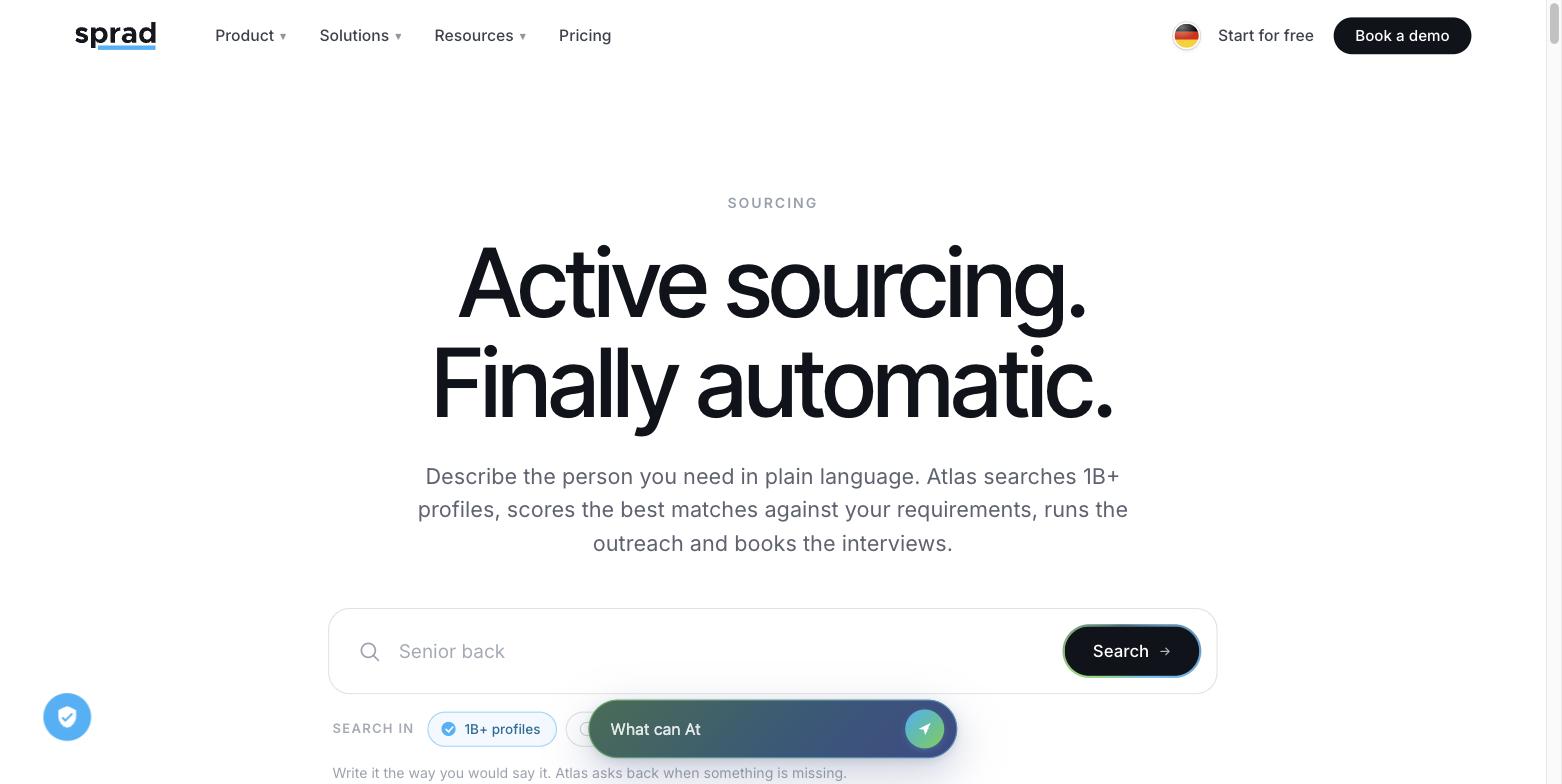
Sprad searches LinkedIn, XING, GitHub and your own talent pool in one search, within a database of over 1 billion profiles worldwide. You describe the person in free text and Atlas checks every profile against your requirements, with a reason per requirement. This is the difference from a keyword filter: a result that appears instantly is almost always a keyword match. Quick Search returns first results in about three seconds, the deep search takes a few minutes because far more AI runs per profile.
- LinkedIn and email in one inbox: messages and follow-ups run automatically, and the system warns you if a colleague has already contacted the person, also for another role.
- WhatsApp on request for the conversation with candidates who have answered. There is no SMS channel.
- Voice, chat or agent pre-screening in several languages replaces the first phone call.
- The pool stays yours: everyone you find remains in your talent network, which is free to use even if you stop searching.
In the public PeopleSearchBench (Recruiting), Atlas ranks first with 73.5 out of 100, 5.3 points ahead of second place. The benchmark was published by Lessie, October 2026; other systems' scores are as published in the benchmark, and Atlas was measured with the benchmark's open test procedure. It tests profile search in general, not trades specifically. Pricing: start free with 100 credits a month; a web search costs 2 credits per profile shown, a verified business email 1 credit, and Recruiter Lite is 79 € per seat and month (current prices).
Worked example: what active sourcing costs per conversation
Assumptions: you view 100 profiles (200 credits, about 20 € at the list price of 0.10 € per credit) and message them. Working time is not included. The reply rates are assumed, not measured.
| Assumed reply rate | Replies from 100 messages | Interested (assumed 40 %) | Tool cost per interested person |
|---|---|---|---|
| 5 % | 5 | 2 | about €10 |
| 10 % | 10 | 4 | about €5 |
| 20 % | 20 | 8 | about €2.50 |
The comparison with ads further down is not like for like: an ad produces applications, active sourcing produces conversations. What matters is the time you spend per message, so keep a short list of 30 to 50 well-chosen people per role rather than hundreds.
Active sourcing or ads: which one for which case?
| Active sourcing | Social ads | |
|---|---|---|
| Reaches | People with a LinkedIn or XING profile | People who scroll Instagram and Facebook, with or without a profile |
| Best for | Master craftspeople, foremen, site managers, scarce skills | Journeymen, installers, helpers, career changers |
| Effort | Time per message, search quality decides | Creative, ad budget, fast reply |
| Cost | Credits or a seat, plus working time | Ad budget, from €1,000 with Sprad plus 10 % |
| Limit | Many tradespeople have no profile | No guarantee of applicants, budget needed |
Where journeymen, installers and apprentices are
The ARD/ZDF online study 2025 shows 28 % of Germans on TikTok daily, 22 % on Instagram and only 6 % on Facebook. You book both Meta platforms together in Ads Manager, so Facebook need not drop out, but creative should be built for Instagram: short, visual, vertical.
Three audiences, three messages:
- Journeymen and skilled workers: they do not read job boards. Show the site, tools, vehicle and team instead of buzzwords.
- Career changers: they want to know whether you train them. Say who mentors them and which qualification you pay for.
- Apprentices: they decide together with parents and friends, a different tone and platform. See our post on apprentice recruiting.
The pattern is not new in the German trades: Deutsche Handwerks Zeitung advised as early as 2018 to use Facebook if a business keeps needing skilled workers or trainees, and said a single vacancy rarely pays off. That argues for spreading one budget across several roles and months rather than restarting for every role.
The ad: an example for a journeyman
“We are looking for reinforcements” is everywhere. A concrete offer a journeyman understands at first glance works better:
Electrician (m/f/d) for installation and service, Musterstadt area
Fixed teams of two to three colleagues, company van also for private use, overtime is paid or taken as time off. Finishing on time because we plan sites realistically. Start by agreement. Apply in two minutes via WhatsApp, no CV needed. You hear from us within 24 hours.
Write only what you deliver, and state an hourly rate or salary range if you can. A 20 to 30 second video with a real employee beats any stock photo.
What Meta restricts in targeting
For ads in the Employment category Meta has limited targeting options, reportedly including age, gender and postcode. Check scope and current status in Ads Manager before you launch. In practice you steer by location with a radius, broad audiences and the ad itself: people who know the trade respond to your copy and picture.
Pre-screening: five questions on WhatsApp
In the trades people apply after work, from a phone, not at a desk. A short message flow asks for what matters and passes only suitable candidates on. Why phone and messaging beat email for hourly and trades roles is covered in frontline recruiting by phone and WhatsApp, not email. Five questions:
- What is your qualification (journeyman, master craftsperson, career changer with experience)?
- Which trade did you last work in, and for how long?
- Do you hold a class B driving licence?
- Where do you live, and how far is your commute to us or to the sites?
- When could you start (notice period)?
Do not ask about age, origin or family plans. Collect consent to data processing in the first message, see contacting candidates via WhatsApp: is it allowed? How screening differs for trades roles compared with office roles is explained in blue-collar screening.
Budget example: what an ad campaign can cost
Reliable German cost-per-applicant figures for the trades are hard to find. As a US reference, Boostpoint's 2026 benchmark (891 campaigns) reports a median of $13.88 per applicant, with a wide range by industry. German figures can differ. Sprad has not published campaign benchmarks of its own, so this table uses assumed costs for a business with two open roles:
| Assumed cost per applicant | €1,500 ad budget | Suitable (assumed 30 %) | Cost per suitable applicant |
|---|---|---|---|
| €25 | 60 applicants | 18 | about €83 |
| €40 | 38 applicants | 11 | about €136 |
| €60 | 25 applicants | 8 | about €188 |
This is a worked example, not a forecast. It shows where to start: a better ad and faster pre-screening cut cost per suitable applicant more than a bigger budget does. Plan three months and spread the budget over all open roles. For a comparison with classic job ads see StepStone costs and prices.
Regions: what to watch
These are assessments, not measured values:
- Munich, Stuttgart: heavy competition for electrical and plumbing, heating and cooling staff; company van and proximity count for more than pay alone.
- Hamburg, Cologne: many commuters, so put the commute to the site in the ad.
- Leipzig, Dresden: smaller pools, so a wider radius and a focus on career changers pay off.
- Rural regions: fewer competing firms but a large radius is needed; a travel allowance can tip the decision.
How Sprad solves it
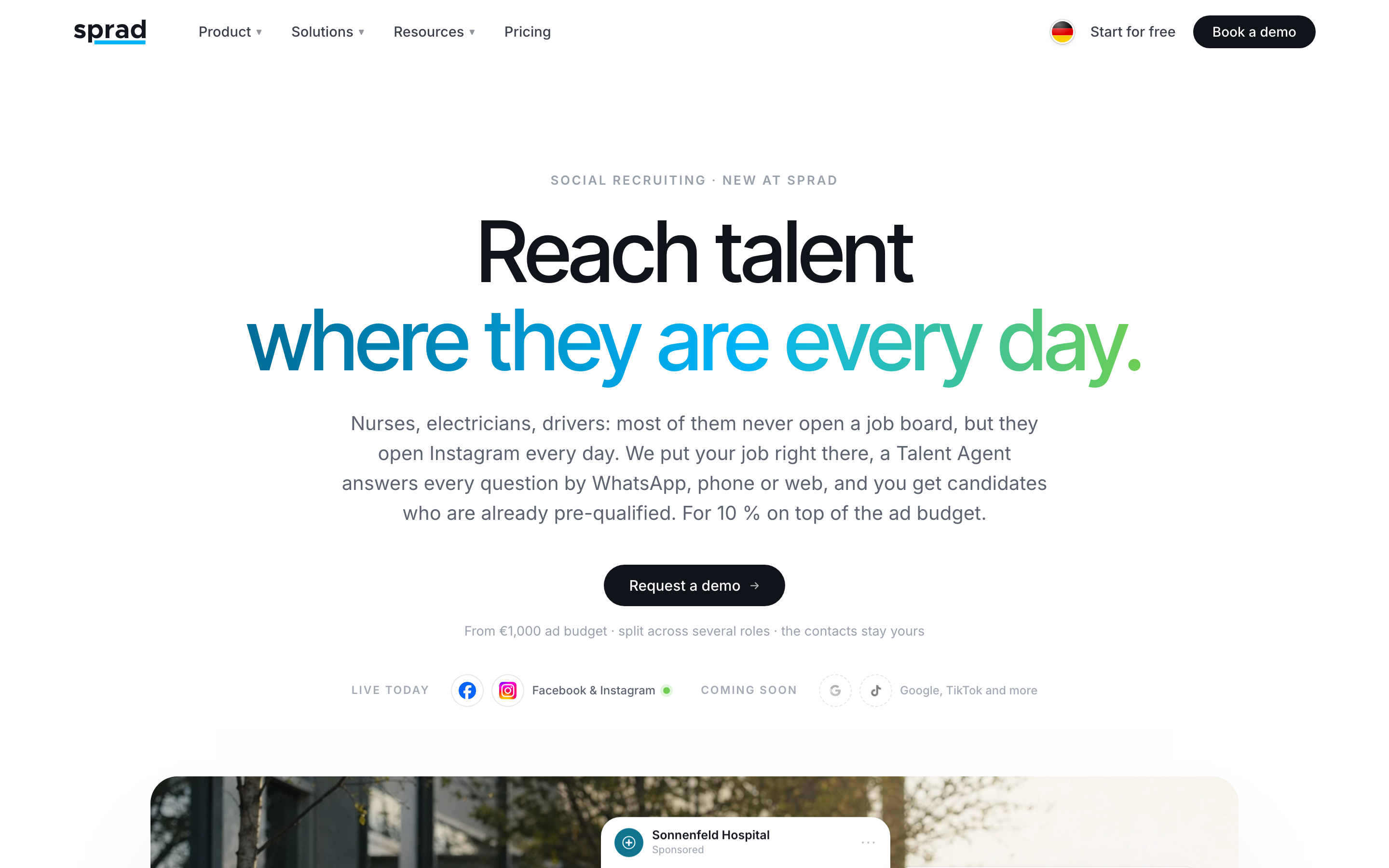
Sprad covers both routes in one tool and one pool. Active Sourcing finds and approaches people with a profile. Sprad Social Recruiting runs job ads on Instagram and Facebook, where nurses, tradespeople, drivers and other frontline workers spend time every day, and an AI talent agent pre-screens every applicant via WhatsApp, phone or web. Every contact lands in the employer's own talent pool, so the relationships stay with the employer instead of a platform. Social Recruiting is ad spend plus 10 %, from a €1,000 budget that can be split across roles. Google and TikTok follow. More for your sector at trades and the talent pool.
FAQ
How do I find tradespeople when nobody applies?
Use two routes. Search XING and LinkedIn for people with a profile and message them personally. Run Instagram and Facebook ads for those without one. Keep the application short and reply within a day.
Can I approach tradespeople on XING and LinkedIn?
Yes, through the network’s message function. Say who you are, why you chose them and where you got their data, and respect the information duty in Art. 14 GDPR.
Do journeymen even have XING or LinkedIn profiles?
Some do, many do not. 13 % of Germans use LinkedIn and 7 % XING (YouGov, May 2025); no study splits this by trade. Foremen, master craftspeople and site managers are likelier to have one. For everyone else, ads and referrals work better.
Is social media recruiting worth it for small trades businesses?
If you keep needing skilled workers or apprentices, yes. For a single role the effort for creative and setup is often too high, so spread the budget across several roles.
What does it cost?
Ad budget you set yourself; with Sprad Social Recruiting you pay budget plus 10 %, from €1,000. Active sourcing starts free with 100 credits a month, a seat is €79 a month (Recruiter Lite). How many applicants or replies that yields depends on trade, region and message. There is no guarantee.
Facebook or Instagram for the trades?
Both, as one campaign in Ads Manager. According to the ARD/ZDF online study 2025, 22 % of Germans use Instagram daily and 6 % Facebook. Design creative for Instagram and let the platforms distribute.
May I message applicants on WhatsApp?
If the applicant has consented, for example by applying through WhatsApp and receiving your privacy notice in the first message. Stricter rules apply to candidates who have not contacted you; see the post on permission.
How fast should I reply?
Within hours. Someone who applies after work often has another offer by the next day. Automatic pre-screening by message or phone catches that.
Jürgen Ulbrich
Jürgen Ulbrich has more than a decade of experience in developing and leading high-performing teams and companies. As an expert in employee referral programs as well as feedback and performance processes, Jürgen has helped over 100 organizations optimize their talent acquisition and development strategies.