Electrical contractors hire electricians by reaching working journeymen where they spend time, on their phones, with pay, van and schedule in the first line, and by pre-screening every applicant before a foreman spends an hour. The trade is short of people and most good electricians are not job hunting, so ads on Instagram and Facebook, a one-minute mobile application and a fast pre-screen beat waiting for resumes. This guide is for contractors who need to hire electricians. If you are a homeowner looking for an electrician to do a job, you want a licensed local contractor, not this article. As of October 2026.
The market in numbers
The US Bureau of Labor Statistics counts about 821,000 electricians in 2025 and projects employment to grow 9 % from 2025 to 2035, much faster than the average for all occupations. It expects about 72,700 openings a year, many of them to replace people who retire or leave the trade. Median pay was $63,190 a year, or $30.38 an hour, in 2025. Almost all electricians work full time, and the BLS notes that evenings, weekends and overtime are common.

The path into the trade is long. Most electricians learn through a four to five year apprenticeship with about 2,000 hours of paid on-the-job training each year plus classroom instruction, and most states require a licence afterwards. That has two consequences for hiring. First, a fully qualified journeyman cannot be trained quickly, so the only way to add one is to attract one from somewhere else. Second, the people you want are already employed, which makes them passive candidates who do not read job boards but do scroll their phones.
Three talent pools, three different messages
Treat electricians, apprentices and career changers as separate audiences. They need different ads and different pre-screening questions.
- Journeymen and masters. They are employed and compare you with their current boss. Lead with pay, take-home vehicle, tools, predictable hours, the type of work (service, new build, industrial) and who they would work with.
- Apprentices and helpers. They need a path. Say how the apprenticeship works, what you pay while they learn, and who trains them. See also recruiting in the trades.
- Career changers. Veterans, people leaving retail or warehouse work, and graduates of trade programmes. They respond to stability, paid training and a clear first year.
Where electricians are, and what Meta lets you target
Electricians are on their phones in the van, at lunch and in the evening. Ads in the Instagram and Facebook feed reach them while they scroll. Three practical points:
- Job ads are a special ad category. According to Meta's rules, employment ads in the US and several other regions have limited targeting: the age range is fixed, gender cannot be selected, location targeting works by radius instead of postal code and lookalike audiences are unavailable. Check the current rules in Meta's Business Help Centre and do not build your plan around demographic targeting.
- The message does the targeting. Write "Service electrician, take-home van, no on-call weekends" and the people who want exactly that will respond. A radius around your shop handles location.
- The application must work on a phone. A lead form or a WhatsApp link beats a career-site form that asks for a resume. Tradespeople often have none. See frontline recruiting by phone and WhatsApp, not email.
An ad that works: a worked example
Answer what, where, what you pay and what makes you different in the first three lines. This is a template with placeholders, not a real posting:
Journeyman electrician, service and tenant improvement work
$[amount] to $[amount] an hour depending on experience, take-home van and fuel card, four 10-hour days. Based in [town], jobs within 40 miles. Tell us about yourself in 60 seconds from your phone, no resume needed.
Use a real photo of your crew or your van instead of stock images, and test two or three versions, for example one led by pay, one by schedule and one by the type of work. Replace the creative every two to three weeks.
Pre-screening: five questions before a foreman spends time
A foreman should not read 80 forms. A talent agent can ask the same five questions of every applicant at any hour, via WhatsApp, phone or web, and hand you a summary of those who fit.

Keep every question job-related. Ask which licence or level someone holds and let a person verify it with the state licensing board before the first day. Right-to-work documents and any background or driving-record check are for a person to run according to your own process. This is not legal advice.
Which route for which situation?
| Route | Speed | Cost | Who owns the contact |
|---|---|---|---|
| Staffing agency | days to weeks | markup or placement fee, ask for it in writing | the agency |
| Job board | weeks | per post or per click | the board |
| Employee referral | weeks, hard to plan | bonus per hire | you |
| Apprenticeship or trade-school partnership | years | wages while learning, trainer time | you |
| Social media ads with pre-screening | days to launch | ad spend plus a platform or tool fee | you, if the tool stores applicants in your pool |
Most contractors mix these: referrals and trade schools for the long term, a staffing agency for a crunch, ads for steady inflow. To see what a placement fee means, take the median pay of $63,190 and assume, as an illustration and not a quoted price, a fee of 20 % of first-year pay. That is about $12,600 for one hire. Ask any agency for its actual terms.
Sprad Social Recruiting for electrical contractors
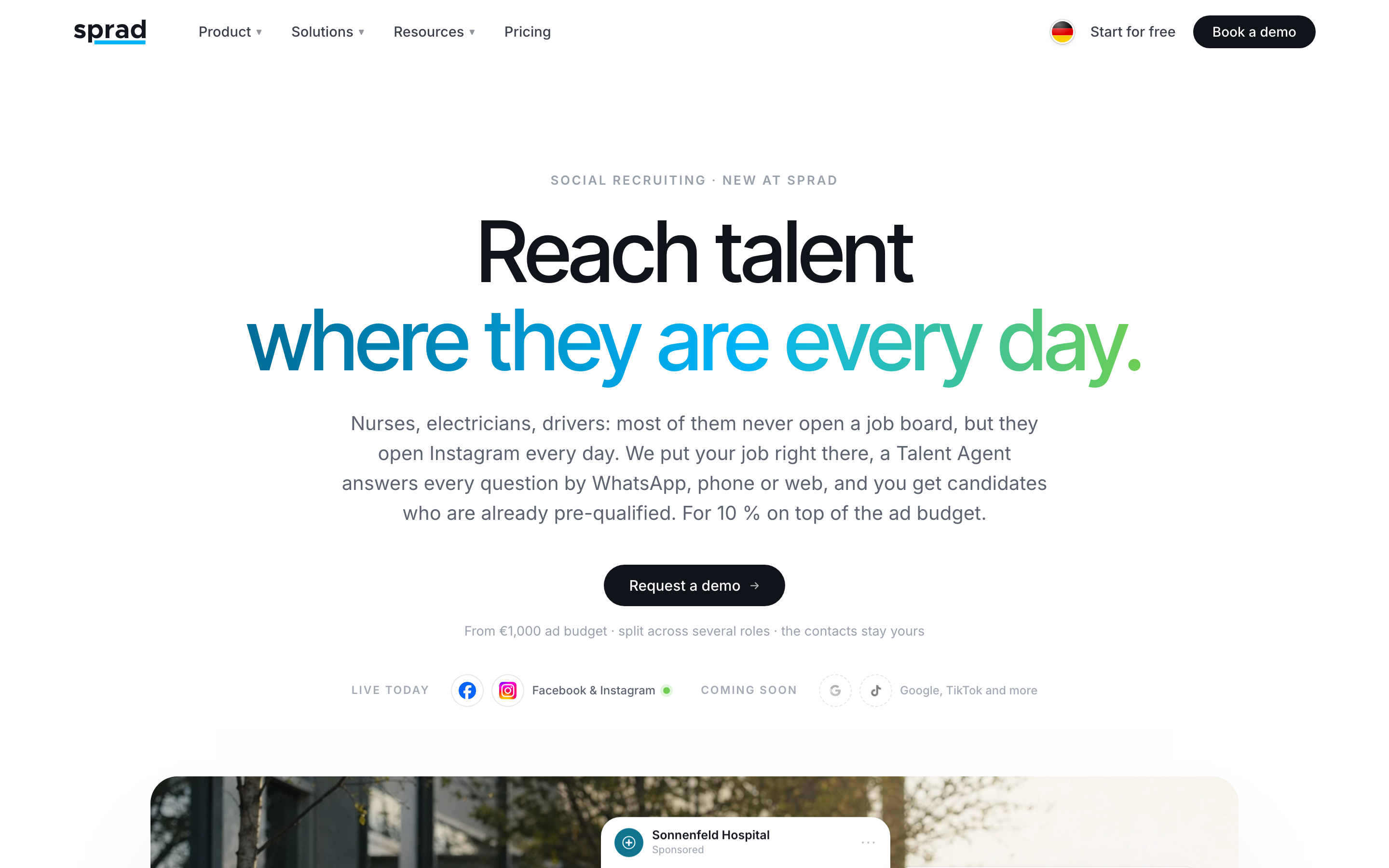
Sprad Social Recruiting runs job ads on Instagram and Facebook, where nurses, tradespeople, drivers and other frontline workers spend time every day. An AI talent agent pre-screens every applicant via WhatsApp, phone or web. Every applicant lands in the employer's own talent pool, so the relationships stay with the employer instead of a platform. Pricing is ad spend plus 10 %, from a €1,000 budget that can be split across roles.
For a contractor this means the apprentice who was not ready last year, or the journeyman who said "not now", is still in your talent pool when the next job is won. More on screening blue-collar applicants and on the product.
Budget example
Sprad charges ad budget plus 10 %, from a €1,000 budget that you can split across roles, with three months recommended. Prices are in euros. The figures are plain arithmetic, not a promise of applicants:
| Example | Ad budget (3 months) | 10 % fee | Total |
|---|---|---|---|
| One shop, one journeyman role | €1,000 | €100 | €1,100 |
| One shop, journeyman plus apprentice | €3,000 | €300 | €3,300 |
| Three branches, several roles | €6,000 | €600 | €6,600 |
How many applications this yields depends on region, ad and pay. For orientation, the Boostpoint 2026 benchmark of 891 Meta campaigns puts the median at $13.88 per application across job categories. That is a US figure and not a forecast for your shop. Divide your budget by your own cost per qualified applicant to estimate conversations.
Where to adjust: regions
Trade labour is local, so run ads in a radius around the shop and adapt the message. These are starting points, not measurements:
- Texas (Houston, Dallas-Fort Worth, Austin): large metro areas with many contractors competing for the same journeymen. Lead with pay, the van and predictable hours.
- Florida and the Southeast: a mix of residential and commercial work. Name the type of work, since it decides who applies.
- Arizona and the Mountain West: long drives between jobs. State the service radius so applicants know the commute.
- UK: state the scheme card or qualification you require, and the rate per hour, since pay is the first thing people compare.
Frequently asked questions
How do I find qualified electricians to hire?
Reach working electricians on Instagram and Facebook with an ad that names pay, vehicle and schedule, add referrals and trade-school partnerships, and pre-screen every applicant for level, licence and availability before a foreman gets involved.
What should I look for when hiring an electrician?
A valid licence or documented apprenticeship for the level you need, relevant experience in your type of work (residential, commercial, industrial, service), a clean driving record if they drive your van, and a sensible attitude to safety. Verify the licence with the state board.
How much does it cost to hire an electrician?
The wage is only part of it. Agencies charge a markup or placement fee, job boards charge per post or click. With Sprad you pay ad budget plus 10 %, so a €1,000 budget costs €1,100. Compare cost per qualified applicant, not cost per click.
How do I hire apprentices?
Say plainly how the apprenticeship works, what you pay while they learn and who trains them. Pre-screen for reliability and a driver's licence, and keep good applicants in a pool for the next intake.
Is this about finding an electrician for my home?
No. This guide is for electrical contractors who need to hire electricians. For a home job, look for a licensed local contractor and ask for proof of licence and insurance.
Jürgen Ulbrich
Jürgen Ulbrich has more than a decade of experience in developing and leading high-performing teams and companies. As an expert in employee referral programs as well as feedback and performance processes, Jürgen has helped over 100 organizations optimize their talent acquisition and development strategies.