The fastest way to hire hotel staff in Germany is social media recruiting: an ad in the Instagram or Facebook feed, an application over WhatsApp without a CV, and a quick pre-screening before your hotel manager spends time. Only a small share of hotel employees search on job boards. The rest react to an offer that fits their rota, and they answer on their phone. This guide covers the German hotel labour market in numbers, where your candidates are, an example ad, five pre-screening questions and a budget example for hotels.
The German hotel labour market in numbers
Hotels have recovered since the pandemic, but the shortage has not gone away. According to Statista, about 298,700 people worked in the German accommodation sector in 2024. In October 2025, 27.9 % of accommodation businesses felt the skills shortage, down from 46.5 % in the second quarter of 2024 (Tageskarte). The Cologne Institute for Economic Research (IW) found that about 38.7 % of vacancies in hotel and restaurant occupations stayed unfilled on average in 2022/23.
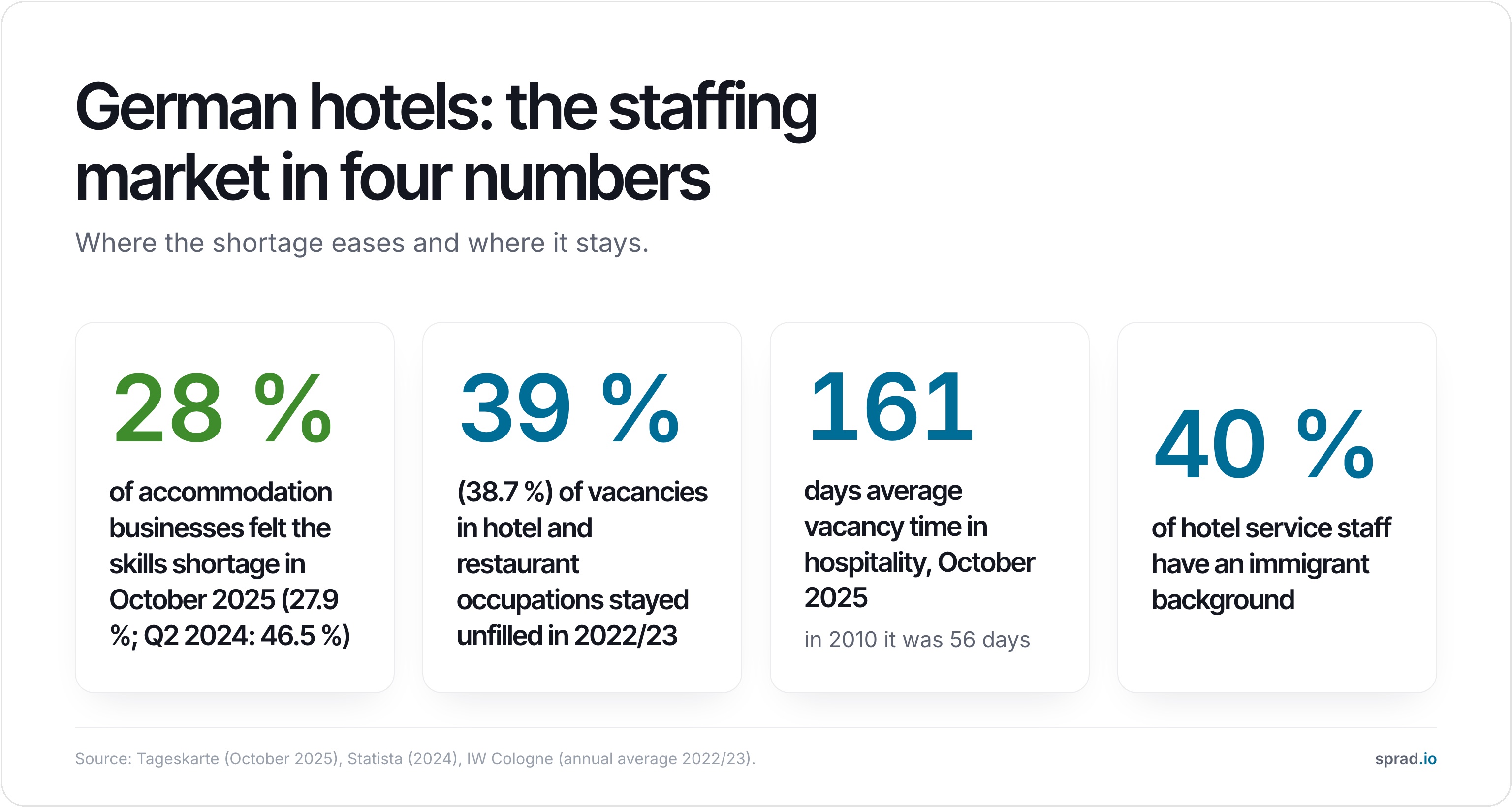
Two numbers change how you search. First, duration: in October 2025 a registered hospitality vacancy was open for 161 days on average, a record for October, against 56 days in 2010. Second, willingness to move: a study on staff recruitment in East Bavarian hotels (OTH Regensburg) found that 85 % of employees do not plan to change employer within two years. When you hire hotel staff you mostly court people who are not looking, and a job board does not reach them. In addition, 40 % of hotel service staff have an immigrant background, so ads in more than one language widen the pool.
Where your candidates are
Hotel staff work shifts, weekends and holidays. They rarely have time for an application portal, but they always have a phone. Three routes beat the classic job ad:
- Feed ads on Instagram and Facebook. They reach people who are not searching but react to a good offer. Meta runs job ads in the special ad category “Employment”, where targeting options are restricted. Check the current rules in Meta's help centre before you start and do not plan around targeting by age, gender or postcode.
- WhatsApp instead of a form. In hospitality candidates often decide within days. How frontline candidates behave is covered in frontline recruiting by phone and WhatsApp, and screening blue-collar candidates explains why the CV is the wrong filter.
- What makes a hotel special. Staff accommodation, meals, travel allowance and reliable rotas are often the strongest argument, above all in holiday regions. Put them in the first line.
The ad: an example for front desk and housekeeping
A good feed ad answers four questions in three seconds: what, where, when, how much. As a template for a front desk agent:
Front desk agent (m/f/d) at our 4-star hotel in [city], full-time or part-time
Fixed shifts, every second weekend off. [Amount] € plus allowances. Room in the staff house on request. Team of 8, onboarding with a mentor. Apply in 60 seconds on WhatsApp, no CV.
The pattern: one line role, one line shifts, one line money and extras, one line team, one line how to apply. For housekeeping and breakfast service, state the hours very precisely (“start 7 am, finish 3 pm, no late shift”). A real photo of your hotel beats a press image.
Pre-screening: five questions before your hotel manager spends time
The ad brings applications, the work starts after. Someone who has no reply after two days has usually gone to the next hotel. A Talent Agent therefore asks five questions at once, around the clock, via WhatsApp, phone or web:
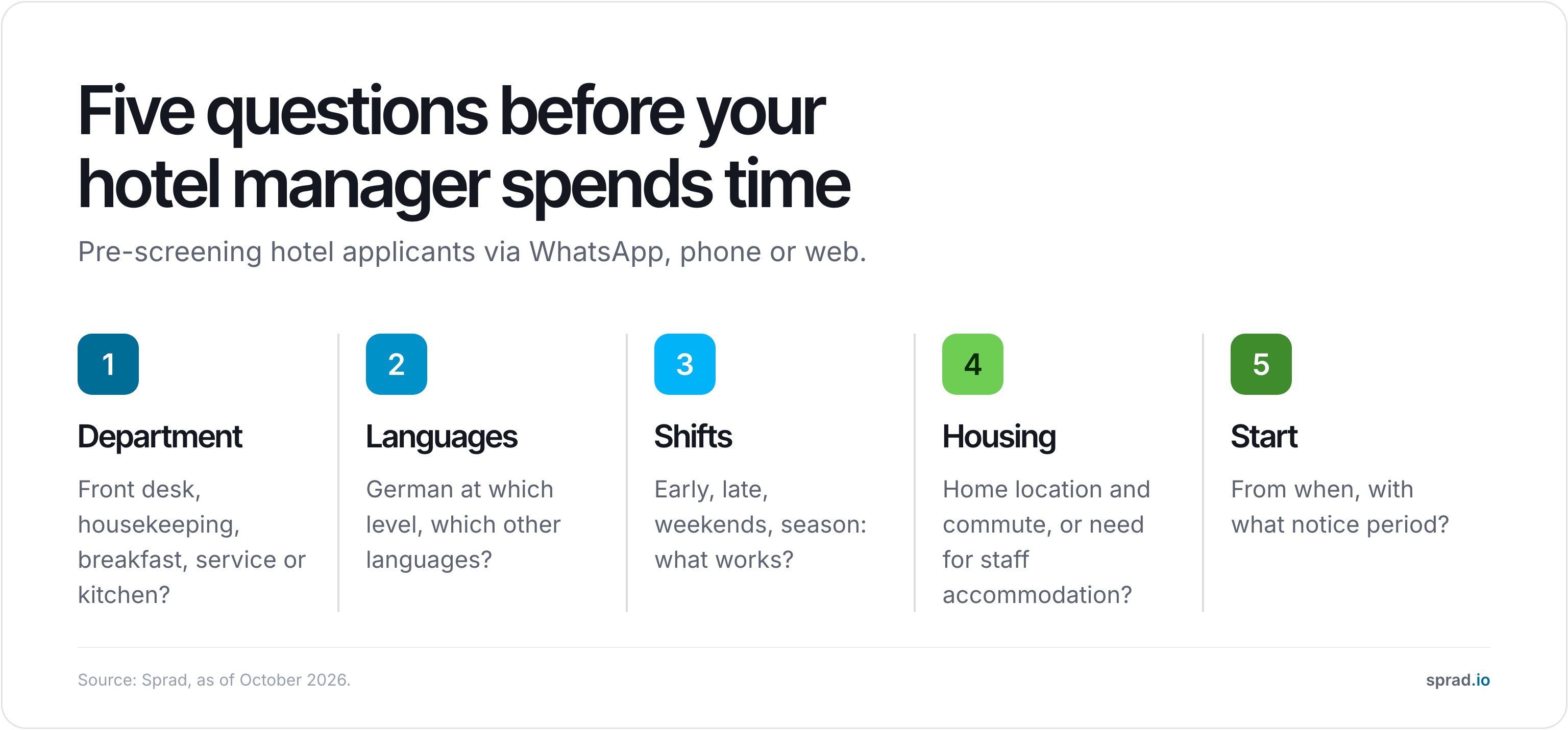
After that you only see applicants who match department, languages and shifts. That saves your management the calls on top of daily operations. More on the sector is on the hospitality industry page.
Sprad Social Recruiting for hotels
Sprad Social Recruiting runs job ads on Instagram and Facebook, where hotel staff and other frontline workers spend time every day. An AI talent agent pre-screens every applicant via WhatsApp, phone or web. Every applicant lands in your hotel's own talent pool. That is useful for hotels: the seasonal worker who declines in winter and the receptionist who would move in spring stay in your pool instead of disappearing into a platform.
Budget example
Sprad charges ad spend plus 10 %, from a €1,000 budget that can be split across roles. We recommend three months. The following figures are plain arithmetic, not an applicant promise:
| Example | Ad spend (3 months) | 10 % fee | Total |
|---|---|---|---|
| Boutique hotel, 1 front desk role | €1,000 | €100 | €1,100 |
| City hotel, 3 roles (front desk, housekeeping, breakfast) | €3,000 | €300 | €3,300 |
| Hotel group, 6 roles at 3 properties | €5,000 | €500 | €5,500 |
How many applications come out depends on region, ad and role. As a US reference, the Boostpoint 2026 benchmark gives a median of $13.88 per application on Meta campaigns, a figure that does not apply to German hotels. Use your own number: budget divided by cost per qualified applicant gives the interviews you can expect. The budget planner on the product page gives a guide value, never a guarantee.
Cities and regions: what matters
- Berlin: many hotels and many international applicants, so languages and fair shifts count.
- Munich: high rents, so staff housing is the strongest ad argument.
- Hamburg: trade fair and tourism city with weekend peaks, say how weekend shifts are shared.
- Frankfurt: business hotels with predictable occupancy, rota reliability sets you apart.
- Coast, Alps, lakes: seasonal operations, so accommodation, meals and travel belong in the first line.
These are starting points, not measurements. Your campaign shows which message works.
FAQ
How do I find hotel staff quickly in Germany?
With a feed ad on Instagram and Facebook that names shifts, pay and extras such as housing, an application over WhatsApp without a CV and a reply the same day.
What does social media recruiting for hotels cost?
With Sprad you pay ad spend plus 10 %, from a €1,000 budget that can be split across roles. Other models charge flat fees or commissions. For classic job boards, see StepStone costs and pricing.
Does this work for seasonal staff?
Yes, if the ad names the period, housing and travel. Pre-screening asks for availability and housing need first.
What about hotel apprentices?
Use a different tone, because teenagers and parents read differently. Apprentice recruiting and training marketing helps.
How long should a campaign run?
We recommend three months. Many hotel employees switch only after a few weeks of thinking, and an ad needs time to reach them. For seasonal hotels, start well before the season.
Sprad Social Recruiting in short
Sprad Social Recruiting runs job ads on Instagram and Facebook, where nurses, tradespeople, drivers and other frontline workers spend time every day. An AI talent agent pre-screens every applicant via WhatsApp, phone or web. Every applicant lands in the employer's own talent pool, so the relationships stay with the employer instead of a platform. Pricing is ad spend plus 10 %, from a €1,000 budget that can be split across roles. See how Sprad Social Recruiting works.
Jürgen Ulbrich
Jürgen Ulbrich has more than a decade of experience in developing and leading high-performing teams and companies. As an expert in employee referral programs as well as feedback and performance processes, Jürgen has helped over 100 organizations optimize their talent acquisition and development strategies.