To hire kindergarten teachers (Erzieher) in Germany, advertise where they already spend time: Instagram, Facebook and messaging apps, not only on job boards. Most qualified educators already have a job and are not searching, but many would move for better conditions. A paid social media recruiting ad with real group details, honest terms and a two-minute application, followed by quick pre-screening over WhatsApp, is the shortest route to suitable applicants.
The situation: daycare staffing in numbers
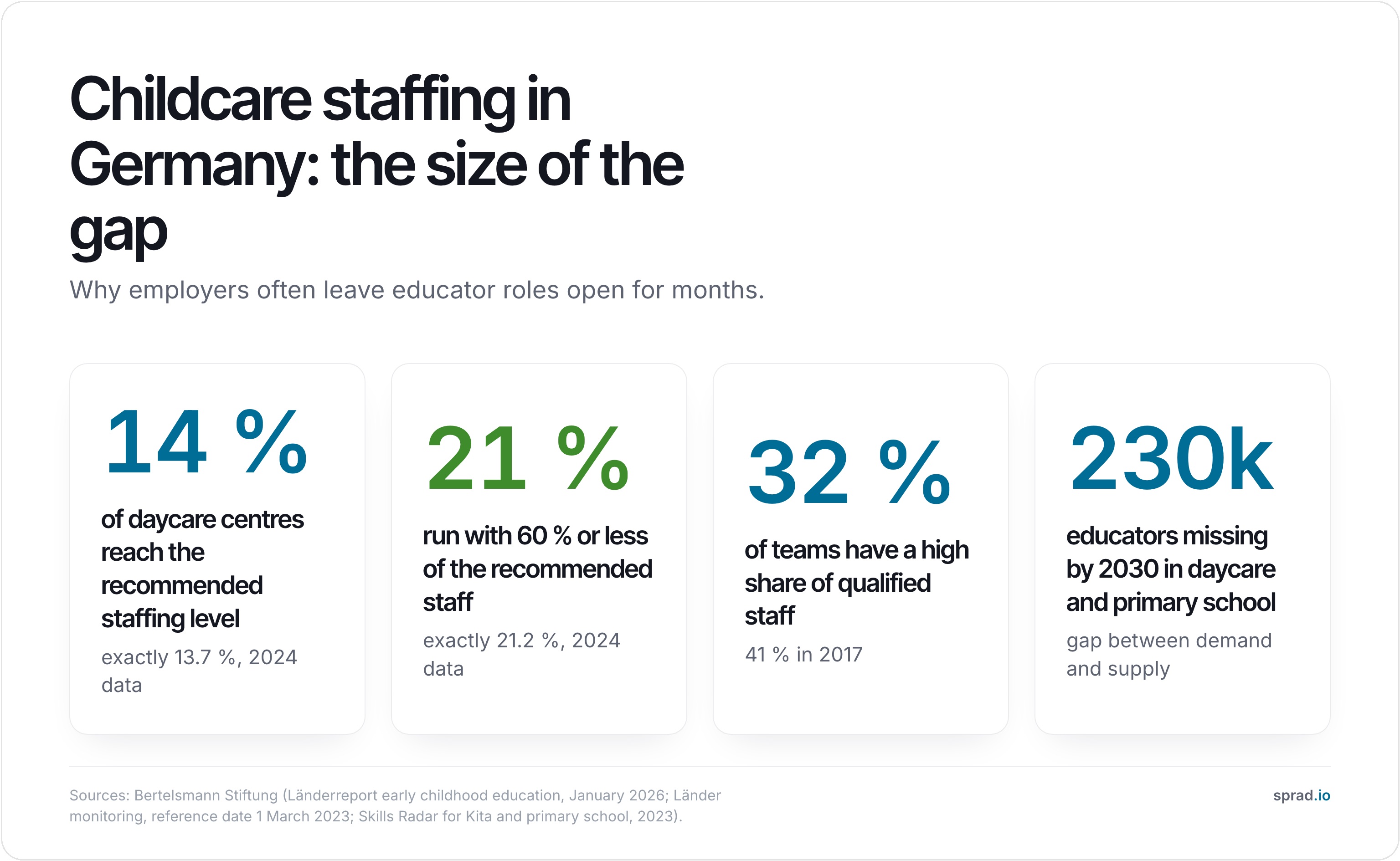
Bertelsmann Stiftung's Länderreport (January 2026) puts the 2024 position at 13.7 % of daycare centres reaching the recommended staffing level, while 21.2 % run with 60 % of it or less. At the reference date of 1 March 2023 only 32 % of teams had a high share of qualified staff, down from 41 % in 2017. The foundation's Skills Radar projects a gap of more than 230,000 educators in daycare and primary school by 2030, helped along by the phased legal entitlement to all-day care for primary school children from 2026.
A survey of about 21,600 childcare workers found that nearly half feel overwhelmed daily or almost daily, and the risk of leaving is highest among staff aged 26 to 30. Some educators are already thinking about moving. They are not looking actively, so you have to reach them before they resign.
Where educators and career changers are
The ARD/ZDF online study 2025 shows 28 % of Germans on TikTok daily, 22 % on Instagram and only 6 % on Facebook. That is no reason to drop Facebook, because Meta's Ads Manager serves both platforms and Messenger from one campaign. It is a reason to design creative for Instagram: short, visual, mobile.
You speak to three groups, and each needs a different message:
- Qualified educators at other centres: they want better conditions. State group size, staffing ratio, preparation time, pay scale and team culture.
- Career changers, childcare assistants and social care assistants: they want to know whether the route is open. Describe the entry models your federal state and provider allow, and who supports them.
- Trainees: they care about mentoring and pay. See our post on apprentice recruiting.
The ad: an example for an educator role
Good educator ads are specific. “We are looking for a qualified professional” persuades nobody who already has a job. An example you can adapt:
Educator (m/f/d) for our nursery group, full time or 30 hours
You look after 10 children as a pair, not alone. We schedule two fixed preparation hours per week, pay by collective agreement and support further training. Start now or on the first of next month. Apply in two minutes via WhatsApp, no CV needed. We reply within 24 hours.
Adjust the numbers to your real situation and promise only what you deliver. Concrete figures on group size and preparation time are more credible than adjectives like “family-like”. State the salary or pay grade if you can: it filters out applicants who cannot afford the job and saves time on both sides.
What Meta restricts in targeting
For ads in the Employment category Meta has limited targeting options, reportedly including age, gender and postcode. Check scope and current status in Ads Manager before you launch. In practice you steer by location with a radius, broad targeting and the ad itself: people interested in the message click.
Pre-screening: five questions before anyone comes to interview
Of ten applications, often only three fit. A short message flow, for example on WhatsApp, separates them early and meets applicants where they already write. See our post on frontline recruiting by phone and WhatsApp, not email. Five questions that work:
- What is your qualification (state-recognised educator, childcare assistant, social care assistant, career changer)?
- Which age group do you want to work with (nursery, kindergarten, after-school care)?
- How many hours per week, and from when?
- Can you provide an extended police clearance certificate? (Required for work with children, § 72a SGB VIII.)
- Where do you live, and how far is your commute?
Do not ask about age, family plans or origin. Collect consent to data processing in the first message; details are in contacting candidates via WhatsApp: is it allowed?
Budget example: what a campaign can cost
Reliable German cost-per-applicant figures for daycare are hard to find. As a US reference, Boostpoint's 2026 benchmark (891 campaigns) reports a median of $13.88 per applicant, with a wide range by industry. German figures can differ. Sprad has not published campaign benchmarks of its own, so this table uses assumed costs:
| Assumed cost per applicant | €1,000 ad budget | Suitable (assumed 30 %) | Cost per suitable applicant |
|---|---|---|---|
| €20 | 50 applicants | 15 | about €67 |
| €35 | 29 applicants | 9 | about €111 |
| €50 | 20 applicants | 6 | about €167 |
This is a worked example, not a forecast. It shows the levers: every improvement in ad and pre-screening feeds straight into cost per suitable applicant. Plan at least three months for a single group role, as most campaigns recommend, and spread budget over several roles when you run several centres. For a comparison with other routes, see what StepStone job ads cost.
Cities: what to watch regionally
These are our assessments, not measured values:
- Berlin: many providers compete for the same staff, so conditions matter more than pay comparison. The Länder monitoring shows a particularly steep fall in qualified-staff share in Berlin.
- Munich, Hamburg: high rents are the issue, so housing or commuting allowances belong in the ad.
- Cologne, Ruhr area: North Rhine-Westphalia is among the states with a strong decline in qualified-staff share, so career-changer offers help.
- Leipzig and rural areas: smaller applicant pools, so use a wider radius and target commuters.
How Sprad solves it
Sprad Social Recruiting runs job ads on Instagram and Facebook, where nurses, tradespeople, drivers and other frontline workers spend time every day. An AI talent agent pre-screens every applicant via WhatsApp, phone or web. Every applicant lands in the employer's own talent pool, so the relationships stay with the employer instead of a platform. Pricing is ad spend plus 10 %, from a €1,000 budget that can be split across roles. Google and TikTok follow. For providers with several centres that means reach is paid for once and the contacts serve every site. More at Sprad Social Recruiting and the talent pool.
FAQ
How do I find kindergarten teachers when hardly anyone is searching?
Reach educators who work at other centres and are not looking actively. Paid ads on Instagram and Facebook reach this group, job boards do not. Show concrete conditions and keep the application short.
What does social media recruiting cost for daycare centres?
You set the ad budget. With Sprad you pay budget plus 10 %, from a €1,000 budget. How many applicants that yields depends on region, ad and pre-screening. There is no guarantee.
Can educators really be reached on Instagram and Facebook?
Yes. According to the ARD/ZDF online study 2025, 22 % of Germans use Instagram daily. In Meta's Ads Manager both platforms run together.
May I ask applicants about age or plans for children?
No. Ask only about qualification, hours, start date, location and the extended clearance certificate, which is mandatory for work with children.
How long should an educator campaign run?
Plan at least three months. In the first two weeks you learn which ad variant works, then you scale.
How do I handle career changers?
Check which routes your federal state permits and say so openly in the ad. Childcare assistants and social care assistants are often the fastest way to strengthen a team.
Jürgen Ulbrich
Jürgen Ulbrich has more than a decade of experience in developing and leading high-performing teams and companies. As an expert in employee referral programs as well as feedback and performance processes, Jürgen has helped over 100 organizations optimize their talent acquisition and development strategies.