To hire nurses faster, advertise where nurses already scroll, make applying take under a minute, and answer every applicant within minutes. Instagram and Facebook feed ads reach nurses who are not searching job boards, a short mobile application removes the CV hurdle, and a pre-screening conversation on WhatsApp or by phone shows your team only the people who fit licence, shift and location. This guide is written for employers: hospitals, care homes, home-care agencies and clinics. It covers the market in numbers, what Meta's employment ad category allows, a worked ad, five pre-screening questions, a budget example and city notes.
The nurse hiring market in numbers
In the US, the Bureau of Labor Statistics projects 6 % growth for registered nurses from 2025 to 2035 and about 180,800 openings a year, many of them from nurses who retire or change occupation. The median pay was $97,550 in 2025 across roughly 3.5 million jobs. The 2026 NSI National Health Care Retention & RN Staffing Report, based on 527 hospitals, puts hospital staff RN turnover at 17.6 % in 2025, the vacancy rate at 8.6 % and the cost of losing one bedside RN at $60,090.

In the UK, NHS England reported a registered nurse vacancy rate of 5.0 % (21,643 vacancies) in March 2026, down from 6.0 % a year earlier and 9.9 % in March 2023. Fewer official vacancies do not mean easy hiring: the workforce is still tight in care homes and community services, which sit outside those NHS figures.
Two conclusions follow. First, retention and recruiting share a budget: if one departure costs about $60,000, a campaign that fills a role quickly with a good fit pays for itself sooner than a cheap but slow process. Second, speed matters because nurses with options do not wait. An applicant who hears back in three days has often accepted another offer.
Where nurses are, and what Meta lets you target
Most nurses work shifts and use their phone between them. Social media ads reach people in the feed who are not actively searching, but are open to a better roster, closer commute or higher pay. Three practical points:
- Job ads are a special ad category. According to Meta's rules, employment ads for advertisers in the US targeting the US, Canada or certain parts of Europe are restricted: the age range is fixed, gender cannot be selected, location targeting covers a radius instead of postal codes, lookalike audiences are unavailable and instant forms cannot collect some personal data. Check the current rules in Meta's Business Help Centre before you plan, and do not build your plan around targeting by age or gender.
- You cannot target by job title on Facebook. You reach nurses through interests, pages and groups they follow, and above all through the ad itself. A clear message to "night-shift ICU nurses" attracts the right people better than a clever audience.
- Use a fast, mobile application. A lead form or a WhatsApp link beats a long career-site form. See frontline recruiting by phone and WhatsApp, not email.
An ad that works: a worked example for an ICU nurse
A nurse decides in about three seconds. Answer what, where, when and how much, and avoid phrases like "competitive pay". A template for a US employer (pay ranges are required in postings in several states, so state it anyway):
ICU registered nurse, nights, 3 x 12-hour shifts
Schedule posted 6 weeks ahead, no mandatory overtime. $[amount]–$[amount] per hour plus night differential. 14-bed unit, 1:2 ratio, paid orientation with a named preceptor. Apply in 60 seconds, no resume needed.
The pattern: one line for the role and shift, one for the schedule, one for pay, one for the team, one for how to apply. Use a real photo of your unit rather than stock imagery, and run two or three versions with different lead lines, for example schedule, pay and team, to see which pulls.
Pre-screening: five questions before a person spends time
Applications are only half of the work. A talent agent can ask five questions at once, around the clock, via WhatsApp, phone or web, and hand a summary to your nurse manager.
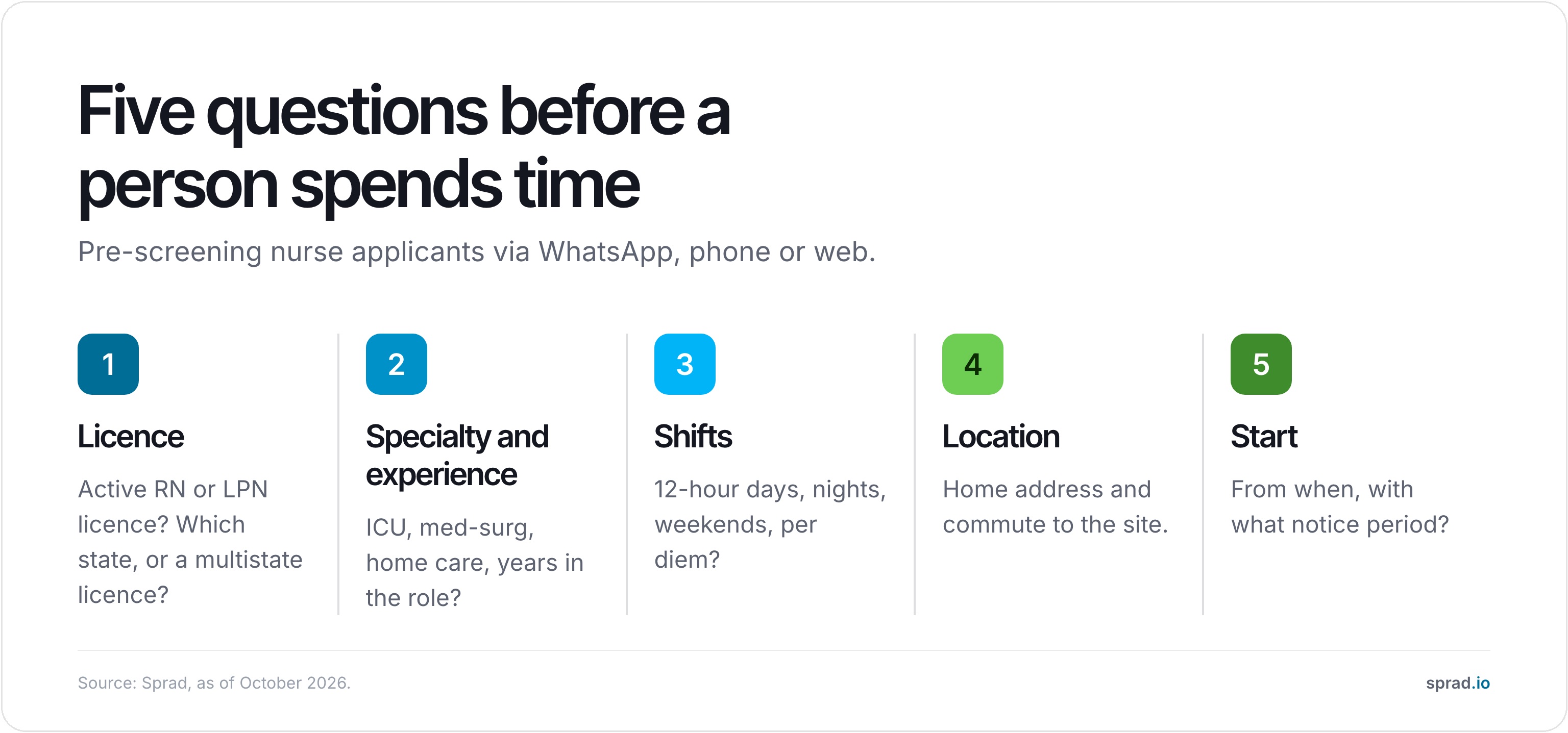
The licence question deserves care in the US. Many states belong to the Nurse Licensure Compact, which lets nurses with a multistate licence practise across member states, so ask whether the applicant holds a multistate licence, not only where they live. Keep every question job-related, and let a human check licences against the state board before an offer.
Sprad Social Recruiting for healthcare employers
Sprad Social Recruiting runs job ads on Instagram and Facebook, where nurses spend time every day. The AI talent agent pre-screens every applicant via WhatsApp, phone or web. Every applicant lands in your own talent pool. In nursing that matters: the nurse who cannot move today but would in three months stays in your pool instead of disappearing on a platform. For other healthcare roles see the healthcare page.
Budget example
Sprad charges ad budget plus 10 %, from a €1,000 budget that you can split across roles, with three months recommended. Prices are in euros. The figures are plain arithmetic, not a promise of applicants:
| Example | Ad budget (3 months) | 10 % fee | Total |
|---|---|---|---|
| Home-care agency, 1 RN role | €1,000 | €100 | €1,100 |
| Care home, 3 roles (RN, LPN, night shift) | €3,000 | €300 | €3,300 |
| Hospital, 5 roles on two units | €6,000 | €600 | €6,600 |
How many applications this yields depends on region, ad and role. For orientation, the Boostpoint 2026 benchmark puts the median at $13.88 per application on Meta campaigns, a general figure that does not apply to nursing specifically. Calculate your own: budget divided by cost per qualified applicant tells you how many conversations to expect. The budget planner on the product page gives a guide value, never a guarantee.
Cities: what to adjust
Nursing is local, and commute decides. Run ads in a radius around the site and adapt the message. These are starting points, not measurements:
- Houston: a very large medical centre, so many employers compete for the same nurses. Lead with schedule and orientation.
- Phoenix: a fast-growing region with long distances. Name the commute time in the ad.
- Orlando and Tampa: an older population means demand for care roles, so home-care and long-term-care ads can stress continuity of patients.
- Manchester and Birmingham (UK): NHS trusts and private care providers recruit side by side. Stress rota flexibility and pay band.
FAQ
What is the fastest way to hire nurses?
Combine an ad that reaches passive nurses, a one-minute mobile application and an immediate pre-screening conversation. Most delay comes after the application, not before it.
Can I target nurses directly on Instagram and Facebook?
Not by job title, and employment ads in several regions have limited targeting. Reach nurses through the content of the ad and a defined radius around your site.
How much does it cost to hire a nurse with social media ads?
It depends on region, role and ad quality. With Sprad you pay ad budget plus 10 %, from a €1,000 budget. Compare cost per qualified applicant, not cost per click.
Is this about hiring a private nurse?
No. This guide is for employers, such as hospitals, care homes and agencies. If you need care for a family member, a care marketplace is the better route.
Jürgen Ulbrich
Jürgen Ulbrich has more than a decade of experience in developing and leading high-performing teams and companies. As an expert in employee referral programs as well as feedback and performance processes, Jürgen has helped over 100 organizations optimize their talent acquisition and development strategies.