The most reliable way to find employees in 2026 is a mix of three things: referrals from people you trust, your own career page with free job boards, and paid reach on Instagram and Facebook for roles where hardly anyone is searching. In Germany, the DIHK skilled-worker report 2025/2026 found that 36 % of surveyed companies cannot fill vacancies at least in part, and more than 40 % of small and mid-sized firms. Which of the twelve ways comes first depends on the role, the size of your business and how fast you need someone. As of October 2026.
Which way fits your situation?
Most guides list options and leave the choice to you. We sort by your situation:
- Small business, little time: referrals, free job boards, Google for Jobs. Cost: close to nothing.
- Frontline roles, shifts, several sites: social media recruiting with WhatsApp pre-screening, plus referrals.
- Skilled roles with a degree or certificate: active sourcing, career networks, targeted job boards.
- Urgent and high value: a recruiter or a staffing agency, for a fee.
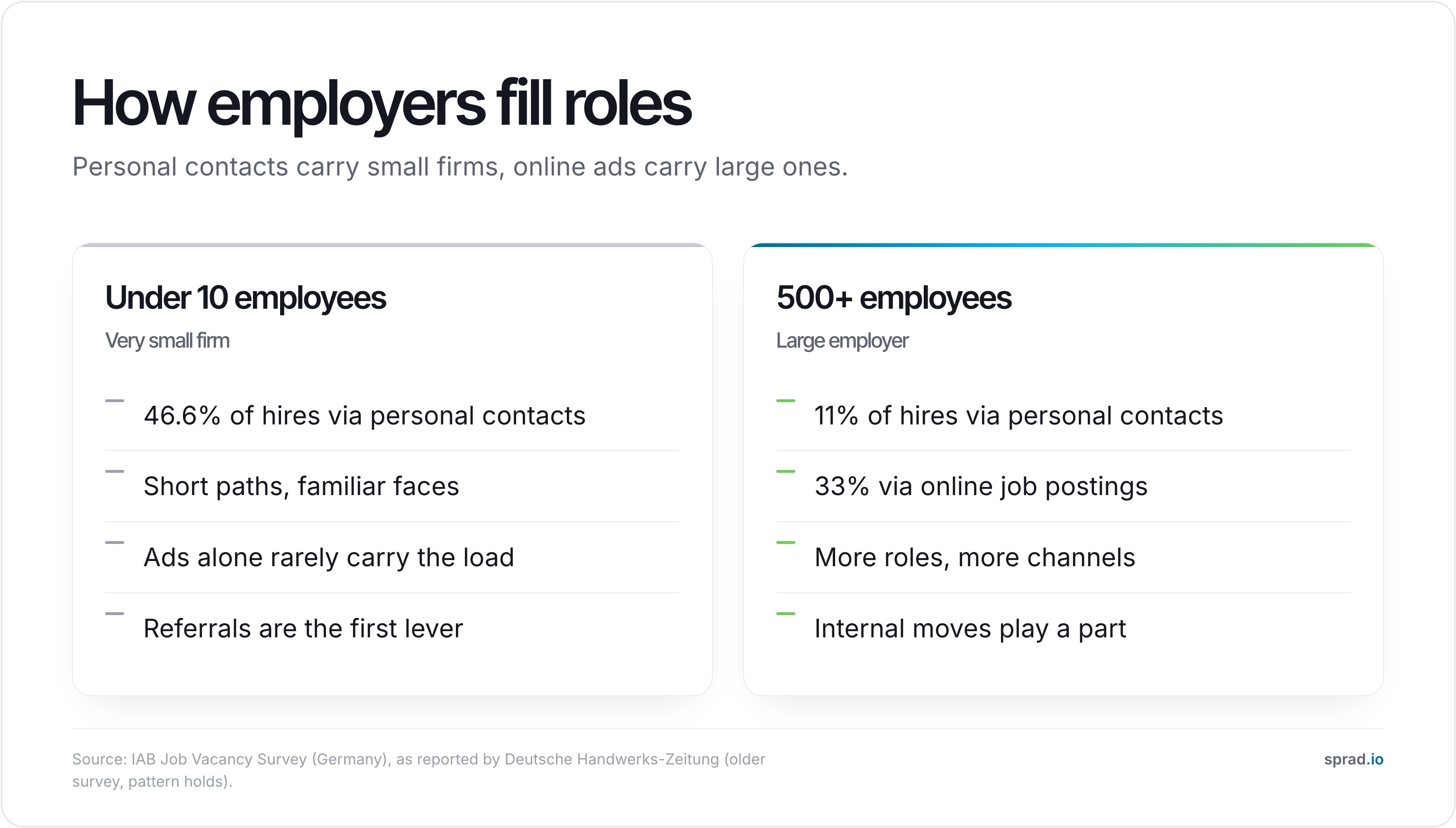
The picture matches an older analysis of the German IAB job vacancy survey, reported by Deutsche Handwerks-Zeitung: in firms with fewer than ten employees 46.6 % of hires came through personal contacts, against 11 % in firms with 500 or more employees, where online job postings lead with 33 %. The survey is not new, and neither is the basic pattern.
The 12 ways compared
| # | Way | Cost | Speed | Good for |
|---|---|---|---|---|
| 1 | Employee referrals | $0 to a bonus | fast | any role, trust-based |
| 2 | Own career page with Google for Jobs | $0 to upkeep | slow, lasting | every business with a website |
| 3 | Free job boards | $0 | medium | active job seekers, hourly roles |
| 4 | Paid job boards | varies, often per post or per application | medium | office roles, experienced hires |
| 5 | Social media recruiting (Instagram, Facebook) | ad budget, from about €1,000 | fast | nursing, trades, logistics, hospitality |
| 6 | WhatsApp or text applications and pre-screening | usually included in a tool | instant | roles with mobile applicants |
| 7 | Active sourcing | tool plus time | medium | skilled people with an online profile |
| 8 | Recruiters | fee, usually a share of annual salary | fast | high-value, urgent roles |
| 9 | Staffing agencies | hourly bill rate | very fast | peaks, cover |
| 10 | Apprenticeships and internships | trainee pay | slow | trades, care, hospitality |
| 11 | Local network, associations, schools | usually $0 | medium | local hiring |
| 12 | Talent pool: past applicants and alumni | $0 if the data exists | fast | any business with application history |
The cost, speed and "good for" columns are our own assessment from market experience, not a measurement. Check individual provider prices directly.
1. Employee referrals
In the IAB analysis, searches through personal contacts led to a hire in 62.7 % of cases, more often than any other route. Referrals work when you make them easy and visible: a job link everyone can share from a phone, a clear bonus and a reminder in the team meeting. Ask suppliers and regular customers too.
2. Your own career page with Google for Jobs
Your career page is the one channel you own. With JobPosting structured data your roles appear in Google for Jobs at no charge. What matters: a clear title, pay or a range, location, shift pattern and an application path of under two minutes. Asking for a resume is the fastest way to lose mobile applicants.
3. Free job boards
Employers who post directly on Indeed can publish up to three free job posts per calendar month, each live for up to 30 days, since 10 December 2025. Government job banks and many smaller boards are free as well. This is a good base layer. We cover the limits in our guide on how to post a job for free.
4. Paid job boards
Paid boards pay off mainly for office and skilled roles, where candidates search on boards. Prices and models differ widely, from a fixed price per post to billing per application. For orientation see StepStone costs and prices and StepStone alternatives. Always calculate cost per hire, not cost per post.
5. Social media recruiting on Instagram and Facebook
Nurses, drivers, tradespeople and service staff rarely search on job boards, but they scroll through Instagram and Facebook every day. A paid ad reaches them there. Meta limits job ads in the US, Canada and more than 40 European countries: you must pick the employment special ad category, age and gender are not selectable, and location is a radius of at least 15 miles or 25 km. Plan from about €1,000 of budget and three months. A 2026 US benchmark by Boostpoint, based on 891 managed campaigns, put the median at $13.88 per application, ranging from $2.91 to $66.45. For frontline hiring by sector, see our pages on healthcare, logistics and trades.
6. WhatsApp or text applications and pre-screening
Many frontline applicants do not want to fill in forms. They prefer a short message: location, license, shift availability, start date. An automated flow asks these must-have questions immediately and passes on only applicants who fit. That removes the slowest part of hiring: sorting and chasing. Legally, what counts is that the applicant starts the chat or agrees to it. See contacting candidates via WhatsApp and frontline recruiting by phone and WhatsApp.
7. Active sourcing
Instead of waiting for applications, you approach people directly. It pays off mainly for skilled people with an online profile. Sprad offers a people search across public profiles and your own pool. Expect more effort per hire, but also candidates who would never have applied.
8. Recruiters
Recruiters usually work on a fee basis, often as a share of annual salary. It makes sense for valuable, urgent roles when you lack the time or network. Ask about the guarantee period, exclusivity and how many candidates come from the recruiter's own pool. For mass hiring it gets expensive quickly.
9. Staffing agencies
Staffing agencies solve peaks and cover quickly, because workers are employed by the agency. You pay an hourly bill rate. Converting a placed worker to your payroll is possible, but usually costs a conversion fee or a waiting period. As a lasting answer to a skills shortage, agencies rarely work.
10. Apprenticeships and internships
Whoever trains apprentices today has skilled staff tomorrow. It is the slowest route and often the most stable one in trades, care and hospitality. Reach young people where they are: Instagram, TikTok, schools, internships. More in our guide to apprentice recruiting (German).
11. Local network, associations and schools
Trade associations, sports clubs, vocational schools and local groups are free channels that work regionally. A visit to a vocational school or a note in a club newsletter costs little and often brings applicants who fit your location.
12. Talent pool: past applicants and alumni
The cheapest candidate is one you already know. Past applicants who did not fit the timing, interns and former employees are a source most businesses never tap, because their data sits in inboxes. A talent pool of your own makes them findable and reachable. In Sprad's Talent Base the contacts stay with the employer.
What does all this cost?
Blanket numbers would be invented. Orders of magnitude instead:
- €0: referrals, career page, free job boards (three Indeed posts a month), network, talent pool. You pay with time.
- From about €1,000 a month: social media recruiting with ad budget. With Sprad, ad spend plus 10 %.
- Fee or bill rate: recruiters and staffing agencies, depending on the contract.
As a worked example with €1,000 of budget per month over three months: €3,000 of ad spend, with Sprad plus 10 %, so €3,300. What one applicant or one hire costs depends on role, region and pay. Nobody can honestly guarantee a number of applicants.
Common mistakes when looking for employees
- Relying on one channel. A single route rarely brings enough applicants.
- No pay in the ad. It costs clicks and applications.
- A long application path. A resume and cover letter put mobile applicants off.
- Replying slowly. If you answer after three days, the applicant is usually gone.
- Not saving applicants. Someone who does not fit today may be the right hire in three months.
Where Sprad fits in
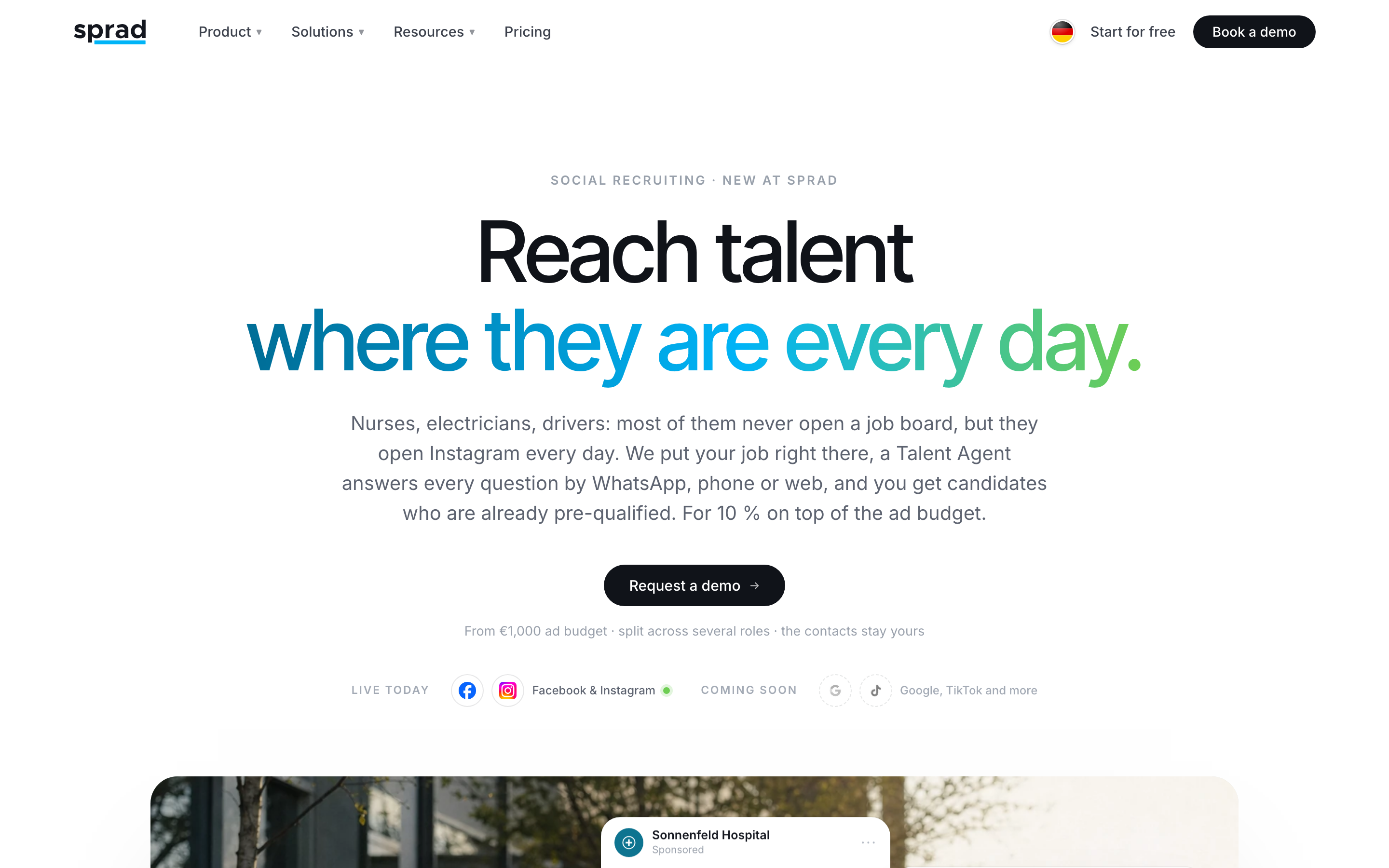
Sprad Social Recruiting runs job ads on Instagram and Facebook, where nurses, tradespeople, drivers and other frontline workers spend time every day. An AI talent agent pre-screens every applicant via WhatsApp, phone or web. Every applicant lands in the employer's own talent pool, so the relationships stay with the employer instead of a platform. Pricing is ad spend plus 10 %, from a €1,000 budget that can be split across roles, with three months recommended. See Sprad Social Recruiting.
FAQ
How do I find employees quickly?
Referrals, paid ads on Instagram and Facebook, and staffing agencies work fastest. A short mobile application path and quick replies decide whether reach turns into applicants.
Where can I find employees for free?
Through referrals, your own career page with Google for Jobs, government job banks, up to three Indeed posts a month, local networks and schools.
How do I find employees for a trade business?
Through referrals, apprenticeships, vocational schools and social media recruiting on Instagram and Facebook. Tradespeople are more active there than on classic job boards.
How much does it cost to find employees?
From $0 for referrals and free boards to a recruiter fee as a share of annual salary. Social media recruiting starts at around €1,000 of ad budget a month.
How long does it take to find an employee?
It depends on role, region and channel. We deliberately name no blanket number, because no reliable open statistic covers all professions.
What should I do if no applicants come?
Check the title, pay and application path, add a second channel and ask your team for referrals. If your audience does not search actively, paid reach on social media helps.
More on social recruiting
Jürgen Ulbrich
Jürgen Ulbrich has more than a decade of experience in developing and leading high-performing teams and companies. As an expert in employee referral programs as well as feedback and performance processes, Jürgen has helped over 100 organizations optimize their talent acquisition and development strategies.