To find a job in Germany as a foreigner, first settle your right to work, then search employers' own career pages and apply with a German-style CV. EU, EEA and Swiss citizens need no permit; everyone else needs a route such as the EU Blue Card (from a job offer paying at least €50,700 gross a year in 2026) or the Opportunity Card, which gives you up to one year to look for work on the spot. Facts and figures are as of October 2026.
This guide answers what job seekers from abroad actually ask: what "finding a job in Germany" means in practice, which permit fits you, how to search and apply step by step, which tools help, which mistakes cost you interviews and how AI changes the search. It is written for applicants from the EU, the US, the UK, India and everywhere else.
What does "how to find a job in Germany" mean in practice?
It is two projects at once: a legal project (the right to live and work in Germany) and a search project (finding and winning an employer). Most guides only cover the second one. In practice the first decides how fast you can start, because many employers will not interview you until your status is clear.
The path depends on one question: where is your passport from?
| Your situation | What you need | What it means for your search |
|---|---|---|
| EU, EEA or Swiss citizen | No work permit; you may live and work in Germany under free movement law | Search and apply directly; register your address after arrival |
| Non-EU with a job offer and a university degree | EU Blue Card: €50,700 gross a year in 2026, €45,934.20 for shortage occupations, new graduates and some IT specialists | Search from abroad; the offer comes first, the permit second |
| Non-EU with a recognised vocational or university qualification, no offer yet | Opportunity Card (Chancenkarte): up to one year of job search, up to 20 hours of side work a week | Come first, interview in person, apply from Germany |
| Non-EU graduate or trainee from a German programme | Residence permit for job search, up to 18 months (§ 20 Residence Act) | Search while you still know the system and the language |
Which permit should I use? Blue Card and Opportunity Card in numbers
EU Blue Card: the job-offer route
You need a concrete job offer and a qualifying degree. In 2026 the minimum gross annual salary is €50,700. A reduced threshold of €45,934.20 applies to shortage occupations such as doctors, STEM academics and teachers, to graduates who finished their degree no more than three years before applying, and to IT specialists without a degree who have at least three years of relevant experience in the past seven years. The reduced card needs approval by the Federal Employment Agency, which may ask for more than the minimum (Federal Employment Agency, issue 03/2026). The thresholds are adjusted every year, so check the current figure before you negotiate.
Opportunity Card: the search-on-the-spot route
The Opportunity Card is issued for up to one year, and you can extend to up to two more years once you hold a qualified job offer (§ 20a Residence Act). You need a state-recognised qualification (at least two years of vocational training or a university degree), basic German (A1) or English at B2, and secured living costs: the Federal Employment Agency lists €1,091 a month for 2026, usually shown with a blocked account. As our own calculation, twelve months come to €13,092. Treat that as an estimate and confirm the exact proof with your embassy.
If you do not hold a fully recognised qualification, you need 6 points:
| Criterion | Points |
|---|---|
| Qualification partially recognised in Germany | 4 |
| German B2 / B1 / A2 | 3 / 2 / 1 |
| English C1 | 1 |
| Work experience of at least 5 years / 2 years | 3 / 2 |
| Qualification in a shortage occupation | 1 |
| Age under 35 / under 40 | 2 / 1 |
| At least 6 months of earlier stay in Germany | 1 |
| Spouse or partner applies for the card too | 1 |
Three worked examples (our illustration of the table, not legal advice): a 31-year-old with a partly recognised degree gets 4 + 2 = 6 points. A 38-year-old with German B1 and six years of experience gets 2 + 3 + 1 = 6 points. A 33-year-old with German B2 and three years of experience gets 3 + 2 + 2 = 7 points. Without language or recognition, even ten years of experience (3) and age (2) give only 5 (6 if your qualification is in a shortage occupation): one language course makes the difference.
During the search you may work an average of up to 20 hours a week and do trial work of up to two weeks at a time. The Opportunity Card itself needs no approval from the Federal Employment Agency. Recognition of your qualification is handled through the government portal Recognition in Germany, and the general overview of routes is on Make it in Germany.
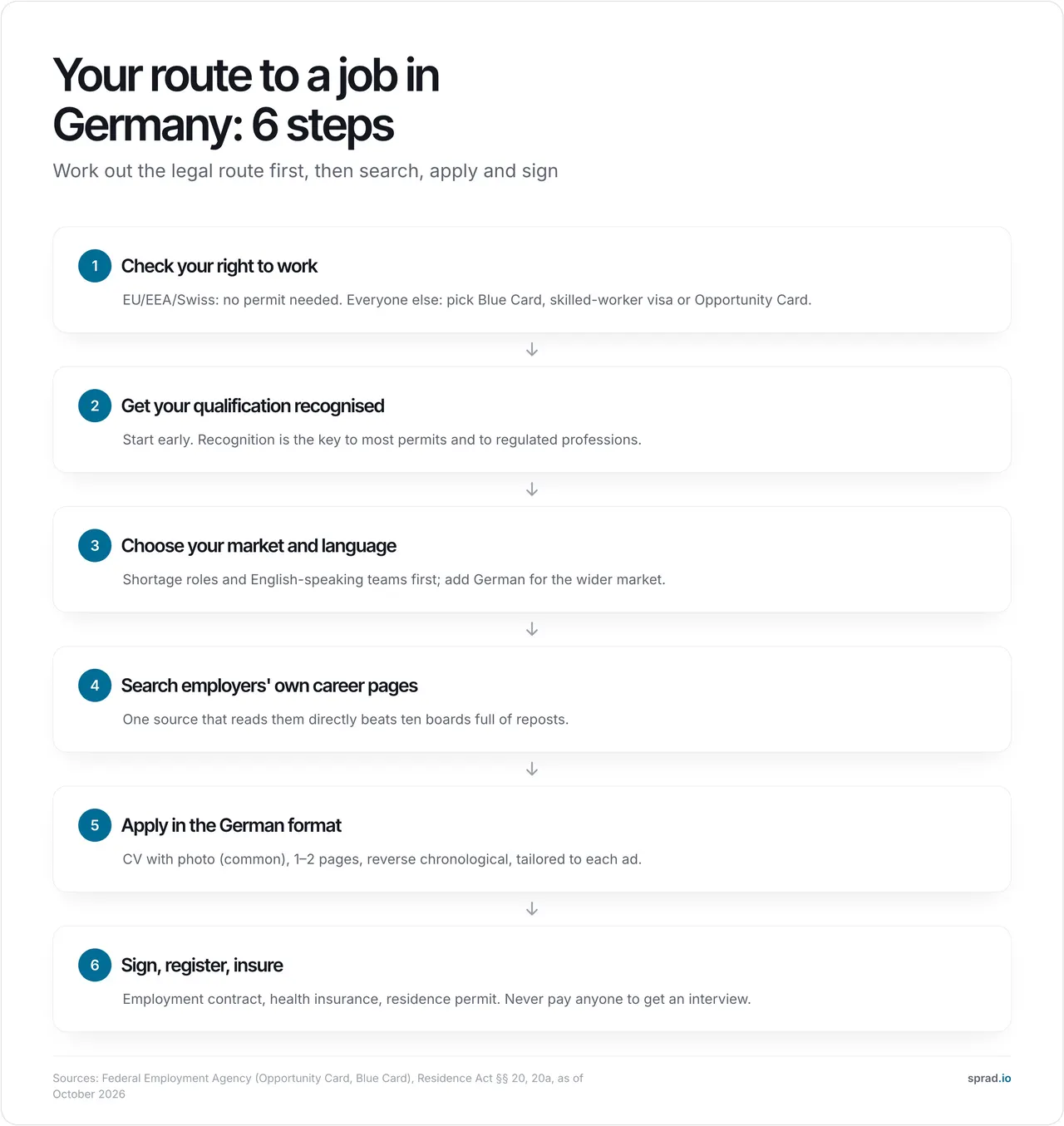
How do I find a job in Germany, step by step?
- Settle your status. Pick the route in the table above and write down what is missing: recognition, language level, a job offer.
- Start recognition early. For regulated professions such as nursing, medicine or teaching you cannot work without it. For others it raises your pay and your points.
- Choose your market. Shortage fields (healthcare, skilled trades, IT and engineering) hire foreigners most often. English-speaking teams exist, mainly in tech and at international companies, but German widens your options a lot.
- Search where jobs start. Most roles appear first on the employer's own career page, then get copied to boards. Use one source that reads those pages directly, the job search of the Federal Employment Agency and one or two general boards such as StepStone, XING or LinkedIn for cross-checks.
- Read the requirements line. Look for the language level ("Deutsch C1"), "work permit required" or "Visa-Sponsoring". Apply even if you meet 70 % of a list, but not if the language level is a hard requirement you cannot meet.
- Apply in the German format. A tabular CV of one to two pages, reverse chronological, with a photo (common, not required), plus a short cover letter that names the role and the employer. Do not write that you want to move to Germany; write what you will do for the team. Our guide on applying in DACH versus the US shows the differences.
- Prepare for the interview. Expect questions on your permit, your notice period and your German. Say clearly when you can start and what you still need to arrange.
- Sign and register. Employment contract, health insurance, registration at your address and your residence permit. Never pay anyone for an interview or a permit.
Which tools and sources help?
| Source | Strength | Weak spot |
|---|---|---|
| Atlas Career (free) | 1.5M+ active jobs straight from employers' career sites, 100,000+ in DACH; match score 0–100 with reasons; tailored CV per application; new matches by e-mail | You still check the permit and language lines yourself and apply yourself |
| Job search of the Federal Employment Agency | Official, large, covers small employers | Mostly German-language ads |
| General boards (StepStone, XING, LinkedIn) | Huge reach, English filters | Reposts, mass competition, many ads without status information |
| Employer career pages | Freshest, no duplicates | Hundreds of sites to check by hand |
| Networks, job fairs, referrals | Roles shared before they are posted | Needs networking time, often German |
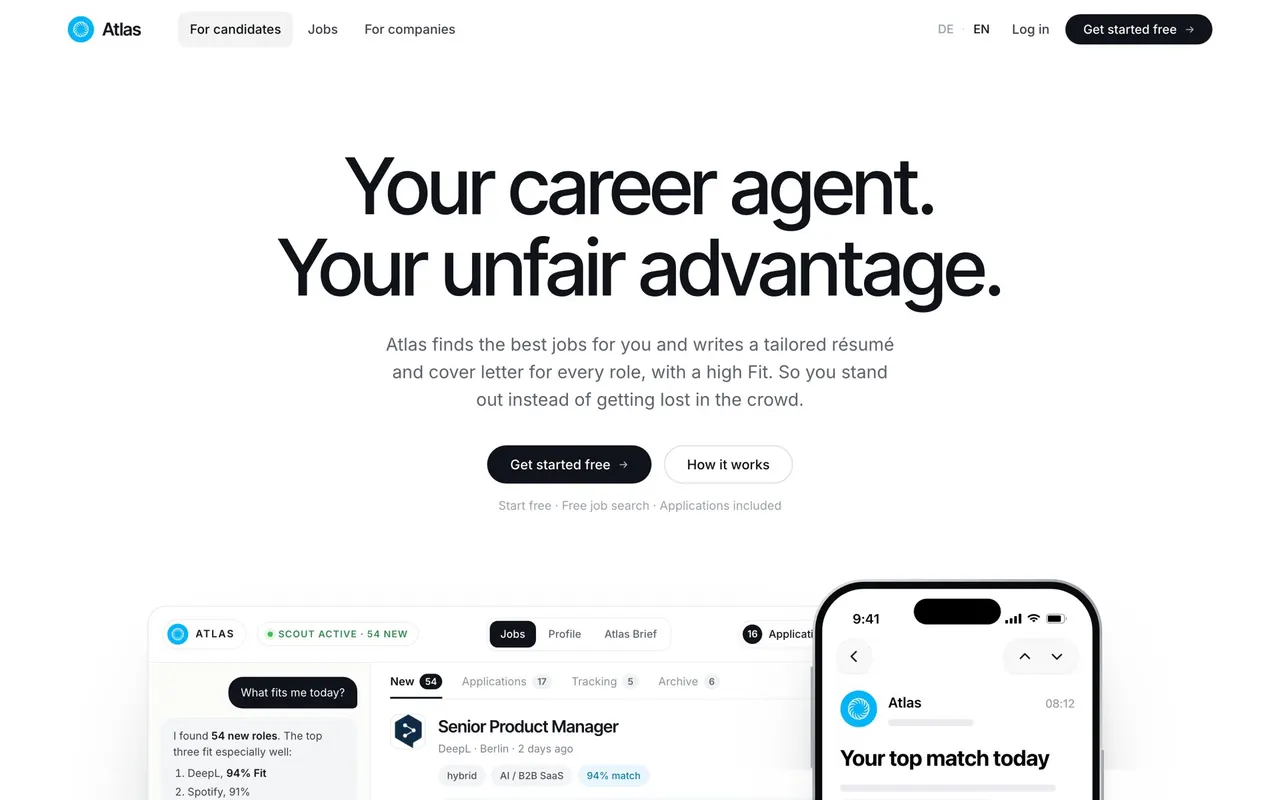
Atlas works like this: you describe role, level, pay, place and no-gos in a short voice conversation (the "Atlas Brief"), Atlas keeps searching and mails you new matches, and you can reply to the mail to change the search ("only Berlin", "English-speaking team"). Every role gets a match score with reasons, and for each application Atlas tailors a CV and, on request, a cover letter in the language of the ad. It sends nothing for you. It is free without limits and developed by Sprad in Vienna, with EU hosting and GDPR compliance. There are focused portals for healthcare, skilled trades, sales and tech. For a wider tool comparison read AI job search tools compared.
Which mistakes should I avoid?
- Mixing up the order. Applying everywhere before you know your permit route wastes weeks. Employers ask about your status in the first call.
- Skipping recognition. A degree that is not recognised cannot earn points and may not qualify you for a regulated job.
- One English CV for everything. German employers expect a tidy, complete, tabular CV; many ads expect German documents.
- Ignoring the language line. "Deutsch C1" in the ad is usually a filter, not a wish.
- Mass applying with AI. A Robert Half survey from March 2026 found that 67 % of HR leaders say AI-generated applications slow down hiring. Employers answer with stricter screening.
- Falling for scams. Warning signs: a job offer after a chat-only "interview", fees for visas, placement or "guaranteed" permits, requests for bank details before a contract, an employer you cannot find on its own domain.
In our experience from seven years of building recruiting and screening software at Sprad, work authorisation and language level are among the first hard filters in a hiring pipeline. An application that leaves both unclear is often gone before anyone reads the motivation paragraph. A one-line statement ("EU Blue Card eligible, German B1, available from March") is worth more than another paragraph of enthusiasm.
How does AI change the search?
AI helps in three places. It searches continuously across thousands of career pages, it explains the fit instead of ranking by keywords, and it tailors documents to each role and market. It does not replace your own check of the status and language lines, and it should not send applications in your name. On the employer side, software that screens applicants is classed as high-risk in Annex III of the EU AI Act, with obligations that apply from 2 December 2027 (Regulation (EU) 2026/1744). For concrete workflows see AI job search tips without spamming recruiters and what an AI career agent is.
How do I apply for jobs in Europe more broadly?
EU and EEA citizens may work in every EU country without a permit, so the same search logic works in Germany, Austria, the Netherlands or Spain. What changes is the application format: photo and tabular CV are common in Germany, Austria and Switzerland, but unusual in the US and UK. Check the format per country before you send anything.
FAQ
Can I get a job in Germany without speaking German?
Yes, but the market is smaller. English-speaking roles exist mainly in tech, at international companies and in startups. Regulated professions such as nursing or teaching need German. For the Opportunity Card you need German A1 or English B2.
Can I apply for jobs in Germany from abroad?
Yes. With a Blue Card or skilled-worker route you apply from abroad and get the permit after the offer. With the Opportunity Card you move first and search on the spot.
Which jobs are in demand for foreigners in Germany?
The shortage-occupation lists of the Federal Employment Agency cover healthcare, skilled trades, IT and engineering, among others. They also decide whether the lower Blue Card threshold of €45,934.20 applies.
How much do I need to earn for the EU Blue Card in 2026?
At least €50,700 gross a year, or €45,934.20 for shortage occupations, new graduates and some IT specialists (Federal Employment Agency, 2026).
Can I work during the Opportunity Card year?
Yes: on average up to 20 hours a week, plus trial work of up to two weeks each.
Is Atlas Career really free?
Yes: search, match score, a tailored CV and a cover letter for every application, without a limit. You review everything and apply directly to the employer. Create a free account or browse current jobs.
Jürgen Ulbrich
Jürgen Ulbrich has more than a decade of experience in developing and leading high-performing teams and companies. As an expert in employee referral programs as well as feedback and performance processes, Jürgen has helped over 100 organizations optimize their talent acquisition and development strategies.