To find interns, ask university career centers and department contacts first, then add referrals from staff and past interns, your own careers page, student clubs and a short search for students by field and graduation year. Decide before you post whether the role is paid and what the intern will deliver, because unpaid internships at for-profit employers are lawful only if the intern is the primary beneficiary.
The effort pays back: in the NACE Internship & Co-op Survey, 63.1 % of 2024-25 interns were converted into hires, the highest rate in five years, and 88.3 % of those offers were accepted (NACE).
Where to find interns
| Channel | Why it works | Catch |
|---|---|---|
| University career centers and department contacts | Direct access to the right majors; faculty can name strong students | Start 3–6 months ahead; career centers are busy in spring and fall |
| Referrals from staff and past interns | Cheap, and past interns know what the job is really like | Small volume; repeats your current network |
| Your own careers page and social posts | Costs only time; reaches people who already know you | Little reach if nobody knows the brand yet |
| Student communities and clubs | Professional societies and campus clubs reach engaged students | Needs a named contact and a clear ask |
| Job boards | Large reach for general roles | Many applicants, little filtering |
| Your talent pool (earlier applicants, past interns) | Warm and already known to you | Needs consent and upkeep |
Timing matters more than the channel. Career centers plan their fall and spring recruiting calendars well in advance, so ask for their dates and post deadlines before you write the description. If you hire every year, name one person at each school who knows your team and the roles you offer. To reach students who have not applied, an active sourcing tool searches public profiles by field and graduation year.
Paid or unpaid: what you need to know in the US
| Type | Pay in the US | What to watch |
|---|---|---|
| Paid summer or semester intern | Wages at or above the federal minimum of $7.25 an hour; your state may set a higher minimum | Treated as an employee: payroll tax and workers' compensation apply |
| Unpaid intern at a for-profit employer | Only lawful if the intern is the primary beneficiary of the arrangement | Seven-factor test in DOL Fact Sheet #71; high risk if the intern does regular work |
| Unpaid at a non-profit or public body | Generally permitted for volunteer-type roles | Rules differ by state; check before you post |
| International student on an F-1 visa | Paid work needs authorization (CPT or OPT) | Ask the school's international office what is on file |
The Department of Labor asks which side is the "primary beneficiary" of an internship. The test (Fact Sheet #71, revised January 2018) weighs seven factors: whether both sides expect no pay, whether the training resembles what a school gives, whether it ties into formal education, whether it follows the academic calendar, whether it ends when the learning ends, whether it complements rather than replaces paid staff, and whether the intern is told there is no promised job at the end. No single factor decides. If the intern does work your staff would otherwise do, pay them.
A realistic budget: 400 hours (ten weeks full time) at $23.35 an hour comes to $9,340 in wages, plus about 7.65 % employer payroll tax, or roughly $10,050. The hourly figure is the average intern wage NACE lists in its 2026 report; pay varies a lot by field and city, so check it against your own market.
Copy-paste search strings
- LinkedIn Boolean (marketing interns): ("marketing" OR "communications" OR "brand") AND (student OR undergraduate OR "bachelor") AND ("expected 2027" OR "class of 2027" OR "graduating 2027") AND (Chicago OR Illinois)
- Google X-Ray (data and analytics): site:linkedin.com/in ("data analytics" OR "statistics" OR "computer science") ("class of 2027" OR "expected 2027") (Boston OR Massachusetts) -recruiter
- Past interns elsewhere (proof of work experience): site:linkedin.com/in ("summer intern" OR "internship") ("class of 2027" OR "expected 2027") "your field"
Replace the graduation year, field and region. Many students list a graduation year in their education section, but not everyone does, so treat the result as a starting list, not a full list. For channels beyond search strings, see our guide on how to find employees.
What to write in the first message
Hi [first name], I lead [team] at [company, city or remote]. Your [project, club role or course project] caught my eye. We are looking for a [role] intern for [term, hours per week], paid at [rate]. You would work on [concrete project] with [name] as your mentor and present it at the end. If it fits your schedule I can send the project outline; if not, thanks for reading. [Your name]
Name the pay and the project in the first message. Students read vague "learn and grow" offers as unpaid. More templates: recruiter outreach email templates.
Must-have and nice-to-have
| Must-have (examples) | Nice-to-have (examples) |
|---|---|
| Enrolled or graduating in a relevant field | A shipped project, club role or part-time job |
| Available for the full term, with start and end date | Prior work with the tools you use |
| Basic skill the project needs (for example Excel, writing, Python) | A second language for international teams |
| Authorization to work in your country | Interest in staying on after the internship |
Five pre-interview questions for interns
- Tell me about one project from class, a club or a job that you finished. What was your part?
- What do you want to learn in this internship, and what would make it a success for you?
- Describe a task where you did not know the answer. How did you start?
- When are you available, and do you have other commitments such as classes, exams or a second job?
- Would you consider a full-time role with us after graduation?
Legal points in short
Pay and classification follow the Fair Labor Standards Act and your state's rules (see above). If you contact students using public profile data and you also recruit in the EU, Art. 14 GDPR requires that you inform the person (EUR-Lex); see contacting candidates by email under GDPR. Keep a short written offer with the dates, pay and project so both sides know what was agreed. For international students, ask the school's international office whether work authorization is on file.
How Sprad fits in
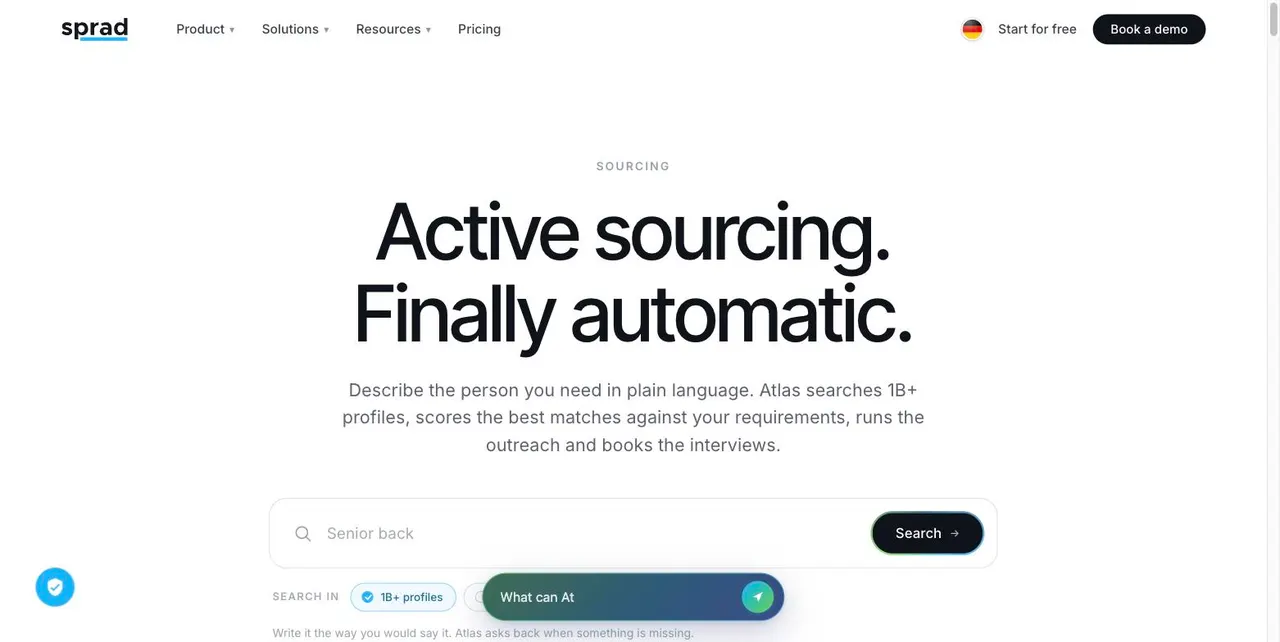
With Sprad's active sourcing tool you describe the intern in plain words, for example "marketing student, graduating 2027, has run a campus club or social account, Chicago or remote". The AI checks each profile against these requirements and gives a reason per requirement, and your earlier applicants and past interns in your own talent pool are searched at the same time. A voice pre-interview in 12 languages costs 30 credits per candidate, and checking a CV costs 2 credits. Recruiter Lite costs 79 € per seat and month, the free plan includes 100 credits a month, and a web search costs 2 credits per profile shown (pricing, status November 2026). We are the vendor here, and the steps above work without any tool.
Frequently asked questions
How early should I start looking for summer interns?
Plan to start in the fall before the summer term. Campus recruiting calendars fill early, and good students often decide months before their term starts. For a spring or fall term, start about three to four months ahead.
Do I have to pay interns?
For a for-profit employer, almost always yes. Unpaid is only lawful if the intern is the primary beneficiary under the seven-factor test, which is rare when the intern does real work. Non-profits and public bodies have more room, but states differ.
How many hours should an internship have?
Ten to twelve weeks is the common summer length. Set the hours per week and the end date in the offer; a clear end date also helps the "limited duration" factor of the DOL test.
How do I turn an intern into a hire?
Give the intern a finished project, a mentor and a review conversation in the last two weeks. NACE reports that 63.1 % of 2024-25 interns were converted into hires, so the internship is also your cheapest way of recruiting entry-level staff (NACE). In Germany the follow-up step is often a working-student contract.
Can remote internships work?
Yes, but NACE's 2025 report found a lower offer rate for mixed remote and in-person programs (about 56 %) than for in-person programs (about 72 %) among 2023-24 interns (NACE). If you run a remote program, plan more check-ins and a named mentor.
Jürgen Ulbrich
Jürgen Ulbrich has more than a decade of experience in developing and leading high-performing teams and companies. As an expert in employee referral programs as well as feedback and performance processes, Jürgen has helped over 100 organizations optimize their talent acquisition and development strategies.