To hire customer service representatives, start with referrals from your support team, your own pool of earlier applicants and adjacent roles such as hotel front desk or retail, then test how candidates sound on a call. The U.S. Bureau of Labor Statistics counts about 2.67 million representatives, a median wage of $44,770 a year and roughly 289,500 openings a year, all from replacing people who leave (BLS Occupational Outlook Handbook, May 2025).
High turnover is the real problem, so a talent pool you can approach again matters more than one more job ad.
How big is the market, in numbers?
| Measure | Value | Source |
|---|---|---|
| Jobs (2025) | about 2,666,000 | BLS |
| Median pay (May 2025) | $44,770 a year, $21.53 an hour | BLS |
| Growth 2025–2035 | −5 % (about −141,800 jobs) | BLS |
| Openings per year | about 289,500, from reps who change occupation or leave the workforce | BLS |
| Entry route | High school diploma, 2 to 4 weeks of on-the-job training (longer in finance and insurance) | BLS |
Two readings matter for sourcing. The occupation is shrinking, so supply of experienced reps is not the bottleneck; keeping them is. And training takes weeks, not years, so attitude and communication count more than a certificate. To reach reps who are not applying, an active sourcing tool searches public profiles by requirements instead of titles.
Where do you find customer service representatives?
Ordered by how much they usually deliver for a support team (more channels in our guide on how to find employees):
- Referrals from your own reps. A rep knows who is good on the phone. A bonus paid after three months keeps it fair.
- Your own pool. Earlier applicants who were good but not hired are a free source. They only help if they are stored and searchable.
- Adjacent roles. Hotel front desk, retail cashiers and restaurant staff already handle upset people in person. Many can switch with two to four weeks of training.
- Entry-level and part-time candidates. Students and returners are a fit when you can offer shifts that suit them; say so in the first message.
- Direct outreach to employed reps. Public profiles on LinkedIn show title and employer. How many reps keep a profile we do not know; use this route for team leads and specialists (billing, technical support) more than for general queues.
Search strings to copy
In Google, put site:linkedin.com/in in front; in LinkedIn they go into the keyword field. Replace the city.
- All titles:
("customer service representative" OR "customer support specialist" OR "customer care" OR "support agent") AND (Austin OR "San Antonio") - Specialists:
("technical support" OR "billing specialist" OR "claims") AND ("customer service") AND Phoenix - Team leads:
("customer service team lead" OR "support supervisor" OR "contact center supervisor") AND Atlanta
The first message: a template
Hi Dana, I lead the support team at a regional insurer in Charlotte, 18 people, calls and email only, no weekends. I saw you have handled claims calls for three years. I will ask directly: would a fixed Monday to Friday schedule with a four-week paid training for a senior role interest you? A ten-minute call is enough, no obligation. If not, that is fine.
Name the schedule, the queue type and one concrete difference. Skip “exciting opportunity”. Keep it short and give an easy way to say no. More templates: recruiter outreach email templates.
Must-haves and nice-to-haves
| Must | Nice to have |
|---|---|
| Clear spoken and written communication | Experience with your help-desk or CRM tool |
| Availability for your shifts (state evenings, weekends and time zone) | Second language for your customers |
| Calm under complaints, with an example | Experience in your industry (insurance, telecom, retail) |
| Basic computer skills and typing while talking | Experience training new colleagues |
A voice pre-interview: test the call before the call
A CV cannot show how someone sounds on the phone. A short voice interview can: the candidate answers by speaking, and you hear tone, clarity and how they structure an answer. Five questions work well:
- Tell me about a time a customer was upset and what you did.
- A customer asks for something our policy does not allow. What do you say?
- Which shifts and hours can you work every week?
- Which help-desk or CRM tools have you used?
- Why this role, and what would make you leave in a year?
Take the answers as a first filter, not a verdict, and let a human make the hiring decision. Some candidates dislike speaking to an AI, so say upfront that it is one, keep it short and offer a call with a person as the alternative.
How Sprad helps
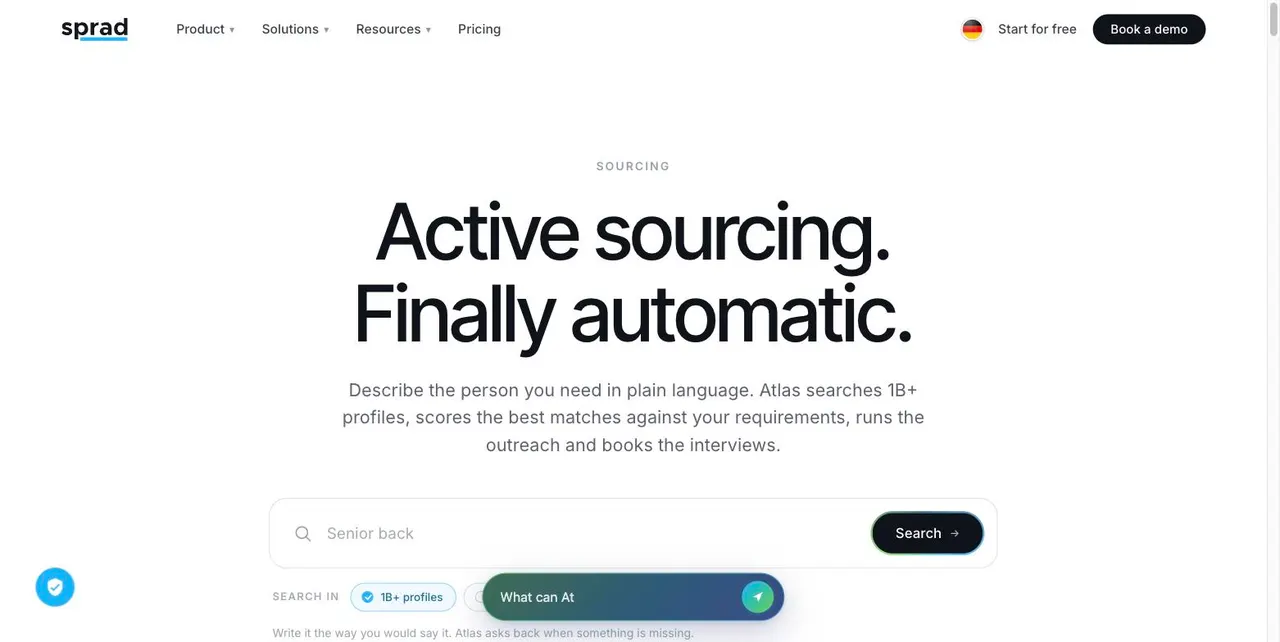
With the requirements search you describe in your own words whom you need (“support rep with insurance claims experience, evenings available”). Sprad checks public profiles and your own pool against those requirements instead of counting keywords, and the Talent Network keeps earlier applicants searchable for the next opening. Replies can get a voice pre-interview in one of 12 languages. More on CV screening and voice interviews.
Worked example (prices as of 29 October 2026, pricing): a “Normal” web search costs 100 credits and returns up to 50 checked profiles (2 credits per profile shown). Twenty voice interviews at 30 credits are 600 credits. Together 700 credits, about €63 at the Atlas Base price of €0.09 per credit, or about €70 at the list price of €0.10. You pay only for what runs.
Pay and legal points
- Pay: use the BLS median ($21.53 an hour, May 2025) as a reference and check your local market and your industry.
- Data: if you contact candidates in the EU, tell them how you process their data (Art. 14 GDPR).
- Shifts: BLS notes evenings, weekends and holidays are common and some centers run 24 hours; state this in the first message.
Frequently asked questions
How long does it take to hire a customer service representative?
It depends on the queue and the schedule. Referrals and your own pool are usually fastest because the candidates already know you. A job post alone waits for people who are searching.
Do you need experience?
Not necessarily. BLS lists a high school diploma and two to four weeks of training as typical. Experience matters more for billing, claims and technical queues.
What does a customer service representative earn?
The U.S. median was $44,770 a year in May 2025 (BLS). Your market and industry can differ.
Remote or on site?
BLS notes working from home is possible at some companies. Name it early, because it widens the pool but also the competition.
Jürgen Ulbrich
Jürgen Ulbrich has more than a decade of experience in developing and leading high-performing teams and companies. As an expert in employee referral programs as well as feedback and performance processes, Jürgen has helped over 100 organizations optimize their talent acquisition and development strategies.