To hire Python developers, first decide which Python job you have: backend and web, data engineering, machine learning or automation. Then search by libraries and tools (Django, FastAPI, Airflow, PyTorch) and judge candidates by tests, type hints and a project others use, not by "Python" on a CV. Python is one of the most-used languages: 57.9 % of all respondents in the Stack Overflow Developer Survey 2025 used it (54.8 % of professional developers).
Because so many people write some Python, the word alone filters nothing.
Which Python developer do you need?
| Python profile | Typical work | Stack signals | Titles (EN / DE) |
|---|---|---|---|
| Backend / web | APIs, services, internal tools | Django, Flask, FastAPI, PostgreSQL, pytest | Python developer, backend engineer / Python-Entwickler, Backend-Entwickler |
| Data engineering | Pipelines, warehouses, orchestration | pandas, Spark, Airflow, dbt, SQL | data engineer / Data Engineer |
| Machine learning | Models, training, evaluation, deployment | PyTorch, scikit-learn, MLOps | ML engineer / ML-Engineer |
| Automation and testing | Scripts, test frameworks, infrastructure glue | pytest, Selenium or Playwright, Ansible | automation engineer, SDET / Automatisierungsentwickler |
Write the profile type into the job before you search. A person who builds data pipelines and one who maintains an API are both "Python developers", yet the first often lives in notebooks and SQL, the second in services and tests. The same goes for active sourcing: first the profile, then the search.
How to read a Python profile
- Tests: a tests folder and CI in a public project signal maintained code.
- Type hints: annotated function signatures suggest a developer who works in teams on larger codebases.
- Packaging: a released package or a clean dependency file shows they have shipped something others install.
- Libraries over language: the named libraries tell you the area faster than the job title.
Where to find Python developers
| Channel | Why it works for Python | Catch |
|---|---|---|
| Referrals from your team | Peers judge code quality quickly | Small volume |
| Public code and package releases | You see tests, type hints and a project that others use | Data work is often private |
| Python and data communities (PyData, PyCon, EuroPython) | Self-selected and active; speakers are easy to find | Slow; one person at a time |
| LinkedIn and XING search by library | Reach across DACH | Titles mix data analysts, scientists and engineers |
| Your talent pool | Earlier applicants for similar roles | Needs upkeep |
Copy-paste search strings
- Backend (LinkedIn Boolean): ("python developer" OR "python entwickler" OR "backend engineer") AND (Django OR FastAPI OR Flask) AND (PostgreSQL OR Docker) NOT (intern OR praktikant OR werkstudent)
- Data engineering: ("data engineer" OR "python developer") AND (Airflow OR Spark OR dbt) AND (SQL OR BigQuery OR Snowflake)
- Machine learning: ("ml engineer" OR "machine learning engineer") AND (PyTorch OR TensorFlow OR scikit-learn) AND (MLOps OR deployment)
- Google X-Ray: site:linkedin.com/in ("python entwickler" OR "python developer") (FastAPI OR Django) (Berlin OR Wien OR Zürich) -recruiter -"talent acquisition"
How strings differ from a plain-language search: Boolean vs requirement search.
What to write in the first message
Hi [first name], we run [one concrete thing] on Python with [FastAPI or Airflow] at [company, location or remote]. I saw your [package, talk or repository]. The role pays [range], and you would work with [name], a [backend or data] engineer. If you want, I can send the two-page brief; if not, thanks for reading. [Your name]
Give the range early: Directive (EU) 2023/970 gives applicants the right to the starting pay or its range before the interview (Art. 5, transposition deadline 7 June 2026, EUR-Lex). More templates: recruiter outreach email templates.
Must-have and nice-to-have
| Must-have (examples) | Nice-to-have (examples) |
|---|---|
| Production Python in the area you hire for | A second area (for example data plus backend) |
| Automated tests and a dependency workflow | Type hints and static checking |
| SQL and one database | Cloud and container experience |
| Language level the team needs | Open-source or package maintenance |
Five pre-interview questions for Python
- Which Python project of yours runs in production today, and who uses it?
- How do you manage dependencies and environments, and what went wrong last time?
- How do you test code that talks to a database or an external API?
- Your service is slow: how do you find out whether it is CPU-bound or waiting on input and output, and what do you change?
- Do you use type hints, and what do they catch that tests do not?
What do Python developers earn?
For orientation: full-time IT specialists subject to social insurance in Germany earned a mean gross salary of 6,114 € per month in 2025 (Bundesagentur für Arbeit, Informatik; a mean across IT occupations, not Python-specific). We found no reliable official figure for Python developers alone. Pay differs strongly between web, data and ML work, so compare offers within the same profile type.
Legal points in short
Collecting data from public profiles triggers the information duty of Art. 14 GDPR (EUR-Lex), and unsolicited advertising by email needs consent under § 7 UWG (gesetze-im-internet.de); details in contacting candidates by email under GDPR.
How Sprad fits in
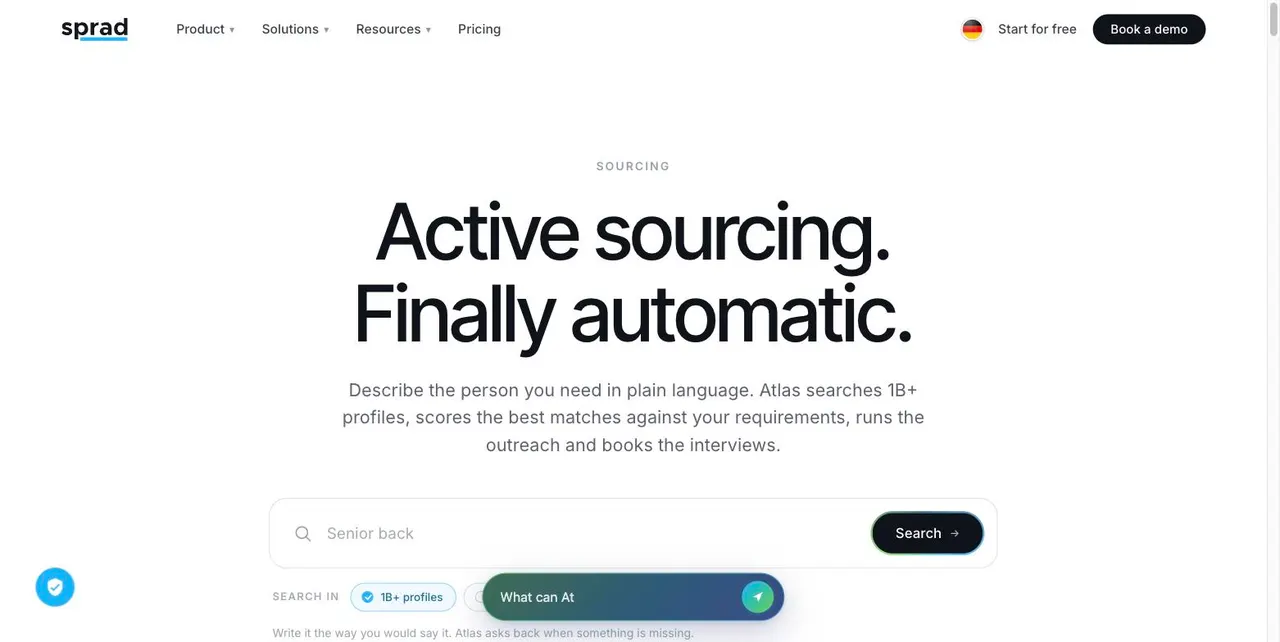
With Sprad's active sourcing tool you describe the profile in plain words, for example "Python backend developer, FastAPI, tests and CI, Vienna or remote", instead of translating it into strings. The AI checks every profile against your requirements and gives a reason per requirement, which helps to separate backend from data profiles. It searches LinkedIn, XING, GitHub and your own talent pool together. A CV check costs 2 credits, a voice pre-interview in 12 languages 30 credits. Recruiter Lite costs 79 € per seat and month, the free plan includes 100 credits a month, and a web search costs 2 credits per profile shown (pricing, as of November 2026). We are the vendor here; the steps above work without any tool.
Frequently asked questions
Python developer or data scientist?
A Python developer builds and maintains software; a data scientist analyses data and builds models, often in notebooks. Both use Python, so name the output you need (a running service or a model and its evaluation) and search by that.
Is Python popular?
It is among the most-used languages: 57.9 % of respondents in the Stack Overflow Developer Survey 2025 used it. A larger pool also means more beginners, so the filter has to be what the person has shipped.
Should I test Python candidates with a coding task?
Keep it short and close to the job: review a small piece of code, or extend a function and explain choices. A long take-home task costs strong candidates, who usually have other offers, more than it costs you.
Where do Python developers hang out?
In open-source projects, meetups and data communities. Contact through a specific piece of their work, not through a template.
Do I need a Python expert to interview?
For the first screen, no: the five questions above work for a non-specialist recruiter. For the technical round, bring in an engineer from the team.
Jürgen Ulbrich
Jürgen Ulbrich has more than a decade of experience in developing and leading high-performing teams and companies. As an expert in employee referral programs as well as feedback and performance processes, Jürgen has helped over 100 organizations optimize their talent acquisition and development strategies.