To hire UX designers, source them through their portfolios and judge case studies, not screenshots: you are looking for a clear problem, research, a decision and a measurable outcome. In the US, web and digital interface designers, the closest official category, earned a median of $104,000 in May 2025 (U.S. Bureau of Labor Statistics, page updated August 2026).
Designers show their work on personal sites, Dribbble, Behance and in design communities long before they show it on a CV. The wider BLS group of web developers and digital designers is projected to grow 5 % from 2025 to 2035.
Which designer do you need? Titles that mean different things
| Title | Mostly responsible for | Look for in the portfolio |
|---|---|---|
| UX designer | Flows, structure, usability of a product | Research summaries, flows, before/after with a result |
| UI / visual designer | Look, components, visual systems | Design systems, component libraries, craft |
| Product designer | UX and UI end to end, close to engineering and product | Shipped features, trade-offs, metrics |
| UX researcher | Interviews, tests, evidence | Method choice, sample, what changed afterwards |
| Interaction / service designer | Motion and behaviour, or whole service journeys | Prototypes, journey maps, cross-team work |
Pick the title that matches the work, then search for its neighbours too: many strong candidates call themselves "product designer" while doing what your job ad calls "UX designer". In active sourcing you search those neighbouring titles as well.
Where to find UX designers
| Channel | What you learn | Tip |
|---|---|---|
| Personal portfolio sites | The full story: process, context, outcome | Best signal. Find them through LinkedIn profiles and X-ray searches. |
| Dribbble and Behance | Visual craft, style, activity | Strong for UI and visual roles; polished shots can hide weak process. |
| LinkedIn and XING | Title, employer, tenure, reach | Best for reaching senior and passive designers. |
| Design communities, Slack and Discord groups, meetups | Who is respected by peers | Join as a person, not a bot; read the rules about job posts. |
| Degree shows and design schools | Junior talent with fresh portfolios | For junior roles; build the relationship before you need it. |
| Referrals from your own designers and product managers | Real ability, vouched for by peers | Design talent clusters socially; ask for names. |
Copy-and-paste search strings
Try each string in your own tool before you rely on it. Replace the bracketed parts. The difference from a plain-language search is explained in Boolean search vs. requirement search.
| Goal | String |
|---|---|
| LinkedIn Boolean, UX and product designers | ("UX designer" OR "product designer" OR "interaction designer" OR "UX/UI designer") AND ("user research" OR usability OR "design system" OR prototyp*) NOT (graphic OR intern OR "visual designer") |
| Google X-ray, public LinkedIn profiles | site:linkedin.com/in ("product designer" OR "UX designer") ("design system" OR "user research") "[city]" |
| Google X-ray, portfolios | ("case study" OR "selected work") ("UX designer" OR "product designer") "[city]" -jobs -hiring -template |
| Plain language, for an AI search | Senior product designer in [city or remote], 6+ years, has shipped features for a B2B SaaS product, strong research habits, owns a design system, portfolio with case studies |
A tip many sourcers use: leave tool names such as Figma or Sketch out of the search. Nearly every designer uses them, so they add noise instead of narrowing the list.
How to read a portfolio in ten minutes
| Question | Good sign | Red flag |
|---|---|---|
| Is the problem stated? | Who had which problem, why it mattered | Starts with finished screens |
| Is there evidence? | Interviews, tests, data, even small ones | "Users loved it" without a source |
| Are decisions explained? | Options considered, trade-offs, what was dropped | Only the final design |
| Is the role clear? | "I did X, the team did Y" | Team work presented as solo |
| Is there an outcome? | Metric, adoption, learning, or an honest "it failed because" | No result at all |
A small number of case studies is not a sign of low experience. Depth beats count, especially for designers whose best work sits behind an NDA.
Must-haves and nice-to-haves
- Must: the profile you chose above, at least two case studies with process and result, collaboration with engineering, a working language of the team.
- Nice to have: industry knowledge, a particular design tool, motion skills, front-end basics, research methods beyond interviews.
- Treat as a must only if true: accessibility (in the EU the European Accessibility Act applies to many consumer-facing digital services since 28 June 2025, see Directive (EU) 2019/882).
Outreach template
Hi [first name], I spent time on your case study about [project], especially how you [specific decision]. We are redesigning [product area] at [company] and face a similar problem: [one sentence]. The role is [title], [location/remote], [salary band]. Would a 20-minute call to walk through the problem be useful? If the timing is wrong, no problem at all.
Refer to one specific decision in their work. Designers can tell in two seconds whether you looked. More templates: recruiter outreach email templates.
Five questions for the first conversation
- Walk me through the project you are proudest of. What was your part?
- Which decision in it would you make differently today?
- How do you work with engineers when the design cannot be built as drawn?
- How do you know a design worked after launch?
- What kind of product problem do you not want to work on?
Prefer a live portfolio walk-through or a short, paid exercise over a long unpaid take-home; experienced designers often decline long assignments.
Freelancer or employee? A legal point that often catches teams
Many designers work freelance. In Germany, whether a freelancer is truly self-employed depends on the actual working relationship: instructions, integration into your organisation and entrepreneurial risk. If the relationship is unclear, the Clearingstelle of the Deutsche Rentenversicherung can issue a binding status decision under § 7a SGB IV. Ask your legal or HR team before the first assignment, not after.
Pay and market
US median pay for web and digital interface designers: $104,000, May 2025. The wider group of web developers and digital designers counts about 220,100 jobs, with 5 % projected growth to 2035 (BLS, above). For Germany, check the Bundesagentur für Arbeit's Entgeltatlas for the occupation aggregate that fits your role; portfolio-heavy roles differ widely by city and industry.
How to run this search with Sprad
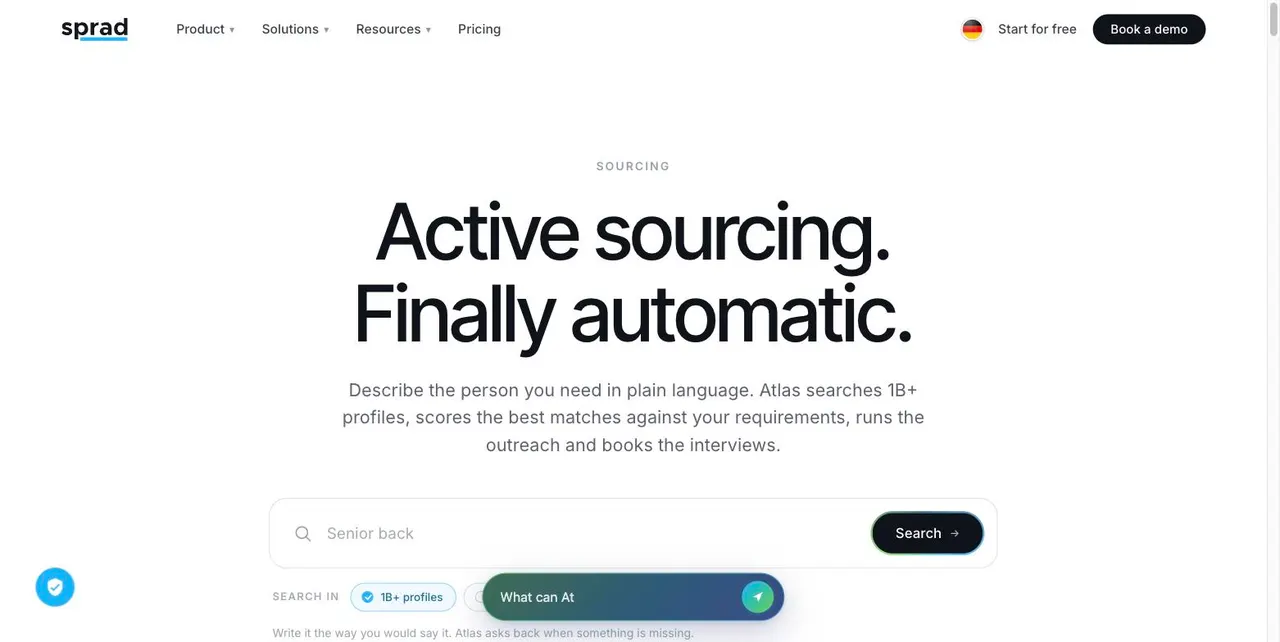
In Sprad Active Sourcing you describe the designer you need in plain words, including must-haves such as "has shipped B2B features" or "owns a design system". Atlas searches public profiles and your own pool and checks each profile against your criteria, with a reason per requirement. Outreach goes out via LinkedIn and email from one inbox, so nobody is contacted twice. Everyone you find can stay in your talent pool for the next opening.
A web search costs 2 credits per displayed profile within the budget you set per run; the free plan includes 100 credits per month, Recruiter Lite is €79 per seat and month (pricing, checked 9 November 2026). Atlas reads profile content and not the visuals of a portfolio, so the portfolio review above stays a human step.
FAQ
Where do I find junior UX designers?
Design schools, degree shows, bootcamps and junior communities. Ask for two case studies with process; juniors usually have fewer, so judge thinking over polish.
Should I ask designers to do a design test?
Prefer a live portfolio walk-through. If you use an exercise, keep it short, pay for it where it is long, and never reuse the result for your product.
What is the difference between UX and UI designers?
UX designers focus on flows, structure and usability; UI designers on visual design and components. Product designers do both. Decide which you need before searching.
Is a degree required?
The BLS lists a bachelor's degree as the typical entry requirement for the broader category, but requirements range widely, and for design, portfolios usually weigh more than diplomas.
Jürgen Ulbrich
Jürgen Ulbrich has more than a decade of experience in developing and leading high-performing teams and companies. As an expert in employee referral programs as well as feedback and performance processes, Jürgen has helped over 100 organizations optimize their talent acquisition and development strategies.