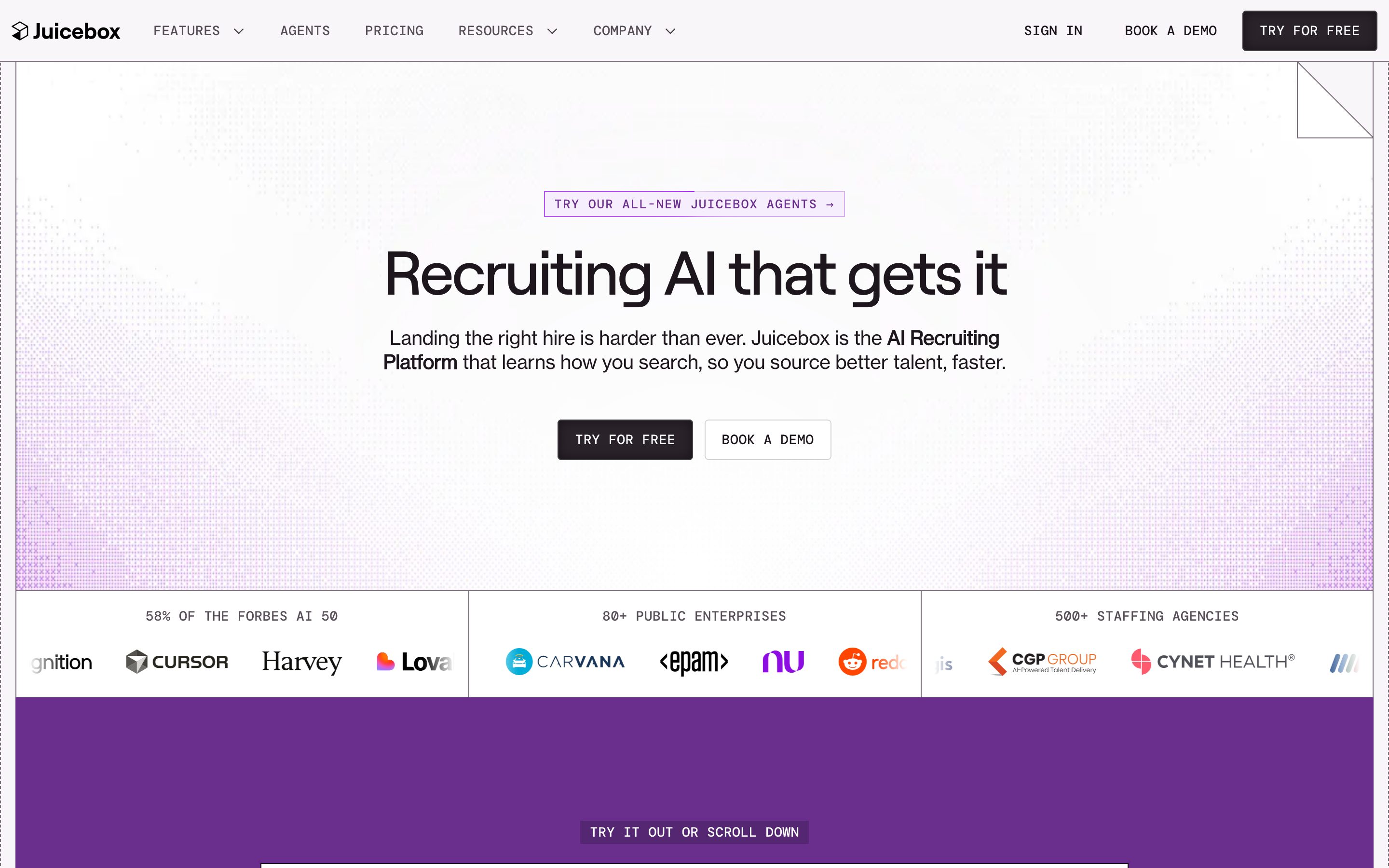
Juicebox AI (juicebox.ai) is a sourcing tool for recruiters whose search engine is called PeopleGPT: you describe the person you want in plain language and it searches a profile index of 800M+ people. Independent reviews are mostly positive about the search itself, but the review base is small (under 50 on G2, as of October 2026) and the recurring complaint is cost: credits and the per-agent add-on push a team of three well past the entry price. Juicebox is not the EV charger of the same name, nor an unrelated data-visualization tool listed under "Juicebox" on Capterra.
Juicebox on G2, Capterra and Product Hunt: what the numbers actually show
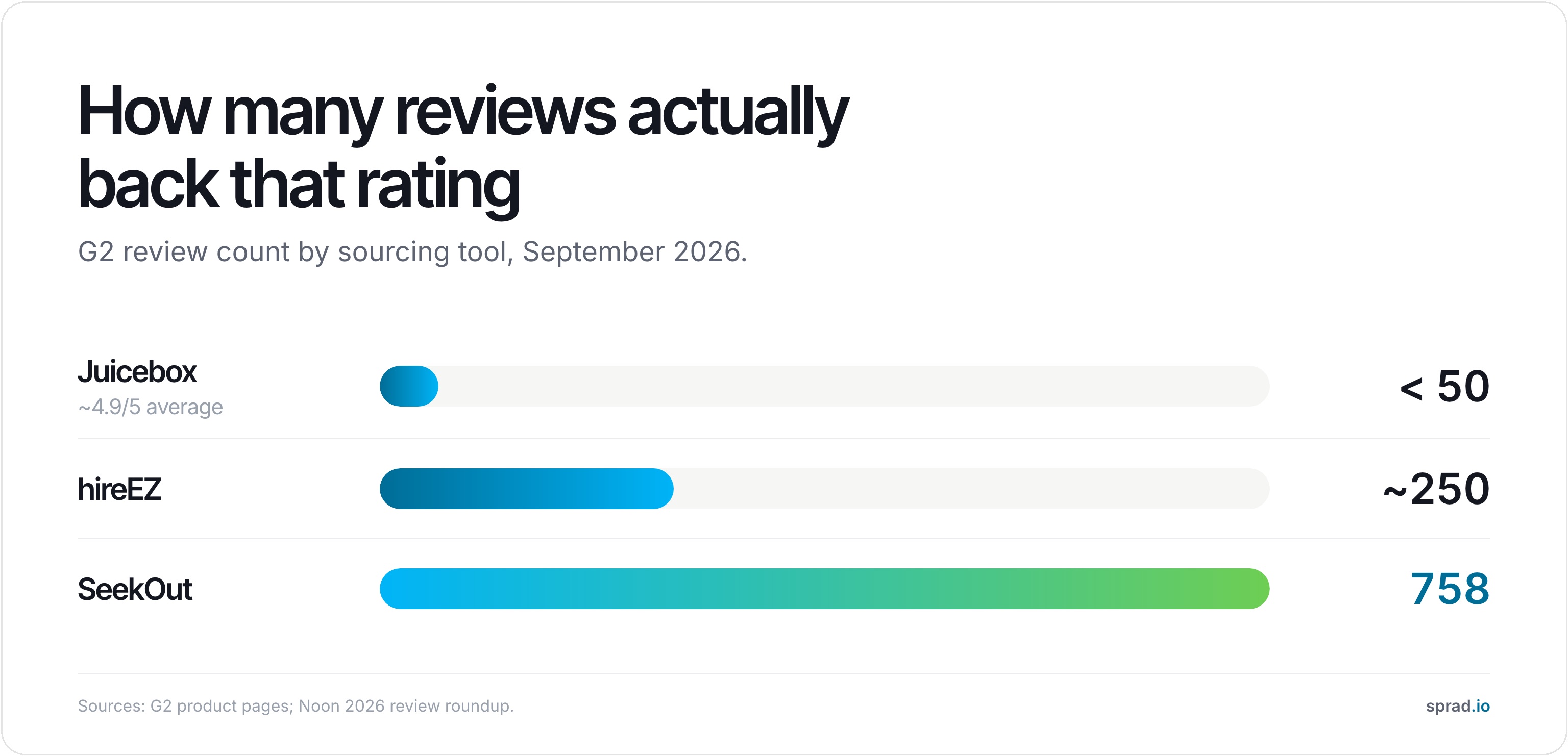
Juicebox's review footprint is small and spread across several sites rather than concentrated in one place — worth knowing before you weight any single score too heavily. According to Noon's 2026 review roundup, Juicebox scores around 4.9/5 on G2, but on a review base "substantially smaller" than sourcing peers like SeekOut (758 G2 reviews) or hireEZ (roughly 250). SelectSoftwareReviews rates it 4.4/5 from 15 independent reviews, and on Product Hunt it sits at 3.5/5 from just 2 reviews — one enthusiastic about the concept, one openly disappointed that a feature promised in the sales demo wasn't included in the paid plan they bought. We could not find a dedicated Capterra listing for the recruiting tool as of September 2026.
| Platform | Rating | Review count | Checked |
|---|---|---|---|
| G2 | ~4.9/5 | Under 50 | Sep 2026 |
| SelectSoftwareReviews | 4.4/5 | 15 | Sep 2026 |
| Product Hunt | 3.5/5 | 2 | Sep 2026 |
| Capterra | No dedicated listing found | — | Sep 2026 |
A handful of reviews isn't a red flag by itself — Juicebox is a relatively young product — but it does mean each individual review carries more weight than it would for a category leader with hundreds of ratings. Read the specifics, not just the star average.
What agencies say they like about Juicebox
- Natural-language search over Boolean strings. The most consistent praise across every source: recruiters describe typing a plain-English requirement instead of building a Boolean query, which Noon and G2 reviewers both single out as the platform's core win.
- Match evidence on candidate cards. Reviewers cited by Noon say seeing the reasoning behind a match "builds trust in results" — you're not just told a candidate fits, you see why.
- Autopilot scoring and "find similar" search. SelectSoftwareReviews highlights the autopilot evaluator that ranks candidates against custom criteria automatically, plus a "find similar profiles" tool for fast pipeline expansion from one strong example.
- Transparent, SMB-friendly pricing at the entry tier. At $99/month annually for the Starter plan, reviewers describe the price as fair for a solo recruiter or small team, well under LinkedIn Recruiter Lite or an enterprise sourcing seat.
- Fast setup. Multiple reviews describe being productive within an hour of signing up, with no lengthy onboarding or sales-led implementation required.
What agencies say they don't like
- Costs stack fast past the entry tier. Noon's review is blunt about it: "costs stack: per seat, then per agent, then Business for unlimited credits." The autonomous Agents add-on alone is $199 per agent per month — two agents on top of Starter takes the bill from $99 to roughly $497/month.
- Credit caps limit real usage. Contact and export credits are capped even on paid tiers, which Noon notes "caps effective volume on every self-serve tier" for teams doing high-volume outreach.
- Small review base means less third-party validation. With well under 50 G2 reviews against hireEZ's roughly 250 and SeekOut's 758, there's simply less independent evidence of how Juicebox performs at scale or over time.
- Sourcing-only, not a full recruiting workflow. SelectSoftwareReviews is explicit that Juicebox has no native applicant tracking system — it's built for sourcing and outreach, and agencies still need a separate ATS for the rest of the pipeline.
- Demo promises don't always match the paid product. The one detailed negative review on Product Hunt describes a feature (ATS integration) shown in the sales demo that wasn't part of the plan they actually purchased, leaving the reviewer to warn others to "do your research before committing."
What Juicebox really costs: a worked example
List prices differ slightly between sources and billing modes (annual vs. monthly), so treat the figures as an orientation. According to a MakerStack review of July 2026, Starter is about $99 per seat and month (500 contact and 500 export credits), Growth $179 per seat (1,500 credits, up to 5 seats), Business is custom, and the autonomous Agents add-on is $199 per agent and month. The same review reports that heavy users end up at roughly $300–400 per month for a single recruiter. Check the vendor's pricing page before you buy; we have not negotiated any contract.
| Scenario (per month) | Juicebox (list prices, as of Oct 2026) | Sprad (list prices, as of Oct 2026) |
|---|---|---|
| 1 recruiter, light use | Starter: ~$99 | Free start with 100 credits, or Recruiter Lite 79 € |
| 3 recruiters, 2 agents | 3 × Growth $179 + 2 × $199 = ~$935 | 3 × Recruiter Lite = 237 € (outreach agent as add-on) or 3 × Atlas Recruiter = 897 € incl. one LinkedIn and mailbox agent per seat |
| 5 recruiters, 2 agents | 5 × Growth $179 + 2 × $199 = ~$1,293 | 5 × Recruiter Lite = 395 € or 5 × Atlas Recruiter = 1,495 € |
Assumptions: every recruiter sources weekly, agents are needed by two people, no negotiated discount, USD and EUR not converted. Where Juicebox is cheaper: a single occasional user on Starter. Where Sprad Atlas Recruiter is more expensive per seat: you pay 299 € for unlimited (fair use) searches, all search depths, 10 deep-context searches and a built-in outreach agent, so it only pays off for people who source daily.
How to evaluate Juicebox in 5 steps (checklist)
- Run your hardest real search, not the demo search. Take an open role with an awkward profile (rare skill, DACH location, German-language CV) and check how many of the first 15 results you would actually contact.
- Test for real AI checking. If results appear instantly, it is almost always a (semantic) keyword search. Profile-by-profile checking takes longer but finds people with poorly maintained profiles. Ask the vendor how each result is checked.
- Count credits, not seats. Estimate contacts and exports per recruiter per month and compare with the credit cap of the plan, then add agents.
- Get every demo feature in writing for the plan you buy. One reviewer reported an ATS integration shown in the demo that was not part of the purchased plan.
- Clarify GDPR and AI Act duties before the first outreach (next section).
Typical mistakes we see: choosing by star rating alone (under 50 reviews), forgetting that a sourcing tool needs an ATS next to it, and sending to profiles without informing the person.
Is Juicebox usable for recruiting in the EU? What to check
Any sourcing tool processes personal data of people who did not apply. Under GDPR Article 14 you must inform a person about the processing at the latest within one month after obtaining the data, or at the first contact, whichever is earlier. The usual legal basis is legitimate interest (Article 6(1)(f)) with a documented balancing test. In addition, AI systems used to filter or evaluate candidates are listed as high-risk in Annex III of the EU AI Act; whether a pure search tool falls under it depends on how much it ranks and filters, so ask the vendor for its position and check the current application dates with your data protection officer. This is orientation, not legal advice. For DACH teams the practical test is: where is the data hosted, is there a data processing agreement, and can a candidate be deleted on request?
How Juicebox compares with LinkedIn Recruiter
LinkedIn Recruiter Lite searches only LinkedIn's own network, has no natural-language search and caps InMails at 30 per month, but it reaches the network most candidates are active on. Juicebox searches an aggregated index beyond LinkedIn and adds email outreach. In DACH, XING is a gap in many US tools; Sprad searches LinkedIn, XING, GitHub and your own pool together. Details: LinkedIn Recruiter vs. Juicebox.
Who Juicebox fits — and who it doesn't
Juicebox is a good match for a solo recruiter or a small agency of one to three people who find Boolean search more of a hassle than a skill, want a fast, self-serve setup, and mainly need to source and reach out — with an ATS handled elsewhere. It's also a reasonable fit for teams that want to try natural-language sourcing without committing to an enterprise contract first.
It's a weaker fit for agencies past roughly five recruiters who need one workspace for sourcing, screening and pipeline management, since there's no native ATS to grow into. It's also not the right choice for teams running heavy outreach volume, since credit caps and the per-agent add-on pricing make cost hard to predict as usage climbs — and, per the reviews above, worth double-checking any feature promised in a sales call actually ships in the plan you're buying.
Cheaper and broader alternatives to Juicebox
Sprad: sourcing, screening and an ATS in one place
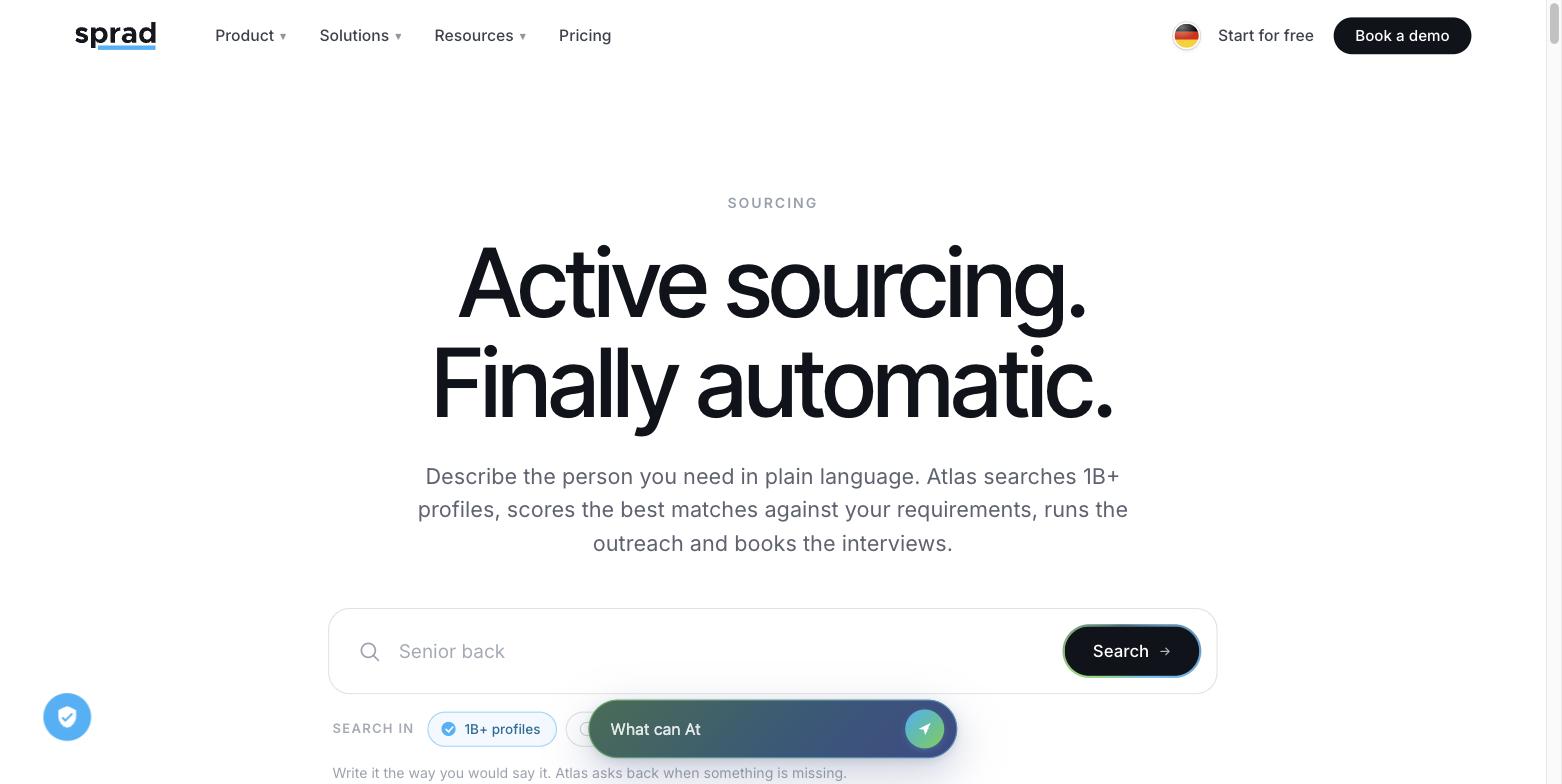
Sprad starts free (100 credits a month); a web search costs 2 credits per profile shown, within a budget of 50, 100 or 300 credits per run, and a voice interview costs 30 credits. For regular sourcing there are flat seats: Recruiter Lite at 79 € per seat and month, Atlas Recruiter at 299 €, which includes the outreach agent for one LinkedIn and mailbox account. In the Recruiting category of the public PeopleSearchBench, Sprad's requirement search (Atlas) comes to 73.5 out of 100 in our own re-measurement, converted to the published scale (Lessie 68.2, Juicebox 65.7 as published). PeopleSearchBench (Recruiting), published by Lessie, October 2026; other systems’ scores as published in the benchmark, Atlas is our own re-measurement with the benchmark’s open test procedure, converted to the published scale; not an official entry; an own test by Sprad on 15 August 2026 had already pointed the same way.
The search itself works differently: an AI checks every single profile against your requirements and explains each result per criterion, and it can search LinkedIn, XING, GitHub and your own pool in one go. Outreach runs on LinkedIn (including InMail) and email, automated with follow-ups and AI templates, in one inbox per candidate. Where Juicebox and Sprad genuinely differ: Juicebox has no built-in candidate screening or interviewing, while Sprad adds voice and video interview screening in 12 languages on top of the same search. Sprad's deep search takes a few minutes (quick search about 3 seconds), and it has no AI call notetaker or placement reporting yet.
How to tell real AI search from keyword search: if results appear instantly, it is almost always a (semantic) keyword search. Real profile-by-profile checking takes longer, and it is what finds people with poorly maintained profiles or without the “right” keywords. For the full field of options, see our Juicebox alternatives roundup; for a detailed cost comparison, see Juicebox pricing, explained.
hireEZ and LinkedIn Recruiter Lite: two more options worth knowing
hireEZ starts at $169/month for a solo seat — more expensive than Juicebox's Starter tier — but brings a deeper, GitHub-heavy data source that 250+ G2 reviews rate 4.6/5, particularly strong for technical and engineering roles. The trade-off reviewers flag most: pricing often triples at renewal without much advance notice, and the interface has a steeper learning curve than Juicebox's plain-language search. LinkedIn Recruiter Lite runs $140/month billed annually and searches only LinkedIn's own network — no external database, and a hard cap of 30 InMails a month — but it's the one option here with true global reach into a network most candidates are already on. See our LinkedIn Recruiter vs. Juicebox comparison for the detailed breakdown.
FAQ
Is Juicebox AI worth it for a small recruiting agency?
For a solo recruiter or a team of two or three who mainly need natural-language sourcing and outreach, yes: reviewers consistently rate the core search highly. It gets weaker once you need a full pipeline workflow or heavy outreach volume, because credit caps and agent add-ons raise the bill quickly.
What is Juicebox PeopleGPT?
PeopleGPT is the natural-language search inside Juicebox. You type a requirement such as "senior backend engineer in Munich with fintech experience" and get a ranked list with match reasons instead of building a Boolean string.
How much does Juicebox cost?
There is a free plan, Starter at about $99 per seat and month, Growth at about $179, custom Business pricing and $199 per agent and month for the Agents add-on (MakerStack, July 2026; vendor pricing page governs). See the worked example above.
How many reviews does Juicebox have on G2?
Fewer than 50 as of October 2026, with a score between 4.8 and 4.9 out of 5. Compared with hireEZ (roughly 250) or SeekOut (758), each review carries more weight.
What do users complain about most?
Cost stacking: seat, then agents, then a Business plan for unlimited credits. Contact and export credits are capped even on paid tiers.
Does Juicebox include an ATS?
No. It is a sourcing and outreach tool; you need a separate applicant tracking system, or a tool like Sprad that includes one.
Is Juicebox GDPR-compliant?
The tool alone does not make your sourcing compliant. You remain responsible for the legal basis, the Article 14 information duty and a data processing agreement. Ask the vendor for hosting location, DPA and deletion process.
Is Juicebox the same as the EV charger brand?
No. This review covers Juicebox.ai's PeopleGPT, an AI sourcing platform.
What is a good alternative to Juicebox?
Sprad covers the same requirement-based search, adds XING, an own talent pool, LinkedIn plus email in one inbox, voice screening and an ATS, and starts free. Compare directly in our Juicebox alternatives roundup and Juicebox pricing explained.
The bottom line
Juicebox earns its praise for making sourcing feel like describing a person instead of writing code, but the review base is small and the cost beyond a single seat is the point every source agrees on. Sprad answers both: one workspace for sourcing, screening and your own talent pool, with an AI check per profile, outreach on LinkedIn and email in one inbox, and a free start (100 credits a month) or flat seats from 79 € per month. Sprad's limits: no AI call notetaker and no placement reporting yet, and deep search takes a few minutes. See what it looks like for your agency at sprad.io/industry/recruitment-agencies.
Jürgen Ulbrich
Jürgen Ulbrich has more than a decade of experience in developing and leading high-performing teams and companies. As an expert in employee referral programs as well as feedback and performance processes, Jürgen has helped over 100 organizations optimize their talent acquisition and development strategies.