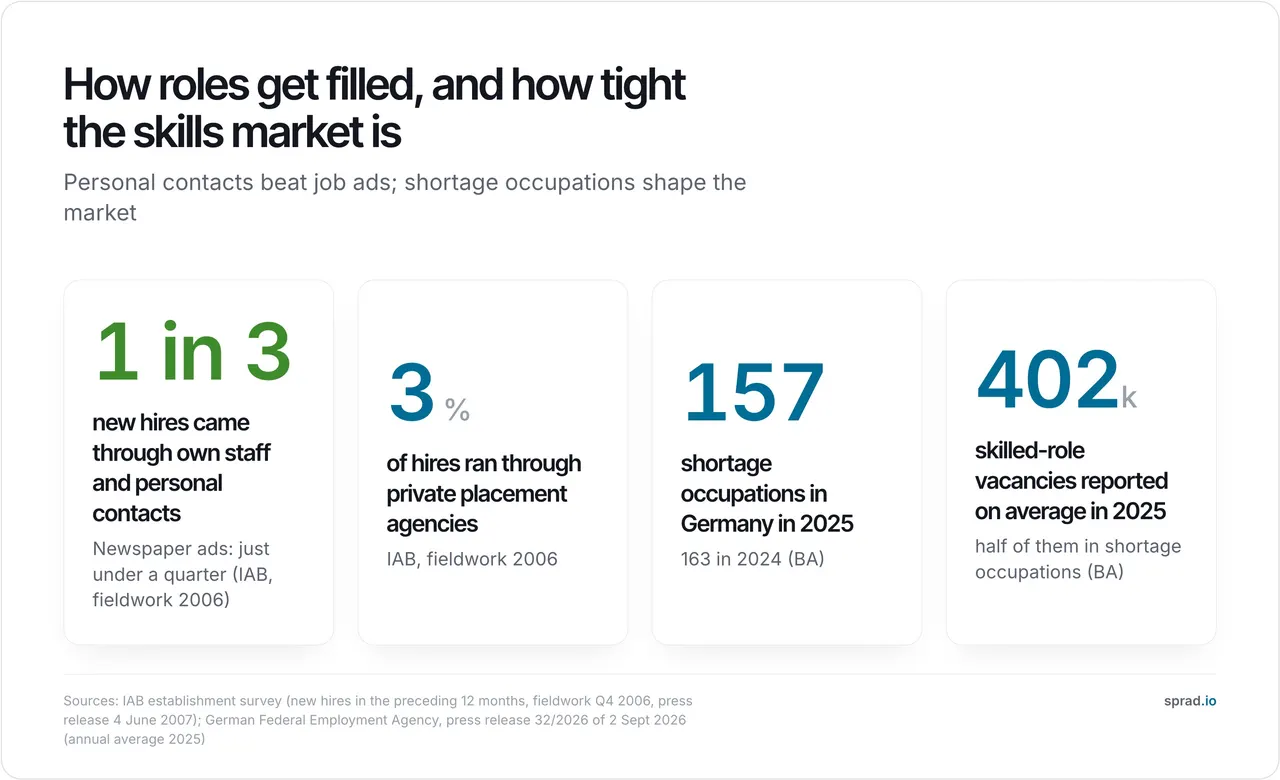
You can find employees without a job ad by approaching suitable people directly (active sourcing) and using your own networks: employee referrals, former staff, a maintained talent pool and industry contacts. In the IAB establishment survey (German employers, fieldwork 2006), about one in three new hires came through own staff and personal contacts, just under one in four through newspaper ads. In practice: sharpen the requirements, find and check profiles, write once personally with a concrete reason to move, follow up twice. In Germany and the EU this is lawful if you meet the information duty under Art. 14 GDPR (as of 30 October 2026).
What does hiring without a job ad actually mean?
It means filling a role without advertising it publicly. The reasons are practical: a succession is confidential, the role is not approved yet, an always-on ad burns budget, or the person you want never visits job boards. An ad reaches only those who are looking. Someone who is happily employed but would talk for the right offer never sees it. This part of the market is often called the hidden job market.
The IAB, the research arm of Germany's Federal Employment Agency, finds that employers see personal contacts as the most promising strategy, especially small firms (IAB short report 26/2011). The numbers from the 2006 survey are old, but give the order of magnitude: about a third of hires through own staff and personal contacts, just under a quarter through newspaper ads, more than one in ten through speculative applications, three percent through private placement. We found no newer breakdown on the same basis, so treat these as an anchor, not a current rate.
Scarcity adds pressure: the Federal Employment Agency counted 157 shortage occupations in 2025 (163 in 2024) and about 402,000 reported vacancies for skilled roles on average, half of them in shortage occupations (press release 32/2026, 2 Sept 2026). Where few people serve many openings, the one who approaches first and personally wins. For the case-by-case choice, see job ad or active sourcing.
Which ways are there to find employees without job ads?
Seven approaches have proven themselves. No single one fits every role; the combination makes the difference.
| Approach | Fits when | Effort | Limit |
|---|---|---|---|
| Direct outreach (active sourcing) | shortage roles, specialists and leaders | medium, recurring | needs search, outreach routine and a clean legal basis |
| Employee referrals | staff with a good network and trust in the company | low once set up | networks look alike; rewards and tax rules (referral program guide) |
| Former employees | roles where company knowledge counts | low | only people who left on good terms; contact must be kept alive |
| Own talent pool | recurring demand, earlier runners-up | ongoing upkeep | goes stale without updates; retention limits (talent pool and GDPR) |
| Networks, events, universities | niche roles, early careers | high, time-heavy | slow, hard to scale |
| Careers page with speculative applications | known brand with reach | low | works only with visibility |
| Recruitment agencies, headhunters | leadership roles, little in-house capacity | fee per placement | cost, dependency (costs and alternatives) |
For most teams direct outreach has the most room to grow, because you can start it at once and independently of staff networks. Start with active sourcing for small businesses if you have no recruiting department.
How do I go about it, step by step?
- Define requirements and the reason to move. Three must-haves, two nice-to-haves and, above all: why would someone move? Scope, responsibility, team, location, working model, pay range. “Exciting tasks” does not count.
- Choose sources. LinkedIn and XING (often decisive in Germany, Austria and Switzerland), GitHub for developers, your own pool, your staff's networks and industry bodies.
- Find and check profiles. Do not write to the first 100; write to the best 30 to 50. Check each profile against the must-haves, even where keywords are missing.
- Write once, personally. Short, specific to the person, with a concrete reason and an easy way to answer (template below).
- Follow up twice. Our recommendation: after about a week with a new argument, then a polite close. Whoever declines is not contacted again.
- Pre-qualify briefly. A 15-minute call or a chat or voice interview clarifies motivation, pay and timing before hiring managers invest time.
- Maintain the pool. Good fits who cannot move now go into the pool with a note and are approached again for the next role.
Template: first message to a specialist
Hello [name], your path from [field] to leading [team] at [company] fits a role we are filling in [place]: ownership of [task], a team of [n] and a working model with [remote/hybrid rule]. If a move is not on your mind, one word is enough and I will not write again. How we handle your data is explained here: [link]. Kind regards, [name, head of department]
Three things make it work: a reference you can only write by looking at the profile, a concrete reason, and an easy exit. The privacy notice is a duty, not decoration (see below).
Which tools and templates help?
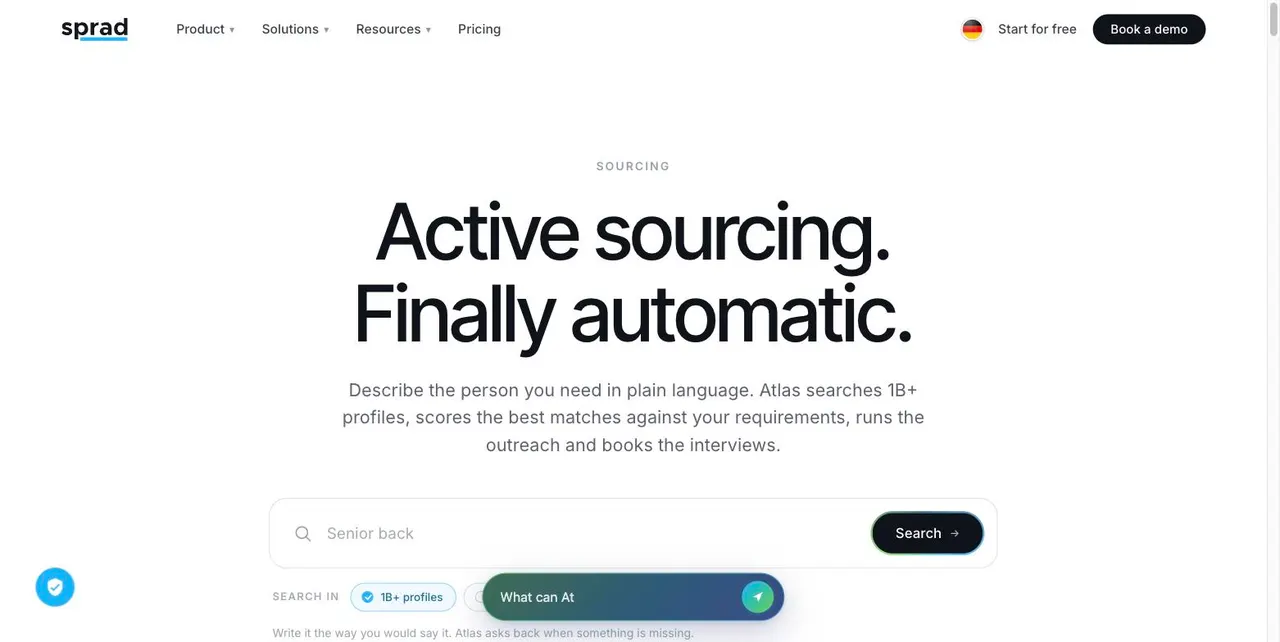
Searching LinkedIn and XING by hand works but costs time: two networks, hand-written messages, status in spreadsheets. A sourcing tool takes over exactly these parts. Sprad searches LinkedIn, XING, GitHub and your own talent pool in one search (over 1 billion profiles in total) and works with requirements instead of keywords: you describe whom you want, and the AI checks every profile individually against those requirements, including poorly maintained profiles. It also handles context that keywords cannot, such as someone who guided an acquisition or took a start-up through Series A.
For outreach the combination is decisive: LinkedIn and email, automated including follow-ups, plus InMails directly from the tool or inside a sequence. Our practical recommendation: this combination usually brings the highest reply rates, because you reach the same person on the channel they are reading. Templates are trainable, there are ready-made ones and a pitch format where you store the selling points of the role and get matching messages suggested. Everything lands in one inbox per person, and the system warns if someone was already contacted, even for another role or by a colleague. Without that, the most common team-sourcing mishap happens: double outreach.
| Task | Manual (LinkedIn and XING separately) | With Sprad |
|---|---|---|
| Search | two networks, keywords, filters | one search across LinkedIn, XING, GitHub and own pool, requirements instead of keywords |
| Checking | read profiles one by one | AI checks every profile against your requirements, reasoning per requirement |
| Outreach | hand-written messages, remember follow-ups | LinkedIn and email automated, follow-ups, AI templates, InMails |
| Status | spreadsheets, inbox and network apart | one inbox per person, warning on double outreach |
| Pre-qualification | phone slots | voice, video, chat and agent pre-qualification, multilingual |
| Data after cancelling | contacts lost | talent network stays free to use, raw data export |
To be fair: the deep search takes a few minutes because far more AI runs per profile; Quick Search returns first results in about three seconds. Sprad does not offer an AI note-taker for calls or placement reporting today.
What does it cost? A worked example
Assumptions (not measurements, replace with your numbers): you fill one specialist role, run one web search at the “Normal” level and look up the business email for 40 profiles. According to the pricing page (as of 30 Oct 2026), the Normal search costs 100 credits for up to 50 qualified profiles (2 credits per profile shown), “find email” costs 1 credit per hit.
- Credits: 100 + 40 = 140 credits
- On Atlas Base (€450 a year incl. 5,000 credits, €0.09 per credit): €12.60
- At list price (€0.10 per credit): €14.00
- Free account: 100 credits a month, 200 in the first month; the search fits almost entirely
Set that against your time: 40 messages at five minutes each is over three hours; AI templates and automation cut it sharply. Assume a 20% reply rate and half of those interested, and you get four conversations from one run. How many lead to a hire depends on pay, brand and role. At this pattern the tool cost is not the factor; your time and your offer are.
If you source often, a flat rate fits: Recruiter Lite costs €79 per seat and month (billed annually, about $95), Atlas Recruiter €299. As a rough guide the flat rate pays off from about six such runs a month (€79 divided by €12.60). Contact data still run on credits with Recruiter Lite. Against separate recruiter licences for LinkedIn and XING, costs are 30 to 80% lower by our calculation, depending on which licences you hold today. All prices net of VAT.
What are the legal points?
In short: direct outreach is permitted in Germany if you keep it short, inform people and respect a no. This is not legal advice.
- Data protection: The legal basis is usually legitimate interest under Art. 6(1)(f) GDPR. Since you do not collect the data from the person, Art. 14 applies: inform them at the first contact, within one month at the latest, about purpose, source and rights. That is why the template carries a link. The UK GDPR works similarly; in the US, privacy duties depend on the state (for example California), so check with counsel.
- Phone calls at work (Germany): The Federal Court of Justice ruled in 2004 (I ZR 221/01) that a short first-contact call is lawful; anyone who keeps working on the person at the workplace acts unfairly, as the court confirmed in 2007 (I ZR 183/04).
- Email: For advertising by email, section 7(2) of the German Unfair Competition Act generally requires prior express consent. Whether a job approach counts as advertising is not settled; have your counsel or data protection officer review the approach and use a message in the career network first where possible. In the US, commercial email rules such as CAN-SPAM require a clear sender and an opt-out.
- EU AI Act: AI systems for selecting people are high-risk under Annex III of Regulation (EU) 2024/1689. Humans still decide; the AI prepares. Check the status of the application dates before deployment.
More: active sourcing and GDPR.
What does AI change?
Classic searches work with keywords: if the term is not on the profile, the person drops out even if they fit perfectly. A rule of thumb: if results appear instantly, it is almost always a keyword search, even with “AI” on the label. Atlas checks every profile individually against your requirements, with context.
In the Recruiting area of the open PeopleSearchBench, Atlas reaches 73.5 out of 100 in our own re-measurement, converted to the published scale, with 14.2 of 15 profiles matching on average. PeopleSearchBench (Recruiting), published by Lessie, October 2026. Other systems' scores as published in the benchmark; Atlas is our own re-measurement with the benchmark's open test procedure, converted to the published scale; not an official entry. More in Boolean versus requirement search.
Which mistakes should I avoid?
- Pasting the job ad into a message. A person reading an ad is in search mode; a person receiving a message is not. Write a reference and a reason.
- Giving no reason to move. Without an answer to “why should I?” the message goes unread.
- Double outreach. Two colleagues write to the same person, each on a channel. It looks unprofessional. One shared status prevents it.
- Never following up. Many replies come only to the second or third message.
- LinkedIn only. In German-speaking markets many specialists sit on XING or in networks without a profile; without a source mix part of the market is missing.
- Volume over fit. 300 careless messages hurt the employer brand more than 40 good ones.
- Letting the pool rot. Old data without upkeep and deletion limits is both a GDPR and a quality problem.
Frequently asked questions
How long does it take to find employees without a job ad?
Expect weeks to months, depending on the role and notice period. Direct outreach shortens finding the person, not the notice period.
Does this work for trades and shift work?
To a degree. For hands-on roles, referrals, social recruiting and local networks are often stronger than LinkedIn. Direct outreach pays off mainly for specialist, expert and leadership roles.
Do I still need a careers page?
Yes. Whoever is approached checks you out first. A clear careers page with a pay range and the team supports every approach.
Is a recruitment agency worth it instead?
For leadership roles and little capacity often yes; for recurring demand for specialists usually not, where your own process with the right tool pays back.
Does AI help with hiring without ads?
Yes, for search, pre-checking and drafting messages. Humans decide, and data protection and the AI Act still apply.
To try it on a real role: start free with Sprad (100 credits a month, 200 in the first month). With Sprad your talent pool stays with you even if you cancel a network subscription; requirement search across over 1 billion profiles, outreach over LinkedIn and email, and pre-qualification sit in one tool.
Jürgen Ulbrich
Jürgen Ulbrich has more than a decade of experience in developing and leading high-performing teams and companies. As an expert in employee referral programs as well as feedback and performance processes, Jürgen has helped over 100 organizations optimize their talent acquisition and development strategies.