Plumbing, heating and air-conditioning technicians (Anlagenmechaniker SHK, the German job title for the trade) earn a median of €3,884 gross per month in Germany working full-time, with the middle 50 % between €3,303 and €4,500 (German Federal Employment Agency, Entgeltatlas, 2025 evaluation). Under collective agreements, wages in the trade rise by roughly 2.5 to 2.95 % in 2026 depending on the region, and North Rhine-Westphalia adds another 2.55 % in March 2027. Where you land depends on collective agreement, company size, region and experience.
How much does an SHK technician earn in Germany?
The most reliable figure comes from the Entgeltatlas of the German Federal Employment Agency. It evaluates reports for full-time employees subject to social insurance and gives the median: half earn more, half earn less. The chart also shows the quartiles, the limits below and above which a quarter of people sit.
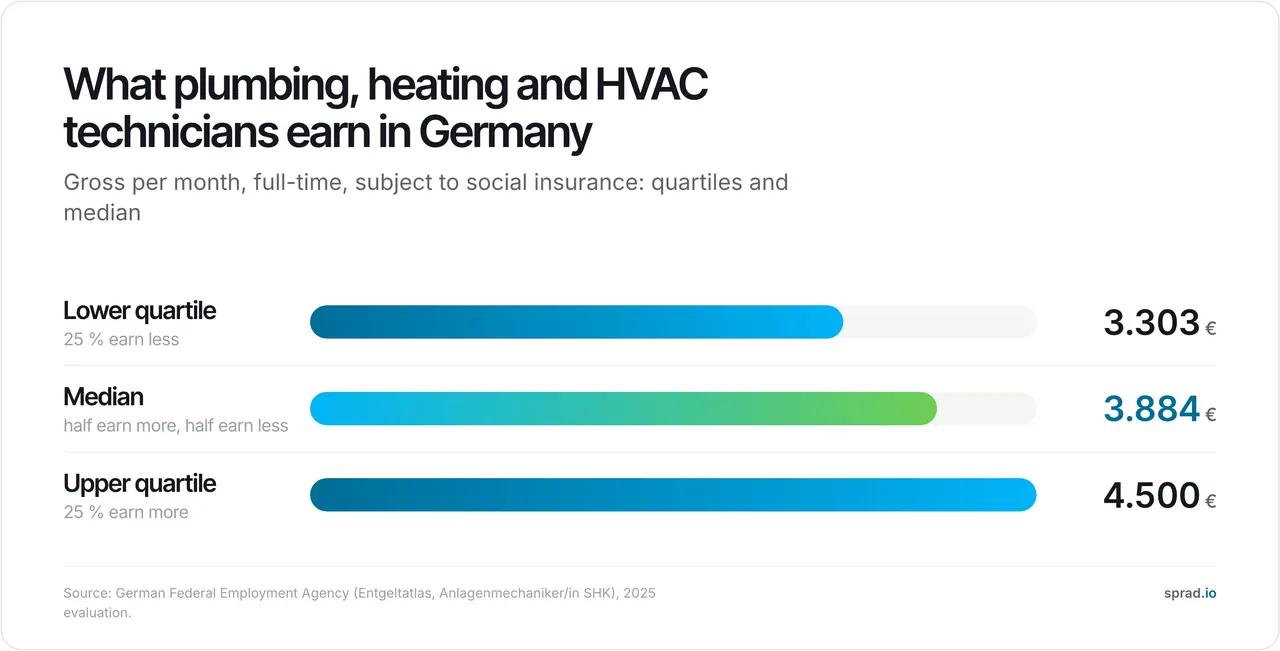
Three points help when reading it. First, the median covers full-time jobs only; part-time, mini-jobs and the self-employed are missing. Second, the gap between lower and upper quartile is €1,197 a month (about 36 %): two technicians can differ by several hundred euros without either being underpaid. Third, €3,884 a month is about €46,608 a year (12 × €3,884, before bonuses; a calculation, not a statistic). At 40 hours a week the median works out at roughly €22.41 per hour (€3,884 ÷ 173.3 hours), at 38 hours about €23.59.
Why do salary sites quote such different numbers?
Open a few portals and you find anything from about €2,700 (entry-level figures) to over €4,000 (experienced specialists). The portal gehalt.de, for example, shows a German median of about €3,655 at 40 hours a week, and by company size a range from roughly €3,850 in small to roughly €4,800 in very large firms. That is not a contradiction. It comes down to the data basis (reported pay against user input and job ads), the method (median against average, full-time against all hours) and the date, because collective wages rise every year. Check the year, the weekly hours and the source behind every number.
Anlagenmechaniker, Heizungsbauer, Installateur, Monteur: is there a difference?
Hardly in pay. “Anlagenmechaniker für Sanitär-, Heizungs- und Klimatechnik” is the official apprenticeship (three and a half years); in daily speech the same people are called heating engineers, installers, plumbers or SHK fitters. The title in a job ad says little. What counts is the activity written in your contract and the pay group you are placed in: someone who commissions heat pumps or runs customer service independently often belongs in a higher group than a fitter doing rough installation.
What do you earn as a newcomer and as an apprentice?
The most reliable entry figure is the collective agreement for your region. In the SHK trade the union IG Metall negotiates with the trade associations region by region, so there is no nationwide standard wage. The latest settlements at a glance:
| Region | Raise | Other points | Term |
|---|---|---|---|
| North Rhine-Westphalia | +2.95 % from 1 Mar 2026, +2.55 % from 1 Mar 2027 | Capital-forming benefits +about 50 % (from 2027 €40, apprentices €20), travel allowance +10 % | 24 months |
| Lower Saxony | +2.5 % from 1 Jan 2026, +2.9 % from 1 Oct 2026 | €250 one-off, standby pay €1.92 → €5.80 per hour | until 30 Sep 2027 |
| Hesse | +2.9 % from 1 Jan 2026 | Apprentices also +2.9 % | until 31 Dec 2026 |
Sources: IG Metall, SHK trade settlements NRW 2026, Lower Saxony 2025 and Hesse 2025 (retrieved 30 October 2026).
What the table cannot show: the percentages apply to the pay tables of your region, which you find at IG Metall or your guild. A collective agreement applies only if your employer is bound by it, for example through the guild, or adopts it in your contract. Ask.
Worked example: what the steps mean per month
Assumption: you earn €3,500 gross a month under the agreement today. In North Rhine-Westphalia, 2.95 % from 1 March 2026 lifts you to about €3,603 (+€103) and a further 2.55 % from 1 March 2027 to about €3,695, together roughly €195 more. In Lower Saxony, 2.5 % from 1 January 2026 gives about €3,588 and 2.9 % from 1 October 2026 about €3,692, roughly €192 more. These are examples with an assumed starting figure, not table values. On top come a one-off €250 gross in Lower Saxony (for October to December 2025, not for apprentices) and, in NRW, higher capital-forming benefits, €40 a month from 2027.
Standby pay: the item many people overlook
Under the Lower Saxony agreement, standby pay (Rufbereitschaft) rises from €1.92 to €5.80 per hour from 1 January 2026, almost three times as much. If you spend 100 hours a month on standby and every hour is paid at that rate, that is €580 instead of €192. How hours are counted is set by agreement and contract. So ask how standby, travel allowance (Auslöse, raised by 10 % in NRW from 2026) and travel time are paid.
Apprentice pay
Example Hesse: since 1 January 2026 the IG Metall settlement gives €1,008 in year one, €1,060 in year two, €1,163 in year three and €1,266 in year four per month, after a 2.9 % rise. In Lower Saxony pay rises at both dates by €25 in years 1 and 2 and €40 in years 3 and 4. Outside collective agreements the figures are often well below, and they depend on the federal state.
What does your pay depend on?
- Collective agreement: Bound employers pay by table and pass on the raises; others negotiate freely.
- Company size: According to gehalt.de, larger companies pay noticeably more on average than small trade businesses; small firms may offer more on allowances or flexibility instead.
- Region: The gaps between regions and between city and country are real. Use the table for your region, not the national median.
- Qualification and focus: Heating and heat pumps, air conditioning and refrigeration, customer service or new build: the Entgeltatlas gives one figure for the occupation. A heat-pump premium is not automatic, so negotiate it.
- Allowances: Travel allowance, standby, dirt, height or shift pay, holiday and Christmas bonus are often not part of base pay.
- Working time: Weekly hours, on-call duty and overtime rules change the hourly value of your pay.
Is the master craftsman worth it?
The Meisterbrief opens roles as team lead, site manager or operations manager and is required to run your own business. How big the premium is depends on the master groups in your agreement; we do not quote a national figure because we found no official one. Work it out for yourself: monthly premium of the master group against the cost and time of the course. The state supports the training through Aufstiegs-BAföG with grants and loans; check which support applies to you.
What do plumbing and HVAC trades earn abroad?
The figures are not like for like: currency, deductions, number of monthly payments and training route differ.
| Country | Value | Source, date |
|---|---|---|
| Germany | median €3,884 gross/month, middle 50 %: €3,303 to €4,500 | Entgeltatlas, 2025 evaluation |
| USA | median $63,800/year (plumbers, pipefitters, steamfitters) | BLS, May 2025 |
| Austria, Switzerland | no reliable single figure for this occupation | collective agreements / Swiss FSO wage statistics |
In the US the Bureau of Labor Statistics reports a median of $63,800 a year for plumbers, pipefitters and steamfitters (May 2025), with about 510,600 jobs; it expects 7 % more jobs by 2035. The usual route is a four- to five-year apprenticeship with paid work and classroom instruction. For Austria and Switzerland we quote no single figure because we found no reliable official source for this occupation; Austria works with collective agreements, and the Swiss Federal Statistical Office publishes Swiss wage statistics.
Gross or net: what is left?
All figures above are gross. Net pay depends on tax class, child allowances, church tax and your health insurer's additional contribution. Use the Federal Ministry of Finance tax calculator instead of a flat rate, and work from the monthly pay your contract actually states, including allowances and excluding irregular bonuses.
How do you get more, and which mistakes should you avoid?
- Know your benchmark. Use the table for your region or the Entgeltatlas as an anchor, not a single portal.
- Have your group checked. Anyone who commissions systems, heat pumps or customer service independently often belongs in a higher group than at hiring.
- Negotiate the package. Besides base pay, standby, travel allowance, travel time, company vehicle, training (for example on heat pumps), tools and time off count.
- Plan the master with a calculation. Set the master group premium against the cost and time of the course.
Typical mistakes from practice: comparing hourly and monthly pay without the weekly hours, reading allowances as base pay, agreeing to the first number without asking about group and step, and judging a job change on salary alone although standby and travel time shape daily life. A step-by-step guide is in our post Salary negotiation: script, 6 email templates and worked example.
Does the salary have to be in the job ad?
In Germany not yet across the board. The EU Pay Transparency Directive 2023/970 requires that applicants learn the starting pay or range before the interview and may no longer be asked about their previous pay. The transposition deadline ran out on 7 June 2026; check how far your country has come. Either way you can always ask for the range before you invest time in a conversation.
How do you find jobs with the right pay?
Only some ads state pay, so a benchmark alone does not help. One way is to scan many jobs at once and pre-sort the fitting ones. Atlas (Atlas Career, free and without limits) searches over 1.5 million active jobs straight from employers, more than 100,000 of them in the DACH region, and has a trades portal covering electrical, SHK, construction, finishing, automotive and metal. For every job Atlas shows a match score with reasons. It shows pay only where the ad states it and does not predict salaries. In a short voice conversation at the start (the “Atlas Brief”) you set role, level, target pay, place and no-gos, then Atlas keeps searching. You review everything yourself and apply directly to the employer.
What does AI change about comparing pay?
Language models give you a number on request, but without date, agreement and region. Use AI to find jobs and tailor documents, and check the numbers yourself against the sources above. More in our comparison of AI job search tools and the post What is an AI career agent?. For matching documents see free AI resume builders without limits.
FAQ
How much does an SHK technician earn per month?
A median of €3,884 gross full-time; the middle 50 % earn between €3,303 and €4,500 (Entgeltatlas, 2025 evaluation).
What does an SHK technician earn at the start of a career?
That is set by the agreement for your region. Portals quote roughly €2,700 to €3,500 for entry, and agreement wages rise by 2.5 to 2.95 % in 2026. Without a collective agreement, pay is negotiated.
What does a heating engineer or SHK fitter earn?
The same field: heating engineer and SHK fitter are everyday names for the occupation Anlagenmechaniker SHK. Pay group and employer matter, not the title.
How much does an apprentice earn in the SHK trade?
In Hesse since 1 January 2026, €1,008 (year 1) to €1,266 (year 4) per month. Other regions and employers without an agreement differ.
What does a plumber or pipefitter earn in the US?
The BLS reports a median of $63,800 a year for plumbers, pipefitters and steamfitters (May 2025).
How can I earn more?
Move to an employer covered by an agreement, have your pay group checked, qualify in heat pumps or customer service, and negotiate the whole package of base pay, standby, travel allowance and training.
Jürgen Ulbrich
Jürgen Ulbrich has more than a decade of experience in developing and leading high-performing teams and companies. As an expert in employee referral programs as well as feedback and performance processes, Jürgen has helped over 100 organizations optimize their talent acquisition and development strategies.