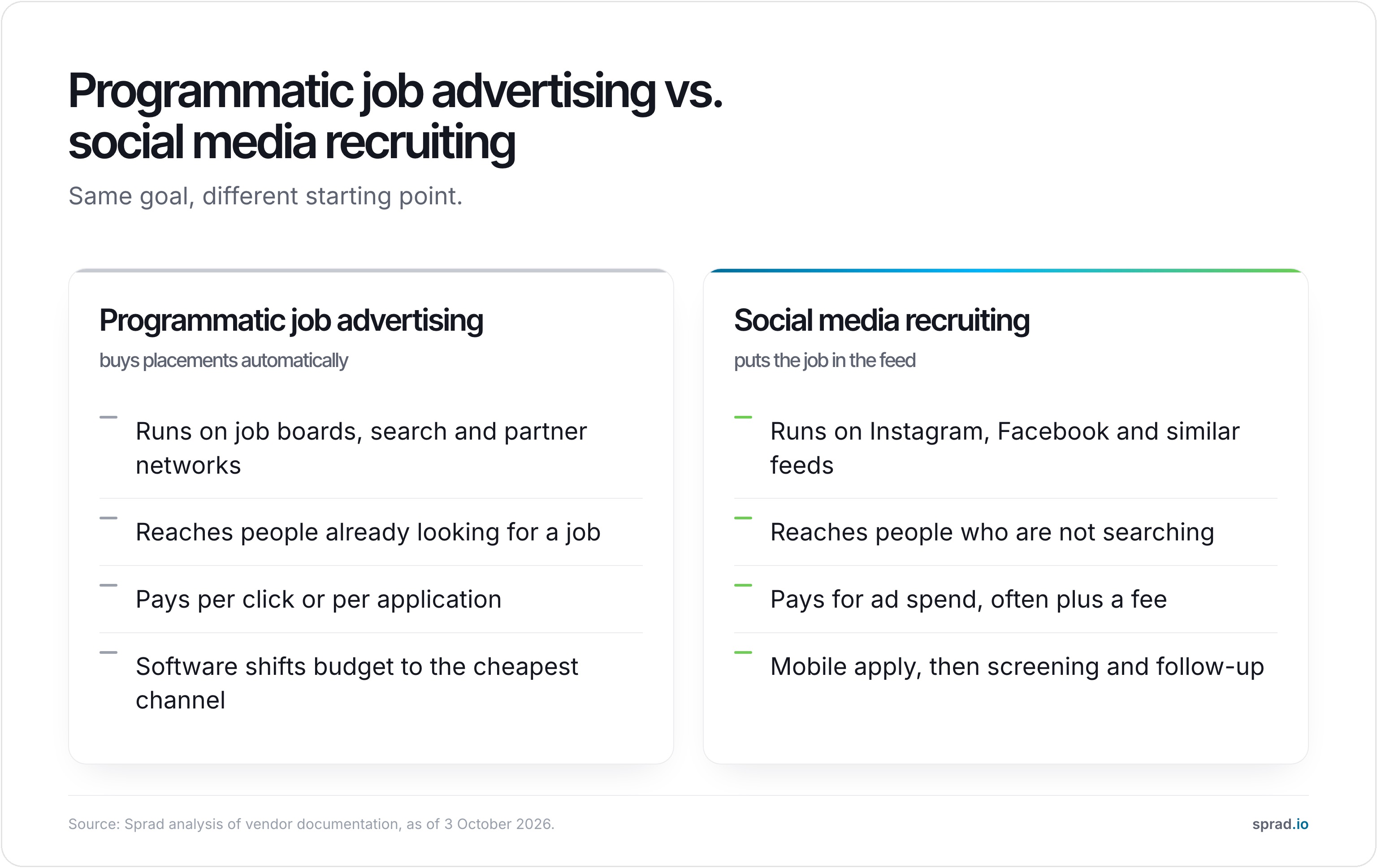
Programmatic job advertising is software that buys job ad placements automatically across job boards, search and partner networks, and moves your budget to wherever clicks or applications are cheapest. Social media recruiting puts a job ad into Instagram or Facebook feeds, where people see it without searching for a job. The two overlap, because programmatic tools can also buy social placements, but they start from different places: programmatic optimizes where an ad runs, social recruiting optimizes who sees it and what happens after the tap.
What programmatic job advertising is
The term comes from digital advertising, where software bids for ad space in real time. In recruiting it works like this: you connect your ATS or a job feed, the platform pulls your open roles, and it distributes them across many channels. It then watches clicks and applications and shifts budget away from channels that do not deliver. Vendors such as Joveo describe it as replacing "post and pray" with pay-for-performance.
- Input: a job feed from your ATS, plus a budget and targets such as cost per application.
- Distribution: job boards, search engines, aggregators and partner publishers.
- Billing: per click (CPC) or per application (CPA), often with a platform fee. A guide published by Pin in April 2026 quotes CPC of $0.30 to $2.50 and platform fees of 10 to 20 % of ad spend; actual quotes vary by vendor and are rarely public.
- Claimed results: Joveo reports 20 to 50 % lower cost per applicant, and the DirectEmployers Association says employers often see 25 % or more. These are vendor and association claims, not independent measurements.
Appcast is the name most associated with the term. It buys placements on job boards and career networks and has been majority-owned by StepStone (Axel Springer) since 2019. Its focus is boards and search, not Instagram or Facebook ads.
What social media recruiting is
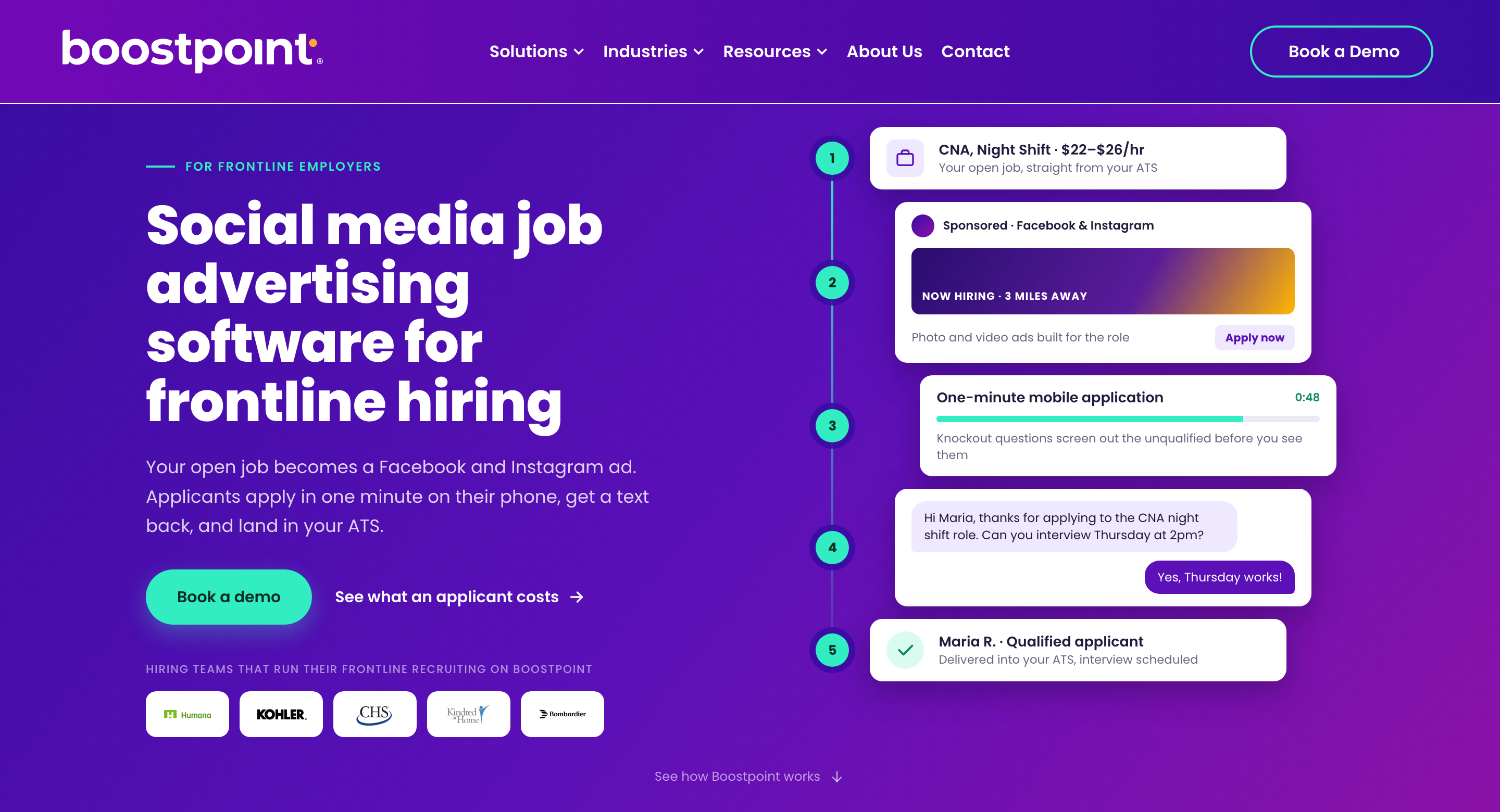
In social media recruiting, the job becomes an ad in a social feed. Most nurses, electricians, drivers and warehouse staff never open a job board, but they open Instagram or Facebook every day. The ad reaches them there, usually with a one-minute mobile application instead of a CV upload.
Two rules shape how it works in practice. First, job ads on Meta run under a special ad category. According to Boostpoint, in the US and Canada this fixes age at 18 to 65+, removes gender targeting, requires a location radius of at least 15 miles and disables lookalike audiences. Check Meta's current rules for your country before you plan targeting. Second, the ad is only the start: what happens between the tap and the finished application matters at least as much as the ad itself.
Programmatic vs. social media recruiting at a glance
| Question | Programmatic job advertising | Social media recruiting |
|---|---|---|
| Where ads run | Job boards, search, aggregators, partner networks | Instagram, Facebook, increasingly TikTok and others |
| Who sees them | People actively searching for a job | People scrolling a feed, including passive candidates |
| What you optimize | Channel mix and bids | Creative, audience, application flow, follow-up |
| Billing | Per click or per application, plus platform fee | Ad spend, often plus a service fee |
| Best for | Many roles, many locations, ATS feed in place | Frontline and shift roles where candidates are not on job boards |
| Who owns the contacts | Usually the job board or your ATS | Depends on the provider: your pool or theirs |
Where the two overlap
The line is blurry on purpose. Wonderkind lists social networks among the channels its programmatic engine buys. Joveo sells "AI Social Advertising" next to job distribution. Boostpoint offers a feed-based product it calls Programmatic 2.0 next to managed Facebook and Instagram campaigns. So the useful question is not "which label", but two practical ones:
- What is the system optimizing for? Clicks and applications at the lowest price, or qualified applicants who show up for an interview?
- What happens after the click? A long form on a career site converts differently from a one-minute mobile application.
What each costs: a worked example
Pricing is where both approaches stay vague, so here are the only public per-applicant numbers we found. Boostpoint's 2026 benchmark covers 891 managed Meta campaigns in the US and was updated on 30 September 2026. The median campaign paid $13.88 per applicant, and the volume-weighted average was $8.02. Half of all campaigns fell between $6.48 and $29.74. The spread by role is wide:
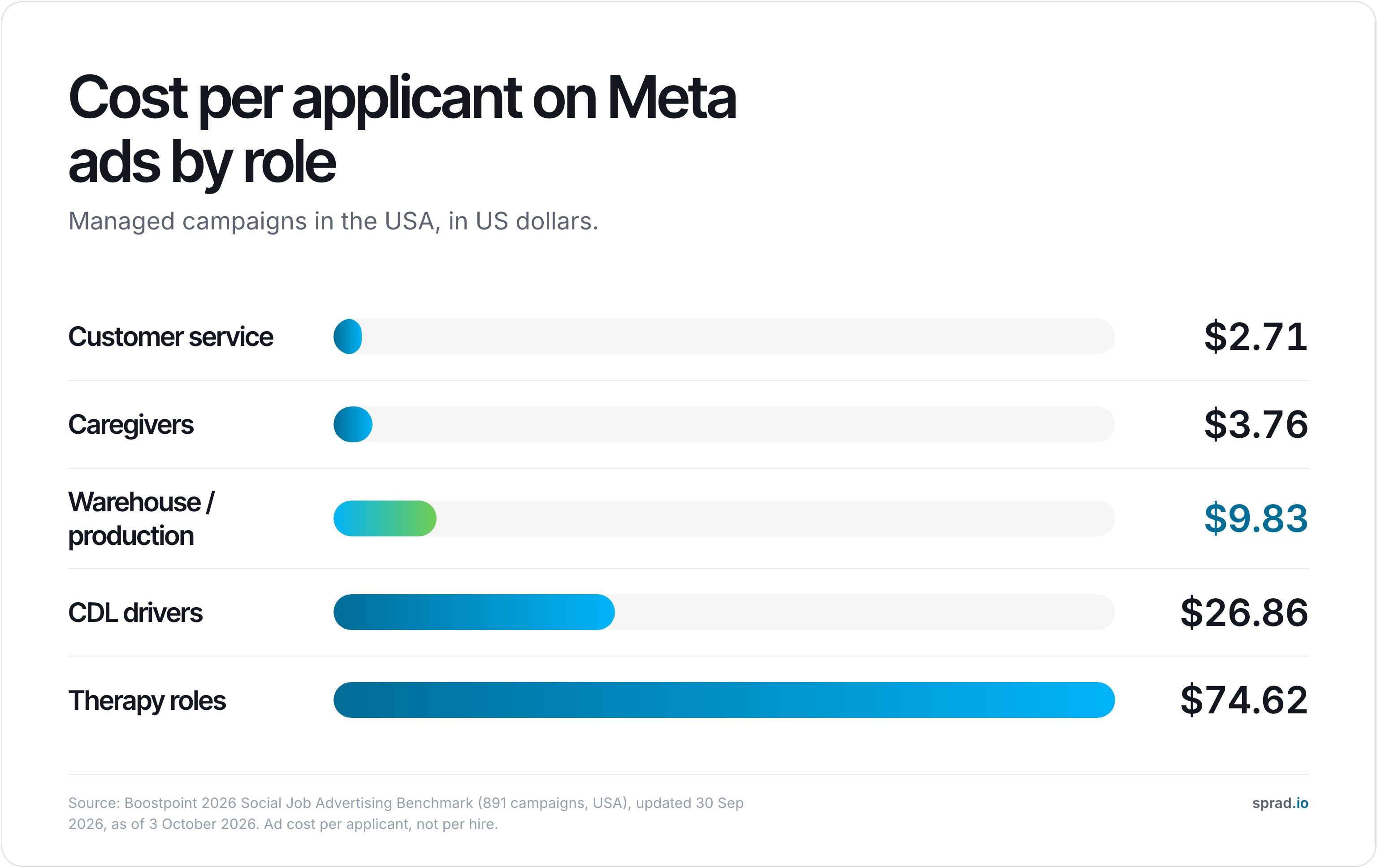
What a US$1,000 media budget would buy at those prices, as simple arithmetic:
| Role family | Cost per applicant | Applicants for $1,000 |
|---|---|---|
| Customer service | $2.71 | about 369 |
| Caregivers | $3.76 | about 266 |
| Warehouse / production | $9.83 | about 102 |
| Median campaign | $13.88 | about 72 |
| CDL drivers | $26.86 | about 37 |
| Therapy roles | $74.62 | about 13 |
Treat this as a planning range, not a promise: the numbers are US ad costs per applicant, not per hire, and your own roles, region and application flow will move them. For programmatic job advertising, no comparable public benchmark exists, because platforms quote custom prices. Ask any vendor for cost per qualified applicant, not per click.
The part neither label tells you
Boostpoint's benchmark found that what happens between the click and the finished application explained 70 % of the difference in cost per applicant between campaigns. What the auction charged explained 18 %. In other words, smart bidding is the smaller lever. A short mobile application, a fast reply and honest screening questions move the result more than another round of budget shifting.
That is also where most programmatic setups end: the ad delivers an applicant into your ATS, and your team then reads, sorts and calls. For high-volume roles, pre-screening before a human spends time is where the real saving sits. The second question is who keeps the contacts. If applicants end up in a job board's pool, you rent the reach again next month.
When to use which
- Choose programmatic job advertising if you hire for many roles and locations at once, already run a clean ATS feed, and your candidates search job boards.
- Choose social media recruiting if your candidates are nurses, tradespeople, drivers, warehouse or hospitality staff who are rarely on job boards, and you can answer applicants quickly.
- Use both if you have a large, mixed hiring plan: programmatic as the always-on base, social for the roles that boards do not fill.
For frontline roles the follow-up channel matters as much as the ad. Our guide on why phone and WhatsApp beat email for frontline recruiting explains why, and recruiting in logistics and production at volume shows how high-volume teams plan it. If you recruit in care or logistics, see our pages for healthcare and logistics.
Where Sprad fits
Sprad Social Recruiting runs job ads on Instagram and Facebook, where nurses, tradespeople, drivers and other frontline workers spend time every day. An AI talent agent pre-screens every applicant via WhatsApp, phone or web. Every applicant lands in the employer's own talent pool, so the relationships stay with the employer instead of a platform. Pricing is ad spend plus 10 %, from a €1,000 budget that can be split across roles; Google and TikTok are to follow. See the details on the Sprad Social Recruiting page and how the Talent Base keeps every applicant.
FAQ
What is programmatic job advertising in simple terms?
It is automated buying of job ad space. You set a budget and a goal, and software distributes your jobs across many channels and shifts spend toward the channels that produce clicks or applications at the lowest cost.
Is programmatic job advertising the same as social recruiting?
No. Programmatic job advertising is a buying method that mostly runs on job boards and search. Social media recruiting is a channel: ads in social feeds. Some programmatic platforms buy social placements too, so they overlap.
Is Facebook advertising programmatic?
Meta's ad auction is automated, but recruiting teams usually reserve "programmatic" for tools that distribute jobs across many publishers from a feed. A managed Facebook and Instagram job campaign counts as social media recruiting.
Which is cheaper for hourly and frontline roles?
There is no neutral public comparison. Meta ads for frontline roles have public benchmarks, from about $2.71 per applicant for customer service to $26.86 for CDL drivers in the US. Programmatic vendors quote custom prices, so ask for cost per qualified applicant.
Does Meta restrict targeting for job ads?
Yes. Job ads run under a special ad category. In the US and Canada, age, gender and ZIP-code targeting are restricted, according to Boostpoint. Check Meta's current rules for your country, because they differ by region.
Who owns the applicant data?
It depends on the provider. With job boards and many platforms, the applicant pool belongs to the platform. Ask whether applicants land in your own talent pool before you sign.
Jürgen Ulbrich
Jürgen Ulbrich has more than a decade of experience in developing and leading high-performing teams and companies. As an expert in employee referral programs as well as feedback and performance processes, Jürgen has helped over 100 organizations optimize their talent acquisition and development strategies.