To recruit nurses from abroad to Germany, an employer needs three things: a nurse whose qualification is recognised (for non-EU nurses by the state authority under § 40 of the Nursing Professions Act, PflBG), a residence route (usually the accelerated skilled-worker procedure under § 81a of the Residence Act) and a recruitment path that follows fair-recruitment rules.
Compared with June 2024, the number of German nationals working in nursing fell by 5,000 while the number of foreign nationals rose by 46,000 (Federal Employment Agency, press release of 2 September 2026), so international recruitment is no longer a niche.
Which route to a foreign nurse is the fastest?
There are four routes. They differ in speed, cost and control, and most employers combine two of them. The first route runs on active sourcing: a targeted search for nurses who will not apply on their own.
| Route | Who it reaches | Time to first shift | Cost and control |
|---|---|---|---|
| Nurses already in Germany (own search) | Qualified nurses working as assistants or in other jobs, recognition pending or done | Weeks to a few months if recognition is done; longer if a knowledge test is still ahead | Lowest cost, most control, needs sourcing effort |
| Federal Employment Agency programmes (e.g. Triple Win) | Nurses from selected partner countries, prepared and language-trained abroad | Many months, because language courses and procedures run abroad first | Employer pays a service fee per placement; the nurse pays no placement fee |
| Private agency with the state quality seal | Nurses from third countries, depends on the agency | Many months | Fee set by the agency; the seal requires the employer-pays principle |
| Own recruitment abroad | Nurses you find yourself on social media or through schools | Longest; you run recognition, language and visa yourself | Highest effort; only sensible for larger employers with a project team |
The Federal Employment Agency lists 157 shortage occupations for 2025, with nursing and health professions among the most affected, and reports that the share of foreign employees in shortage occupations has doubled from about 7 % in 2014 to about 14 % (same press release). For the wider picture see Nursing shortage in Germany.
How does recognition of a foreign nursing qualification work?
Nurses with EU, EEA or Swiss training are covered by the EU recognition rules (§ 41 PflBG). For training outside these states, § 40 PflBG applies: the authority checks whether the training is equivalent to the German one. If there are essential differences, or the documents cannot be assessed with reasonable effort, the nurse must prove equal knowledge by a knowledge test on the content of the state final exam or an adaptation course of at most three years with a final exam. The nurse chooses between the two (§ 40 PflBG).
This step is where candidates are lost. According to the Federal Institute for Vocational Education and Training (BIBB), about 60,000 nurses qualified outside the EU applied for recognition between 2012 and 2021; a large share had to complete a compensation measure, and many dropped out of the procedure. Your offer should therefore state who pays for the course and the exam fees and whether the nurse works as an assistant in the meantime. The authorities are run by the federal states, so deadlines and fees differ; ask the competent authority in your state early.
Which visa route applies?
Employers can request the accelerated skilled-worker procedure. Under § 81a AufenthG the employer signs an agreement with the immigration office. The office starts the recognition procedure, obtains the approval of the Federal Employment Agency where needed, invites the employer to a meeting within three working days when the recognition body asks for more documents or issues its findings, and gives pre-approval for the visa once all conditions are met. Spouses and minor children can be included if their visa applications are filed at about the same time. If a qualification measure is still needed, the procedure can continue towards a residence permit for recognition (§ 16d AufenthG). Which provision fits depends on the nurse's status; the immigration office decides.
What does it cost, and who pays?
The fair-recruitment principle is simple: the employer pays, the nurse does not. The state quality seal "Faire Anwerbung Pflege Deutschland" is owned by the Federal Ministry of Health and awarded as a RAL quality mark by the GAPA association. It requires recruitment that is free of charge for the nurse, written information in an understandable language and fixed contacts throughout. It applies to recruitment outside the labour administration, that is to employers recruiting on their own and to private agencies (Federal Ministry of Health, page updated 5 February 2026).
For the Triple Win programme, a presentation by the Federal Employment Agency and GIZ (September 2023) gives a fee of €7,900 gross per placement (€6,638.66 net). Fees change and differ by country of origin, so ask ZAV for the current figure. Worked example (assumptions: fee as of September 2023, 10 placements, no other cost): 10 × €7,900 = €79,000 for the placement fee alone. Language courses, recognition fees, travel and housing support come on top, depending on funding. Compare that with your cost per hire for local nurses before you decide.
Pay: the median for qualified nurses is €4,587 gross per month (Entgeltatlas, full-time, 2025 data, Federal Employment Agency). The statutory minimum wage for nursing specialists in elderly care is €21.03 per hour since 1 July 2026 (Federal Government).
Where do you find nurses from abroad?
- Nurses already in Germany. About 352,600 foreign nationals work in nursing, roughly 20 % of a workforce of 1.76 million (Mediendienst Integration, 2025 data, factsheet). Some hold a recognised qualification and want to change employer; others work as assistants while the procedure runs. This is the pool with the shortest path.
- Programmes and agencies. The Federal Employment Agency's Triple Win works with partner countries including Bosnia and Herzegovina, the Philippines, Tunisia, Indonesia, the Indian state of Kerala and Jordan (deutschland.de; the list changes). Ask private agencies for the quality seal and for references.
- Language and recognition courses. Providers of exam preparation courses know who is close to the knowledge test. Offer a talk or a job board entry; do not collect names without a legal basis.
- Your own team. Colleagues with a migration background often know nurses in their home country and in Germany. A referral bonus is usually cheaper than an agency fee.
- Public profiles. Search professional networks for nurses with German-language and recognition keywords (strings below). Check the WHO list first.
Check the country first. The WHO publishes a health workforce support and safeguards list (2023) with 55 countries that face the most serious health-worker shortages. It does not ban recruitment, but it recommends government-to-government agreements and benefits for the source country; the list is updated from time to time, so check the current version. Fair-recruitment standards follow the WHO code. Avoid active recruitment from listed countries unless a framework agreement exists.
Which search strings find nurses with recognition and German skills?
Copy and adapt these. The first two target nurses who are already in Germany, the third nurses abroad.
| Goal | String (LinkedIn search or Google X-Ray) |
|---|---|
| Nurses in Germany, recognition pending | ("Pflegehelfer" OR "Pflegeassistent" OR "nursing assistant") AND ("Registered Nurse" OR "BSN" OR "Krankenschwester" OR "Pflegefachkraft") AND ("Anerkennung" OR "Kenntnisprüfung" OR "recognition") |
| Nurses in Germany with a German diploma | ("Pflegefachfrau" OR "Pflegefachmann" OR "Gesundheits- und Krankenpfleger*") AND (Deutschland OR Germany) AND ("Arbeitgeber wechseln" OR "open to work" OR "offen für") |
| Nurses abroad with German language | ("Registered Nurse" OR "Staff Nurse") AND ("German B1" OR "German B2" OR "Goethe" OR "telc" OR "Deutsch") |
| Google X-Ray | site:linkedin.com/in ("Registered Nurse" OR "Pflegefachkraft") ("Goethe" OR "telc" OR "B2") -recruiter -staffing |
Strings only find public profiles. Keep the search lawful: tell people where you got their data (Art. 14 GDPR) and respect the channel rules in the legal section below.
Which criteria should you set?
Must: a nursing qualification of at least three years (or a clear plan for recognition), willingness to complete the procedure, German at B1 at the start and B2 for the procedure (usually what the state authority requires), availability for shift work. Nice to have: experience in your setting (geriatric care, ICU, home care), a driving licence for home care, a second language that residents speak. Keep the must list short; every extra must shrinks the pool.
What should the first message say?
Name the job, the support and the next step, in simple language. A template:
Hello [Name], I am looking for registered nurses for [facility, city]. We support the recognition procedure (we pay the course and the exam fees) and you work as [assistant/nurse] from day one with a mentor. Pay follows [collective agreement / at least the statutory nursing minimum wage]. If you would like to know more, I can send you the steps on one page or call you at a time that suits you. Where I found your profile: [source]. If you do not want to be contacted, tell me and I will delete your data.
Do not promise a recognition result or a start date you do not control.
What are the five questions for the first call?
- In which country and when did you finish your nursing training, and how many years of practice do you have?
- Where are you in the recognition procedure (not started, applied, knowledge test, adaptation course, done)?
- Which German level do you have, with which certificate, and when could you take the next exam?
- When could you start, and do you need help with housing or family?
- Which settings and shifts can you work, and what do you want to learn in the first year?
What does the law require of the employer?
- Professional title and work: without recognition and permission, a nurse may not use the protected title and may only do assistant tasks. Plan the assistant role and its pay in the contract.
- Fair recruitment: never charge the nurse for placement; the seal and the WHO code are built on this principle.
- Data protection: inform people within one month after collecting their data (Art. 14 GDPR) and delete data you do not need.
- Contact channel: emailing or phoning people who did not consent can be unfair competition under § 7 UWG; a message inside a professional network is the cleaner first contact.
- Immigration: the immigration office decides on the permit. This article is not legal advice.
How can Sprad help with sourcing?
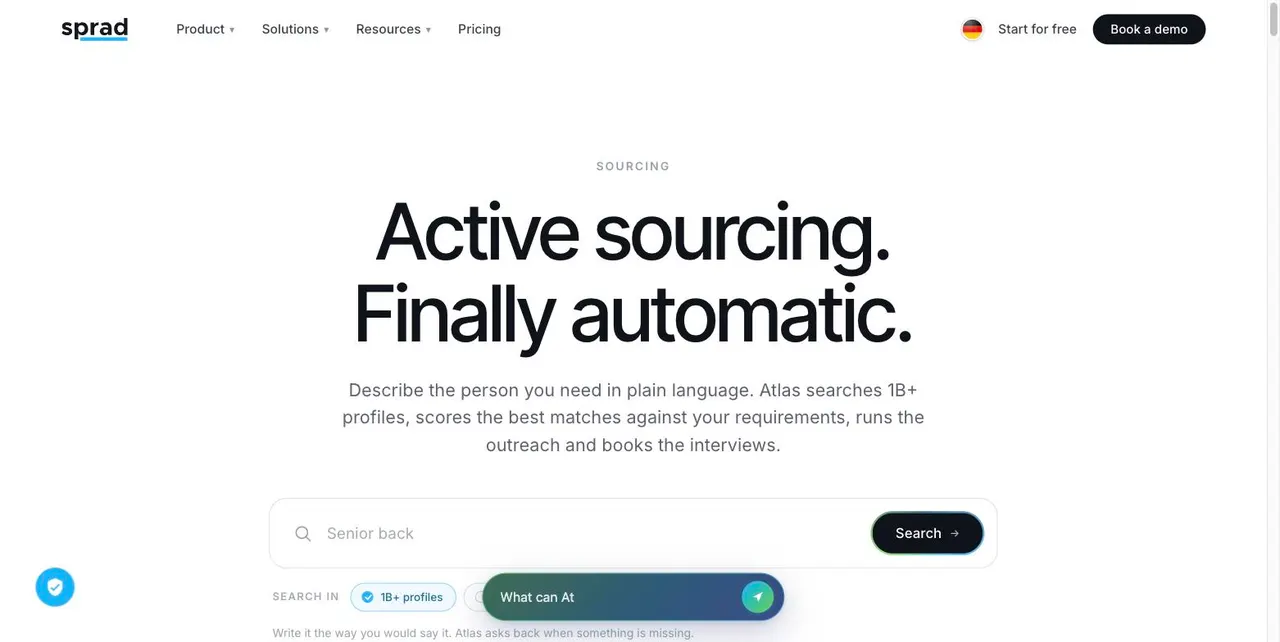
In Sprad's Active Sourcing you describe the nurse you need in your own words (for example registered nurse, German B1 or higher, recognition in progress). Sprad searches public profiles and your own network and explains why each profile fits. Nurses who are not ready yet, for instance while their knowledge test is ahead, go into your talent pool with a note, so you can write again when their permission arrives. A voice pre-interview (12 languages, 30 credits) lets you hear how a nurse handles a call in German or English; it does not replace a language certificate. A free account includes 100 credits per month, a profile shown in a web search costs 2 credits, and current prices are on the pricing page. Sprad is itself a vendor. It does not handle recognition or visas, so for placements from abroad you still need an authority or a fair-recruitment partner.
More on the method: what active sourcing is and hiring nurses in Germany.
FAQ
How long does it take to bring a nurse from abroad to Germany?
There is no official average. The time depends on the country, the language courses and the state authority. Plan many months for nurses from abroad, and weeks to a few months for nurses already in Germany whose recognition is done.
Who pays for recognition and language courses?
Under the fair-recruitment principle the employer pays recruitment costs. Whether you also pay recognition fees and courses is part of your offer; public funding may exist, so check with the Federal Employment Agency.
Can a nurse work before recognition?
Only in assistant tasks, not in the protected role of a nurse. Many employers hire such nurses as assistants and raise the role after recognition.
Is recruiting from the Philippines or India allowed?
Yes, within the law and fair-recruitment rules. Check the WHO list for the country and use a partner or programme with a quality seal.
What language level do nurses need?
Usually B2 for the recognition procedure; the state authority names the accepted certificates. Plan language support for the first year.
As of November 2026. Facts come from the sources linked above; fees and deadlines change, so ask the authority or the programme for current values.
Jürgen Ulbrich
Jürgen Ulbrich has more than a decade of experience in developing and leading high-performing teams and companies. As an expert in employee referral programs as well as feedback and performance processes, Jürgen has helped over 100 organizations optimize their talent acquisition and development strategies.